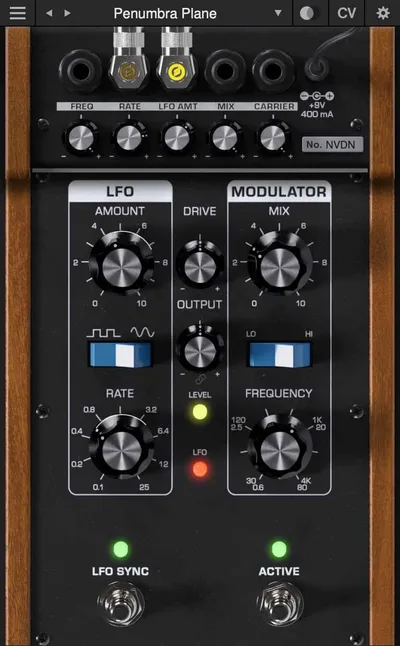
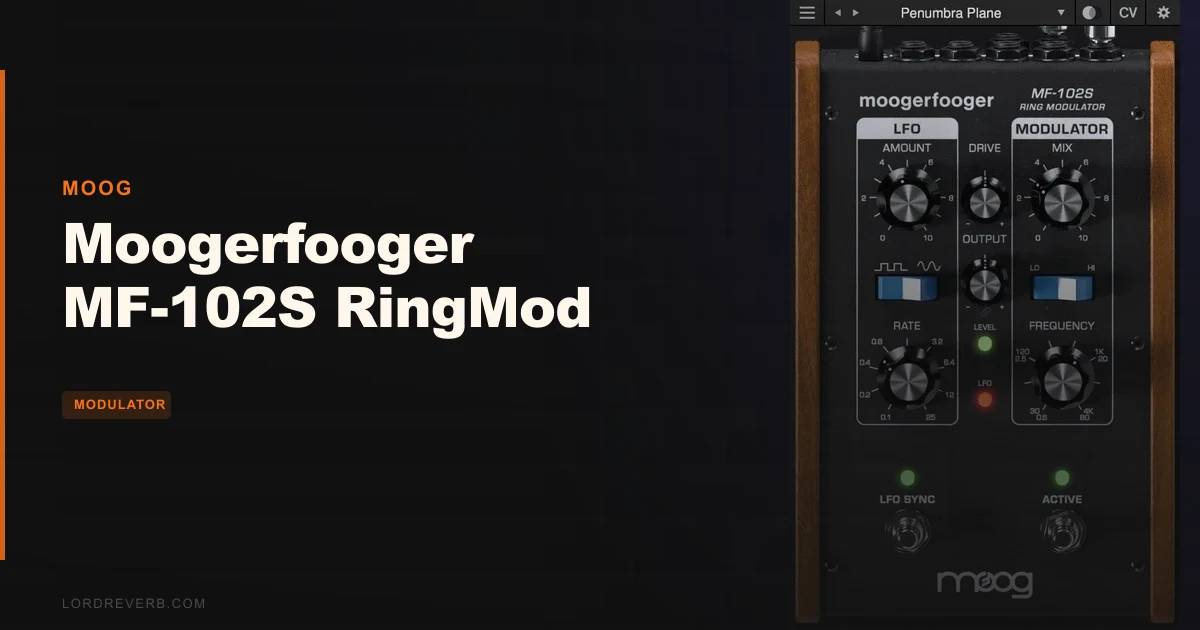
The Moogerfooger MF-102S RingMod gets compared to Soundtoys Ring Thing and Eventide's Ring Modulator. Its distinguishing feature is CV patching between instances.
At $79, this isn't a plugin you buy to fix a vocal. It's one you buy to wreck a vocal on purpose, then automate the wreckage.
It suits sound designers, synth people and experimental producers who like modulation as a patching problem. It doesn't suit anyone who wants a quick metallic-tone preset and a clean exit.
Ring modulation is a niche effect. This plugin leans into the niche harder than anything else in its price bracket, and that cuts both ways.
How Does It Compare to Ring Thing and Eventide Out of the Box?
Next to Soundtoys Ring Thing and Eventide's Ring Modulator, the difference is philosophy.
Those two are comparable ring modulation plugins. They put the effect in front of you and let you get on with it.
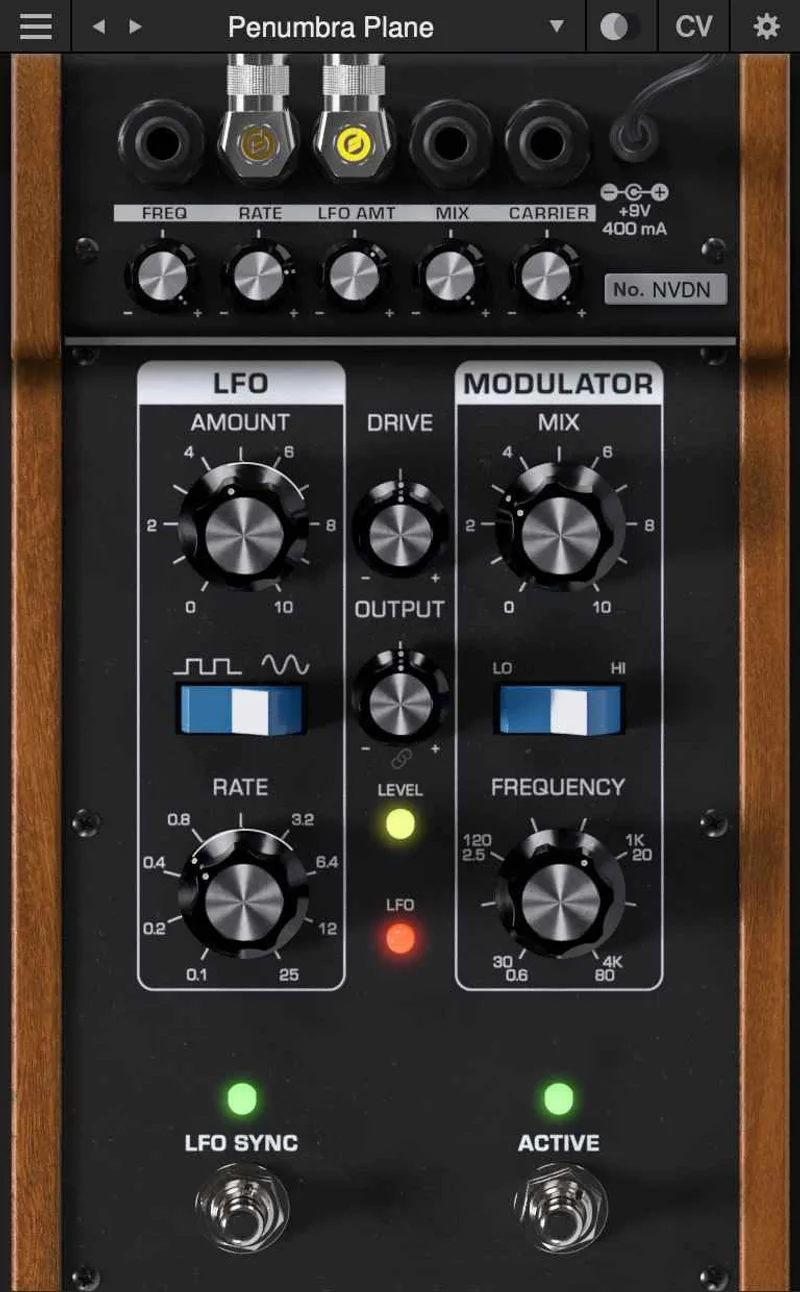
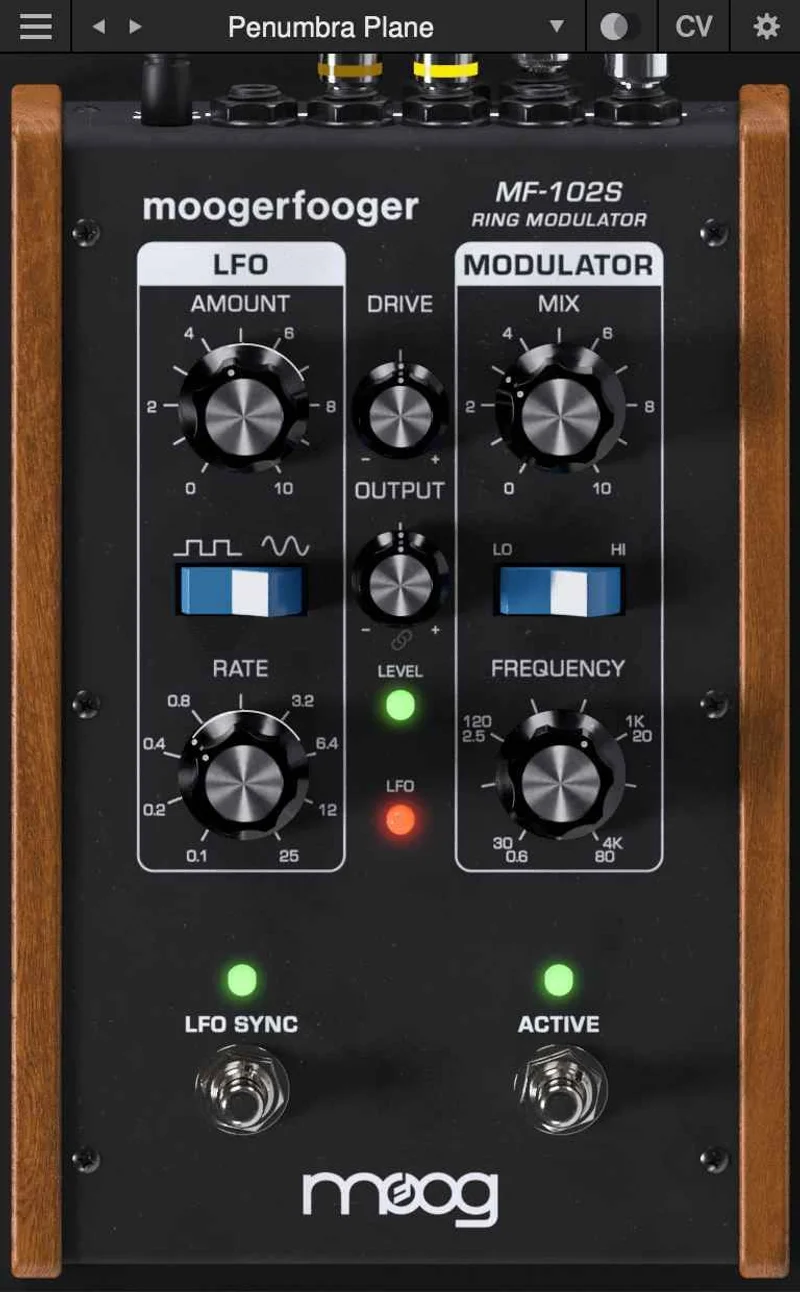
The MF-102S is a emulation of the 1998 MF-102 analog pedal, and it behaves like one. You get a ring modulator, a voltage-controlled carrier oscillator and a voltage-controlled dual-waveform LFO. All three are complete modular functions, not just a tone generator with a wet/dry knob.
That means the first ten minutes feel less like loading an effect and more like sitting down at a small patch bay.
Against the generalist modulation plugins people also mention, Unfiltered Audio BYOME and Melda's MMultiModulator, the picture flips. Those are built to modulate anything. This one is built to do one strange thing with a lot of character.
If you want breadth, it isn't that. If you want one voice with real personality, keep reading.
The Signal Path: Ring Modulator and Carrier Oscillator
The ring modulator multiplies your input against the carrier oscillator. That's the whole trick, and it's why the output has frequencies your source never contained.
Feed it a sine and you get sum and difference tones. Feed it a vocal and you get Dalek territory. Feed it a piano chord and the harmony goes somewhere you didn't plan.
Carrier modes: Mono, Stereo, Panning and Reverse
The carrier comes in four types: Mono, Stereo, Panning and Reverse. Stereo mode is where the plugin goes past what the original pedal could do. Owners describe the stereo processing as an expansion of the hardware, with the warmth and Moog character intact.
Panning mode is the one to try on a hi-hat loop. Push the carrier toward the audio range and let the image move.
Inputs and drive
It takes guitar, voice, synth or any other audio source. Side-chain support is there too, so another track can drive the modulation.
Here's the annoying part. Some owners report they can't dial in input level matching with the Drive knob. Gain staging into a ring modulator matters, because the amount of signal changes the amount of effect. If the drive control fights you, you'll be riding track gain upstream instead.
The LFO and the CV Patching System
The dual-waveform LFO is the second of the three modular functions, and it's the reason this plugin can double as a tremolo. Owners say exactly that: use it as a tremolo unit, or push it into what they call insane experimental sounds.
Both uses are real. One is gentle. The other is a sound-design weapon.
Attenuverters on every CV input
Every CV input has a digital attenuverter. That's a knob that scales the incoming control signal and can invert it. It sounds like a small detail. It isn't.
It means a single LFO can push one parameter up while pulling another down, with the depth set per destination.
Instances modulating each other
This is the headline feature, and it's the clever one. Each instance can modulate parameters of any other instance across a project. Run several copies and you've built a little modular rig inside your DAW.
Picture a drum bus with one instance on the hats, another on a shaker and a third acting purely as a modulation source. The third one never touches audio. It just drives the other two.
Nothing in the Soundtoys or Eventide ring modulators works this way, going by the notes we have. That's the biggest single reason to pick this one.
Where Does It Actually Sound Good?
Reviewers say it works best on shakers, hi-hat, piano and echo repeats.
That list makes sense. Shakers and hats are noisy and bright, so ring modulation turns them into something metallic and alive. Piano gives the effect clear pitched material to mangle. Echo repeats give it a tail to chew on.
Try it on the repeats of a delay, not the dry signal. The dry hit stays intact while the tail goes strange. Satisfying, and easy to automate.
Now the other side. Ring modulation pulls sources out of tune. That's constant, and it's inherent to the effect, not a bug in this plugin. Any ring modulator does it.
If your melody has to stay in key against the rest of the track, you'll spend time tuning the carrier to match.
Presets, Automation and Workflow
All parameters are automatable and the plugin supports preset saving and management. For a modulation plugin that's the baseline, and it's here.
Formats are VST3, AU and AAX. It runs on macOS 11.7 or newer on Intel or Apple Silicon. On Windows it needs Windows 10 or newer on a 64-bit Intel system or newer.
Automation is the quiet strength. Because every parameter is automatable and the CV system lets instances drive each other, you can build movement that never repeats the same way twice.
Where It Wins
It wins on interconnection. Instance-to-instance CV patching is the feature the simpler ring modulators don't offer.
It wins on structure, too. Three complete modular functions in one plugin means the ring modulator, the oscillator and the LFO can each be used on their own terms.
It wins on stereo. The Stereo and Panning carrier modes give you width the original pedal couldn't.
And it wins on character. Owners hear authentic hardware emulation with warmth and Moog personality. For $79, that's a specific flavour you can't fake with a generic modulator.
The developer calls the sound spaced-out and retro-futuristic. That's marketing, but owner reports back up the general idea.
Where the Competition Wins
Simplicity goes to the rivals. Ring Thing and Eventide's Ring Modulator are comparable ring modulation plugins without a patching layer to learn.
Bypass behaviour is the plain weakness here. Owners report signal bleeds into the bypassed path, because it isn't true bypass. Automating the effect in and out of a mix gets messy fast, and workarounds are required.
That's frustrating on a plugin whose whole pitch is automation.
The input gate is the other sore spot. Owners report it fails to hold during long sustained notes from certain instruments. Pads and held strings are the obvious worry.
Some users also report signal eating and sustain destruction that persisted even after trying proper settings. Not everyone hits that. Enough do that you should treat the trial as mandatory.
For breadth, BYOME and MMultiModulator win outright. They're generalist modulators, so they cover far more ground.
Head-to-Head: Which One Wins in Which Situation?
| Plugin | Best for | Strongest point | Weakest point |
|---|---|---|---|
| Moogerfooger MF-102S RingMod ($79) | Patch-minded sound design | CV patching between instances, three modular functions | Non-true bypass, input gate on sustained notes |
| Soundtoys Ring Thing | Quick ring mod on a track | Direct, comparable ring modulation without a patching layer | N/A |
| Eventide Ring Modulator | Straight ring mod duty | Direct, comparable ring modulation without a patching layer | N/A |
| Unfiltered Audio BYOME | Modulating everything | More generalist modulation | Not a dedicated ring modulator character |
| Melda MMultiModulator | Wide modulation routing | More generalist modulation | Not a dedicated ring modulator character |
Our call: the MF-102S wins when the project is about building movement across several tracks. The simpler ring modulators win when you need one effect, fast, with no patching.
Who Should Buy Which
- ✅ Buy if you want CV patching between instances, with attenuverters on every input.
- ✅ Buy if you process shakers, hi-hats, piano or echo repeats and want a metallic, moving result.
- ✅ Buy if you like building modular-style rigs inside your DAW.
- ❌ Skip if you want a drop-in effect with clean automated bypass.
- ❌ Skip if you work with long sustained notes and need a gate that holds.
- ❌ Skip if you play in a band and need the sound to blend with other players.
Specs & Technical Details
| Spec | Detail |
|---|---|
| Developer | Moog |
| Price | $79 |
| Plugin Format | VST3 / AU / AAX |
| OS Support | Mac (macOS 11.7 or newer, Intel or Apple Silicon) / Windows (Windows 10 or newer, 64-bit Intel or newer) |
| Activation | N/A |
| CPU Usage | N/A |
| Trial Available | N/A |
| Version Reviewed | N/A |
Score Breakdown
| Category | Score | Notes |
|---|---|---|
| Sound Quality | 3.5/5 | Owners report warmth and Moog character, but ring mod detunes sources by nature |
| Value for Money | 3.5/5 | Deep patching for $79, held back by bypass and gate complaints |
| Ease of Use | 3.0/5 | Modular patching has a learning curve, and drive matching frustrates some owners |
| Features | 4.0/5 | Three modular functions, four carrier modes, side-chain, instance CV |
| CPU Efficiency | N/A | Moog publishes no CPU data, so this row is not scored |
| Overall | 3.4/5 | Strong patching and character, weakened by non-true bypass and a gate that can fail on sustained notes |
Alternatives to Consider
Soundtoys Ring Thing
A comparable ring modulation plugin. Pick it if you want the effect without the patching layer.
Eventide Ring Modulator
Also a comparable ring modulator. It's the other straightforward choice when you need ring mod and nothing else.
Unfiltered Audio BYOME
A more generalist modulation plugin. Pick it if ring modulation is one tool among many in your sound design.
Melda Production MMultiModulator
Another generalist modulation plugin, and a better fit if you want modulation routed across a wide range of targets.
The Verdict: Who Should Buy the MF-102S, and Who Should Walk
The MF-102S is a patching toy with real hardware personality, and a so-so everyday effect.
Buy it at $79 if you want instances talking to each other, an LFO you can bend into tremolo or chaos, and a ring modulator that rewards experimenting on hats, shakers, piano and echo tails.
Skip it if clean bypass matters to you, if you lean on long held notes, or if you need a sound that sits politely in a band mix. The non-true bypass and the gate behaviour aren't small gripes on a plugin built around automation.
Run the trial through your busiest session before you commit. If the bleed and the gate don't bother you there, it's a rewarding weird little rig.
Related reviews: Orbitron Review
Frequently Asked Questions
What is the Moogerfooger MF-102S RingMod?
It's a plugin emulation of the original 1998 MF-102 analog effects pedal. It combines a ring modulator, a voltage-controlled carrier oscillator and a voltage-controlled dual-waveform LFO in one effect.
Which plugin formats and systems does it support?
It comes in VST3, AU and AAX. It runs on macOS 11.7 or newer on Intel or Apple Silicon, and on Windows 10 or newer on 64-bit Intel systems or newer.
Can multiple instances control each other?
Yes. It offers CV interconnectivity, and each instance can modulate parameters of any other instance in your project. Every CV input also has a digital attenuverter.
What are the known problems with it?
Owners report signal bleeding when it's bypassed, an input gate that can fail on long sustained notes, and some cases of signal eating and sustain loss. Ring modulation also pulls sources out of tune, which is inherent to the effect.