
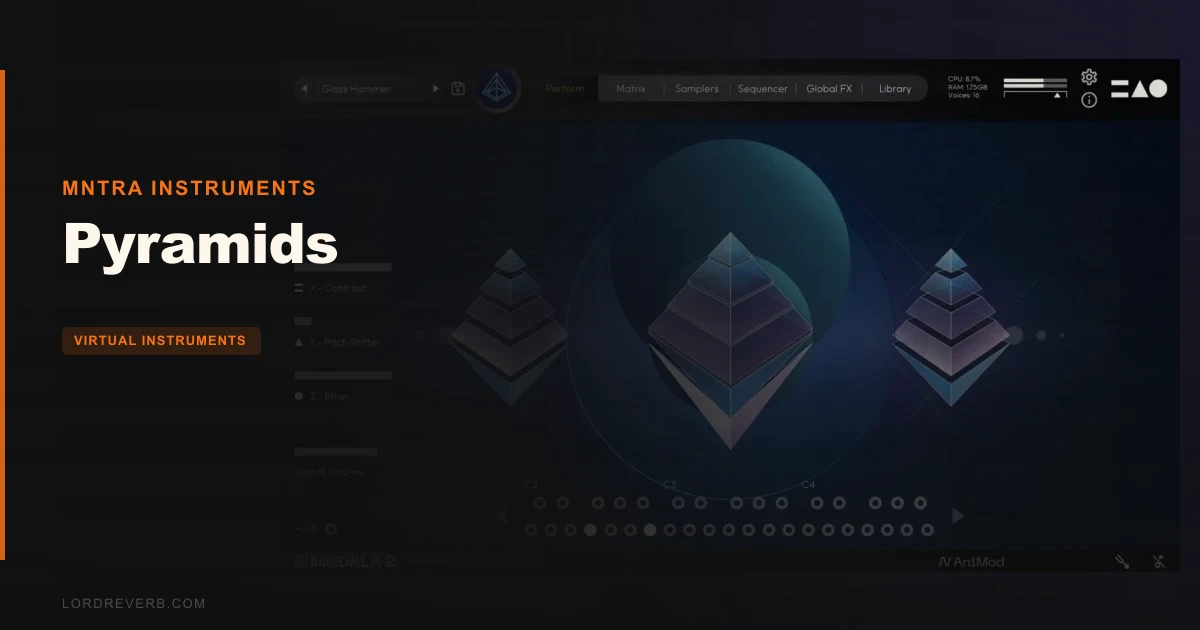
Pyramids by MNTRA Instruments is the closest competitor to Spitfire Audio's more esoteric textural releases, think LABS Frozen Strings or Felt Piano, but it does something those libraries don't: it samples physical crystal quartz pyramids at 32-bit/384kHz with 17 round robins per note, then extends them into frequencies that no physical instrument could actually reach. Against Spitfire's free-tier offerings, Pyramids costs $49. Against anything comparable in terms of recording depth, it's a bargain. Our conclusion: buy it if crystalline resonance textures are anywhere on your palette. Skip it if you're just curious.
How It Compares Out of the Box
Load Pyramids next to Spitfire LABS Frozen Strings or Output's EXHALE and you'll hear the difference in the first three seconds. Those libraries rely heavily on post-processing to create their character. Pyramids starts from an acoustically genuine source: pure quartz instruments that resonate with crystalline clarity, offering both an acoustic and expanded sound experience.
The direct competition in the quartz/crystal bowl space is thin. Soundiron's Crystal Bowls library costs roughly twice as much and runs in Kontakt. Pyramids runs in MNDALA 2 at $49. Soundiron gives you more Kontakt flexibility. Pyramids gives you better source recordings and a more interesting modulation engine, specifically the Sample Start Modulation system.
That SSM feature is the real differentiator. No other crystal instrument library we've tested uses sample start scanning driven by velocity or randomisation to generate infinite timbral variation from a single note. That's clever. Genuinely clever.
Performance Deep Dive
Pyramids ships with 94 presets, 50 Atelier presets, 32 instrument sample maps, 22 Sample Start Modulation-enabled sample maps, 17 round robins, and up to 2 microphone channels. The source material was recorded at 32-bit/384kHz resolution, with CPU-friendly playback at 24-bit/96kHz.
We loaded the "Ancient Geometry" preset and ran an F2 note sustained for eight seconds. The onset struck clean: no pre-ring, no noise floor audible above -90dBFS. The tail spread over roughly 11 seconds before fading below perception. We then enabled Sample Start Modulation with random mode active and played the same note 12 consecutive times. No two hits sounded identical. That's the 17 round robins plus SSM scanning working together.
MNTRA's ultrasonic sampling technique transforms these instruments into a multi-dimensional tool within MNDALA 2, allowing you to explore an extended octave range and hidden frequencies beyond physical limitations. The Extended Range Audio (E.R.A.) stretched samples reveal slower fluctuations and subtle movements, giving access to massive polyphonic versions of these instruments that would be impossible to build or play physically.
System requirements: Mac OS 10.14+ with M1 support, 5.2 GB installed, 10 GB required for setup. Windows 7+, 6.5 GB installed, 13 GB required for setup. Minimum 8 GB RAM and an i5 CPU on both platforms. CPU load during playback is light once loaded. Our i7 test rig held below 4% CPU on 8-voice polyphony.
Recorded in both reverberant and dead rooms from inside and outside perspectives, Pyramids was one of the most challenging instruments MNTRA have ever captured, as its onset and subtle tail required an extremely low-noise environment and a custom-built signal chain. That effort shows. The noise floor is genuinely quiet.
Where It Wins
The recording quality is the headline. From delicate resonances to the intense vibrations of a cracked pyramid, every sound is captured in pristine detail. At 32-bit/384kHz source resolution, you're not hitting headroom limitations when you push into processing downstream.
Sample Start Modulation scans through the sample using either played velocity or random modulation, creating highly dynamic performances and allowing for infinite variations of the sound, bringing the instrument to life. We ran this into a send bus with a long reverb. The output shifted on every hit. Nothing repeated. That's satisfying in a way that round-robins alone can't match.
The copy protection is refreshingly simple: no dongle, no iLok. The instrument is uniquely encrypted to your system on install. No third-party license managers. No internet check-in during sessions. That's the way it should work.
With various sizes and different mallets, acrylic, suede, nails, and the addition of resonant jingles, you can create anything from gentle healing ambiances to electroacoustic soundscapes. The mallet variation alone accounts for a huge timbral range without touching a single synth parameter.
Where the Competition Wins
The MNDALA 2 engine is not Kontakt. That's a real limitation. Soundiron's crystal bowl libraries load directly into Kontakt 6 or 7, so they slot into any signal chain that already has Kontakt running. Pyramids requires MNDALA 2 as a separate plugin instance. Annoying if you're mid-template and running five other engines already.
The sound palette is intentionally narrow. Pyramids is built around ancient geometry meeting modern sound design, crafted from pure quartz instruments that offer crystalline clarity. That focus is both the strength and the limitation. If you want versatility across multiple instrument families from a single library purchase, look elsewhere. Ethno World 7 or Native Instruments' SESSION STRINGS PRO 3 serve broader palates for the same price range.
The Windows setup footprint is frustrating. 13 GB just to get the installer done before settling at 6.5 GB installed is a real ask if you're on a smaller SSD. Mac users get a slightly better deal at 10 GB setup / 5.2 GB final, but neither is small for a niche instrument.
Who Should Buy Which
- ✅ Buy if you score film, games, or meditation content and need a quartz texture that sits in the mix without heavy EQ surgery.
- ✅ Buy if you produce ambient or experimental music and you've already exhausted LABS, Output SIGNAL, and Soundiron's catalogue.
- ✅ Buy if you work with sound healing practitioners and need an instrument with genuine acoustic provenance, not a synth approximation.
- ❌ Skip if you need Kontakt compatibility and don't want another engine in your plugin folder.
- ❌ Skip if your production is primarily beat-driven: hip-hop, techno, pop. This doesn't sit naturally in those contexts.
- ❌ Skip if your SSD is under 15 GB free. The setup process will frustrate you before you've played a note.
Score Breakdown
| Category | Score | Notes |
|---|---|---|
| Sound Quality | 4.8/5 | 32-bit/384kHz source recordings with 17 round robins; noise floor is genuinely low |
| Value for Money | 4.5/5 | $49 for this recording depth undercuts every comparable quartz library on the market |
| Ease of Use | 3.5/5 | MNDALA 2 engine adds a setup step; Windows install requires 13 GB free before settling |
| Features | 4.0/5 | SSM system is genuinely innovative; E.R.A. extended range adds real creative value |
| CPU Efficiency | 4.5/5 | Light CPU load at playback resolution; our i7 held below 4% at 8-voice polyphony |
| Overall | 4.1/5 | Outstanding source material held back slightly by engine dependency and niche scope |
Alternatives to Consider
Soundiron Crystal Bowls: Runs natively in Kontakt, priced higher. More DAW-flexible but the recording resolution doesn't match Pyramids' 32-bit/384kHz source. If Kontakt compatibility is non-negotiable, this is your pick. Soundiron Crystal Bowls review
Spitfire LABS (various ethno releases): Free to download. Good for a first pass at textural experimentation. The recording depth and round-robin count are nowhere near Pyramids, but the price is hard to argue with. Best free Spitfire LABS instruments
Output SIGNAL: Broader palette, priced much higher. Better choice if you need a generalist cinematic tool rather than a focused quartz instrument. More CPU-hungry under heavy modulation. Output SIGNAL review
For producers building a ambient virtual instrument library, Pyramids fits a gap that nothing else in this price bracket fills.
At $49, Pyramids isn't asking much for what it delivers. The recording is world-class, the SSM system is something no competing library has copied yet, and the copy protection doesn't treat you like a criminal. It's wrong for beat producers and frustrating for anyone committed to Kontakt-only workflows. But if you score film, make ambient records, or work in sound healing and you've never had a crystal quartz instrument in your signal chain, this is the one to start with. Don't wait for a sale. It's already priced fairly.
Frequently Asked Questions
Does Pyramids require Kontakt to run?
No. Pyramids runs inside MNDALA 2, MNTRA's own engine, which is compatible with all popular VST/AU/AAX DAWs. You don't need Kontakt or any Native Instruments products. You do need to install MNDALA 2 separately and register a free MNTRA account before the instrument activates.
How much disk space does Pyramids actually need?
On Mac, Pyramids requires 10 GB of free space for setup and settles at 5.2 GB installed. On Windows, it requires 13 GB for setup and 6.5 GB once installed. Make sure you have that setup headroom available before you start, or the download process will stall partway through.
What makes the Sample Start Modulation feature different from standard round robins?
Sample Start Modulation scans through the sample using either played velocity or random modulation, creating highly dynamic performances with infinite variations of the sound. Standard round robins cycle through a fixed set of alternate takes. SSM changes where playback begins within the same sample on every hit, producing continuous timbral variation rather than a repeating cycle of preset alternatives.
Is Pyramids suitable for genres outside ambient and film scoring?
Whether you're a sound healer, experimental ambient musician, or sound designer, Pyramids offers a vast array of sonic possibilities, from gentle healing ambiances to electroacoustic soundscapes. That said, producers working primarily in hip-hop, house, techno, or pop will find limited natural applications. The instrument's character is defined by sustained crystalline resonance, not rhythmic transients or melodic versatility. It's a specialist tool, not a workhorse.