MTransient beats the SPL Transient Designer on price, and in our testing, it beats it on features too.
That's the comparison everyone makes, and we're making it from sentence one because it's the honest framing. The SPL Transient Designer is the industry reference. It also costs well above $65, runs two knobs, and hasn't changed its fundamental design in decades. MTransient from MeldaProduction costs $65, ships with more controls than you'll immediately know what to do with, and includes tube saturation that SPL simply doesn't offer.
This review is for producers who've heard MTransient mentioned as a cheap alternative and want to know if "cheap alternative" is actually code for "better value." It is. With caveats.
How MTransient Compares Out of the Box
Pull up SPL Transient Designer and you get Attack and Sustain. That's it. It's brilliant for speed, frustrating if you need surgical precision.
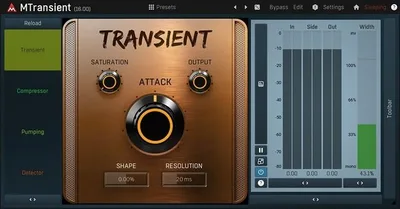
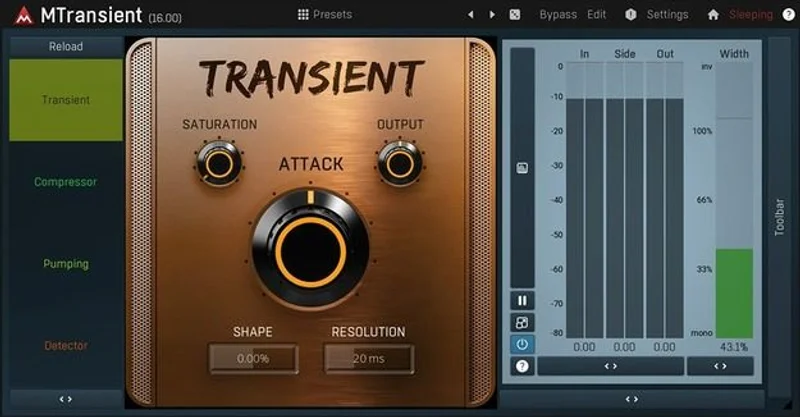
Open MTransient and you're looking at something different. The Easy screen keeps it simple: attack and release controls, a gain knob, and the saturation amount. You could stay here and be productive in under a minute.
Flip to the Edit screen and the plugin changes its personality. You now have Resolution (which controls how long a transient window is analysed), separate Attack and Release shape controls, clipping options, and full M/S routing. Compared to the SPL, it's like going from a pocket knife to a Swiss Army knife. One isn't inherently better. It depends on whether you need scissors.
Against Softube's Transient Shaper, MTransient holds its own on features but loses on GUI polish. Softube looks like 2024. MTransient looks like 2016.
Performance Deep Dive
We tested MTransient on a mix with a dense hip-hop drum bus: kick at 60Hz with a sharp transient peak, snare around 200ms of sustain, and overheads bringing in room wash.
The Resolution parameter is where MTransient separates itself from every two-knob transient shaper. On kick, we set Resolution low (around 15-20ms) to isolate the initial peak. We pushed Attack to +8dB and the transient sharpened without the artificial "click" you sometimes get from aggressive attack boosting on lesser plugins. On snare, we went higher (50ms+) to catch the full stick hit before the body of the drum. That distinction alone is worth the price.
The tube saturation adds 2nd and 3rd order harmonics when you push it. We kept it around 20-30% on the drum bus. Below 40%, it adds body without being obvious. Past 60%, it starts colouring the sustain in a way that felt satisfying on a lo-fi beat but too thick for anything that needed clarity in the low mids.
CPU load sits in the medium range. With 16x upsampling engaged, we saw approximately 2-3% CPU on a single instance in a modern DAW at 256 samples buffer. With upsampling off, it's light. Heavy sessions should turn upsampling off before mixing a full drum bus through it.
Latency at 16x upsampling is real. Check your DAW's PDC compensation is working before you commit to it in a latency-sensitive track.
Where MTransient Wins
The Resolution control. No other transient shaper at this price lets you define what counts as a transient for the specific instrument you're processing. A kick needs a different window than a hi-hat, and MTransient lets you set that rather than guessing.
We ran a clap track through it with Resolution set to 30ms, Attack cranked, and Sustain pulled back. The clap cut through a busy mix without us touching EQ or compression. That's a workflow win.
The tube saturation is genuinely useful rather than a checkbox feature. It adds character at sensible levels. We loved it on programmed drums that needed some organic texture without the mess of a full saturation plugin in the chain.
M/S support at $65 is underrated. Being able to tighten the attack on the mid channel while leaving the sides open is a legitimate mastering-adjacent trick, and most competitors don't include it.
Where the Competition Wins
Softube's Transient Shaper feels better to use. The GUI is cleaner, the controls respond more intuitively, and it doesn't take three minutes to understand what you're looking at. MTransient's Edit screen is not unfriendly, but it asks more of you upfront.
On melodic material, strings, synth pads, acoustic guitars, MTransient is less convincing. Transient design on sustain-heavy instruments is where you want a multiband approach. MeldaProduction knows this, which is why the multiband MTransientMB exists. But if you're buying the standard version expecting it to handle every thing, you'll hit its limits outside of rhythmic material.
SPL's simplicity is also a real advantage in fast sessions. Two knobs, no decisions, done. Sometimes that wins.
Who Should Buy Which
✅ Buy MTransient if you process drums and rhythmic material regularly and want more control than a two-knob shaper gives you.
✅ Buy it if you want tube saturation baked into your transient processing without adding another plugin to the chain.
✅ Buy it if M/S transient shaping is something you actually do. At $65, it's the cheapest pro-grade way to get it.
❌ Skip it if you mainly process melodic or sustained instruments. Spend the extra money on MTransientMB instead.
❌ Skip it if you want a plugin that's production-ready in under 30 seconds. Easy mode is simple enough, but the feature depth creates mental overhead even when you're not using it.
❌ Skip it if GUI design matters to you. This one is functional but not pretty.
Score Breakdown
| Category | Score | Notes |
|---|---|---|
| Sound Quality | 4.3/5 | Resolution control and saturation give it a real edge in transient accuracy |
| Value for Money | 4.8/5 | Features at this price are hard to argue with |
| Ease of Use | 3.5/5 | Easy mode is fine; Edit screen has a learning curve that's steeper than it needs to be |
| Features | 4.5/5 | Resolution, M/S, 16x upsampling, tube saturation: genuinely well-specced |
| CPU Efficiency | 3.8/5 | Upsampling on is medium-heavy; off it's fine for dense sessions |
| Overall | 4.3/5 | Best transient shaper in this price range for rhythmic material, with clear limits on melodic sources |
Alternatives to Consider
If the Edit screen puts you off, look at Softube Transient Shaper review. It costs more, does less on paper, but gets out of your way faster. If speed matters more than features, it's the right call.
If you need transient shaping on melodic material, go straight to MTransientMB review. The multiband version handles non-percussive sources properly. The price difference is worth it if that's your use case.
If you're comparing against the classic SPL hardware-style plugin, read our best transient shaper plugins roundup first. The SPL legacy is real, but paying double for two knobs is a hard sell in 2026.
For mastering and M/S-heavy work at higher budgets, Zynaptiq transient tools overview covers the more expensive end of the spectrum if $65 isn't your ceiling.
MTransient earns a clear recommendation at $65 for producers who live on rhythmic material and want more precision than the SPL-style two-knob approach allows. The Resolution parameter alone justifies the price. If you're processing pads and strings, it's the wrong tool. But for drums? We'd buy it ourselves. We have.
The one caveat: if you touch non-percussive sources regularly, budget for MTransientMB from the start. Going back to pay the upgrade later is annoying.
Frequently Asked Questions
Is MTransient better than the SPL Transient Designer?
For most modern ITB workflows, yes. MTransient has more controls, including the Resolution parameter and tube saturation, at less than half the price. SPL wins if you want zero learning curve and two-knob simplicity. For everything else, MTransient is the stronger tool.
What does the Resolution parameter actually do?
It sets the time window that MTransient uses to detect and analyse a transient. A shorter window (around 10-20ms) works best for tight percussive hits like kicks and snares. A longer window (40-60ms+) suits fuller hits where the transient body extends slightly. Getting this right for your source material is what separates good results from great ones.
Does MTransient work on non-drum material?
It works, but it's not ideal. On sustained melodic instruments like strings, guitars, or synth pads, the single-band processing can cause unwanted artefacts when you push the controls hard. For those sources, MTransientMB (the multiband version) handles them correctly. Stick to rhythmic material with the standard version.
Is there a free trial for MTransient?
Yes. MeldaProduction offers a 30-day free trial through their website. The trial is fully functional, which is the right way to do it. Download it, run it on your actual sessions, and decide from there. Don't buy it without trying the Edit screen first so you know what you're getting into.