Violonair is a genuinely beautiful-sounding Kontakt instrument that earns its place in a cinematic or sound design rig, but it'll frustrate anyone who expects drop-in orchestral strings or a tidy, beginner-friendly interface.
At $49, Loot Audio's Renaissance viola da gamba library sits in an unusual spot. It's not trying to replace your symphonic string section. It's after something narrower: an organic, slightly untamed bowed string tone with the kind of pitch life that programmed libraries almost never deliver. For the right producer, that specificity is the whole point. For everyone else, it's a limitation worth knowing before checkout.
The Dynamic Tuning script is the headline feature, and owners confirm it earns that billing. Subtle pitch fluctuations shift note by note, the way a live player drifts across a phrase without ever falling out of tune. That's not achievable with a simple pitch LFO. It makes held notes breathe.
But the interface is basic, the keyswitch system takes real patience to decode, and if you're building a traditional orchestral track, this is the wrong tool. We'll break down exactly who should spend $49 here and who should save it for something else.
What You're Actually Getting
Violonair is a sampled viola da gamba, a bowed Renaissance string instrument with a tone somewhere between a cello and a lute, slightly nasal up top, warm and slow in the lower register.
The library packs five dynamics per note, multiple round robins, three modes of harmonics, and editable special effects you can store across memory banks. Articulation switching happens in real-time via mod wheel or key switches. Recording was done through tube preamplifiers with a modified linear power supply-driven computer, all captured with Krystalos hi-resolution technology. That signal chain matters: the tube colour and high-resolution capture are audible in the detail of the attack and the complexity of the sustain.
It runs in Kontakt Full V5.8.1 or later. Full. Not Player. That's a hard requirement, not a suggestion.
The Good
The Dynamic Tuning script is clever in a way that most realism features aren't. Load a sustained note and play a slow legato line. The pitch doesn't sit perfectly locked. It shifts, micro-corrects, drifts at the tail. Owners describe it as the thing that makes them forget they're playing a sample library. That's not hyperbole from a press release; that's what people who bought it report.
Five dynamics per note is the kind of spec that separates usable from frustrating. You'll hear the difference when you push into forte on a melody line. The bow pressure changes character the way it should. Combined with round robins, repeated phrases don't pile up that comb-filtered machine-gun texture that ruins otherwise decent libraries.
The editable special effects section is where the library turns strange in the best way. Dial those in, save to a memory bank, and you've got a toolkit for underscore and transition work that isn't a preset everyone else already has. Sound on Sound called it beautiful in the main but noted the SFX palette leans toward horror and sci-fi. That's a fair read, and honestly, it's also an argument for buying it.
The Krystalos hi-res recording process captures transient detail that lower-resolution libraries compress into smear. The bow bite at note start is clean and present without being harsh.
The Not-So-Good
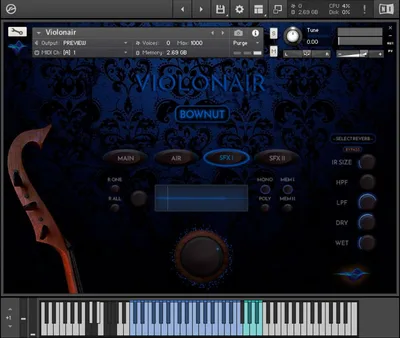
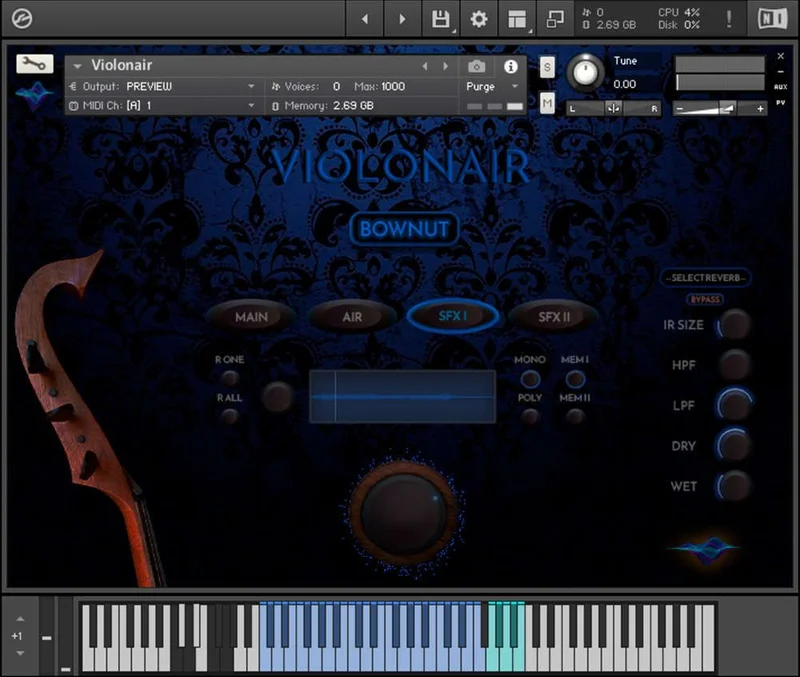
The interface is basic. That's not a death sentence, but combined with a keyswitching system reviewers describe as overcomplicated and not immediately obvious, the early hours with Violonair can feel frustrating in a way that slows down sessions.
You'll spend time reading documentation you didn't expect to need. If you're on a deadline and trying to dial in an articulation mid-session, that's annoying. Genuinely annoying. Once you've decoded the system, it works. But "rewarding after effort" is not the same as "good design," and we won't pretend otherwise.
The Kontakt Player lockout is a real barrier. If you're not already a Kontakt Full owner, Violonair just added a significant software cost to its own price tag. No workaround exists.
And the sonic identity is narrow. This is a cinematic, slightly spectral bowed string instrument. It's not a string section. It's not a cello legato patch. Push it into a traditional orchestral context and it sticks out.
Who Should Buy This
- ✅ Buy if you score for film, games, or trailers and need a bowed string texture that doesn't sound like every other library on the market.
- ✅ Buy if you already own Kontakt Full and work regularly in sound design or dark ambient production.
- ✅ Buy if the Dynamic Tuning concept is exactly what you've been missing: organic pitch life without manual automation.
- ❌ Skip if you need traditional orchestral string articulations that sit in a standard string section mix.
- ❌ Skip if you only have Kontakt Player. It won't load.
- ❌ Skip if you hate spending an afternoon learning an unintuitive keyswitch layout before you can work freely.
Specs & Technical Details
| Developer | Loot Audio |
| Price | $49 |
| Plugin Format | Kontakt Instrument (.nki) |
| OS Support | N/A |
| Activation | N/A |
| CPU Usage | N/A |
| Trial Available | N/A |
| Version Reviewed | N/A |
| Minimum Kontakt Version | Full V5.8.1 or later |
| Kontakt Player Compatible | No |
Score Breakdown
| Category | Score | Notes |
|---|---|---|
| Sound Quality | 4.5/5 | Krystalos hi-res recording and tube preamp chain produce a rich, detailed tone that owners love |
| Value for Money | 3.5/5 | At $49 it's reasonable, but the Kontakt Full requirement adds hidden cost for some buyers |
| Ease of Use | 2.5/5 | Basic interface and an overcomplicated keyswitch system that reviewers flag as a genuine barrier |
| Features | 3.5/5 | Dynamic Tuning and editable SFX are satisfying; five dynamics and round robins do the job properly |
| CPU Efficiency | N/A | No data available |
| Overall | 3.5/5 | A brilliant-sounding specialist tool let down by a workflow that takes patience to get through |
The Verdict, Sorted by Who You Are
The Cinematic Composer
You write underscore for picture. You need textures that feel aged, slightly unsettled, alive. Violonair is built for exactly this. The Dynamic Tuning script does the heavy lifting on realism, and the SFX palette gives you transition material that doesn't sound like a library preset from 2018.
Buy it. With confidence.
The Sound Designer
You love a bowed string that you can push somewhere strange. The editable SFX, the memory banks, the harmonic modes, these are your tools. Save a few memory bank presets, and you'll have a unique instrument ready for cinematic and sound design work.
Buy it. Accept the learning curve as a one-time cost.
The Orchestral Arranger
You're building string sections, doubling cello lines, writing chamber music. This isn't the library. The viola da gamba tone sits outside modern orchestral blends, and the SFX palette pulls even further left of centre. You'll wish you'd spent this money on something else.
Skip it.
The Beginner Producer
Kontakt Full V5.8.1 or later is required. That's a cost on top of $49. Then there's the keyswitch learning curve. If you're early in building your sample library collection, there are more practical places to start. This is a specialist purchase for a specific gap in a kit that already has the fundamentals covered.
Wait until you need exactly this.
Violonair is a narrow tool that does its narrow thing with real quality. The Dynamic Tuning alone separates it from most bowed string libraries in this bracket. If the viola da gamba sonic world fits your work, this is an underrated purchase. If it doesn't, no amount of beautiful tone changes that.
Frequently Asked Questions
Does Violonair work with the free Kontakt Player?
No. Violonair requires Kontakt Full, version 5.8.1 or later. The free Kontakt Player will not load it. If you don't already own Kontakt Full, factor that into your total cost before purchasing.
What is the Dynamic Tuning script in Violonair?
Dynamic Tuning is a scripted feature that introduces subtle, note-by-note pitch variations across the library. It mimics the natural pitch fluctuations of a live performer rather than locking every note to perfect equal temperament. Owners report this is the feature that makes the instrument feel alive and organic rather than programmed.
Is Violonair suitable for traditional orchestral string arrangements?
Not really. The viola da gamba has a distinct Renaissance-era timbre that sits outside the sound of a modern orchestral string section. Reviewers and owners consistently place it in cinematic, horror, sci-fi, and sound design contexts. If you need something to blend with a standard string section, this won't sit cleanly in that mix.
How does the keyswitching system work in Violonair?
Violonair supports real-time articulation switching via mod wheel or key switches. Reviewers note the system is functional but overcomplicated and not intuitive out of the box, with a learning curve before it becomes fast to use in a session. Budget time for the documentation before your first deadline-driven session with it.