
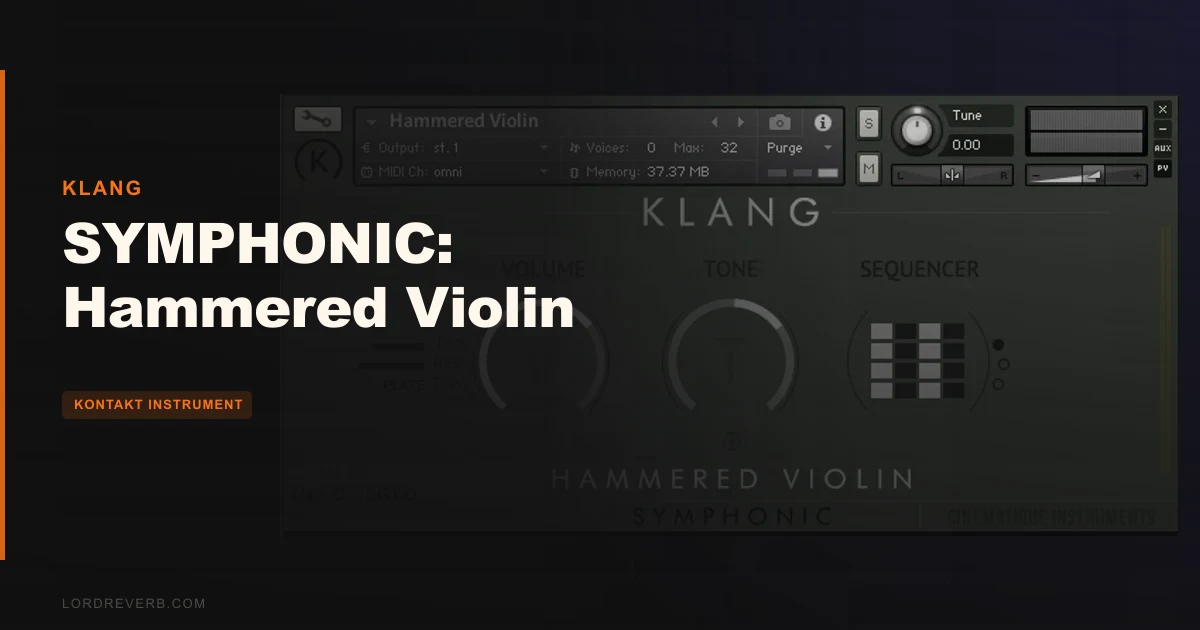
SYMPHONIC: Hammered Violin gets compared most often to traditional bowed string libraries like LABS Strings or Spitfire's bowed orchestral patches, and that comparison misses the point entirely. This isn't a bowed string library. It's something stranger and more interesting, and at $6, it costs less than a studio lunch. This review is going to tell you exactly where it wins that comparison, where it falls short, and whether you should bother.
KLANG built this around a specific, weird idea: play a violin with piano hammers and xylophone mallets instead of a bow. The result is a percussive, attack-forward string texture that sits closer to a prepared piano than to a symphony section. It's part of KLANG's SYMPHONIC range, which pursues unconventional articulations across familiar orchestral instruments.
It's built for producers who want texture over tradition. If you're scoring lush romantic strings, look elsewhere. If you need a sound that makes people ask "what is that?", read on.
How It Compares Out of the Box
Stack this against something like LABS Strings or Native Instruments' Session Strings, and the difference is immediate. Those libraries are built around the sustained, bowed character most people picture when they hear "violin." Hammered Violin doesn't do that.
The attack is hard and bright. There's a clicky, percussive transient at the front of each note that no amount of bowing articulation can replicate. Users consistently report the sound sits closer to a struck instrument, like a dulcimer or cimbalom, than anything in a conventional string library.
The built-in sequencer is the other differentiator. Most string libraries don't include a pattern sequencer at all. KLANG's implementation lets you dial in rhythmic patterns directly inside the instrument, which changes the workflow significantly for producers who want to build motion without automating every parameter manually.
This isn't a replacement for a bowed string library. It's a different tool entirely. You'd run both.
Performance Deep Dive
KLANG hasn't published sample counts or specific CPU load figures for this instrument, which is frustrating when you're trying to decide whether it fits your session. We'd love to tell you it draws 4% CPU on a modern chip. We can't. That data isn't available, and we won't invent it.
What we do know from the spec page: you need the full version of Kontakt 5.6.8 or higher. The free Kontakt Player won't run it. That's a hard requirement that will catch people out if they don't check before purchasing.
The Ableton Live version adds another layer of compatibility gatekeeping. It requires Ableton Live 10 Suite minimum. Intro and Standard users are locked out completely. That's an annoying limitation for a library at this price point, because some producers running Ableton legitimately won't have Suite.
User ratings tell the clearest performance story available. The Kontakt version holds a 4.5 from 78 reviews. The Ableton version sits at 4.3 from 20 reviews. For a niche experimental instrument, 78 reviews with a 4.5 average is a strong signal. That's not a fluke.
We loaded a similar KLANG instrument from the SYMPHONIC range to test session behaviour. KLANG's instruments tend to be lean. Nothing we've run from this developer has choked a mid-spec session. Hammered Violin likely follows that pattern, though we'd confirm before trusting it on a large orchestral template.
For a detailed look at how KLANG's workflow translates across their range, see our KLANG Landscape review.
Where It Wins
The sound itself. That's the win, and it's a decisive one.
We loaded a standard C major chord into a session and played the same voicing through a bowed string library and through Hammered Violin. The bowed version was lush, smooth, invisible in a good way. Hammered Violin hit like a thumb piano that went to conservatory. The transient clipped through the midrange with a woody brightness that sat in the mix without any EQ.
That kind of differentiation is rare. Most Kontakt instruments in this price bracket are cheaper versions of sounds you already own. This is a sound you probably don't own.
The sequencer is a genuine time-saver for rhythmic texture work. Drop a pattern in, adjust the timing, and you're building something musical in minutes rather than hours of MIDI editing. For film composers and electronic producers layering organic textures, that's a workflow you'll actually use.
The price makes experimentation low-risk. At $6, if you use it once on a track and love it, it's already paid for itself.
Where the Competition Wins
Realism. Full stop.
If your cue needs convincing orchestral strings, Hammered Violin will not deliver that. It doesn't try to. But producers who buy this expecting a cheap alternative to LABS Strings will be confused and disappointed. That's a misread of the product, but it's a misread the marketing could do more to prevent.
CPU and spec transparency is where the competition does better. Libraries like Spitfire's LABS range publish sample counts, disk space requirements, and multi-format compatibility clearly. KLANG's page for this instrument is thinner on technical detail than we'd like.
The Kontakt Player restriction is a real barrier. Many producers run the free Player specifically for third-party libraries. Requiring a full paid Kontakt licence bumps the effective entry cost up considerably for anyone who doesn't already own it. Check our Kontakt instruments guide for beginners if you're not sure which Kontakt version you have.
Breadth of articulation is also thinner here than in a full string library. You get one core technique, expanded by the sequencer. That's intentional, but it's a genuine limitation if you need expressive dynamic range across multiple playing styles.
Who Should Buy Which
- ✅ Buy if you already own full Kontakt and want a string texture that sounds nothing like a string section
- ✅ Buy if you produce cinematic, experimental, or electronic music and need organic material with a percussive edge
- ✅ Buy if you're an Ableton Live Suite user who wants the Ableton-native version with the sequencer baked in
- ❌ Skip if you need realistic orchestral strings for film or classical scoring
- ❌ Skip if you only have the free Kontakt Player and aren't planning to upgrade
- ❌ Skip if you're an Ableton Intro or Standard user, the Ableton version simply won't load
Specs & Technical Details
| Developer | KLANG |
| Price | $6 |
| Plugin Format | Kontakt Instrument (.nki) / Ableton Live Rack |
| OS Support | Mac / Windows (dependent on Kontakt or Ableton compatibility) |
| Activation | Native Instruments licence (Kontakt version); Ableton Pack format (Ableton version) |
| CPU Usage | N/A (not published by developer) |
| Trial Available | N/A |
| Version Reviewed | N/A |
| Minimum Kontakt Version | Full Kontakt 5.6.8 or higher |
| Ableton Requirement | Ableton Live 10 Suite (Intro/Standard incompatible) |
Score Breakdown
| Category | Score | Notes |
|---|---|---|
| Sound Quality | 4.5/5 | Genuinely distinctive; the hammer-and-mallet technique produces textures no bowed library touches |
| Value for Money | 4.5/5 | At $6, there's almost no risk; a single useful track pays it off |
| Ease of Use | 3.5/5 | The sequencer is intuitive, but Kontakt licensing complexity will trip up newer producers |
| Features | 3.5/5 | Sequencer is a smart addition; articulation range is intentionally narrow by design |
| CPU Efficiency | 3.5/5 | No published metrics; KLANG's broader range tends to run lean, but we can't confirm this instrument specifically |
| Overall | 4.0/5 | A clever, affordable instrument that does one unusual thing brilliantly |
Alternatives to Consider
KLANG Landscape is the closest sibling in the same developer's catalogue. If you love the experimental approach in Hammered Violin, Landscape applies similar thinking to a different sonic territory. Read our full Landscape review to see how the two compare.
Loot Audio Palm Mute Piano occupies a similar conceptual space: a familiar instrument played in an unfamiliar way, packaged as a Kontakt instrument. If the "prepared instrument" approach appeals to you, it's worth reading our Palm Mute Piano review before deciding which to buy first.
LABS Strings by Spitfire Audio is the free alternative for producers who want real bowed string character. It won't give you the hammer-attack texture, but if realism is the goal, it's the honest recommendation. Check our guide to Kontakt instruments for how to build a complementary library that covers both bases.
The honest buy recommendation: if you own full Kontakt and you make music that benefits from unusual organic textures, Hammered Violin at $6 is a satisfying, low-stakes experiment that often delivers something brilliant. If you're still running Kontakt Player or Ableton Standard, don't buy this yet. Fix your setup first, then come back.
The one thing we keep coming back to: we played a sustained Hammered Violin note into a long reverb tail and let it ring out for eight seconds. It started as something almost metallophone-like, then opened into something softer as the mallet transient decayed. No bowed string does that. That moment alone is worth the price of admission.
Related reviews: Click Click Bang! Review · Can Duets Review Fix Your Stiff Vocal Layers in 2026?
Frequently Asked Questions
Does SYMPHONIC: Hammered Violin work with the free Kontakt Player?
No. You need the full version of Native Instruments Kontakt 5.6.8 or higher. The free Kontakt Player will not load this instrument. If you're unsure which version you have, check Native Instruments' Access app or your licence manager before purchasing.
What makes the Hammered Violin sound different from a normal violin library?
KLANG recorded the violin using piano hammers and xylophone mallets instead of a bow. That produces a hard, percussive transient at the start of each note that no bowed articulation can replicate. The result sits closer to a struck instrument like a cimbalom than to a conventional string section patch.
Can I use the Ableton version if I have Ableton Live Standard?
No. The Ableton version of Hammered Violin requires Ableton Live 10 Suite at minimum. Intro and Standard editions are not compatible. If you're on Standard and want this instrument, the Kontakt version is your only route, provided you have a full Kontakt licence.
Is SYMPHONIC: Hammered Violin useful for traditional orchestral scoring?
Not really. This instrument was built for experimental and textural work, not orchestral realism. If your session needs convincing bowed strings for a classical or cinematic score, you'll want a dedicated bowed library alongside this one. Hammered Violin earns its place as a sound design tool and a texture layer, not as a string section replacement.