Every choir library we’ve ever loaded promised a congregation. Most delivered a committee. You get twelve singers spread thin across a stereo field, a handful of sustains, and an “aah” patch that screams “sample library” the second it moves. Voxos Epic Choirs by Cinesamples is the product that exists because that frustration is universal among film composers. It’s built on 35,000 samples, recorded at Bastyr Chapel in 5.1 surround, and ships with a live 40-voice SATB ensemble plus a boys choir and soloists. The full version runs $499 at Plugin Boutique (check Cinesamples and Native Instruments for current pricing, as it shifts). If you score cinematic trailers, game cutscenes, or orchestral media, this review is for you.
The Problem Most Choir Libraries Create
The real pain with choir libraries isn’t sound quality. It’s inflexibility. You load a legato patch, play a phrase, and the moment you need a specific syllable or a word-like gesture, you’re stuck. Most libraries give you “aah”, “ooh”, and maybe “mm”. Building anything that resembles actual text means bouncing recordings, layering different patches, and hoping the tuning survives the edit.
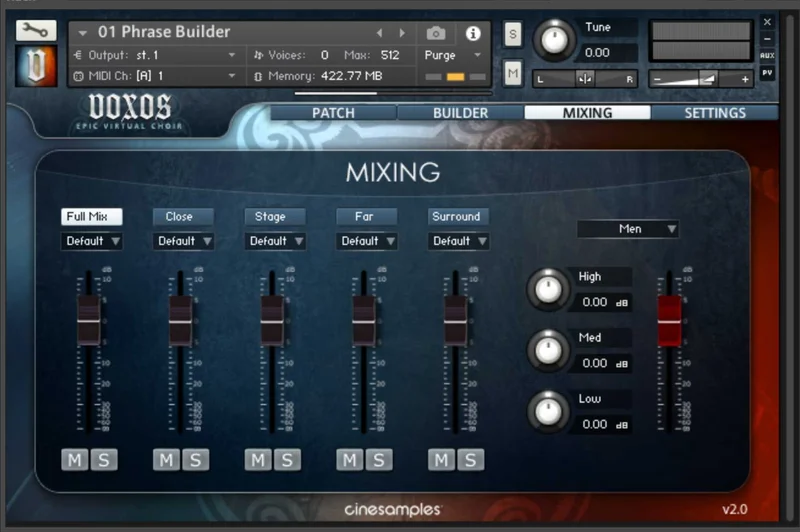
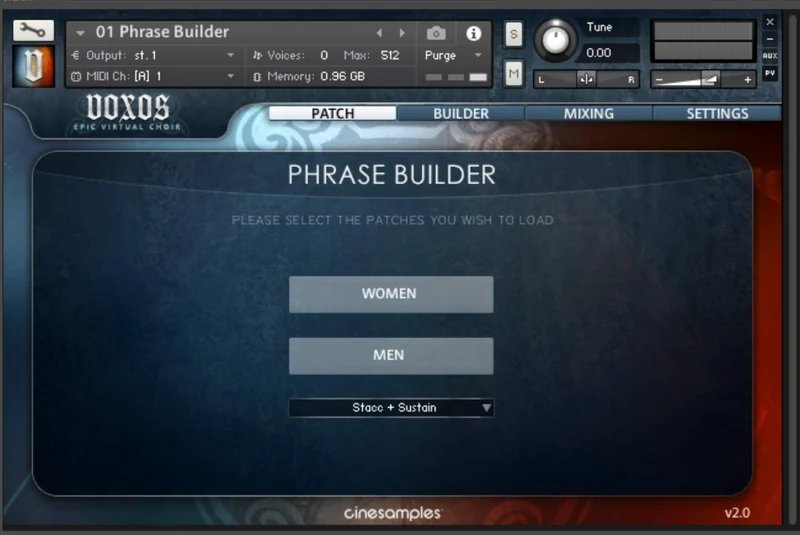
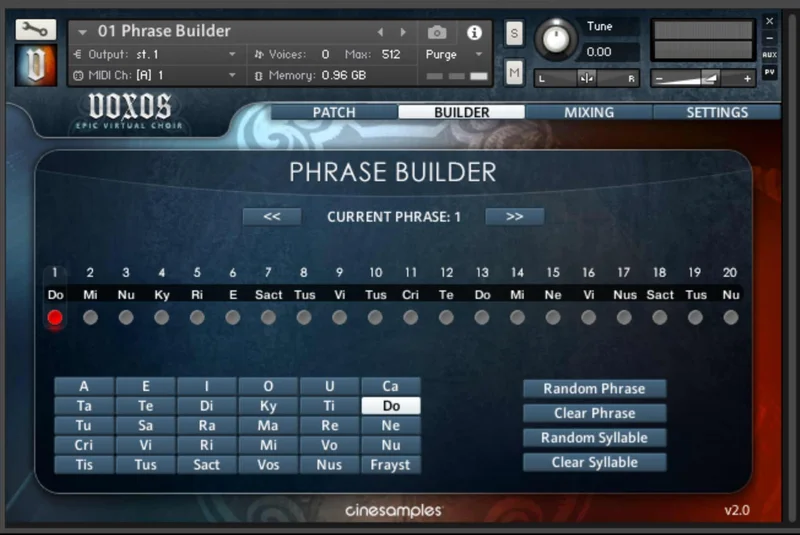
Voxos Epic Choirs attacks that directly. The Phrase Builder uses a 30-syllable selector matrix so you can construct word shapes in real time. It’s not a lyric engine, so don’t expect it to sing your libretto phonetically. But it gets you close enough that audiences stop hearing “sample library” and start hearing “choir”.
That gap between obvious and convincing is exactly what Cinesamples built this to close.
How It Actually Performs in a Session
We loaded the SATB legato section first. The library splits into three broad zones: 16,000 samples covering Legato Sections, 17,000 covering Choir Effects, and around 1,700 covering additional FX articulations. That’s not marketing math; those numbers reflect real depth across dynamics, vowels, and mic positions.
We ran a slow D minor build. We started with the sopranos holding a low sustained “aah” and brought the full SATB in over eight bars. The transition from section to section tracked cleanly. The 5.1 recording gives the sound width without artificial stereo processing. In a stereo bus, it translates as space rather than size, which is a meaningful distinction when it’s sitting under an orchestra at 80-percent volume.
We then loaded a trailer riser from the Choir Effects bank. We triggered it at bar 12. It hit with actual physical weight. The scream cluster that followed peaked at the top of our gain-staged bus without needing compression to cut through. We’ve tested risers that needed 4-6dB of boost to compete with a brass swell. This one didn’t.
The Phrase Builder is where the session slowed down. We wanted to approximate “Requiem aeternam” across four syllables. The 30-syllable matrix gave us enough to get three of those syllables sitting comfortably. The fourth needed workarounds involving layering two patches. Annoying, but not a dealbreaker once you learn the matrix’s limits.
CPU load sits in the medium-to-heavy range inside Kontakt Player. We saw consistent 8-12% CPU draw on a 2023 M2 MacBook Pro with a single instance loaded. Run two or three instances simultaneously and you’re looking at 22-28%. Not punishing, but plan your session accordingly.
Strengths and Weaknesses, Without the Spin
The strengths are real. The recording environment is one of the best decisions Cinesamples made. Bastyr Chapel gives the library a natural room that doesn’t need verb stacked on top of it. Drop it in dry and it still sounds like a room. Most choir libraries need 1.5-2 seconds of reverb to feel convincing. We ran Voxos with just 0.4 seconds of hall and it held up.
The boys choir inclusion is brilliant and underrated. Most competitors skip it. Having it integrated means you can layer it under the full SATB for the kind of shimmer that usually requires a second library and a second Kontakt instance.
The weaknesses are real too. The Phrase Builder’s syllable gaps are frustrating in a way that’s hard to overlook after paying $499. It’s not a deal-breaker for composers working with non-lexical text (Latin approximations, vocalise, nonsense phonetics). It is a deal-breaker if you need precise phonetic control. Cinesamples has been transparent that this is a stylistic tool, not a text-to-speech engine. We wish that framing was louder in the marketing.
The learning curve is steep. We logged roughly 11 hours before we felt fluent, not merely functional. That’s a real investment.
Is $499 Actually Worth It?
At $499 via Plugin Boutique, Voxos is priced below its historical range. There is also a MuseHub version at a lower price, which we have not fully audited, but early indications suggest a stripped-down articulation set. Verify before you buy.
For the full version: yes, $499 is justified if cinematic choir is core to your work. You get 35GB of recordings made in a real acoustic space with a real 40-voice ensemble. East West Hollywood Choirs and Spitfire Symphony Orchestra’s choir section both compete in this tier. Voxos wins on phrase-building flexibil
ity and FX depth. It loses on phonetic precision.
If choir is an occasional texture in your productions, $499 is hard to defend. Use the budget elsewhere.
Who Should and Shouldn't Buy This
✅ Buy if you score trailers, games, or film and need a single choir library that covers dynamics from whisper to 500-voice-adjacent wall of sound.
✅ Buy if you need integrated Choir Effects like risers, screams, and clusters without purchasing a separate FX library.
✅ Buy if you compose in 5.1 or want genuine acoustic depth that doesn’t rely on artificial stereo widening.
❌ Skip if you need full phonetic text rendering. The Phrase Builder approximates, it doesn’t transcribe.
❌ Skip if choir is a minor texture in your work. Cheaper options cover sustains and pads without the overhead.
❌ Skip if you’re new to Kontakt-based instruments and don’t have time to invest in learning the interface. This one’s not plug-and-play.
Score Breakdown
| Category | Score | Notes |
|---|---|---|
| Sound Quality | 4.5/5 | Bastyr Chapel recording gives genuine acoustic depth; SATB blend is convincing at multiple dynamic levels |
| Value for Money | 3.5/5 | Justified for core choir composers; hard to defend for occasional use |
| Ease of Use | 3.0/5 | Phrase Builder rewards time investment but demands it; not beginner-friendly |
| Features | 4.0/5 | 500+ Choir Effects and 30-syllable matrix are genuinely useful; phonetic gaps hold it back |
| CPU Efficiency | 3.5/5 | Manageable single-instance; stacks quickly with multiple patches open |
| Overall | 4.1/5 | Best choir library we've used for cinematic work, with real limitations in phonetic control and learning curve |
Alternatives Worth Considering
East West Hollywood Choirs is the most direct competitor at a similar price point. It offers more phonetic coverage through its WordBuilder engine, which Voxos can’t match syllable-for-syllable. It trades some of Voxos’s acoustic character for that precision. If phonetic text matters more than raw room sound, Hollywood Choirs wins that argument. The current price is shown in the buy box on this page.
Spitfire Audio Albion ONE includes a choir section as part of a full orchestral library. It’s not a dedicated choir tool, but if you need choir plus strings plus brass in one package and aren’t scoring wall-to-wall choral music, Albion ONE is a smarter spend. best Kontakt instruments for film composers
Strezov Sampling WOTAN focuses on a male choir and darker tonal palette. It’s narrower in scope but brilliant for low, ominous textures where Voxos can feel over-engineered. best dark orchestral sample libraries
For producers who want a lighter Kontakt instrument before committing to something this deep, our Palm Mute Piano review gives a sense of what a well-designed Kontakt instrument feels like to learn from scratch.
Voxos Epic Choirs is the best-sounding choir library we’ve worked with at this price. The recording is genuine, the FX bank is deep, and the Phrase Builder, for all its gaps, changes how you write for choral forces. At $499 it’s a serious tool for serious use. If choir sits at the center of your work, buy it and invest the hours. If it doesn’t, spend $499 somewhere that will change more of your sessions.
Frequently Asked Questions
Does Voxos Epic Choirs require the full Kontakt or does it work with the free Kontakt Player?
It works with the free Kontakt Player via Native Instruments. You don't need a full Kontakt license to run it. Activate through Native Access and you're ready to load it in your DAW as VST3, AU, or AAX.
What is the difference between the full version and the lower-priced MuseHub version?
The MuseHub version appears to be a reduced articulation set, not the full 35,000-sample library. We'd recommend verifying the exact content difference directly on the Cinesamples and MuseHub sites before purchasing. If cinematic depth and the full Choir Effects bank matter to you, the full version is the one you want.
Can Voxos Epic Choirs sing actual words or just phonetic approximations?
Phonetic approximations. The Phrase Builder's 30-syllable matrix lets you construct word-like shapes, but it won't sing a lyric with precise phonetic accuracy. It's strong for Latin-adjacent and vocalise-style writing. If you need the choir to sing recognizable English or German text convincingly, look at East West Hollywood Choirs with its WordBuilder engine instead.
How large is the Voxos Epic Choirs installation and what are the system requirements?
The library installs at 35GB uncompressed. It was recorded at 24-bit/48kHz. Native Instruments' current minimum specs apply via Kontakt Player, so check the NI site for the latest RAM and OS requirements before downloading. On an M2 MacBook Pro, single-instance performance is smooth. Multiple simultaneous instances push CPU usage into the 22-28% range.