
The Bandoneon by Loot Audio is a convincing, well-recorded virtual bandoneón that earns its price at $13 and deserves a spot in any tango, world music, or film scoring session where the real instrument isn't an option. It's not a deep-sampled monster with a hundred round robins, and it doesn't pretend to be. What it offers is a premier bandoneón recorded in Buenos Aires with a signal chain that most plugin developers wouldn't bother with at this price, and owners report convincing sound with minimal tweaking.
The catch is straightforward: you need the full version of Kontakt, and the velocity resolution is modest. If you're building a tightly-detailed solo performance with every breath and swell mapped precisely, you'll feel those limits. For everything else, $13 is a satisfying spend.
What You're Actually Getting
The Bandoneon is a Kontakt instrument built around a premier bandoneón recorded in Buenos Aires by composer Guillermo Guareschi. The bandoneón is a type of concertina central to tango music, the backbone of the orquesta típica, with a reedy, accordion-adjacent sound that sits somewhere between a harmonium and a squeezebox with significantly more soul.
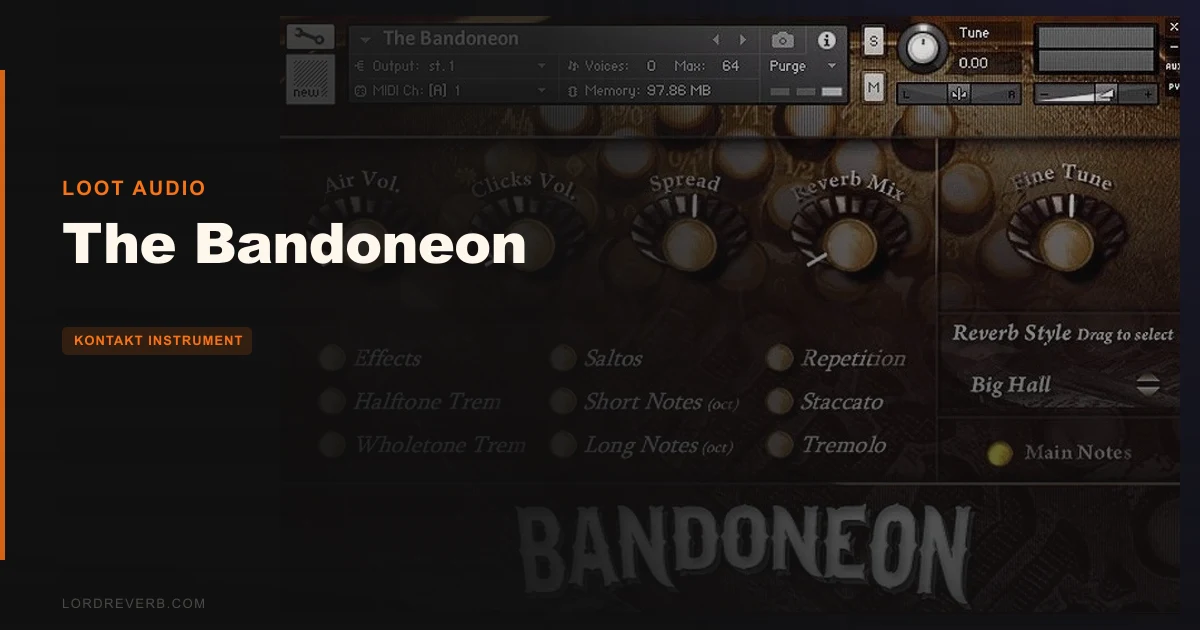
The library ships at 24-bit 48kHz and takes 810MB of disk space. Each note is sampled across 3 velocity layers: piano, mezzo-forte, and forte. You get 9 articulations, switch buttons to toggle them, and controls for air sound (3x Round Robin) and keyclick (7x Round Robin). There's a spread control for stereo width, fine tuning from -100 to +100 cents, and a drag-and-select panel covering 5 convolution reverbs. The reverb mix sweeps from zero to fully drenched.
Microphone setup was serious. The left hand ran through a Neumann and a ribbon mic for low-frequency body. The right hand was captured by a modified SE A5600 II tube microphone alongside an AKG that caught the natural roof ambience of the recording space. Everything went through vintage Telefunken preamps, with no console in the chain.
The Good
That signal chain matters. No console in the path means nothing smearing the character of the instrument before it hits your session. The Telefunken preamp colour is there, but it's intentional, not incidental. You hear it in the low-mid body of the left-hand register: thick and present without being muddy.
The air control is clever. Push it up and you get the breath and bellows noise that makes the instrument feel alive. Pull it back for cleaner passages. With 3x Round Robin on the air sound, repeated notes don't machine-gun. It's a small thing that makes a real difference on sustained phrases.
The keyclick control is where things get interesting. At $13, you wouldn't expect this level of textural control. Stacking staccato samples with the keyclick cranked produces aggressive, unconventional tones that sit far outside traditional tango territory. If you're scoring something tense or percussive, that's a genuinely useful tool.
And the basic playability is satisfying. The interface is intuitive enough that you can get convincing results fast, without reaching for the manual. That's not a small thing. Realistic and delicate bandoneón sound without an afternoon of troubleshooting is worth real money.
The Not-So-Good
Three velocity layers is the number you need to know. Piano, mezzo-forte, forte: that's your palette. For most parts in a mix, it's enough. But if you're writing a nuanced solo line with gradual swells and subtle dynamic shaping, you'll hit the ceiling. The jumps between layers can be audible when you're pushing and pulling the velocity on a slow melodic line.
Nine articulations sounds like plenty until you're trying to replicate a specific live performance technique and realise there's no good approximation for it. It's not a dealbreaker for most use cases. It is frustrating if you need that last mile of expressiveness.
The Kontakt requirement is non-negotiable and worth repeating: the free Kontakt Player will not load this. You need a licensed full version of Kontakt 4.2.2 or above. If you're running free players from Native Instruments, this library stays locked. That's a real barrier for some buyers, and it's annoying that it's not always obvious before purchase.
Compared to the Alternatives
The closest named comparison is the PSound Bandoneon, described as a philological reproduction of a historic Alfred Arnold instrument sampled with 2 round robins. That framing signals a different priority: historical accuracy and instrument-specific character over ease of use and textural flexibility. If you're reconstructing a specific period tango sound and care about the provenance of the instrument model, that may be the right tool.
The Bandoneon by Loot Audio leans toward playability and contemporary usefulness. The air control, keyclick, 5 convolution reverbs, and spread control are features oriented toward getting a good result quickly in a modern session. The Buenos Aires recording is authentic, but the design is pragmatic.
Guareschi also created The Ronroco, a different instrument entirely: a stringed instrument built for film composition. That's not competition for this library, it's a companion piece if you're already in Guareschi's sonic world and need another texture.
Who Should Buy This
- ✅ Buy if you score tango, Latin, or world music and need a convincing bandoneón that sits in a mix without heavy editing.
- ✅ Buy if you own a full Kontakt license and want a high-character instrument with a serious recording chain at a low price point.
- ✅ Buy if you want textural flexibility: the keyclick and air controls push this beyond a straight "realistic" instrument into something more compositionally useful.
- ❌ Skip if you only have the free Kontakt Player. It won't work, full stop.
- ❌ Skip if you need dense velocity resolution for a highly expressive solo performance. Three layers will limit you.
- ❌ Skip if you need a wide articulation library for deeply detailed orchestral mockups. Nine articulations is a focused set, not an exhaustive one.
Specs & Technical Details
| Developer | Loot Audio |
| Price | $13 |
| Plugin Format | Kontakt Instrument (.nki) |
| OS Support | N/A |
| Activation | N/A |
| CPU Usage | N/A |
| Trial Available | N/A |
| Version Reviewed | N/A |
| Disk Space | 810MB |
| Sample Resolution | 24-bit / 48kHz |
| Velocity Layers | 3 (piano, mezzo-forte, forte) |
| Articulations | 9 |
| Kontakt Required | Full version 4.2.2 or above |
Score Breakdown
| Category | Score | Notes |
|---|---|---|
| Sound Quality | 4.5/5 | Buenos Aires recording through Telefunken preamps and high-quality mics delivers genuine character |
| Value for Money | 4.5/5 | At $13, the signal chain and textural controls are hard to argue with |
| Ease of Use | 4.5/5 | Owners report convincing results without consulting the manual |
| Features | 3.5/5 | Air, keyclick, and 5 reverbs are clever; 3 velocity layers and 9 articulations cap the ceiling |
| CPU Efficiency | N/A/5 | No data available |
| Overall | 4.3/5 | A focused, honest bandoneón library with a serious recording pedigree and a price that makes the limits forgivable |
Alternatives to Consider
PSound Bandoneon, A philological reproduction of a historic Alfred Arnold bandoneón instrument, sampled with 2 round robins. If historical instrument accuracy is your priority over modern workflow flexibility, it's the more specialised choice. The Loot Audio library has more textural controls; PSound leans on provenance.
The Ronroco (Loot Audio / Guillermo Guareschi), Not a bandoneón at all: it's a stringed instrument from the same composer, built for film composition. Worth knowing about if you're already using The Bandoneon and want to extend your palette of South American timbres into a different register and character.
The Verdict
You're a film composer scoring a Buenos Aires scene at 2am. You need a bandoneón on the track by morning. The Bandoneon loads fast, sounds right immediately, and the air control adds that living, breathing quality that separates a real instrument from a sample.
Push the keyclick up on a staccato line. Suddenly you've got something rhythmic and percussive that works in a cue where a sweet legato melody would have felt wrong. That flexibility is what makes this library love-worthy at this price.
If you need that final layer of dynamic expressiveness across a solo performance, you'll wish for more velocity layers. That's a real limit. But it's a $13 limit, and that changes the calculation.
Own Kontakt. Need a bandoneón. Buy this. The recording is honest, the design is smart, and the price makes the trade-offs easy to live with. If you're running only the free Kontakt Player, that's the one scenario where this is a hard skip regardless of everything else.
Frequently Asked Questions
Does The Bandoneon work with the free Kontakt Player?
No. The Bandoneon requires the full licensed version of Kontakt 4.2.2 or above. It will not load in the free Kontakt Player. If you're unsure which version you own, check your Native Instruments account before purchasing.
What is a bandoneón and how does it differ from an accordion?
A bandoneón is a type of concertina that developed a central role in Argentine and Uruguayan tango music. Unlike a standard accordion, it has a distinct reedy, plaintive tone and is traditionally played in the orquesta típica, the classic tango ensemble. The sound sits between a harmonium and a squeezebox, but with more expressive range in the hands of a skilled player.
How many articulations does The Bandoneon include?
The library includes 9 articulations, toggleable via switch buttons on the interface. For most tango, world music, and film scoring applications, that's a workable set. Players who need a wider articulation palette for detailed solo mockups may find it limiting.
Where was The Bandoneon recorded, and does it matter?
It was recorded in Buenos Aires, Argentina by composer Guillermo Guareschi, using vintage Telefunken preamps and a multi-microphone setup that included a Neumann, a ribbon mic, a modified SE A5600 II tube microphone, and an AKG capturing the natural room ambience. No mixing console was in the signal path. For a library at this price, that recording approach is unusually serious and it shows up in the character of the low-mid register.
Can The Bandoneon be used for music styles outside of tango?
Yes. Owners report that cranking the keyclick control alongside staccato articulations produces aggressive, unconventional tones far outside traditional tango territory. The 5 convolution reverbs and spread control also help it fit into contemporary film scores, ambient music, and experimental production contexts. The instrument's core character is rooted in tango, but the controls give you enough room to push it somewhere unexpected.