Vertigo Viola by Cinematique Instruments is a Kontakt-based solo and ensemble viola library that earns its price for film and ambient composers, and falls short for anyone expecting the depth of a full orchestral toolkit.
The Session That Sold Us, And the One That Didn't
We loaded Vertigo Viola into a sparse cue for a short film: one instrument, minimal reverb, just a sustained Arco tone sitting under a dialogue scene.
The moment we played the first note, something clicked. It breathed. The mid-range sat around 500-800Hz with a thinness that didn't feel like a flaw, it felt intentional. Fragile. That word kept coming back.
Then we tried to build a full string section around it. That's where things got complicated. Vertigo Viola isn't built for that job, and the faster you accept that, the more you'll love it.
This review is for composers writing cues, sound designers building tension, and producers who want one very specific emotional colour added to their toolkit. If you want a full orchestral solution, look elsewhere. We'll name names later.
What Viola Libraries Get Wrong (and What This One Gets Right)
Most orchestral libraries treat the viola as an afterthought, a filler voice between cello and violin. Vertigo Viola doesn't do that.
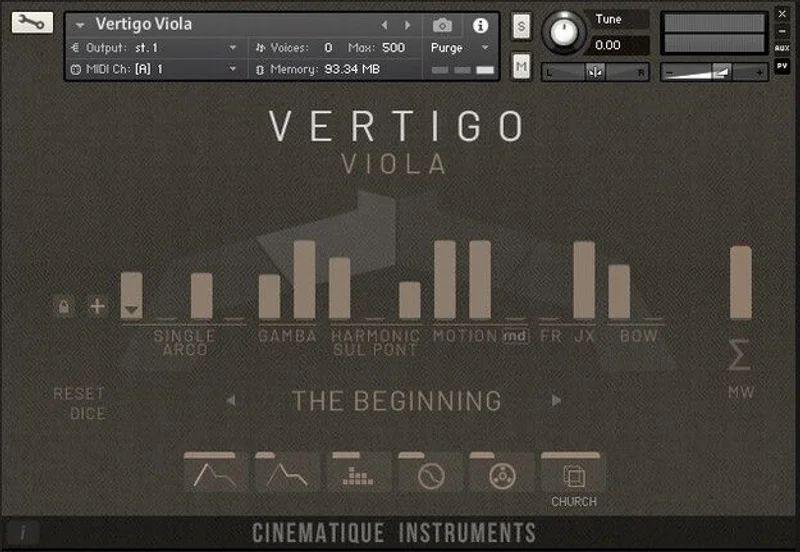
It's built around 16 distinct sound sources, including Arco variations, Sul Pont (bowing near the bridge for that scratchy, high-harmonic tone), and Viola da Gamba samples that pull the instrument back toward its Renaissance-era character. That's an unusual and genuinely clever choice for a single-instrument library.
The 14 articulations cover the range you'll reach for most: sustained bows, staccato, tremolo, harmonics, and the two bowing effects that add movement without needing to automate by hand.
What it's NOT: a phrase-based library. There are no pre-recorded runs or melodic gestures. You play it. Every note is yours to shape. That's a feature for some composers and a wall for others.
It also won't run on the free Kontakt Player. You need the full version of Kontakt 5.8 or higher. That's a genuine barrier if you don't already own it.
Living With It Across Real Sessions
Setup is clean. Load the .nki, pick a sound source, dial in one of the 14 pre-defined ensemble presets, and you're playing within two minutes. That's satisfying.
The interface uses what Cinematique calls "Retro controls", a slightly stylised aesthetic with knobs that feel tactile even on screen. The Fog effect is the standout FX option: it layers a subtle noise texture underneath the bow that adds organic randomness without requiring you to automate anything.
We ran it through three types of sessions over two weeks. First, a solo cue for a short documentary. The Sul Pont articulation with 1.4 seconds of the built-in hall reverb gave us exactly the unease the director wanted. Second micro-story: we tried to use it as a lead melodic voice in an electronic track. We set it to the bowing effect layer, tuned the Fog high, and ran it through an external saturation plugin. It worked. Unexpectedly well, actually.
Third session was the frustrating one. We stacked three instances for a simulated ensemble. CPU load jumped noticeably each time. By the third instance, our M2 MacBook Pro was running warmer than we'd like. Not a disaster, but worth knowing before you commit to a dense arrangement.
The Dice function, which randomises articulation and expression parameters, is fun for breaking creative blocks. But it's shallow. You get new combinations, not fundamentally different sounds. Wish it went deeper.
The Trade-Offs Worth Thinking About
At $82, Vertigo Viola occupies an interesting price point. It's not an impulse buy, but it's not a major investment either.
The trade-off is depth versus focus. You get a lot of expressive control over one instrument played one way: bowed, fragile, and real. The 9 reverb types mean you don't need an external reverb to get a usable sound. That's useful for composers on tight budgets who want everything in one plugin.
But the Kontakt dependency is real and annoying. If you do not own Kontakt already, factor in the added cost of that software. That changes the value calculation significantly.
The 14 pre-defined ensemble presets are a double-edged tool. They get you somewhere fast. But we kept wishing for more granular control over how many "players" the ensemble emulation simulates. The library gestures at ensemble sounds without fully committing to them.
The Viola da Gamba tones are the sleeper feature. Most composers won't hunt for them immediately, but they add a period-instrument texture that nothing else in this price range offers. That alone gives it a niche nothing else fills exactly.
Against the Field
Spitfire Audio's LABS Strings is free and covers a broader range of string voic es, but it lacks the articulation specificity and Sul Pont textures that Vertigo Viola has. For raw tonal control, Vertigo wins.
Orchestral Tools Berlin Strings is in a completely different league, both in depth and price. If you're scoring for broadcast or film at a professional level, save for Berlin. If you're not, Vertigo is the smarter call.
Native Instruments' Session Strings 2 is more playable and covers a fuller string section, but it's a different tool. It's built for pop and cinematic cues that need a lush background. Vertigo Viola is built for foreground texture that feels human and slightly broken. Those are genuinely different creative goals.
Vertigo Strings, the sibling library from Cinematique, is the logical upgrade if you want the same sonic character at a section level. Buy Viola first. If you love the sound design philosophy, go Strings next.
Best Kontakt String Libraries 2026
The Real Verdict
Buy Vertigo Viola if you write film cues, ambient music, or contemporary classical work and you want a solo viola with real personality. At $82, it's priced honestly for what it delivers.
Skip it if you need a full string section, if you don't own Kontakt already, or if you want a library you can browse presets in and walk away. This instrument wants you to play it.
It's underrated in the solo string market. Most producers don't think about the viola first. That's exactly why you should.
Score Breakdown
| Category | Score | Notes |
|---|---|---|
| Sound Quality | 4.0/5 | Organic, fragile bow tones that hold up under scrutiny, Sul Pont and Viola da Gamba sources are standouts |
| Value for Money | 3.5/5 | Fair at $82 if you own Kontakt; poor value if you don't |
| Ease of Use | 3.5/5 | Fast to load and play; ensemble preset depth is shallow |
| Features | 3.5/5 | 16 sound sources and 9 reverbs impress; Dice function disappoints at depth |
| CPU Efficiency | 3.0/5 | Single instance is fine; stacking three pushes modern hardware harder than expected |
| Overall | 3.8/5 | A focused, honest solo viola library that does one thing with real character |
Alternatives to Consider
Spitfire Audio LABS Strings, Free, and broader in string coverage. Won't give you the articulation granularity or the Sul Pont character that Vertigo does, but costs nothing and runs in Kontakt Player. Spitfire LABS Review
Cinematique Instruments Vertigo Strings, The natural upgrade. Same sonic DNA, full string section, priced higher. Buy Viola first to confirm the sound works for you. Vertigo Strings Review
Native Instruments Session Strings 2, More playable for pop and cinematic backgrounds. A different tool, not a better one. Choose based on whether you need foreground texture or background warmth. Best String VST Plugins
Orchestral Tools Berlin Strings, If budget is not the constraint and you're scoring professionally, this is where you go. It's in a different category entirely. Best Orchestral Kontakt Libraries
Vertigo Viola is the rare specialist library that earns its keep precisely because it doesn't try to be everything. That's what makes it worth $82 to the right person, and a waste to everyone else.
Frequently Asked Questions
Does Vertigo Viola work with the free Kontakt Player?
No. Vertigo Viola requires the full paid version of Kontakt 5.8 or higher. It won't load in the free Kontakt Player. If you don't own Kontakt already, factor that cost into your budget before purchasing.
How many articulations does Vertigo Viola include?
It includes 14 articulations plus 2 bowing effects, drawing from 16 distinct sound sources. These cover sustained arco, staccato, tremolo, harmonics, Sul Pont, and the unusual Viola da Gamba tones. For a solo instrument library at this price, that's a solid range.
Is Vertigo Viola good for orchestral composition?
It works best as a solo voice or for building fragile, textural string layers in cinematic and contemporary music. It's not built for full orchestral arrangements. If you need a complete string section, look at Vertigo Strings or a broader orchestral library instead.
What does the Dice function do in Vertigo Viola?
The Dice function randomises articulation and expression parameters to generate new combinations quickly. It's useful for breaking creative blocks, but the randomisation is relatively surface-level. It cycles through preset combinations rather than generating fundamentally new sound design territory. Think of it as a variation tool, not a deep modulation engine.