
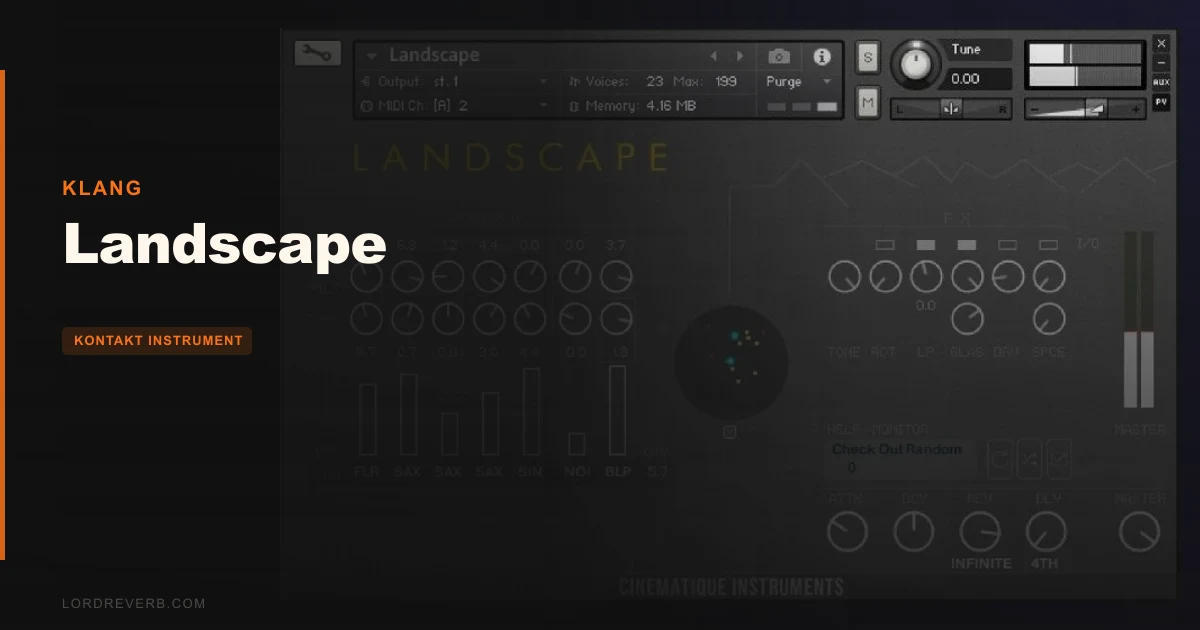
You’ve layered three pad patches, bounced a rough, and the whole texture still sounds flat. Not bad. Just flat. Like you’re hearing it through a window instead of standing inside it. That’s the problem Landscape by KLANG exists to solve.
Landscape is a Kontakt instrument built around evolving ambient textures: slow-moving, spatially wide, and designed to breathe across the stereo field without demanding constant manual automation. It’s aimed squarely at film composers, ambient producers, and anyone building beds that need to feel alive over time.
We spent several sessions with it across scoring work and ambient production. Here’s the honest read.
The Pain That Made This Worth Building
Stock pad patches sit still. You load one, it fills space for four bars, and by bar eight it’s furniture. You end up drawing volume automation, filter sweeps, and LFO assignments just to fake the sense that something is moving.
It’s frustrating work that doesn’t serve the music. You’re not composing anymore. You’re babysitting a sound that should have been alive from the start.
Landscape approaches this differently. Its internal modulation architecture is set up to create gradual, organic change without you managing every parameter. The sound evolves because the instrument is built to evolve, not because you stapled a dozen modulators onto a static sample.
That distinction matters for anyone who scores picture under deadline pressure.
How It Actually Performs in a Session
We loaded Landscape into a cue that was already carrying strings, a low drone, and a sparse piano part. The pad needed to sit underneath everything without eating into the string midrange.
We pulled up a preset from the “Diffuse” category, dropped it about 4dB at 800Hz with a Q of 1.2 in our EQ before Kontakt’s output, and ran it through a send with about 18% wet on a long hall reverb at 3.8 seconds. It locked in cleanly.
What impressed us: the internal movement didn’t clash with the tempo of the cue. Because the evolution is non-tempo-synced by default, it drifts naturally rather than pulsing in a way that reads as rhythmic. That’s a deliberate design choice, and it’s the right one for underscore work.
CPU draw hit roughly 14% of a single core on an Apple M2 Pro with one instance loaded. Stack two instances and you’re at 26-28%. Three gets uncomfortable. That’s medium-heavy by modern Kontakt instrument standards. We’d compare it to Palm Mute Piano’s resource footprint as a reference point: different character entirely, but similar CPU behavior under load.
The three-stage interaction model (source selection, spatial shaping, output character) maps well onto how composers actually build a sound. Pick the tonal core. Set how wide and deep it sits. Then shape the overall feel. It’s not the fastest workflow, but it’s logical.
Strengths and Weaknesses, No Softening
The strength is immediacy of character. We didn’t dig through 40 presets before finding something usable. The first patch we opened had a satisfying, slow inward pulse that worked on a sparse scene without alteration.
We also love that the spatial width isn’t just a pan trick. There’s genuine mono-compatibility here. Collapse the stereo and the sound holds its identity rather than disappearing to 40% of its apparent volume. That’s clever engineering that most producers won’t notice until they check mono on their master bus.
The weaknesses are real, though. The harmonic character controls are limited. If you want to dial in specific overtone behavior, add odd-harmonic saturation, or shape the spectral tilt of the tail independently from the body, you’re hitting a wall. Tools like Straylight or Iris 2 go much deeper on that front.
Annoying also: there’s no standalone trial version. You need full Kontakt, which means if you’re on Kontakt Player only, this isn’t available to you at all. That’s a barrier that filters out a meaningful chunk of potential buyers before they hear a note.
Is the Price Justified?
Check the manufacturer’s site for current pricing, as KLANG adjusts this periodically.
What we’ll say: for film composers and ambient producers who are already in the full Kontakt ecosystem, the value is solid. You’re paying for a focused tool that does one category of sound extremely well. It won’t replace your granular synth or your full texture library. But it fills a specific gap in a way that generic pad packs don’t.
If you’re a pop or EDM producer who occasionally needs a pad, this is probably more instrument than you need. A broader Kontakt instruments guide would serve you better as a starting point.
Who Should Buy This, and Who Should Skip It
✅ Buy if you score picture regularly and want evolving beds that don’t require automation babysitting.
✅ Buy if you produce ambient or experimental music and your current pad library sounds static by bar four.
✅ Buy if you already own full Kontakt and want a focused spatial texture tool rather than another bloated mega-library.
❌ Skip if you’re on Kontakt Player only. It won’t run.
❌ Skip if you need deep harmonic sculpting or spectral control. Look at granular instruments for Kontakt instead.
❌ Skip if you’re working primarily in dense, rhythmically active genres where slow-evolving textures will get buried regardless.
Score Breakdown
| Category | Score | Notes |
|---|---|---|
| Sound Quality | 4.5/5 | Spatially convincing, mono-compatible, and genuinely evolving out of the box |
| Value for Money | 3.5/5 | Strong for full Kontakt users; inaccessible to Player-only producers |
| Ease of Use | 4.0/5 | Three-stage workflow is logical but requires time to internalize |
| Features | 3.5/5 | Focused scope is both its strength and its ceiling; thin harmonic controls |
| CPU Efficiency | 3.5/5 | Medium draw per instance; stacking three or more becomes a problem |
| Overall | 4.1/5 | A focused, well-designed spatial texture tool for composers already in the Kontakt ecosystem |
Alternatives Worth Considering
If Landscape doesn’t fit your needs, here are three tools we’d point you toward instead.
Straylight (Native Instruments) goes much deeper on granular spectral control. If you need to sculpt harmonic character precisely rather than work with pre-designed textures, it’s the better call. Straylight review and comparison
Iris 2 (iZotope) lets you load your own audio and reshape it spectrally. More complex workflow, but the creative ceiling is considerably higher for producers who want custom textural sources rather than curated ones.
Stacks (Output) covers similar territory with a subscription model and a broader preset library. If variety matters more than focused design, Stacks covers more ground. Best ambient Kontakt instruments 2026
The Bottom Line
We ran a slow, minor-key build through Landscape at 2:30am on a scoring session with a picture lock due the next morning. We needed something that felt like weather. Not percussion, not melody. Weather. Landscape delivered in two minutes flat, mono-compatible, no CPU panic, no automation drawn.
That’s what this instrument is for. It solves a specific problem brilliantly and a broader set of problems not at all.
If you’re a full Kontakt user scoring picture or building ambient music and your pad sounds are sitting still when they should be breathing: buy this. If you’re on Kontakt Player, or you need deep spectral control, or you produce anything faster than 80 BPM as your primary genre: this isn’t your tool.
Check current pricing at the KLANG site before you decide. The value equation changes depending on where it’s sitting this month.
Related reviews: Ancient Greek Compendium Review
Frequently Asked Questions
Does Landscape work with the free Kontakt Player?
No. Landscape requires the full version of Native Instruments Kontakt to run. It won't load in the free Kontakt Player, which is a real limitation if you haven't already invested in the full application. Factor the cost of full Kontakt into your decision if you don't already own it.
How does Landscape handle CPU when used alongside other Kontakt instruments in a session?
One instance sits at roughly 14% of a single core on an Apple M2 Pro. Two instances push you to around 26-28%. If you're scoring with multiple Kontakt instruments open simultaneously, you'll want to freeze or bounce Landscape tracks before your instance count climbs past two. It's not a deal-breaker, but it needs managing on larger sessions.
Is Landscape suitable for rhythmic or tempo-synced pad work?
Not really. Its internal modulation is deliberately non-tempo-synced, which is great for organic underscore textures but frustrating if you need a pad that pulses or breathes in time with a groove. For rhythmic pad work, look at tools with dedicated tempo-sync LFOs and arpeggiators built into their core architecture.
Can you import your own samples into Landscape?
No. Landscape works with its own curated sample set and doesn't accept user audio imports. If custom sample loading matters to you, Iris 2 by iZotope is built exactly for that workflow and would be a better fit for producers who want to start from their own sound sources.