

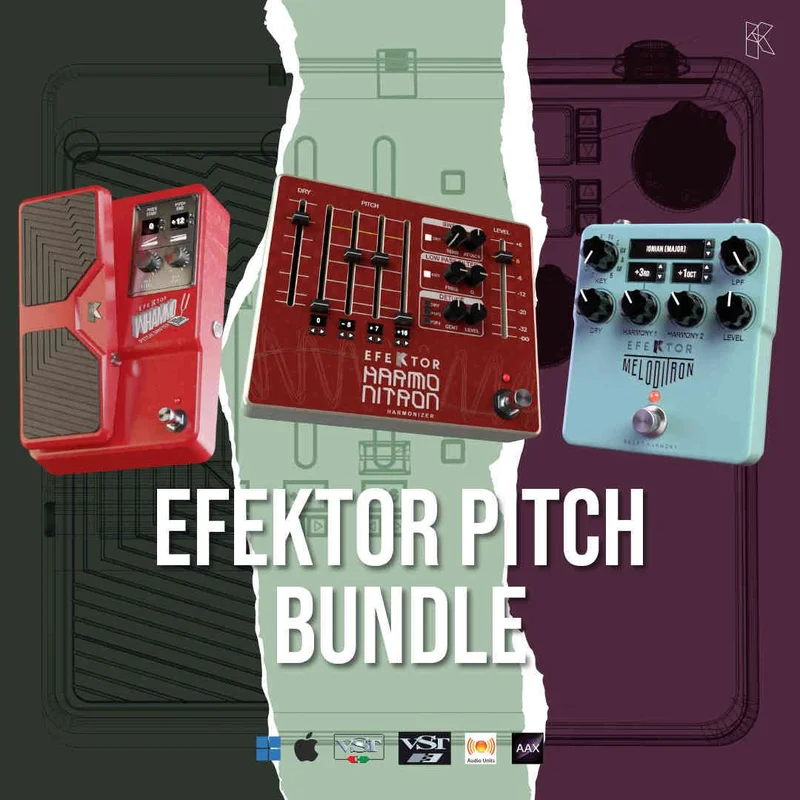
The EFEKTOR Pitch Bundle gives you three creative pitch manipulation plugins for $79: Meloditron (smart harmonizer), Harmonitron (quad pitch shifter), and Whammo (pitch bender with MIDI control).
We loaded all three on a dry guitar DI track last month, signal chain running into Harmonitron first, then Meloditron, then Whammo at the end for expression control. The first thing we noticed was how different these three tools actually are from each other. Not interchangeable. Not redundant. Each one has a distinct job. The second thing we noticed was that Harmonitron ate about 18% CPU on its own with all four pitch engines running. That got our attention fast.
This bundle is built for guitarists, producers doing harmony work, and sound designers who want pitch as a texture tool rather than a correction tool. If you’re looking for Melodyne-style note editing or Auto-Tune-style pitch repair, stop here. This isn’t that.
What These Three Plugins Actually Do
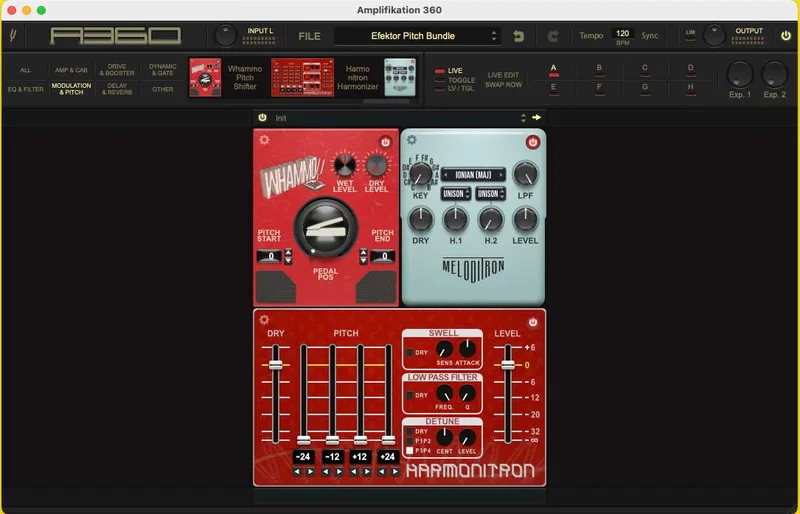
Meloditron is a monophonic smart harmonizer. You pick a key and a scale from 18 options, and it generates diatonic harmonies alongside your playing. It tracks single notes and produces up to two harmony voices with individual panning per voice. The 8x oversampling option is the headline spec, and it does clean things up.
Harmonitron is the heavy lifter for studio work. Four independent pitch shifting engines, each with its own transpose slider covering -24 to +24 semitones, plus a global detune of up to +/- 50 cents, a swell (slow attack) control per engine, and a low-pass filter. That’s where the goregrind-level low vocal thickening comes from. It also explains the CPU hit.
Whammo is the performer’s tool. Smooth pitch bending across the full two-octave range, MIDI assignable, built for divebombs and controlled pitch sweeps. Chord input produces that musical flutter Kuassa name-checks from Radiohead’s “Iron Lung.”
What it’s not: it’s not a tuner, not a pitch corrector, not a vocal alignment tool. Don’t buy this expecting iZotope RX pitch editing. These are effect pedals in plugin form.
Living With It: Three Sessions In
We ran Whammo on a baritone guitar playing a slow, descending riff. Assigned the pitch sweep to a MIDI expression pedal, set the range to -12 semitones down. Smooth. No stepping, no crackle. The attack stayed crisp even at the bottom of the sweep. That was satisfying. After years of grainy pitch-bending plugins, something that holds the pick attack through a full octave drop actually feels like progress.
Meloditron tested on a clean single-note guitar lead in D minor. Selected natural minor scale, set one harmony a third above and one a sixth above, panned them hard left and right. The tracking was tight on held notes. On fast runs above 160 BPM, it occasionally chose the wrong scale degree on hammered notes, which sounds ugly in context. Turning on 8x oversampling smoothed the audio quality but didn’t fix the tracking on the fast runs. Frustrating, but honest: most smart harmonizers struggle here.
Harmonitron gave us a great moment on a synth bass patch. Two engines pitched down 12 semitones with slow swell engaged, two engines pitched up 7 semitones. The result was a wide, organ-like chord swell that needed almost no EQ to sit in the mix. We love that swell control. It’s clever and underused in plugins at this price.
The Trade-Offs You Need to Know
The CPU situation is real. Harmonitron running four engines simultaneously pushed CPU usage noticeably higher than comparable single-voice harmonizers we’ve tested. If you’re running a dense mix and want three or four instances, freeze tracks or print to audio. It’s manageable, but you’ll feel it on older systems.
The trade-off for Meloditron is tracking speed vs. oversampling quality. High oversampling sounds cleaner at the cost of slightly more latency. That latency adds up in a live-monitoring context. For studio work on recorded material, 8x oversampling is the right call. For real-time guitar monitoring, drop it down.
Whammo is the most CPU-light of the three and the easiest to love without reservation. It does one thing and does it well. The MIDI implementation is straightforward: assign, sweep, done. No modulation matrix, no envelope followers. That simplicity is either a strength or a weakness depending on how deep your sound design usually goes.
The price is honest. $79 for three tools is reasonable. Buying each separately would cost more.
Against the Field
Waves Harmony covers smart harmonization with vocal-focused pitch correction built in. It costs more and sounds great on voice. If your primary source is vocals, compare harmonizer plugins for vocals and put Waves Harmony at the top of that list. Meloditron doesn’t
For pitch shifting surgery on recorded audio, iZotope RX Pitch Editor is in a different category. That’s a repair tool with note-level editing. The EFEKTOR bundle doesn’t compete there.
Where the EFEKTOR Pitch Bundle wins: guitarists who want pedal-style pitch effects ITB, producers on a budget who need all three pitch manipulation types in one purchase, and sound designers who like the swell and low-pass filter combination in Harmonitron.
Eventide’s plugin lineup covers similar pitch territory but at a much higher price point. The EFEKTOR bundle is a credible budget alternative for creative use, not for studio-critical harmonic accuracy.
The Real Verdict
Buy this if you’re a guitarist moving ITB and need Whammo’s MIDI pitch bending, or a producer who wants a quick harmony layer on guitar leads without spending on Eventide.
Skip it if your pitch work lives in vocals, if you need pitch correction rather than pitch manipulation, or if your CPU is already under pressure.
Read our full Meloditron review for deeper tracking analysis
At $79 for three tools with genuine tonal variety, this bundle earns its price for the right buyer. It’s not trying to replace surgical tools. It knows what it is.
Score Breakdown
| Category | Score | Notes |
|---|---|---|
| Sound Quality | 3.5/5 | Whammo and Harmonitron sound good; Meloditron tracking on fast runs is inconsistent |
| Value for Money | 4.0/5 | Three distinct tools at $79 is a fair deal for guitarists and producers |
| Ease of Use | 3.5/5 | Whammo is immediate; Meloditron's scale selection has a learning curve with thin documentation |
| Features | 3.5/5 | 18 scales, quad engines, swell control, 8x oversampling, solid for the price |
| CPU Efficiency | 3.0/5 | Harmonitron at full load hits hard; multi-instance use requires freezing on mid-range systems |
| Overall | 3.5/5 | Honest bundle with genuine use cases, not for everyone, right for guitarists going ITB |
Alternatives to Consider
Waves Harmony, Better smart harmonization for vocals with pitch correction built in. Higher price, but if your source is a voice rather than a guitar, it’s the smarter buy. best harmony plugins for vocals
Kuassa EFEKTOR Meloditron (standalone), If you only need the smart harmonizer and don’t want Whammo or Harmonitron, buying Meloditron on its own may cost less. EFEKTOR Meloditron full review
Kuassa EFEKTOR Blues Brother Bundle, If you’re already in the Kuassa ecosystem and need drive and modulation alongside pitch, that bundle pairs naturally with this one. EFEKTOR Blues Brother Bundle review
Three plugins, one job: creative pitch manipulation. The EFEKTOR Pitch Bundle costs $79 and does that job well enough for guitarists and producers who aren’t asking it to be a vocal repair suite. If you are asking it to be a vocal repair suite, buy something else. We’d buy this for a guitar-heavy project. We wouldn’t install it expecting miracles on a lead vocal.
See all Kuassa plugin reviews
Frequently Asked Questions
Does the EFEKTOR Pitch Bundle work on Apple Silicon Macs?
Yes. Kuassa lists native Apple Silicon compatibility for M1 and M2 processors. Mac OS 10.11 or later is required. All three plugins run in VST, VST3, Audio Unit, and AAX formats on Mac.
Is the EFEKTOR Pitch Bundle good for vocals?
Not really. These are creative pitch effect tools, not pitch correction tools. Meloditron tracks monophonic input and generates diatonic harmonies, which can work on simple vocal lines in a fixed key. But for nuanced vocal harmony generation or pitch repair, you'll want a dedicated vocal tool like Waves Harmony or Melodyne instead.
Can you control Whammo with a MIDI expression pedal?
Yes. Whammo's pitch sweep is MIDI assignable, which is the whole point of it. Assign your MIDI CC to the pitch control, set your range within the -24 to +24 semitone window, and sweep in real time. It's one of the more straightforward MIDI implementations we've used at this price point.
How does the Harmonitron's swell control work?
The swell control adds a slow attack to each pitch engine independently. When engaged, the pitched voice fades in gradually rather than hitting immediately with your pick attack. This creates an organ or synth-like quality where the original attack cuts through but the harmony voice swells in behind it. Each of the four engines has its own swell setting, so you can mix swelling and immediate voices simultaneously.