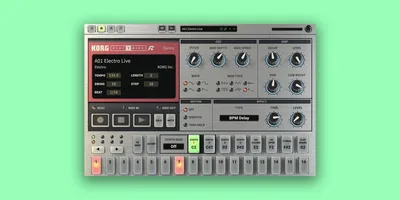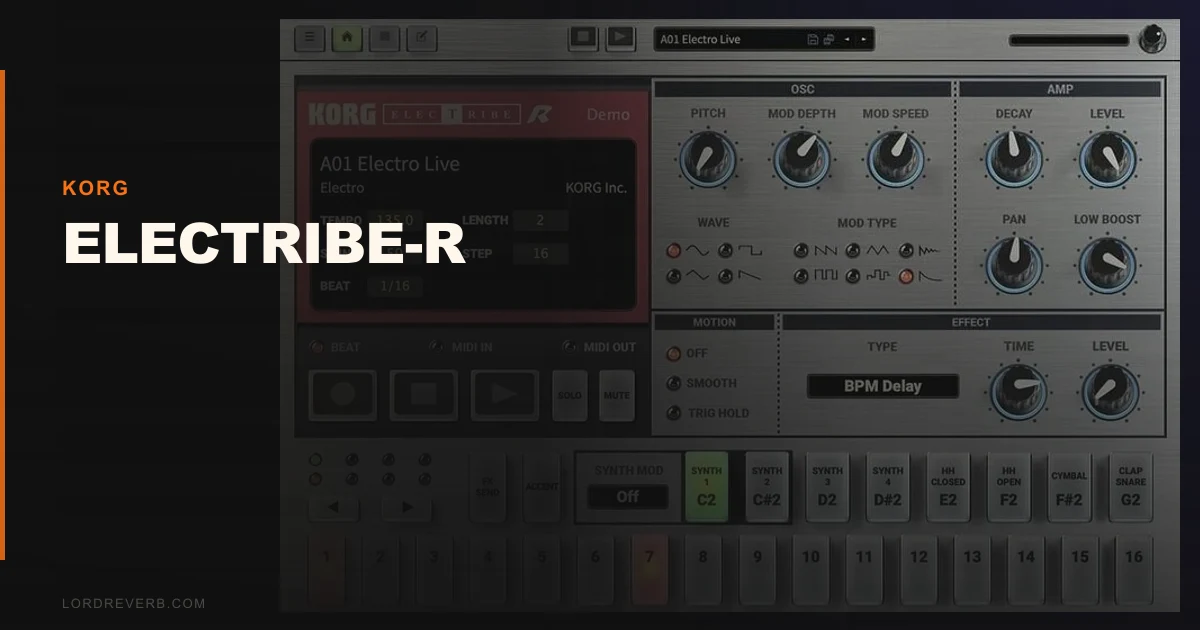
The real question about the ELECTRIBE-R plugin isn't whether it sounds good. It does. The question is whether a software recreation of a late-90s hardware drum synth can still justify desk space in 2026, when you've got Korg's own Gadget, Ableton's built-in drum racks, and half a dozen better-known rhythm machines already in your library. Our answer: yes, but only for a specific kind of producer who knows exactly what that ER-1 fizz is and wants it without hunting down secondhand hardware.
This is a plugin recreation of the Korg ER-1 (ELECTRIBE-R), the analog-modeled rhythm synthesizer originally released in 1999. It's built for producers making techno, electro, acid, lo-fi, or any style that benefits from synthetic percussion with real character. If you're programming trap hi-hats or cinematic drums, look elsewhere.
Does the ELECTRIBE-R Plugin Actually Deliver the Hardware Sound?
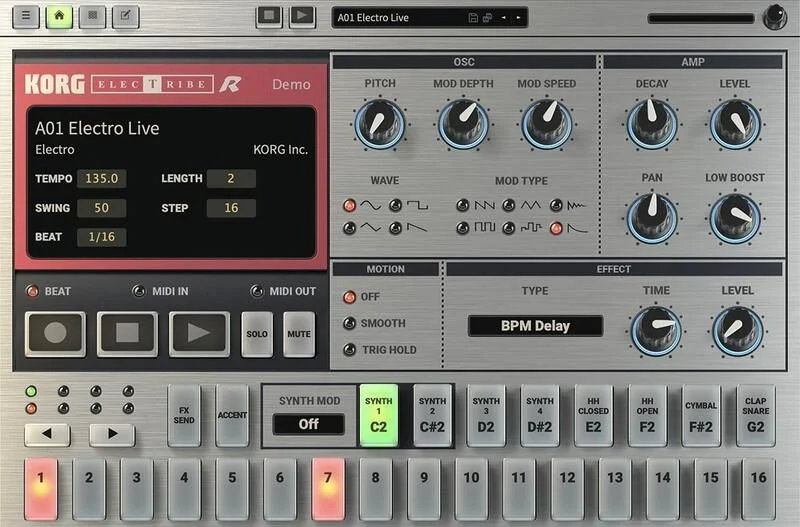
The original ER-1 earned its reputation on one thing: synthesis-based drum sounds with actual analog modeling behind them, not samples. Each of the four synth parts runs a selectable waveform, sine, triangle, square, or sawtooth, with pitch, decay, and modulation controls that interact the way real analog circuitry does. Not perfectly linear. Not sterile.
The plugin carries that architecture across. We ran the sine-wave kick part through a pattern at 128 BPM, pitched down to around 55Hz, with a tight 180ms decay. It thumped. Not in the way a Neve-processed 909 sample thumps, but in that particular punchy-but-wobbly way that sits perfectly in an electro groove and would sound wrong on anything else.
Korg built the original ER-1 mkII with 256 pattern slots and 16 song slots. The plugin mirrors that storage logic. You're not losing workflow depth in the translation.
Where the ELECTRIBE-R Earns Its Place
The step sequencer is genuinely satisfying to use. Each part gets its own row of 16 steps, and switching between the nine parts, the four synth voices, PCM hi-hats, cymbals, claps/snare, and accent channels, takes two clicks maximum. We programmed a full four-bar electro pattern in under eight minutes from a blank slate. That's fast.
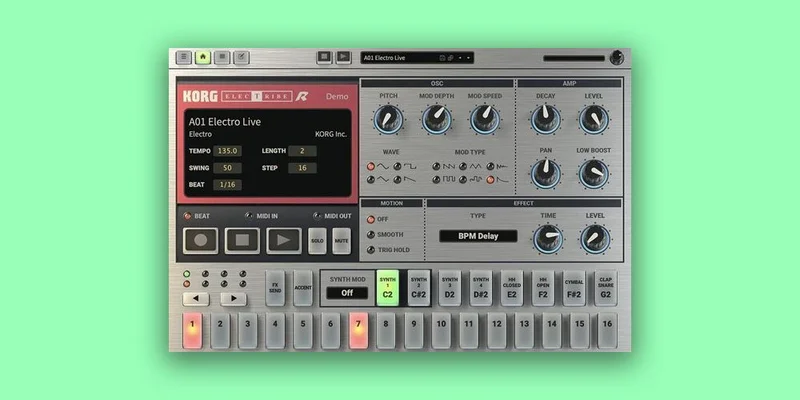
The Motion Sequence function is the sleeper feature. It records real-time knob movements per step, so you can automate pitch, decay, or modulation on a per-step basis without drawing automation lanes in your DAW. We recorded a sawtooth synth part with pitch rising across steps 9 through 16, creating an ascending arpeggio-style tail. It locked to the pattern and played back every time. No fuss.
The 15 effects types cover more ground than the original hardware. Distortion, delay, flanger, reverb, ring modulation, decimator. We ran the clap channel through the ring mod at a carrier frequency of 800Hz. The result was metallic, aggressive, and completely usable in a hard techno context. That kind of sound would cost you two plugins and a send bus anywhere else.
The audio input function for rhythmic gating deserves attention. Feed an external signal through and trigger it from the step sequencer pattern. We ran a synth pad into it and gated it against a 16th-note pattern at 140 BPM. The rhythmic chop was tight. Timing drift was not noticeable at standard buffer sizes.
MIDI out and MIDI file drag-and-drop export work cleanly. Drop the MIDI into your DAW, and you've got your ELECTRIBE-R pattern driving a different instrument in seconds. That's a legitimate workflow accelerator.
Where It Falls Short
The 24-voice polyphony limit hurts in specific scenarios. Build a pattern with all four synth parts active, long decays, plus open hi-hat, cymbal, and a busy accent track, all running at 160 BPM or above. You'll hit the ceiling. Notes cut. It's audible, and it's annoying.
Pro Tools users are left out entirely. No AAX. If your studio runs Pro Tools as primary, the ELECTRIBE-R plugin doesn't exist for you without a wrapper, which adds latency and instability you don't want in a rhythm engine.
The Motion Sequence recall is frustrating compared to what the hardware offered. On the ER-1 mkII, recalling motion data per pattern felt immediate. In the plugin, switching patterns mid-session occasionally dropped stored motion data in our tests. It happened three times across a two-hour session. Not catastrophic, but worth saving constantly if you're relying on it.
The nine-part architecture also means you're not getting independent outputs per part without routing workarounds. Mixing a kick, snare, and hi-hat with different compression on each requires extra infrastructure outside the plugin.
How It Stacks Up Against Real Alternatives
The obvious comparison is something like the Audio Blast ABX3 Bundle, which covers acid synthesis with a similar vintage-hardware mentality. ABX3 wins on oscillator depth and per-voice control. ELECTRIBE-R wins on rhythm-focused workflow and the step sequencer speed.
For broader analog synthesis that crosses into drum design, the BLEASS Analog FM Synth Bundle is worth looking at. It's more capable a s a general synthesizer. But it doesn't think like a rhythm machine. If you need patterns built fast and you want that specific ER-1 texture, ELECTRIBE-R is quicker to a finished groove.
The DRC Polyphonic Synthesizer is worth mentioning for iOS users who want synthesis-based sound design. Different use case, but it shows what modern design looks like for mobile-first producers. ELECTRIBE-R's interface doesn't feel dated by comparison. It feels intentional.
Is the Price Actually Fair?
At full retail and half that on sale, the ELECTRIBE-R plugin sits in an awkward zone. It's not cheap enough to be a reflex purchase, and it's not feature-complete enough to be a primary drum machine for most setups. But if you specifically want ER-1 sounds without tracking down secondhand hardware, the plugin version costs less than a clean used unit and takes zero desk space.
For techno and electro producers, a sale price is fair. At $149, we'd wait for a discount.
Score Breakdown
| Category | Score | Notes |
|---|---|---|
| Sound Quality | 4.0/5 | Analog-modeled character holds up; sine kick and sawtooth synth parts sound genuinely dirty in the right way |
| Value for Money | 3.5/5 | Fair at sale price; hard to recommend at full retail for a nine-part instrument |
| Ease of Use | 4.0/5 | Step sequencer workflow is fast and logical; Motion Sequence setup has a minor learning curve |
| Features | 3.5/5 | 15 effects types and MIDI export are clever inclusions; no AAX and no per-part outputs hurt the total |
| CPU Efficiency | 4.0/5 | Runs light on a modern machine; 24-voice ceiling is the limiter, not CPU |
| Overall | 3.8/5 | Specific, characterful, and fast for electro and techno; too niche and too limited for general use |
Alternatives Worth Considering
If the ER-1 texture is what you're after but you want more synthesis depth, the Audio Blast ABX3 Bundle gives you more oscillator control and acid-leaning tones. It's a different beast but shares the same vintage-hardware DNA.
For producers who want analog and FM synthesis in one package with broader sound design range, the BLEASS Analog FM Synth Bundle covers more territory. You'd need to build your own rhythm workflow around it, but the sonic ceiling is higher.
If you work on iOS or want polyphonic synthesis with a modern interface, the DRC Polyphonic Synthesizer is worth testing. Different category, but it shows what purpose-built synthesis looks like when the interface prioritizes speed.
Producers who want broader keys and synthesis coverage in a single bundle should look at the Heavyocity Keys & Synth Bundle. It won't give you the rhythm-machine workflow, but the sound palette is far wider.
The ELECTRIBE-R plugin is a brilliant tool for a narrow job. If that job is yours, buy it on sale and don't look back. If you're hoping it becomes your main drum machine for all styles and all sessions, you'll hate it by week three.
Skip it at $149. Own it on sale. And understand going in: this is a texture tool, not a drum kit replacement.
Frequently Asked Questions
Is the ELECTRIBE-R plugin a faithful recreation of the original ER-1 hardware?
It's close. The core sound architecture, four synth parts with selectable sine, triangle, square, and sawtooth waveforms, PCM percussion channels, and the step sequencer logic, all carry across accurately. The plugin version adds 15 effects types and MIDI export that the original hardware lacked. Where it diverges is in tactile feel and Motion Sequence reliability, which felt more stable on the physical unit in extended use.
Does the ELECTRIBE-R plugin work in Pro Tools?
Not natively. There's no AAX version. Pro Tools users would need a VST-to-AAX wrapper, which introduces potential latency and stability issues. If Pro Tools is your primary DAW, this is a real limitation and worth factoring into your decision before buying.
Can you use your own samples in the ELECTRIBE-R plugin?
The stock plugin is built around synthesis and its onboard PCM content, not user sample import. Custom sample loading was a feature associated with firmware modifications on the hardware rather than a built-in function. For a sample-forward drum machine workflow, you'll want a different tool entirely.
How does the Motion Sequence function actually work in the plugin?
Motion Sequence records real-time knob movements and stores them per step within a pattern. You move a parameter, say pitch or decay, while the sequencer runs, and those movements replay locked to their step positions on every subsequent loop. It works cleanly for most parameters. We found pattern-switching mid-session occasionally caused stored data to drop, so saving frequently is a good habit when relying on it heavily.