
Phase Plant by Kilohearts is the best semi-modular softsynth at its price, and it's not particularly close.
We were halfway through a drone ambient session, trying to build a texture that breathed on its own without automating fifteen parameters. The synth we'd been using couldn't do it without ugly workarounds. We loaded Phase Plant, dropped a granular generator on a 4-second field recording, routed an envelope follower to the grain position, added a second LFO with a random curve into grain size, and it was alive. That whole patch took about four minutes.
That's what Phase Plant does that nothing else at this price does as cleanly. It sits at the intersection of "synth you can actually learn" and "modular system deep enough to get lost in." If you're a sound designer, a film scorer, or a producer who builds sounds from scratch rather than scrolling presets, this is worth your serious attention.
If you just want to find a great bass patch in 90 seconds, there are better options. We'll get to those.
First Impressions: It Doesn't Hold Your Hand
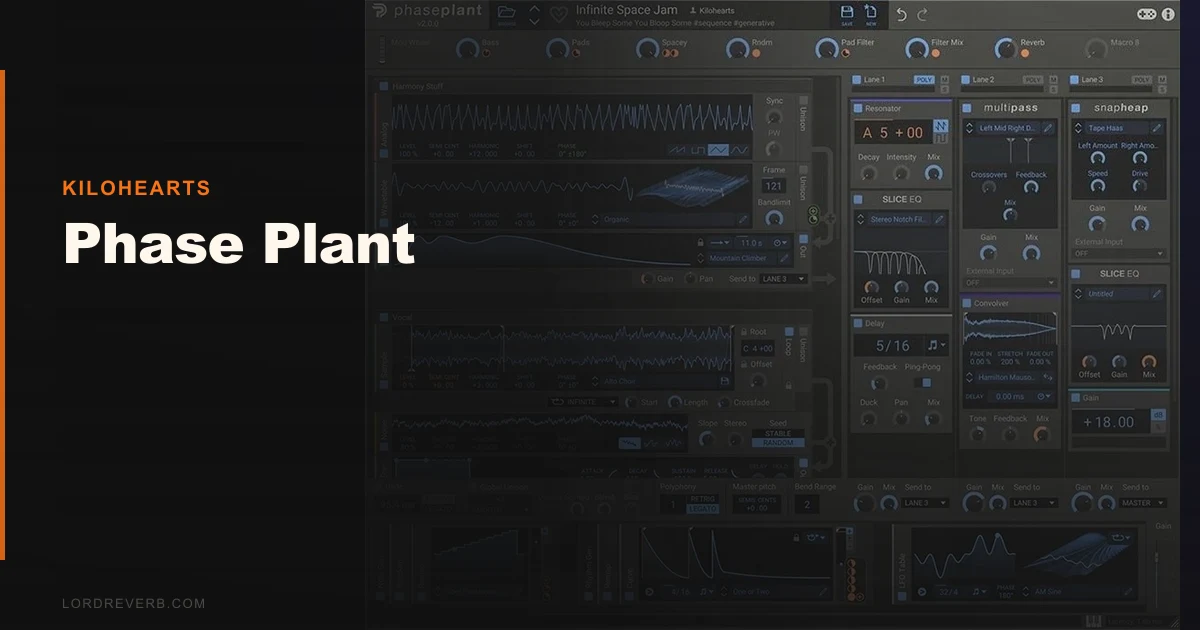
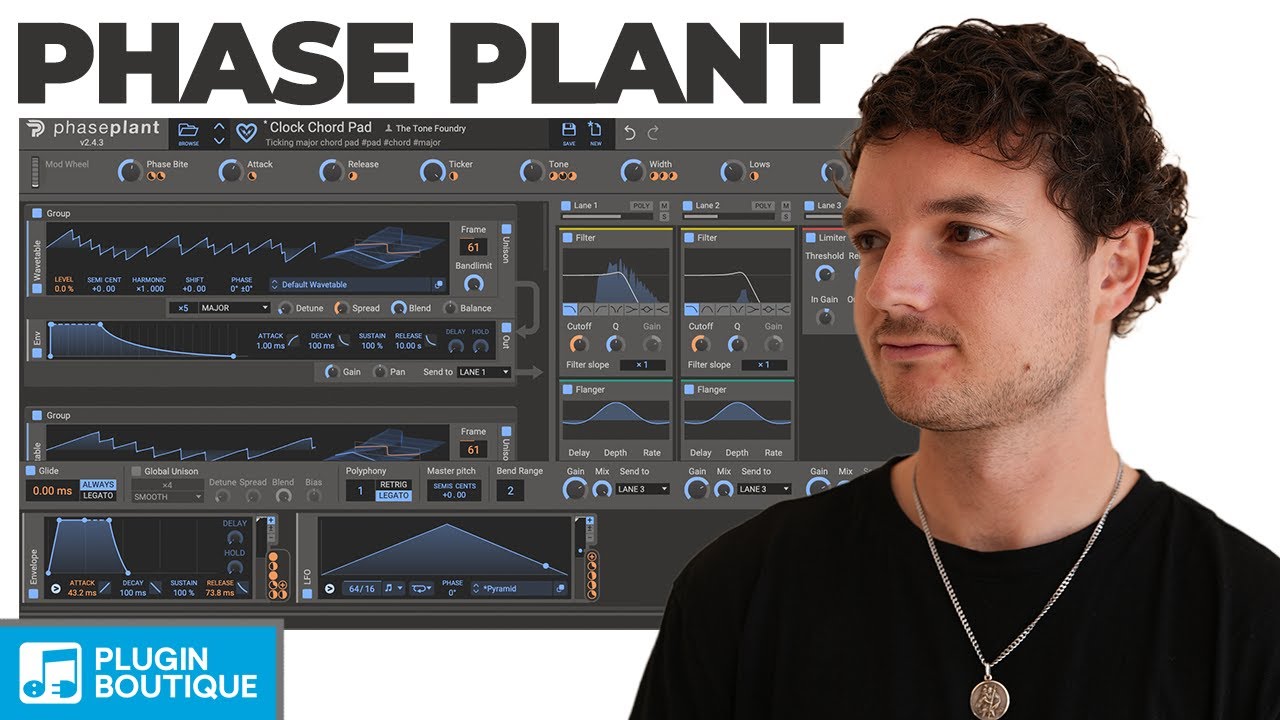
Opening Phase Plant for the first time, the UI lands somewhere between a modular patchbay and a very clean spreadsheet. It's organized into three vertical lanes: generators (your sound sources), modulators (your movement), and effects (your processing).
Everything snaps into place visually. Nothing is hidden behind a right-click menu you'd never find.
But there's no tutorial layer, no guided mode, no "here's what to do first." The 300+ factory presets help orient you. Clicking through them shows you what the architecture can do before you understand how it does it. We'd start there. Spend 20 minutes deconstructing three presets before you build anything.
Installation uses the Kilohearts license system through their app. Straightforward. No iLok. No offline activation drama.
Getting It Into a Real Workflow
Phase Plant runs as VST3, AU, and AAX. We tested it in Ableton Live 12 and Logic Pro. No issues in either. It showed up, it loaded patches, it didn't crash.
The first friction point is modulation routing. You connect modulators to parameters by dragging from a modulation source to a target knob. Clean idea. In practice, once you've got eight modulators active on a patch, the connection lines pile up and it becomes genuinely hard to track what's controlling what.
We wish Kilohearts had added a modulation list view, something that shows every active connection in a simple table. It's not there in v2.3.1.
The second friction point is CPU. A simple wavetable patch runs light. Add two granular generators with independent envelopes, then stack a convolution reverb in the effects lane, and your CPU meter moves. On a modern Apple M2, it's manageable. On an older Intel system, watch your buffer size.
For workflow purposes: Phase Plant rewards producers who build sounds before the session, then load finished patches. It's not the synth you improvise on mid-bounce.
What Phase Plant Is Genuinely Good At
The granular engine is the star. It handles position, grain size, spray, pitch randomization, and reverse playback independently, all modulatable in real time. We loaded a piano sample, reduced grain size to 40ms, modulated spray with a slow random LFO, and had a shimmer texture that sounded like a tape machine dreaming. That's a Friday afternoon experiment, not a two-day patch.
The wavetable engine supports 256 frames at 2048 samples per frame. For comparison: Serum's wavetable engine uses 2048 samples per frame but handles fewer simultaneous wavetable manipulations within the same patch architecture. Phase Plant lets you run multiple wavetable generators in parallel, each with independent modulation, which opens up timbral layering that's hard to replicate in a single-engine synth.
FM is done through the generator stack too. You drop an FM generator, point it at another generator as a carrier, and dial in the ratio and depth. It's not as deep as a dedicated FM synth like Dexed or FM8, but for adding FM character to a wavetable or granular source, it's brilliant and fast.
The modular synthesis approach explained is what separates Phase Plant from synths that just label themselves "modular." The architecture actually works that way. Generators feed into each other. Modulators affect anything. There's no hardwired routing you're fighting against.
The Rough Edges
The modulation UI is the biggest frustration. It's clever for simple patches and annoying for complex ones. The connection-line system works beautifully up to about six modulators. Past that, it gets messy fast, and there's no way to group or label connections.
There's no Eurorack-style step sequencer built in. If you want rhythmic modulation, you're building it from LFOs with manual step shapes or routing in from your DAW. It works, but it feels like a gap in an otherwise complete modular toolkit.
MPE support exists but isn't well documented. We had to dig through the Kilohearts forum to find out how to get polyphonic expression working correctly with an MPE controller. The feature is there. The onboarding for it isn't.
CPU with multiple granular generators plus effects chain is heavier than Serum running a comparable complexity patch. Not unworkable, but worth knowing before you stack four instances on a bus.
Who Phase Plant Is Really For
- ✅ Buy if you build sounds from scratch and want one synth that covers wavetable, granular, FM, and virtual analog without switching tools.
- ✅ Buy if you've hit the ceiling on Serum or Vital and want modular routing without buying hardware.
- ✅ Buy if you score to picture, make ambient music, or design sound effects and need textures that move on their own.
- ❌ Skip if you mostly tweak presets and don't want to learn a patching workflow.
- ❌ Skip if you're new to synthesis. Start with a simpler wavetable option and come back when you're comfortable with envelopes and LFOs.
- ❌ Skip if your system is running near capacity. The granular engine is CPU-hungry at higher polyphony and grain density.
Score Breakdown
| Category | Score | Notes |
|---|---|---|
| Sound Quality | 4.5/5 | Granular and wavetable engines produce textures no comparably priced synth matches |
| Value for Money | 4.5/5 | Five synthesis types in one plugin at the current sale price is hard to argue with. |
| Ease of Use | 3.0/5 | Semi-modular architecture has a real learning curve; no guided onboarding |
| Features | 4.5/5 | 256-frame wavetable, granular, FM, virtual analog, sample playback, and full modulation matrix |
| CPU Efficiency | 3.5/5 | Simple patches run fine; complex granular builds push the meter |
| Overall | 4.3/5 | Outstanding synthesis depth at a fair price, held back slightly by UI and CPU limitations at scale |
Alternatives to Consider
Serum by Xfer Records is the obvious comparison. It's more accessible, has a massive preset ecosystem, and the wavetable editor is faster to learn. We'd point preset-first producers toward Serum without hesitation. Phase Plant beats it on modulation depth and synthesis variety, but Serum wins on day-one usability.
Vital is free and covers wavetable synthesis with a visual modulation system that's actually easier to read than Phase Plant's. If budget is the issue, check our breakdown of wavetable synth options before spending anything. Vital might be all you need.
Loot Audio Zero 1 is a different beast, but if you want a synth that punches well above its price in a specific niche, it's worth a look before committing to a modular workflow you're not sure suits you.
Nothing at this price point replicates Phase Plant's combination of granular depth and semi-modular routing. If those two things matter to you, there's no real substitute at this price point.
On sale, Phase Plant is one of the most satisfying purchases in the plugin world for producers who want to build sounds, not browse them. At $199 regular price, it's still worth it if you'll actually use the architecture. If you mostly play patches other people made, this synth will sit mostly unused in your library, and that would be a waste of something this clever.
Frequently Asked Questions
Is Phase Plant good for beginners?
It's not ideal as a first synth. The semi-modular architecture assumes you already understand what an envelope does, how LFOs behave, and why routing signal order matters. If you're new to synthesis, start with something like Vital or SynthMaster One, build your foundational knowledge, and then come back to Phase Plant. You'll get far more out of it once those concepts are solid.
How does Phase Plant compare to Serum in 2026?
Serum wins on accessibility and preset depth. Phase Plant wins on modulation flexibility, synthesis variety, and the granular engine. If you're a sound designer building from scratch, Phase Plant is the stronger tool. If you spend most of your time tweaking factory patches, Serum's ecosystem is more useful day to day.
Does Phase Plant support MPE controllers?
Yes, MPE support is available in Phase Plant, but the documentation is thin. You'll get polyphonic expression working, but expect to spend time in the Kilohearts forum or knowledge base to configure it correctly. It's not a plug-in-and-play situation. The feature works once configured; getting there takes some digging.
Is the Kilohearts subscription worth it instead of buying Phase Plant outright?
The monthly subscription includes Phase Plant plus all Kilohearts Snapin effects and third-party expansion packs. If you're also interested in their snapin effects ecosystem, the subscription is better value than buying Phase Plant alone. If you only want the synth, the one-time purchase at sale price is the smarter call long-term.