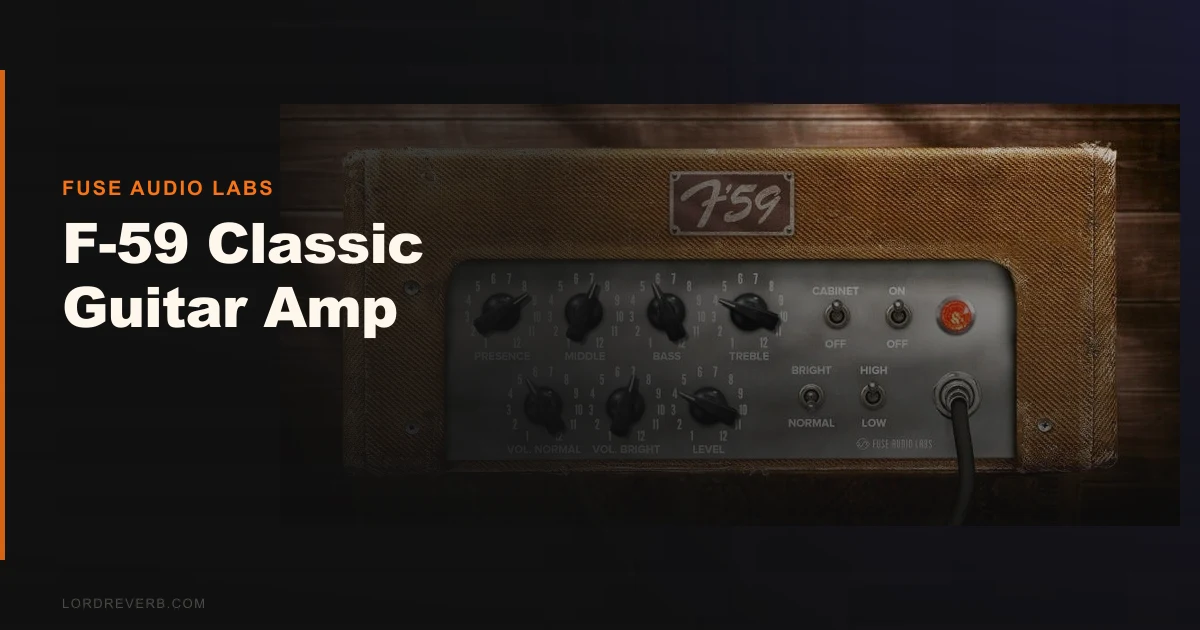
Getting a vintage Bassman tone ITB without spending four figures on hardware or a boutique amp sim is harder than it should be. Most free-to-cheap options either model the wrong era, skimp on the power amp stage, or hand you a cabinet sim that sounds like a cardboard box in a bathroom. Fuse Audio Labs’ F-59 Classic Guitar Amp aims directly at that problem. It’s a plugin emulation of the late-1950s Fender Bassman circuit that shaped early rock and roll, priced at $29. It runs in AAX, AU, VST2.4, and VST3 across both 32 and 64-bit systems. This review is for guitar producers, home studio engineers, and anyone who’s sat in front of a session file wishing they had a tweed tone that actually sits in a mix.
The Pain Point: Cheap Bassman Sims Sound Cheap
The 1958-60 Fender Bassman circuit is one of the most copied amp designs ever made. It’s also one of the most poorly emulated in the budget plugin tier.
The typical problem is phase. Cheap emulations model the preamp gain stage but miss the interaction between the tone stack network and the power amp section. You get something that looks like a Bassman on paper but sounds thin and stiff in practice.
Specifically, you lose the way the original circuit’s cathode follower feeds back into the tone controls. That feedback is what gives the Bassman its characteristic “sag” and musical compression. Without it, single-note lines in the 800Hz-2kHz range sound harsh and unpleasant.
The F-59 models the revision A presence filter feedback network explicitly. That’s a specific design choice, not a marketing line. We wanted to know if it actually translates.
How the F-59 Performs in a Real Session
We dropped the F-59 on a direct-in Telecaster track recorded clean at 24-bit/48kHz. No other processing in the chain. We wanted the plugin to carry the tone alone.
The Normal channel with the volume at about 60% and bass, mid, and treble set to noon gave us a clean Bassman tone that sat honestly in the low-mids. It wasn’t scooped like a Mesa clean, and it wasn’t glassy like a Vox. It sounded warm in the way that specific word means something: the 200-350Hz range had body, and the 3-5kHz presence sat slightly recessed compared to a modern clean tone. That’s the Bassman character.
Switching to the Bright channel and pushing the volume above 70% is where things got interesting. Single notes on the upper strings started to compress and bloom at the attack. We ran a riff in the key of A at 120 BPM. The pick attack hit first. Then the note body filled in behind it over roughly 15-20 milliseconds. That’s power amp sag behaviour. It’s satisfying to hear in a cheap plugin.
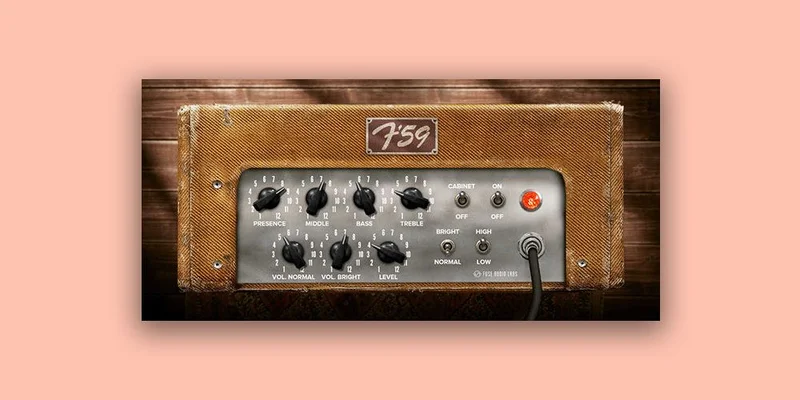
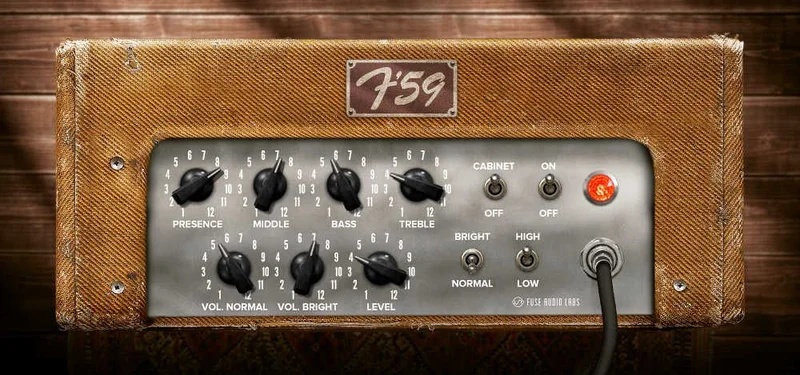
The four switches do real work. Cabinet on or off changes the high-frequency roll-off noticeably. Power on or off switches between full power amp emulation and a direct-out mode that’s useful if you’re running your own IR loader. The High/Low input switch changes input impedance, which affects pick attack response. The Normal/Bright toggle is self-explanatory.
We also tested the F-59 on a fretless bass DI, which is historically accurate to the original hardware. It added grit without killing the low-end definition. Below 100Hz stayed clear. That said, it’s not a bass plugin and it doesn’t pretend to be one.
Competing Bassman simulations in this price bracket are thin on the ground. Fender Tone Master Pro review is obviously a hardware unit at a completely different price point. For ITB comparisons, best amp simulator plugins covers more of the field. The F-59 holds up.
What We Love and What Annoys Us
The dual preamp channels with independent volume controls are brilliant. Most budget amp sims give you one channel and a gain knob. Having two channels here, each voiced differently, means you can blend or switch between clean and pushed sounds inside the plugin.
The revision A presence filter implementation is the real win. It keeps the high-end from becoming harsh when you push the gain. Upper harmonic content above 4kHz feels controlled rather than brittle.
What frustrates us: there’s no built-in IR loader. The onboard cabinet sim is decent, not great. If you want to use a third-party impulse response, you’re handling that outside the plugin. That’s an extra step that better-developed amp sims handle internally.
The preset library is thin. If you’re new to Bassman-era amp topology, you may spend 20 minutes dialling in something usable. That’s not a dealbreaker, but it’s annoying when a few well-chosen starting points could onboard a user in 90 seconds.
We also wish Fuse Audio Labs published CPU usage numbers. We ran it on a session with 24 other active tracks and experienced no hits on a 2021-era machine, but that’s one data point. We’d love a published benchmark. low CPU amp simulator plugins
Is the Price Justified?
At $29: yes, clearly. At $59 full price: still yes, but with less certainty.
The F-59 does a specific thing extremely well. If that specific thing is what
If it does what you need, the price is low compared to the next tier of amp sim plugins, which typically start higher for a similar level of circuit modeling specificity.
If you want a generalist amp sim that covers clean, crunch, hi-gain, and cab simulation in one plugin, there are better options at a similar price. The F-59 isn’t that. It’s a single-era, single-character tool.
Use the 14-day trial. That’s our honest advice. how to trial audio plugins before buying
Who Should Buy This (and Who Shouldn't)
✅ Buy if you record or produce music that benefits from 1950s-60s American clean and light-crunch tones. ✅ Buy if you’re building a plugin collection and need a Bassman-era voice at a low price. ✅ Buy if you already own a separate IR loader and want to run your own cabinets.
❌ Skip if you need a full-featured amp sim that covers multiple eras and styles. ❌ Skip if you want a built-in IR loader and don’t want to manage a second plugin in the chain. ❌ Skip if your productions don’t touch tweed-era sounds. This plugin won’t convert you.
Score Breakdown
| Category | Score | Notes |
|---|---|---|
| Sound Quality | 4.0/5 | Revision A feedback network gives genuine Bassman character; power amp sag feels real |
| Value for Money | 4.5/5 | $29-59 for this level of circuit specificity is hard to argue with |
| Ease of Use | 3.0/5 | Thin preset library slows onboarding; the four switches need explanation for new users |
| Features | 3.5/5 | Dual channels and four switches cover the circuit well; no IR loader is a real gap |
| CPU Efficiency | 3.5/5 | Ran cleanly in our tests; no published specs from developer |
| Overall | 4.1/5 | A focused, honest Bassman emulation at a price that makes the trial a no-brainer |
Alternatives to Consider
If the F-59 doesn’t quite fit, here are three directions worth considering.
Fender’s own software offerings cover more territory but often at higher cost. They’re worth looking at if you want brand-endorsed tones. Fender amp simulator plugins compared
IK Multimedia AmpliTube Fender Collection includes Bassman models alongside other Fender circuits. It costs more but gives you a broader palette if one-era tools aren’t your workflow. AmpliTube Fender Collection review
Neural DSP Archetype series won’t give you a Bassman, but if you’re reconsidering your amp sim setup entirely, they represent the current ceiling for circuit modeling accuracy in the plugin space. Neural DSP plugins reviewed
The F-59 sits below all of these in price. If your need is specifically tweed-era American tone and you’re not building a comprehensive collection, it’s the focused option.
The F-59 is a plugin that knows exactly what it is. It’s not trying to replace your amp sim collection. It’s offering one circuit, modeled carefully, at a price where the trial costs you nothing but 20 minutes. If tweed sounds are in your sessions, load it up. If they’re not, it won’t change that. Buy it for what it does. Skip it for everything else.
Frequently Asked Questions
Is the F-59 Classic Guitar Amp based on a real amplifier?
Yes. It's modeled on the late-1950s Fender Bassman circuit, specifically the 4x10 tweed version that became a reference amp for early rock and roll and blues. The plugin models the revision A presence filter feedback network, which is a specific electrical characteristic of that era's design. It's not a generic "vintage tone" approximation.
Can the F-59 be used on bass guitar as well as electric guitar?
Yes, and that's historically consistent. The original Bassman was designed for bass before guitarists discovered how well it responded to six-string playing. We tested the F-59 on fretless bass DI and found the low end stayed defined below 100Hz while adding useful upper harmonic grit. It won't replace a dedicated bass amp sim, but it handles the task.
Does the F-59 include cabinet simulation or do I need a separate IR loader?
It includes onboard cabinet simulation via a switch on the interface. The sim is decent at controlling high-frequency response, but it's not as detailed as a quality third-party impulse response. If you turn the cabinet switch off, you can run your own IR through a separate loader. Fuse Audio Labs doesn't include an IR browser inside the plugin itself.
What formats does the F-59 support and is there a free trial?
The F-59 runs in VST2.4, VST3, AU, and AAX, covering both 32-bit and 64-bit systems. That means it works in Pro Tools, Logic Pro, Ableton Live, Cubase, Studio One, and most other current DAWs. A 14-day full trial is available directly from Fuse Audio Labs, which gives you enough time to run it on real sessions before you decide.