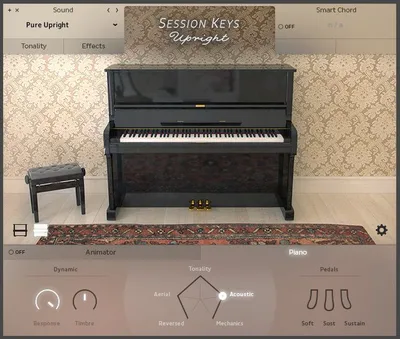
Session Keys Upright beats the 8Dio 1901 Upright on workflow speed and sound-design depth, but it doesn't touch Native Instruments' Gentleman on raw acoustic realism. That's the honest frame for this review, and it's where the purchase decision lives.
e-instruments built this for producers who need an upright that does things. Not a museum piece. Not a concert hall replica. A working instrument with character baked in and tools to push it further without leaving the plugin.
It targets the producer who would otherwise layer a basic piano sample with three separate plugins. If that's you, keep reading.
How It Compares Out of the Box
Load Session Keys Upright next to the 8Dio 1901 Upright and the first thing you'll notice is that e-instruments made two distinct choices on tone. The "Open" instrument has a spatial stereo sound with individual notes intentionally detuned, creating a chorus-like effect when combined. "Closed" targets a modern, intimate, and perfectly tuned piano: direct, focused, and edgy.
The 1901 skews heavily atmospheric. Its lo-fi, aged tone is brilliant for one specific job. Session Keys Upright gives you two distinct sonic starting points before you've touched a single effect.
Against the NI Gentleman, the gap is different. The Gentleman has more dynamic nuance in the upper registers and more convincing room sound at low velocities. Session Keys Upright doesn't pretend to compete there. It wins on flexibility, not on acoustic purity.
This piano works well in pop and rock but is equally at home in hip-hop and scoring, cutting through the mix with clear tones and stacks of personality.
Performance Deep Dive
The sample library sits at 40GB uncompressed, 20GB with lossless compression applied. Audio quality is 24-bit, 44.1 kHz throughout. Those are solid fundamentals. The compression option is the practical choice for most drives without a sound quality trade-off.
We loaded the Closed preset into Kontakt 5 inside Logic Pro X on an M1 MacBook Pro. Initial load time sat around 22 seconds with the full library purge off. With purge on, load drops to about 4 seconds and RAM usage falls to under 600MB, though you'll hear a brief stutter on first note triggers per register. Annoying on stage, fine in the studio.
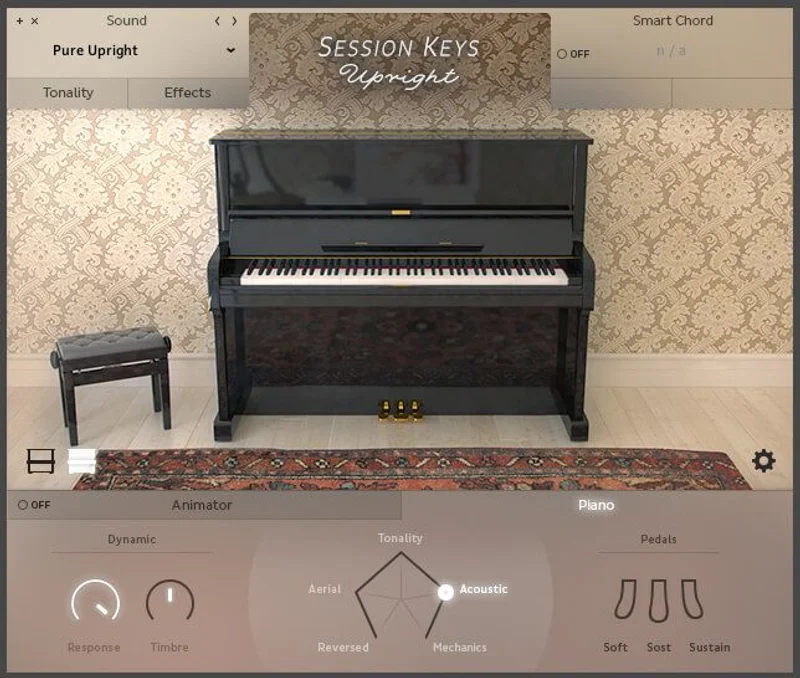
The effects section includes a 3-band EQ, a Color function for sonic colouration, a convolution reverb, a compressor, stereo width control, and a delay. The Color function's 22 presets range from analogue outboard gear emulations and classic channel strips to heavily alienating effects. That's a complete signal chain inside one instrument instance.
We ran the Open piano through the Color section with the analogue channel strip preset engaged at 40% intensity. The low-mid presence around 250Hz thickened noticeably. Pulling it back to 20% and hitting the convolution reverb with a short room IR kept the upright in its lane without washing out the 2-5kHz "plink" that makes this instrument identifiable.
The Animator offers over 400 flexible piano phrases that follow your harmonies. The pitch bend and modulation wheels control complexity and dynamic, essentially turning it into a session partner. CPU overhead with Animator running stays moderate. On an older Intel Core i7 at 128-sample buffer, we saw around 14-18% CPU on the Kontakt instance. Liveable.
Where It Wins
The Pentamorph is the thing nobody talks about enough. This pentagonal controller transforms the sound from normal piano to eerie atmospheres to pure mechanical sounds and back. By the time you're done, no one will even know it's a piano. Instant flexible control in a single knob.
We were building a scoring cue that needed a piano intro that dissolved into something more textural. We dragged the Pentamorph from 9 o'clock toward the mechanical corner over 8 bars. The decay character shifted from recognizable upright to something more percussive and hollowed-out. No automation of five separate plugin parameters. One knob, done.
That's where Session Keys Upright pulls clearly ahead of the 1901 and the Gentleman. Neither of those gives you in-instrument morphing at that speed. If you're a composer who sketches fast, this matters.
Smart Chord Mode lets you trigger full chords or Animator riffs from single keys or pad controllers. Just set the key of your song and it creates the chords. Underrated feature for producers who play melodies but want harmonic movement without stopping to program it.
Where the Competition Wins
The NI Gentleman wins on realism. Full stop. Its velocity response below MIDI 40 has a softness this instrument doesn't replicate. If you're writing classical piano music or solo acoustic arrangements where the listener is expecting a real room, the Gentleman is the more honest tool.
The 8Dio 1901 wins on aged character. If you need a piano that sounds like it's been sitting in a forgotten parlour for 80 years, that library has it dialled into the samples themselves, not approximated through an effects preset.
Session Keys Upright's Kontakt 5 dependency is also a frustration we can't ignore. In 2026, with Kontakt 7 pushing forward and the NI ecosystem shifting, you're relying on a Player engine that's showing its age. Load management, NKS integration aside, it's not the most DAW-agnostic experience.
There's also no streaming mode for the full 40GB library. That 20GB compressed option helps, but you're still committing serious SSD real estate compared to something like Spitfire's streaming-first instruments.
Who Should Buy Which
- ✅ Buy if you produce pop, hip-hop, or film scores and want one upright instrument that handles both tracking and sound design without leaving Kontakt.
- ✅ Buy if the sale price catches you. At that price point, the value argument is easy.
- ✅ Buy if you use NKS hardware. The NKS integration includes optimal parameter assignment and Light Guide feedback on Komplete Kontrol keyboards. That's genuinely useful at a keyboard in front of you.
- ❌ Skip if you need acoustic realism above all else. The Gentleman or even a well-sampled Yamaha U1 library will serve you better.
- ❌ Skip if your SSD is already stressed. 20GB minimum is real, and the full 40GB rewards a dedicated sample drive.
- ❌ Skip if you're on Kontakt 7 only and don't want to maintain a Kontakt 5 Player install alongside it. The compatibility friction is real.
Score Breakdown
| Category | Score | Notes |
|---|---|---|
| Sound Quality | 4.0/5 | Two distinct voices with real character; not the most acoustically accurate, but satisfying in a mix |
| Value for Money | 4.5/5 | On sale this is a near-automatic recommendation, and at full price it is still fair for the tool set. |
| Ease of Use | 4.0/5 | Pentamorph and Smart Chord are intuitive; the Kontakt 5 ecosystem adds friction for new users |
| Features | 4.5/5 | 400+ Animator phrases, 22 Color presets, 25 reverb IRs, Pentamorph: genuinely well-stocked |
| CPU Efficiency | 3.5/5 | Medium load with Animator; older Kontakt 5 engine doesn't optimise for modern silicon as cleanly |
| Overall | 4.1/5 | A clever upright instrument that earns its price with production tools the competition doesn't bundle |
Alternatives to Consider
Native Instruments Gentleman is the right call if acoustic realism is your priority. It costs more, but the dynamic range and room behaviour at low velocities are in a different tier. If you're writing solo piano pieces, go there. For session work where the upright sits under a vocal or a beat, Session Keys Upright holds its own. See also how NI approaches session instruments in our Session Guitarist Acoustic Sunburst Deluxe Still Leads 2026.
8Dio 1901 Upright beats this on vintage, broken-in character. If you specifically need a piano that sounds like it's been through three decades of neglect, 1901 has it. It doesn't have the Pentamorph, the Animator, or the Smart Chord system. Great library. Narrower use case.
Spitfire Audio LABS Upright Piano is free and worth having as a comparison point. It sounds clean and loads fast. It's also the most stripped-back option possible. Session Keys Upright wins the moment you need more than a straightforward note-for-note piano track.
If you want to understand how real session instrument libraries approach playability, our Can Session Guitarist Picked Nylon Replace a Real Guitar? is worth reading alongside this review. For broader context on what session-ready virtual instruments look like in 2026, check our Ample Ethno Ukulele Review 2026: Full Session Verdict. And if you're building out a full production rig alongside this, our BFD Player Expansion Vintage Rock 2026: Session-Ready Drums pairs well with an upright piano library for rootsy or organic production contexts.
The Bottom Line
Session Keys Upright is a producer's upright, not a purist's upright. That's not a criticism. That's exactly what e-instruments built.
The Pentamorph alone makes this worth picking up on sale. The two-voice system gives you a chorus-width character and a focused modern tone in one package. The Animator runs 400+ phrases that actually follow your harmonic changes. The built-in effects chain means you're not hopping between plugins to get a usable sound.
We'd skip it if you need the most acoustically convincing upright in the world. We'd also skip it if your SSD situation is already dire and a 20GB minimum installation puts you over the edge.
But if you write pop, hip-hop, or scoring cues and you want an upright that's ready to work the moment you load it? Buy it at $99. Absolutely buy it at $99. Just make sure you've got the drive space, because that's the one cost the price tag doesn't warn you about.
Frequently Asked Questions
Do I need the full version of Kontakt to run Session Keys Upright?
No. Session Keys Upright is compatible with the free Kontakt 5 Player or Kontakt 5 version 5.6.8 or higher. You don't need a paid Kontakt licence to run it. That said, the free Player locks you out of certain Kontakt browser features and time-limits unlicensed instruments after 15 minutes, so confirm your licence status before a session.
What's the actual difference between the Open and Closed piano sounds?
Open delivers a spatial stereo character with individual notes intentionally detuned to create a chorus-like effect when combined. Closed is a modern, intimate, and perfectly tuned piano: direct, focused, and edgy. In practical terms: Open sits wide in a mix and works well under reverb-heavy productions. Closed cuts through in drier, more punchy arrangements.
Does the Animator lock me into specific tempos or keys?
The Animator offers over 400 flexible piano phrases that follow your harmonies. You can use the pitch bend and modulation wheels to increase or decrease complexity and control the dynamic. Phrases sync to your DAW's tempo via Kontakt's MIDI clock, and the Smart Chord system handles key-following, so you're not fighting the instrument to use it in your session's context.
Is 20GB enough if I use the lossless compression option, or do I need the full 40GB?
The library is 40GB uncompressed or 20GB with lossless sample compression applied. Lossless compression means there's no degradation in audio quality, just a smaller footprint. The 20GB version is what we'd recommend for most users. If you're on a fast NVMe drive, you're unlikely to hear any difference in loading or playback performance between the two.