We loaded a thick electronic bassline into Voltage Modular, dropped the PSP GEQ10 into the chain, and immediately heard what PSPaudioware does well: surgical without being sterile. Pulled 3dB at 250Hz, Q tight, and the mud cleared without that hollow plastic sound you get from generic modular EQ modules. That moment was good. What came next was the reality check: we’d spent 20 minutes just getting the environment configured before we could hear a single note. That setup friction colors everything about this collection.
The PSP Studio Modular Collection is a 3-module bundle for Cherry Audio’s Voltage Modular platform. It’s built for producers who want PSP’s processing quality inside a modular workflow, and it does deliver that quality. But it asks a lot in return.
What It Is (and What It's Not)
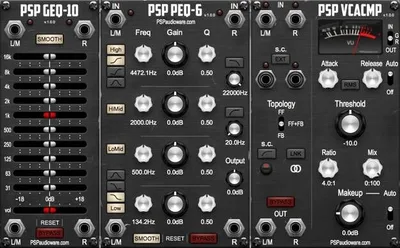
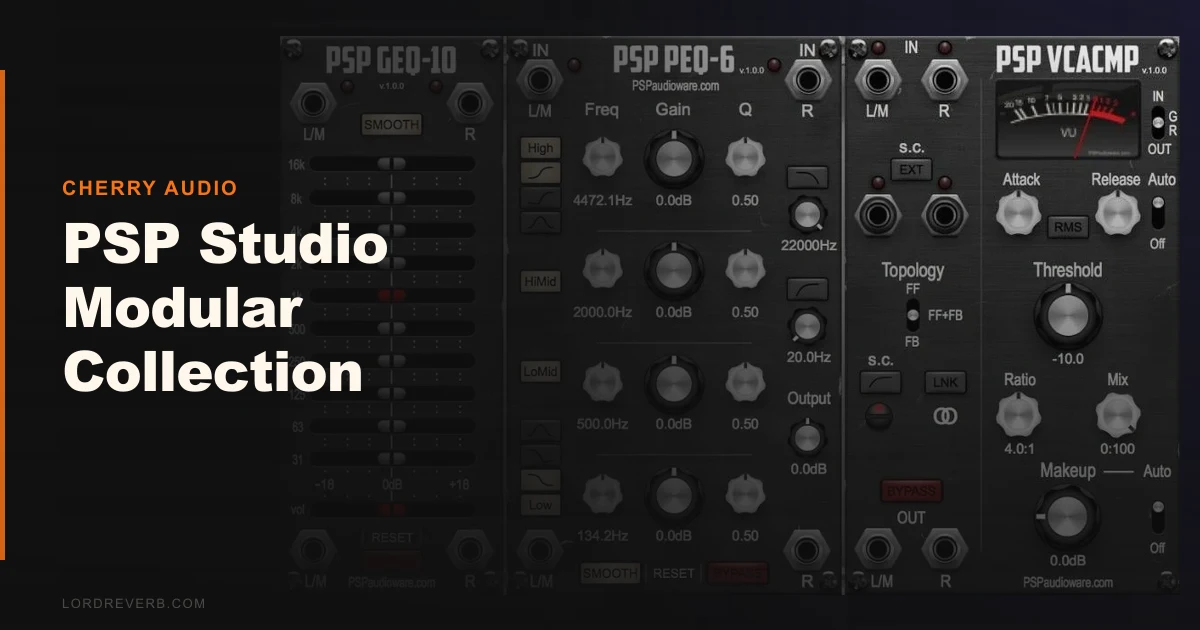
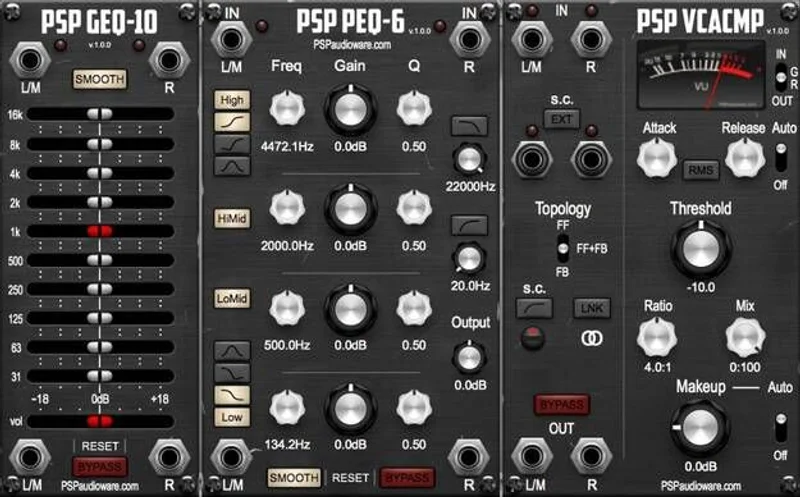
The bundle contains three modules: a VCA-style compressor, the PSP GEQ10 (10-band graphic EQ), and the PSP PEQ6 (analog-style parametric EQ). All three run 64-bit double precision math at sample-level operation with zero latency.
It is not a standalone plugin. It doesn’t show up in your DAW’s plugin folder. It lives entirely inside Cherry Audio’s Voltage Modular, which means your signal chain runs through a modular environment before it hits your session.
This is not for producers who want to slot a quality EQ onto an insert and move on. It’s for people already committed to modular-within-DAW workflows, or those building hybrid synthesis rigs inside Voltage Modular. If that’s not you, browse our standard EQ plugin recommendations and save yourself the detour.
Living With It
Setup takes longer than it should. You install Voltage Modular first, launch it as a plugin inside your DAW, then purchase and install the PSP modules through Voltage Modular’s in-app browser. The automatic installation works cleanly once you’re inside, but the path there involves three separate accounts and two pieces of software before you’ve touched a single knob.
Day-to-day, the GEQ10 is the workhorse. Ten bands, fixed frequencies, and that Smooth mode is the reason to own this bundle. Smooth mode rounds the band curves, softening the transitions between EQ points in a way that mimics analog shelving behavior. We ran a drum bus through it with a 2dB boost at 10kHz, Smooth engaged. The air came up without the top end going brittle. That’s satisfying.
The PEQ6 handles four fully parametric bands plus high and low shelves. We found it most useful on synth pads and electronic bass. On acoustic material, it felt slightly thin compared to what we’d reach for in a standard DAW context.
The VCA compressor is the least exciting module of the three. It does its job. Attack and release respond predictably. We noticed maybe 2-3ms of softness on transient hits that some producers will love and others will find frustrating. It doesn’t have the character of PSP’s standalone compressor plugins.
We ran all three in series on a subtractive synth lead. The signal stayed clean through the whole chain. No aliasing, no pumping artifacts. The 64-bit processing shows.
The Trade-Offs
The honest trade-off here is convenience versus quality path. PSP’s processing quality is real. These modules sound better than most of the free and budget modular EQ options floating around the Voltage Modular store. That matters if you’re building a modular chain and want professional-grade processing at each stage.
But the price stings when Cherry Audio’s own native modules are strong, and when PSP’s Ultimate Modular Collection bundles 30-plus modules for a larger but better-value sum. The math on the Studio Collection only works if you genuinely need exactly these three processors and nothing else.
There’s also the workflow tax. Every time you want to use these modules, you’re working inside a virtual modular environment. Patching cables, managing module positioning, routing audio in and out of Voltage Modular. For producers who love that process, this is a feature. For everyone else, it’s friction added to tasks that a standard plugin handles in two clicks.
We wish the VCA compressor had more character. For the price, we’d love a saturation knob or a selectable detector mode. It works, but it doesn’t inspire.
Against the Field
If you’re inside Voltage Modular and want PSP quality, the Studio Collection makes sense. But look at the alternatives before buying.
Cherry Audio’s own native modules cover a lot of this ground at lower cost, and some are free. They won’t match the GEQ10’s Smooth mode, but they’re close enough for most mixing tasks.
The PSP Ultimate Modular Collection gives you 30-plus modules at a higher price point. If you’re goin g to commit to PSP inside Voltage Modular, that’s the smarter buy. The Studio Collection is an expensive stepping stone.
Outside Voltage Modular entirely, FabFilter Pro-Q 4 gives you more precise, more flexible EQ in a standard plugin format for around the same money, with zero platform dependency. If your question is “what’s the best EQ for my mix?” the answer isn’t locked behind a modular environment.
Graphic EQ plugin roundup
The Real Verdict
Buy the PSP Studio Modular Collection if you’re already working inside Voltage Modular and want the GEQ10’s Smooth mode in your modular chain. That one feature is genuinely clever and earns most of the asking price on its own.
Skip it if you’re not already a Voltage Modular user. The platform dependency is too high a cost for three modules.
Skip it if you’re comparing prices and already know you’ll want more PSP tools. The Ultimate Collection makes the Studio Collection irrelevant.
It’s a narrow use case. PSP delivers quality. The format limits who that quality actually serves.
Score Breakdown
| Category | Score | Notes |
|---|---|---|
| Sound Quality | 4.0/5 | 64-bit precision processing is clean; GEQ10 Smooth mode is the highlight |
| Value for Money | 2.5/5 | Three modules is hard to defend against the Ultimate Collection's much larger bundle |
| Ease of Use | 2.5/5 | Setup friction is real; intuitive once inside Voltage Modular but getting there takes effort |
| Features | 3.0/5 | GEQ10 and PEQ6 cover useful ground; VCA compressor lacks character |
| CPU Efficiency | 3.5/5 | Zero-latency, runs light on modern hardware |
| Overall | 3.6/5 | Quality audio processing let down by platform lock-in and questionable bundle value |
Alternatives to Consider
If the Studio Collection doesn’t fit your workflow, here’s where to look instead.
PSP Ultimate Modular Collection review, If you’re committed to PSP inside Voltage Modular, spend a little more and get 30-plus modules. The Studio Collection’s value disappears once you see what the Ultimate bundle offers.
FabFilter Pro-Q 4 review, The benchmark ITB parametric EQ. No platform dependency, more bands, better workflow for standard DAW sessions. Around the same price.
Best graphic EQ plugins 2026, If the GEQ10 caught your eye but the Voltage Modular requirement put you off, this roundup covers standalone graphic EQ options that drop straight onto any insert.
The PSP Studio Modular Collection’s GEQ10 Smooth mode is genuinely underrated. But you’re paying $60 to access it inside a specific software environment, and that’s a tax most producers shouldn’t pay.
If you’re in Voltage Modular daily, buy it. If you’re not, it won’t change that.
Frequently Asked Questions
Do I need to buy Cherry Audio Voltage Modular to use the PSP Studio Modular Collection?
Yes. The PSP Studio Modular Collection only works inside Cherry Audio's Voltage Modular software. The good news is that Voltage Modular itself is free to download. You'll need to install it, create a Cherry Audio account, and then purchase and install the PSP modules through the in-app store before you can use them in your DAW.
What's the difference between the PSP Studio Modular Collection and the PSP Ultimate Modular Collection?
The Studio Collection includes 3 modules (VCA compressor, GEQ10 graphic EQ, PEQ6 parametric EQ) for $60. The Ultimate Modular Collection bundles 30-plus PSP modules for a higher price. Unless you specifically want only these three processors, the Ultimate Collection is the better value by a wide margin.
Is the PSP GEQ10 Smooth mode the same as analog EQ emulation?
Not exactly. Smooth mode softens the transition curves between EQ bands, which produces a result closer to how analog graphic EQs behave compared to a brick-wall digital graphic EQ. It reduces inter-band phase interactions and rounds the shelving behavior at band edges. It's a convincing approximation, not a circuit-level emulation of a specific hardware unit.
Can I use the PSP Studio Modular Collection on a live monitoring path without latency issues?
Yes. All three modules operate at zero latency with sample-level processing. The 64-bit double precision architecture means no buffering delay introduced by the modules themselves. Your total monitoring latency will still depend on your audio interface buffer settings and DAW configuration, but the PSP modules won't add to that number.