
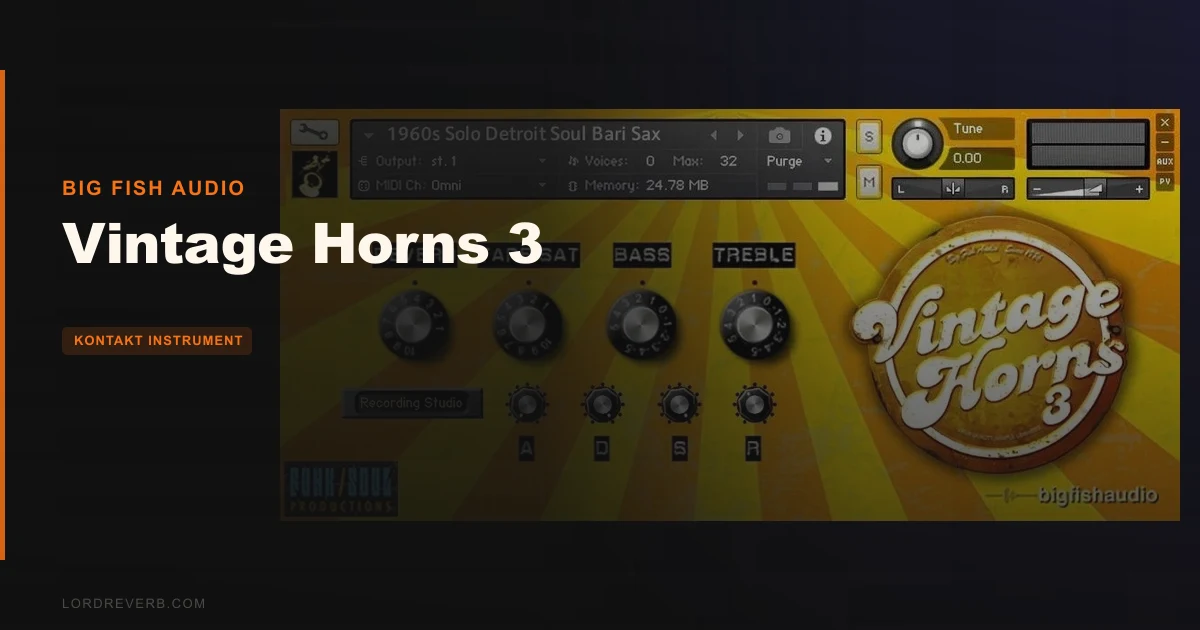
Vintage Horns 3 is the brass and woodwind library to buy when you want records that actually sound like records, and it earns that position at $199.95 by doing something most horn libraries refuse to do: leaving the imperfections in.
If your production needs horns that sit in the mix the way a Motown session date did, or a J.B.'s rehearsal tape sounds, this is the library built for that job. It runs inside Kontakt 7 Player (free) or full Kontakt 7, covers 17 instruments from a 1930s C Melody Tenor Sax to a 1970s growling Cuban Mambo trumpet, and ships with its own reverb, tape saturation, EQ, and ADSR controls.
At $199.95 it sits in serious-money territory for a Kontakt library. This review is going to tell you whether that price is justified, who it's right for, and who should walk away.
What You're Actually Getting
Vintage Horns 3 is a multi-sampled Kontakt 7 instrument library with 17 brass and woodwind instruments. Not 17 variations of the same trumpet. Seventeen distinct instruments, each built around a specific era, region, and real-world player.
You get saxophones across four types (alto, tenor, bari, soprano, and a C Melody), two trumpets with mute variants, two trombones, flugelhorn, flute, and clarinet. Each instrument has its own articulation set accessed via key-switches: Sustain on B, Staccato on Bb, Stab on A, Falloffs on Ab, and Doits on G.
The interface gives you convolution reverb pulling from 15 vintage recording spaces, a tape saturation knob, bi-polar Bass and Treble controls, and a full ADSR envelope. That's a usable signal chain without touching another plugin, which matters when you're trying to stay in the session and keep the vibe alive.
The library installs at approximately 3.5GB and asks for 4GB RAM minimum. Mac users need OS 12 or higher on Intel Core i5 or Apple Silicon. Windows requires Windows 10 or higher on equivalent CPU hardware. It supports VST3, AU, AAX Native, Standalone, and NKS. The free Kontakt 7 Player is enough to run it.
The Instrument List: What Each One Is Actually For
This is where Vintage Horns 3 pulls ahead of generic brass libraries. Every instrument here is tied to something specific. These aren't just "alto sax" and "trumpet." They're named, sourced, and built around real players and real sessions.
The Saxophones
The 1970s Solo R&B Alto Sax is the David Sanborn instrument. If you've spent any time with 70s soul records and tried to get that breathy, wide-vibrato alto tone, you know exactly why this exists. The Vintage Bebop Alto Sax aims at Charlie Parker's articulation and attack. Two very different altos. Both valid. The choice between them is stylistic, not technical.
The Grungy Solo Rock 'N' Roll Tenor Sax pulls from Jr. Walker, King Curtis, and Bobby Keys. That's a specific sound: hard-blown, slightly distorted, the kind of tenor that sounds like it's about to fall apart and never does. Put it on a honky-tonk rhythm track and push the Tape Saturation. That's where the grit lives.
The Soul Jazz Tenor Sax is modeled after Eddie Harris and comes with altissimo effects, meaning you get the upper-register squeals and overtones that define that late-60s electric jazz sound. The Jazz Fusion Soprano Sax draws from Grover Washington Jr. and Wayne Shorter. The 1960s Soul Jazz Flute is the one with flutter-tongue and sung-flute samples, the kind of detail that makes a Philly soul breakdown feel real.
And then there's the 1960s Solo Detroit Soul Bari Sax, inspired by Mike Terry, who played on more Motown records than most people can name. Deep, punchy, slightly growling low-end bari. If you're building a Motown-style arrangement and your bass needs company, this is the one.
The Trumpets
Three trumpets, all different. The Soul Jazz Trumpet pulls from Lee Morgan, Nat Adderley, and Benny Bailey. The Vintage Jazz Trumpet is Harry James territory: big, brassy, vibrato-forward. The Vintage Plunger Vibrato Trumpet is inspired by Bubber Miley and King Oliver, which puts it in early New Orleans jazz and Ellington-era big band sounds.
The Vintage Cuban Mambo Band Growling Trumpet is the one that earns its own listing. Wah-wah cup mute, growling tone, designed for Latin horn charts. If you're building a mambo or salsa arrangement and need a trumpet that sounds like it's playing inside a tin cup, that instrument is not an accident. It's that sound, built to order.
The Trombones and Everything Else
Two trombones with sharp personalities. The New Orleans Trombone draws from the Preservation Hall Brass Band tradition: loose, live, room-sounding. The R&B Trombone is Fred Wesley. As in, the man who played trombone for James Brown and Parliament-Funkadelic. That's a dry, punchy, syncopated trombone built for funk horn section work, not orchestral swell.
The Soul Ballad Flugelhorn pulls from Greg Adams and Mic Gillette of Tower of Power. Warm, round, slightly melancholy. The kind of flugelhorn that works on a slow jam or a mid-80s soul ballad. The New Orleans Clarinet covers Sidney Bechet, Benny Goodman, and Barney Bigard. That's the full spectrum of New Orleans and swing-era clarinet in one patch.
The Vintage C Melody Tenor Sax is the real outlier: warm, wide-vibrato, 1930s big band character. The C Melody sax is a mostly defunct instrument by today's standards, but its tone on pre-war recordings is unlike any modern tenor or alto. This instrument alone earns its place for producers building jazz-era period pieces.
The Controls: How the Interface Actually Works
The interface is stripped back. That's not a complaint. Too many Kontakt libraries bury their controls under tabbed menus that interrupt the flow. Vintage Horns 3 keeps the important controls visible.
Key-Switch Articulations
Five articulations per instrument via key-switches. Sustain on B gives you held, legato notes. Staccato on Bb cuts them short. Stab on A is harder, more accented. Falloffs on Ab add the pitch drop at the end of a note that defines horn phrasing on soul records. Doits on G give you the upward pitch rise before or on a note.
Falloffs and Doits are the ones that matter most for authenticity. Any library can do sustain and staccato. The ability to trigger a falloff exactly where you want it in a piano roll is what separates a convincing horn line from a MIDI-sounding approximation. Map them to pads if you're programming live, or drop them in on specific note endings during editing.
ADSR Envelope
Standard Attack, Decay, Sustain, Release. The Attack knob is what shapes whether a note has the slow bloom of a held ballad note or the snap of a staccato stab. Pull the attack back on the Soul Ballad Flugelhorn and the note sneaks in the way it would on an album track. Push it up on the Rock 'N' Roll Tenor Sax and it punches through a dense rhythm section.
Release matters for tail behaviour. Short release on staccato playing keeps notes clean. Longer release lets the natural room decay breathe. The ADSR isn't doing anything unusual here, but having it front-and-centre means you're adjusting it in the moment rather than going to find it.
Bi-Polar Bass and Treble
These are boost-or-cut controls, not just shelves that add. Pull the Bass down on the Grungy Tenor Sax and it thins out. Push it on the R&B Trombone and the bottom end fills up. The Treble knob is where the air and edge live: boosting it on the 1970s Solo R&B Alto Sax gets the upper-register presence forward. Cut it on the Vintage C Melody Tenor Sax and it settles further back in the mix.
These controls are broad strokes. They're not a surgical EQ. For fine shaping you'll still want a parametric EQ on the channel. But for getting the instrument to sit in the right ballpark without leaving the patch, they work.
Tape Saturation
This is one of the cleverer inclusions. The tape saturation control isn't just adding harmonic distortion for effect. It's recreating the slight compression and warmth that happens when horn recordings hit tape, especially older tape running at slower speeds. Push the drive on the Cuban Mambo trumpet and the top end gets grittier. Use it gently on the New Orleans Clarinet and it softens the transients to sound like a 78 RPM recording rather than a bright digital sample.
It's a single knob. There are no settings for tape speed or saturation character. What you get is a useful range from clean to noticeably coloured. For deeper tape emulation you'd reach for a dedicated plugin. For dialling in the vintage vibe quickly, the built-in control is satisfying to use.
Convolution Reverb: 15 Vintage Spaces
Fifteen convolution reverb presets covering vintage recording spaces. Not generic hall and room patches. Spaces designed to match the kind of rooms these instruments were recorded in historically.
If you're building a Motown-style track and you drop the Detroit Soul Bari Sax into a tight, slightly boxy room reverb rather than a bright modern hall, the instrument sits in the arrangement the way the original recordings did. That specificity is what this reverb section is built for. You won't be using these on drums or synths. They're here to make the horns feel like they belong in an era, and they do that job well.
The reverb is a bonus, not a replacement for a dedicated reverb plugin on your bus. For a deeper look at reverb tools for vintage productions, the library's own reverb is a starting point you'll augment rather than rely on exclusively.
The Good
The instrument sourcing is brilliant. The decision to tie every instrument to specific players and eras isn't just marketing copy. It shapes what the samples actually sound like. The Charlie Parker alto and the David Sanborn alto are not the same instrument with different names. They behave differently in a mix because they were recorded differently, and that's the whole point.
The style-based programming is what makes this library underrated in conversations about brass instruments. The regional and era-specific grouping means you're not hunting for the right sound across dozens of generic patches. The Philly soul instruments sound like Philly soul. The Detroit patches sound like Motown. That's not something you can fake with a generic trumpet and some EQ.
The onboard signal chain is genuinely useful. Reverb, saturation, EQ, and ADSR in one interface means you're shaping the character of the instrument without breaking the creative moment to go hunting for plugins. For a producer who wants to stay in the arrangement view and move fast, that matters.
Owners report the sounds are realistic and bring authenticity to projects in ways that expand what brass virtual instruments can do. That's the kind of feedback that points to a library doing its job.
The Not-So-Good
The intentional imperfections are a deliberate design choice, not a flaw. But they will frustrate you if you expected a clean, correctable library. Loose tuning, honking, squawking, warbling, slurred notes: these are baked into the samples. You can't tune them out with a pitch correction plugin without destroying the character that makes them work.
If your session is running through a highly produced, modern pop arrangement and you want pristine, pitch-stable brass that sits perfectly in tune with everything else, Vintage Horns 3 is the wrong tool. This is not the library for that session. Full stop.
The Kontakt 7 dependency is annoying if you don't already own it. The free Kontakt 7 Player handles it, but it's still a separate install, a separate piece of software to manage, and an additional layer between you and making music. For anyone new to the Kontakt ecosystem, the setup friction is real.
Earlier versions of Vintage Horns reported issues with dramatic dynamic layer jumps and a lack of round robins; version 3's status on these points is worth checking in a demo. It's not confirmed whether version 3 has resolved these specifically. That's worth checking in a demo before committing at $199.95.
3.5GB isn't a huge install by today's standards. But if your sample drive is already packed, it adds up. Factor that in alongside the 4GB RAM minimum if you're running a lighter rig.
Compared to the Alternatives
Chris Hein Horns Compact is the comparison that comes up most for articulation depth. If you need a library with a deeper, more detailed articulation system for complex horn writing, that's the direction to look. Vintage Horns 3 doesn't try to compete on articulation quantity. It competes on character.
New Orleans Brass by Infinity Samples gets mentioned by some producers as their preference for vintage horn character. If that's specifically the sound you're building toward, it's worth auditioning both. The two libraries aren't identical in focus or approach.
Mojo and Mojo 2 come up as alternatives for broader usability. If you need a brass library that covers more genres and sits cleanly in modern productions as well as vintage ones, Mojo's flexibility might suit you better. Vintage Horns 3 is not a broad-use library. It's a specialist one.
Glory Days is the other alternative name that surfaces in comparison discussions. Again, it comes down to whether you need vintage-specific character or something with wider application. vintage-inspired Kontakt instruments worth your money covers some of these in more detail.
For a different angle on vintage character in virtual instruments, Fabric Vintage Pro review and Vacuum Vintage review are worth reading alongside this one.
Who Should Buy This
- ✅ Buy if you produce soul, R&B, funk, or jazz and need instruments tied to specific eras and players rather than generic brass patches.
- ✅ Buy if you already own or plan to install Kontakt 7 Player, and you want a library that gives you a usable signal chain without additional plugins.
- ✅ Buy if you're scoring period pieces, film cues, or tracks set in the 1930s through 1970s and need historically grounded horn sounds.
- ❌ Skip if you need clean, pitch-stable, modern brass that sits in highly produced pop or contemporary R&B without tuning quirks.
- ❌ Skip if you're not already invested in the Kontakt ecosystem and don't want to manage the extra dependency.
- ❌ Skip if your disk space is critically low or your RAM is under 4GB.
Three Moments Where This Library Proves Itself
You're building a funk track and the horns aren't cutting through. You've got a clean brass sample sitting politely on the beat and it sounds like a MIDI mock-up. Load the R&B Trombone inspired by Fred Wesley, switch to Stab articulation, and place it a 16th note before the downbeat. That push-pull pocket is what the library was built to deliver. Clean brass never gets there.
You're scoring a 1930s jazz scene and you need something that sounds like a needle drop, not a plugin. Load the Vintage C Melody Tenor Sax, dial the Tape Saturation toward the warmer end of its range, apply one of the tight vintage room reverbs, and drop the Treble a touch. The result sits in the arrangement like a period recording, not a modern approximation of one. Producers who love that era will find this instrument alone worth the price of entry.
You're in a late-night session trying to give a soul ballad its horn top line. The melody needs a flugelhorn tone that's warm but not syrupy. The Soul Ballad Flugelhorn, with its Tower of Power DNA, gives you that quality without over-sweetening. Push the Attack slightly, give it a medium release so the tails breathe, and park it in the mix with the built-in reverb doing the spatial work. It sits. That's the whole job.
Specs & Technical Details
| Developer | Big Fish Audio |
| Price | $199.95 |
| Plugin Format | VST3 / AU / AAX Native / Standalone / NKS |
| OS Support | Mac (OS 12 or higher, 64-bit) / Windows 10 or higher (64-bit) |
| Activation | N/A |
| CPU Usage | N/A |
| Trial Available | N/A |
| Version Reviewed | 3 |
| Kontakt Requirement | Kontakt 7 Player or Kontakt 7 (Version 7.10 or higher) |
| Disk Space | Approximately 3.5GB |
| RAM Minimum | 4GB |
| Instruments | 17 |
| Articulations | 5 per instrument via key-switch |
| Reverb Presets | 15 convolution vintage spaces |
Score Breakdown
| Category | Score | Notes |
|---|---|---|
| Sound Quality | 4.5/5 | Instrument sourcing and era-specific character are exceptional; intentional imperfections are a feature, not a bug, for the target audience |
| Value for Money | 3.5/5 | Specialist tool at a premium price; strong value for producers in the target genre, weaker value for anyone outside it |
| Ease of Use | 4.0/5 | Clean, accessible interface with front-and-centre controls; Kontakt 7 dependency adds friction for new users |
| Features | 4.0/5 | 17 instruments, 5 articulations each, onboard reverb, saturation, and EQ is a strong package; articulation count is not the deepest in this price bracket |
| CPU Efficiency | N/A | No data available in current notes |
| Overall | 4.0/5 | A focused, character-driven brass library that does its specific job with conviction |
Alternatives to Consider
Chris Hein Horns Compact review is the library to look at if articulation depth is your priority. It covers more complex horn writing scenarios where Vintage Horns 3 keeps things focused on character and feel over technical range.
New Orleans Brass by Infinity Samples review is the alternative preferred by some producers specifically for vintage horn character. If your work is centred on New Orleans brass band sounds rather than the broader 1930s-to-1970s spectrum that Vintage Horns 3 covers, it deserves an audition.
Mojo 2 sits in this comparison as the option for producers who need vintage-leaning brass that still works cleanly in modern contexts. If you want flexibility across genres rather than deep period specificity, that's where to look. best Kontakt brass libraries ranked covers several of these side by side.
The Verdict
At $199.95, Vintage Horns 3 is not trying to be your all-purpose brass library. It knows what it is, and it delivers that without apology.
If you produce soul, R&B, funk, jazz, or Latin music and you've been frustrated by brass libraries that sound clinical and lifeless in the mix, this library solves that problem in a way that's hard to replicate with EQ and saturation plugins after the fact. The character is in the source material. Seventeen instruments, each tied to a real player, a real era, a real regional sound. That approach is why owners report the kind of authenticity that shifts how a whole arrangement feels.
The loose tuning and deliberate imperfections are not a compromise. They're the entire point. But they are also the thing that will make this library completely wrong for certain sessions, and you should be honest with yourself about which kind of session you actually make most of the time.
The Kontakt 7 dependency is a legitimate extra consideration. The free player handles it, but it's still a barrier. The 3.5GB install and 4GB RAM minimum are not heavy by current standards, but they're real. Factor these into your decision alongside the price.
We love what Big Fish Audio was trying to do here, and mostly they pulled it off. The Cuban Mambo Growling Trumpet and the Fred Wesley-inspired R&B Trombone are the kind of instruments that make you wish more libraries were built this deliberately. The Vintage C Melody Tenor Sax alone is harder to find in a sample library than it should be.
But if your work lives in clean, modern production territory, this library is the wrong spend. And if you're on the fence about vintage brass character versus polished correctness, go listen to a Motown session tape before you decide. Vintage Horns 3 sounds like those records because it was built to. Whether that's what your music needs is the only question that matters.
Related reviews: Ambius Prime · Quijongo Guanacasteco Oscar Jimenez
Frequently Asked Questions
Does Vintage Horns 3 require a paid version of Kontakt?
No. The library runs on the free Kontakt 7 Player as well as the full paid Kontakt 7. You need version 7.10 or higher of either. If you don't already have Kontakt installed, you'll need to download and install the Player first, which adds a step to the setup process but doesn't cost anything additional.
How much disk space does Vintage Horns 3 take up?
The library requires approximately 3.5GB of disk space once installed. That's moderate by current sample library standards. If you're managing a full sample drive, it's worth accounting for alongside other Kontakt libraries you may already have installed.
Is Vintage Horns 3 suitable for modern pop or contemporary R&B productions?
Not if you need clean, pitch-stable brass. The library is intentionally built with loose tuning, honking, squawking, and other expressive imperfections from vintage era recordings. These characteristics are what make it sound authentic for period-specific productions. For polished, modern brass, a different library will serve you better.
What articulations are available in Vintage Horns 3?
Each instrument has five articulations accessible via key-switch: Sustain on B, Staccato on Bb, Stab on A, Falloffs on Ab, and Doits on G. Falloffs and Doits are the articulations that give horn lines their authentic phrasing, covering the pitch drops and rises that define vintage brass performances.
Which formats does Vintage Horns 3 support?
The library supports VST3, AU, AAX Native, and Standalone operation. It also includes NKS integration for use with Native Instruments hardware controllers. It's compatible with Mac (OS 12 or higher, 64-bit) and Windows (Windows 10 or higher, 64-bit).
How does Vintage Horns 3 compare to Chris Hein Horns Compact?
Chris Hein Horns Compact is the stronger choice if articulation depth and technical horn writing are your priorities. Vintage Horns 3 wins on era-specific character and regional sound design, with instruments tied to specific players and styles rather than focusing on the number of articulation variations. They serve different production goals.
Are there any known issues with Vintage Horns 3?
Earlier versions of Vintage Horns reported extreme dynamic layer jumps and lack of round robins, which could make repeated notes sound mechanical. It's worth checking a demo or current user feedback before buying at full price if this is a concern for your workflow.