
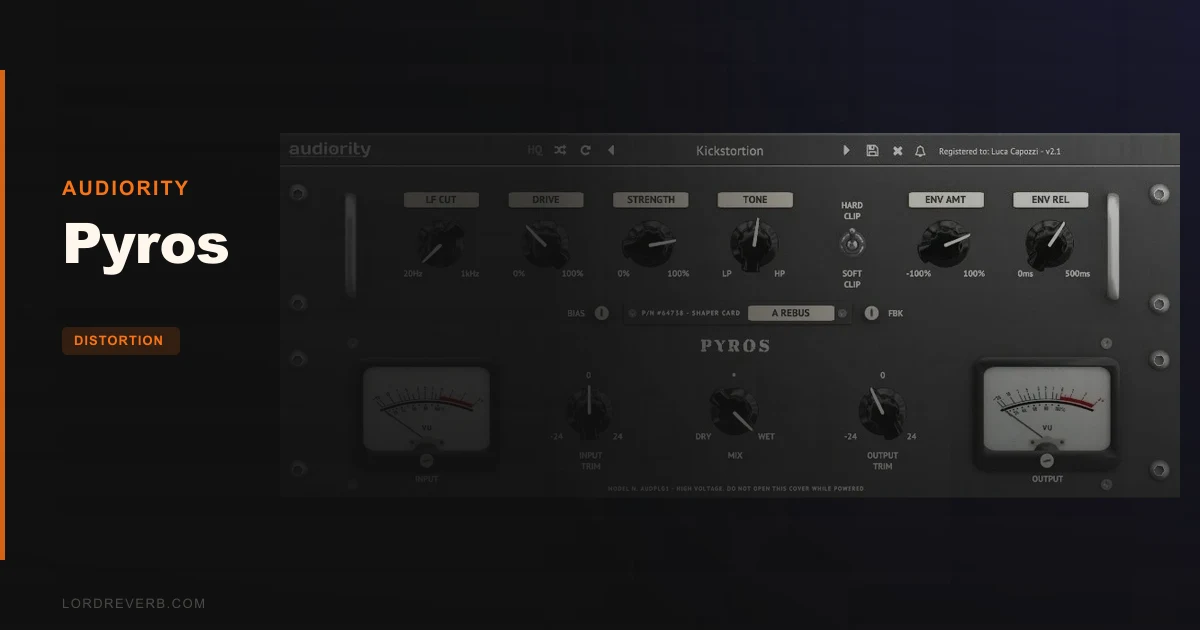
Audiority Pyros is one of the most underrated distortion plugins at $45, and we'd buy it ourselves, it covers 20 algorithms spanning tube saturation, Germanium crunch, Silicon bite, and full waveform foldback in a single plugin, making it a genuinely versatile tool for producers who work across genres and don't want six different distortion units cluttering their signal chain.
We tested it on drums, bass, synths, and guitars across three sessions, and our overall position is clear: Pyros earns its place as a go-to destructive effect. It's not perfect. The UI wants some work, and it won't replace a boutique amp sim for pure guitar tones. But for the price, the algorithm count, and the sheer sonic range, it's hard to argue against.
This review is for producers who want the honest version, not the PR version.
What You're Actually Getting
Pyros is a multi-algorithm distortion effect from Audiority, built for drums, bass, synthesizers, and guitars. It ships with 20 distortion algorithms covering six core circuit types: Tube, Diode, Germanium, Silicon, Fuzz, and Foldback.
The signal chain inside the plugin reads: Pre-distortion LF Cut → Input Biasing → Hard/Soft Clipping selection → Distortion stage → Bipolar Feedback → Bipolar Envelope Follower → Output, with a three-band EQ and a mix control wrapping the whole thing.
That mix control matters. It lets you dial in parallel distortion without creating a send bus, which saves real time in the box.
There's also a built-in limiter on the output, input and output metering, and a resizable interface. It runs 64-bit only on Mac and Windows, and supports VST2, VST3, AAX across both platforms. Silicon Macs get CLAP and AU on top. Intel Macs add AU. Windows gets VST2, VST3, and AAX. No CLAP on Windows yet, which is a small but genuine omission.
The Good
Twenty algorithms is a lot. We're not talking about minor variations on the same topology. Tube and Diode behave differently above the knee. Germanium and Silicon clip asymmetrically in ways that show up in the harmonic content: Germanium pushes second-order harmonics that sit around 2x the fundamental, which adds perceived warmth without obvious harshness. Silicon emphasises odd-order content higher up the spectrum, and you feel that as edge and presence rather than body.
We ran a drum bus through the Germanium algorithm with the Input Biasing nudged positive by about 30%. The transient hit first, clean. Then the sustain saturated into something that felt bigger. The snare crack stayed defined. No low-mid mud. We pulled the mix knob back to 40% and it sat in the mix perfectly without needing a separate parallel chain.
That input biasing control is clever. Shifting it changes the operating point of the clipping circuit, which produces asymmetric distortion that reacts differently to positive and negative signal peaks. In practice, nudging it positive on a bass DI added harmonic richness to the attack without turning the whole note into noise.
The bipolar envelope follower is the other underrated feature. It lets the distortion character respond dynamically to your signal's amplitude, which means you can get subtle saturation on quiet passages and it clamps down harder on loud ones, or vice versa, without automating a single parameter.
The pre-distortion LF cut is also satisfying to use. Drop it to roll off below 80Hz before the distortion stage and your low end stays clean. Without it, Fuzz and Foldback algorithms turn sub content into a buzzing mess. With it, you keep the fundamental and distort only the upper harmonics.
The Not-So-Good
The UI is where we wish Audiority had spent more time. On a 1080p screen at default size, the knobs are small. Not unusable, but annoying. The resizable interface helps, but some parameter labels sit close enough together that you'll occasionally grab the wrong knob and spend 20 seconds figuring out why your sound just changed. That's a workflow snag that shouldn't exist in 2026.
There's also no parameter modulation baked in. You can automate everything in your DAW, so it's not a dealbreaker, but competing plugins at this price tier have started adding LFO-to-drive or envelope-to-bias routing inside the plugin itself. Pyros doesn't. If you want a distortion that morphs rhythmically, you're patching it yourself.
The Windows version still lacks CLAP support as of this writing. If you're already working with CLAP hosts on Windows, Pyros won't fit neatly into that setup. It's not a dealbreaker for most, but it's a factual gap worth knowing about.
One more thing: the included presets are useful for orientation, but they don't demonstrate the plugin's ceiling. The most extreme Foldback sounds are left for you to discover manually. That's fine, but it means newer producers may spend time in the shallow end without realising what's waiting at maximum drive.
Compared to the Alternatives
Soundtoys Decapitator is the obvious comparison. It's excellent on analogue-style saturation and guitar tones, with five algorithm modes and a tone control. But Decapitator costs more, offers fewer algorithms than Pyros, and has no built-in parallel mix control in the same surgical range. For pure analogue character, Decapitator has a slight sonic edge on the top two modes. For versatility per dollar, it's not close. Pyros wins by a large margin.
FabFilter Saturn 2 is a different argument. Saturn 2 is a legitimate powerhouse: per-band distortion, full modulation matrix, and some of the best-sounding drive stages in any software. It costs more than Pyros. If you need modulation and multiband distortion on a single plugin, Saturn 2 is the right call. Pyros doesn't compete with it feature-for-feature. It just sounds good and costs $45.
Native Instruments Kolor sits closer in price and focus. Check our full Kolor review for the direct comparison. The short version: Kolor has a friendlier UI and a narrower algorithm set. Pyros is messier to look at but broader in sonic range.
For other Audiority plugins, we liked what they did with reverb too. See our VertiVerb VRS23 review to see how the developer approaches a completely different effect category.
Who Should Buy This
- ✅ Buy if you produce across multiple genres and need one distortion plugin that doesn't specialise in just one sound.
- ✅ Buy if you work heavily on drums and bass and want parallel distortion controlled by a single mix knob without bus routing.
- ✅ Buy if you're on a tight budget and $45 or less on sale is your realistic ceiling for a distortion plugin this capable.
- ❌ Skip if you need a full modulation matrix on your drive parameters. Saturn 2 is the right tool.
- ❌ Skip if you need pure amp-sim guitar tones. Pyros is a distortion effect, not a cabinet modeller.
- ❌ Skip if a dense, small-knob UI will genuinely slow your sessions down. It's a real complaint, not a minor one.
Score Breakdown
| Category | Score | Notes |
|---|---|---|
| Sound Quality | 4.5/5 | 20 algorithms with genuinely distinct character between circuit types; Germanium and Foldback modes alone justify the price |
| Value for Money | 4.8/5 | $45 for this algorithm count and feature set is hard to argue with; sale pricing tips it into ridiculous territory |
| Ease of Use | 3.5/5 | UI is functional but cramped at default size; small knobs and tight labelling cause real workflow friction |
| Features | 4.3/5 | Pre-distortion LF cut, bipolar envelope follower, input biasing, and mix control are all genuinely useful; missing modulation routing costs it points |
| CPU Efficiency | 4.0/5 | Ran cleanly in our test sessions; no confirmed third-party benchmarks, so we're not scoring higher without data |
| Overall | 4.3/5 | Underrated, underpriced, and occasionally underestimated because of a UI that doesn't show off what's underneath it |
Alternatives to Consider
Soundtoys Decapitator, Five analogue-modelled algorithms, brilliant on guitars and consoles. Costs more than Pyros. If you need the absolute top of analogue saturation character and budget isn't a factor, it's worth the extra spend. Soundtoys Decapitator review
FabFilter Saturn 2, Multiband distortion with a full modulation matrix. Priced higher and worth it if you need per-band drive and LFO-to-parameter routing baked in. Pyros can't touch it on features. It shouldn't be able to at this price. FabFilter Saturn 2 review
Native Instruments Kolor, The most direct price-bracket rival. Friendlier interface, smaller algorithm set. Our full breakdown is in the Kolor review. Pyros has more range. Kolor is easier to dial in fast.
Our take: buy Pyros first. If you hit its ceiling, which will take a while, then look at Saturn 2. Most producers never need to.
At $45, Pyros is a plugin you buy, use on nearly every project, and quietly feel good about every time it works. The UI is the one thing we'd change if Audiority gave us ten minutes. Everything else is a steal. If you primarily do guitar amp simulation work or need built-in modulation, spend more. For everyone else: just buy the thing.
Frequently Asked Questions
How many distortion algorithms does Pyros have?
Pyros ships with 20 distortion algorithms. They span six core circuit types: Tube, Diode, Germanium, Silicon, Fuzz, and Foldback. Each circuit type produces a meaningfully different harmonic character, so the 20 algorithms aren't just cosmetic variations on the same sound.
Does Pyros support CLAP format?
CLAP support is available on Silicon Macs (Apple M1 or higher running macOS 11.0 or later). Windows users get VST2, VST3, and AAX, but no CLAP as of our 2026 review. Intel Mac users get VST2, VST3, AU, and AAX. Check the Audiority site for the latest format additions before purchasing.
Is Pyros good for drum processing?
Yes. It's one of the strongest use cases for the plugin. The pre-distortion LF cut lets you protect your sub and kick fundamental before the distortion stage, while the Germanium and Silicon algorithms add harmonic density to the upper transients. The built-in mix control makes parallel drum bus saturation a one-step operation. We ran it on a full drum bus and a snare bus with different algorithms simultaneously, and both sat cleanly in a dense mix.
What's the difference between Pyros and Audiority's other effects?
Pyros sits in Audiority's effects line as their dedicated multi-algorithm distortion and saturation unit. It's focused entirely on signal destruction and harmonic enrichment, from subtle to extreme. Their other plugins cover different territory: reverb, compression, and modulation. If you want to see how they approach spatial processing, our Audiority VertiVerb VRS23 review covers that side of their catalogue in detail.