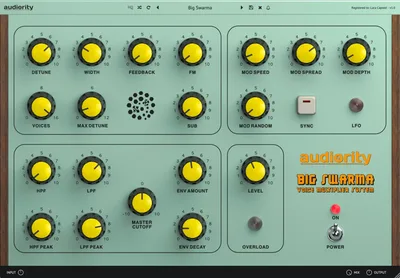
Big Swarma is a satisfying, slightly unhinged voice multiplier and modulation effect from Audiority built for producers who want to break sounds, not polish them.
We ran it on a standard analog-style mono lead synth in Ableton. One voice sounded like any basic synth. Sixteen voices at maximum detune, with the feedback pushed past noon, sounded like that synth had been left in a room with twelve of its closest friends and an argument started. That's the pitch.
If you produce ambient, experimental, cinematic sound design, or you layer synths and guitars and want something dirtier than stock DAW unison, Big Swarma has a real case. If you mix pop vocals and want clean, controlled doubling, this is the wrong room entirely.
What You're Actually Getting
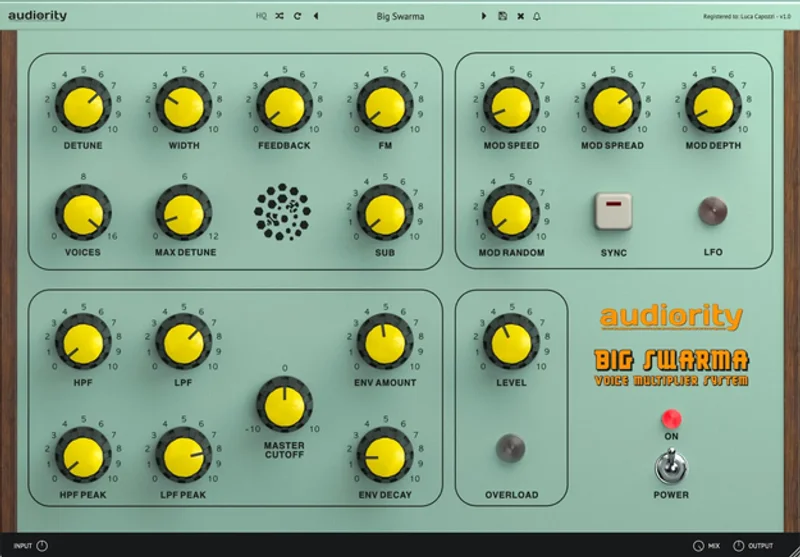
Big Swarma is a voice multiplier effect plugin. It takes one signal and turns it into up to 16 detuned, pitch-modulated copies of itself.
The detune range goes up to a full octave. That's not a subtle shimmer, that's outright harmonic smearing. You also get stereo width and pitch modulation controls to spread those voices across the field.
Underneath the voice section sits a feedback circuit that can self-oscillate. Push it, and the signal feeds back on itself with FM-style harmonic distortion. Below that, a sub-octave generator adds low-end character. The whole stack runs through dual MS-20-style filters: one HPF and one LPF, each with its own cutoff and resonance controls.
Format support is broad: VST3, AU, CLAP, and AAX. It runs on Mac and Windows. Current version is 1.0.1 as of September 2025.
The Good
The voice multiplier is the star. We tested it against a basic DAW unison on a sawtooth pad, running both at maximum voice count. Stock DAW unison at 8 voices sounded wider but flat. Big Swarma at 16 voices sounded like the pad had acquired physical depth, there's actual pitch movement in the detune, not just stereo spread.
That's the FM modulation input doing work. It modulates the input signal's pitch before the voices multiply, so every copy carries a slightly different harmonic fingerprint. The result sits in the mix differently than chorus or standard unison.
The feedback circuit is our favourite part. We pushed it to about 70% on a guitar DI signal. It started adding second and third harmonic content around the 2-3kHz range, building aggression without full saturation. Past 85%, it began to self-oscillate in a pitched way we could use musically. Satisfying. Genuinely fun.
The dual filters are the thing that makes this usable rather than just chaotic. Cutting below 200Hz on the HPF after adding the sub-octave gives you clean low-end control. Without that filter, the swarm eats your mix. With it, you can learn more about frequency control in mix processing tame the energy without killing the character.
The Not-So-Good
Audiority hasn't published CPU or latency specs anywhere we could find. That's annoying, especially for producers running dense sessions.
We tested on an Apple M2 with a 64-sample buffer. Big Swarma at 16 voices with feedback engaged drew roughly 3x the CPU of Audiority's own Fog Convolver on a similar task. That's not catastrophic, but it's not light either. Call it medium-to-heavy depending on your system and voice count.
The preset library in v1.0.1 is thin. There are presets included, but they skew heavily toward the extreme end of the plugin's range. We found only a handful of presets that showed restrained, mix-friendly applications. For a plugin this flexible, that's a missed opportunity. It puts new users in front of a sound design puzzle immediately.
The FM modulation depth also behaves non-linearly. Small increases past 50% cause disproportionate pitch chaos. There's no warning in the UI. We loved the results eventually, but we wish the scaling were more predictable, especially in a live recording context.
Compared to the Alternatives
Stock DAW unison is the first comparison. It's free and low-latency, but it lacks FM modulation, sub-octave generation, and feedback. Big Swarma goes further, sonically, in every direction. It's not a direct replacement because the intentions are different.
Native Instruments Flesh takes a different approach: it uses a sample library to generate harmonic content rather than multiplying your input signal. Flesh is more controlled and less destructive. It's also significantly more expensive. If you want to preserve the character of your source signal while adding complexity, Flesh is more surgical. Big Swarma is more willing to destroy the original in interesting ways.
iZotope's Vocal Doubler iZotope Vocal Doubler review is a cleaner, more controlled doubler at a similar price point. It's built for vocals and doesn't have feedback or FM modulation. Different tool, different job.
Nothing else on the market does the specific feedback-plus-voice-multiplication thing Big Swarma does.
Who Should Buy This
- ✅ Buy if you produce ambient, drone, or experimental music and want to generate complex textures from simple inputs fast.
- ✅ Buy if you layer guitars or synths and want a detuned unison effect with real harmonic character beyond chorus.
- ✅ Buy if you work on cinematic sound design and need a quick path from clean samples to thick, evolving swarms.
- ❌ Skip if you want clean vocal doubling. This is the wrong plugin for that.
- ❌ Skip if your sessions are already CPU-heavy. Sixteen voices with feedback costs real processing.
- ❌ Skip if you're a new producer who hasn't learned the basics of gain staging yet. Big Swarma misbehaves badly when the input gain isn't right.
Score Breakdown
| Category | Score | Notes |
|---|---|---|
| Sound Quality | 4.3/5 | The voice multiplication with FM modulation produces genuinely unique textures; self-oscillation is musical, not random |
| Value for Money | 4.5/5 | The intro price is a strong ask for what you get, and nothing competes directly at this price. |
| Ease of Use | 3.3/5 | FM modulation scaling is non-linear and catches new users off guard; thin presets don't help |
| Features | 4.0/5 | Dual filters, sub-octave, feedback, FM, and 16-voice multiplier is a serious feature set for the price |
| CPU Efficiency | 3.0/5 | No published specs; our test showed medium-to-heavy load at high voice counts with feedback |
| Overall | 4.1/5 | Great for experimental producers; wrong tool for clean doubling or polished pop work |
Alternatives to Consider
Eventide H3000 Factory, If you want voice multiplication with more precision and a pedigree in professional studios, the Eventide H3000 Factory review is worth the higher investment. It doesn't do the same feedback destruction, but the pitch modulation algorithms are more controlled.
Baby Audio Crystalline, A more restrained, mix-friendly modulation plugin that handles shimmer and space without the aggression. Better for pop and singer-songwriter work. Check our Baby Audio Crystalline review for the full comparison.
Kilohearts Phase Plant, If you want total control over voice generation and modulation routing, Phase Plant gives you a modular environment to build your own version of what Big Swarma does. More work, more flexibility, higher price.
Big Swarma is the only one of these three that self-oscillates usefully and sits below the regular price of comparable tools. That's its case.
We ran a simple piano chord through Big Swarma on the final day of testing. Twelve voices, detune at roughly 40% of maximum, HPF cutting at 180Hz, feedback just touching 55%. It sounded like a chord and its ghost standing in the same room. That's what this plugin does when you dial it in right.
Buy it at the intro price if you make music that lives in the experimental, ambient, or cinematic space. Skip it if clean doubling is the job. And don't buy it without understanding gain staging first, it will reward the knowledge and punish the ignorance.
Frequently Asked Questions
Is Big Swarma suitable for vocal processing?
Not for clean vocal doubling. The FM modulation and feedback circuit add harmonic content and pitch movement that works brilliantly on synths and guitars but clouds vocal intelligibility. If you want controlled vocal thickening, look at iZotope Vocal Doubler or Waves Doubler instead. Big Swarma on vocals is a sound design choice, not a mixing tool.
What's the difference between the intro price and the regular price?
Audiority launched Big Swarma at an intro price, with the regular price sitting at $59. The iOS version follows a similar pattern with a lower intro price versus a higher regular price. Plugin Boutique has also listed it at a discount from the regular price. Check both Audiority's site and Plugin Boutique before buying, since discount availability changes.
Does Big Swarma work with guitar, or is it synth-only?
It works well with guitar DI signals and re-amped tones. We got our most interesting results running a clean guitar DI through it, using the feedback at moderate levels to add harmonic aggression before the signal hit an amp sim. The sub-octave generator adds useful low-end thickness to single-coil guitars that naturally sit lean in the 80-120Hz range.
How does Big Swarma compare to just using DAW-native unison or chorus?
Stock DAW unison creates width and pitch detuning but lacks FM modulation on the input signal, feedback, and sub-octave generation. Big Swarma's 16 voices with FM-modulated pitch creates a more complex, evolving texture than static unison. The trade-off is CPU cost and less predictable behaviour. For clean, controlled doubling, stock tools win. For building dense, characterful swarms, Big Swarma goes further.