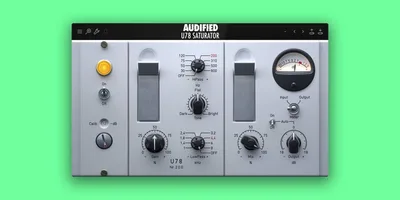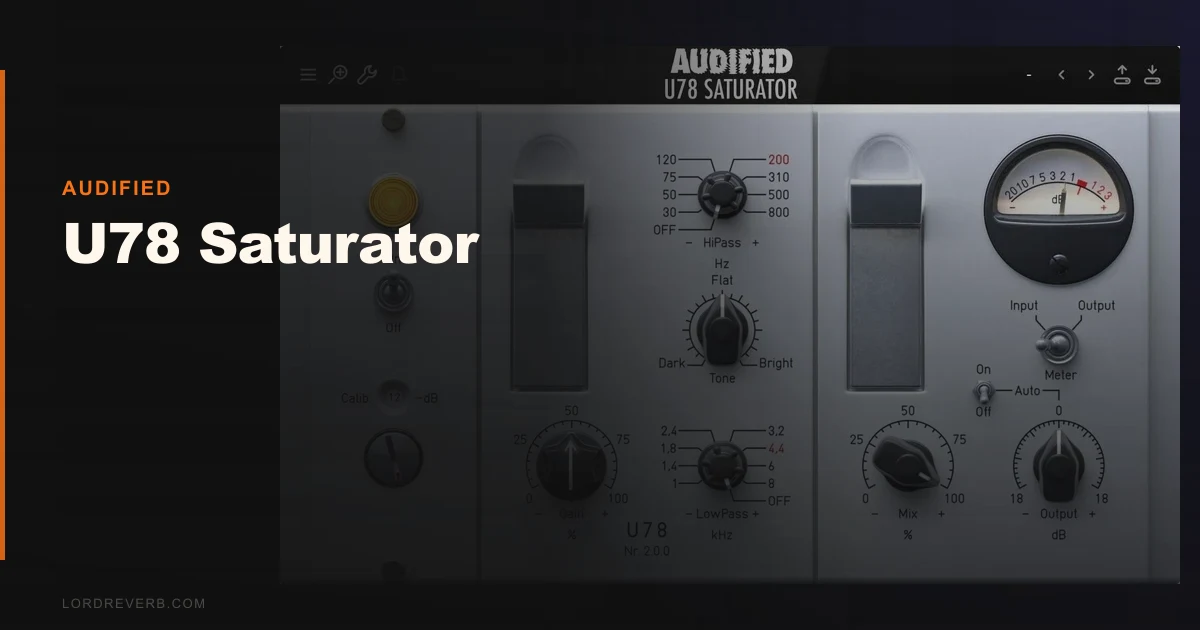
The U78 Saturator by Audified is a solid, character-driven saturation plugin built on the same circuit modeling as their U73b Compressor, and it earns its place on a bass bus or drum room channel without much argument.
We were mixing a lo-fi hip-hop record. The bass had all the right frequencies but none of the right feeling. Clean, polite, going nowhere. We'd already tried two other saturators and landed somewhere between over-processed and still boring.
We dropped the U78 on the bass bus, hit a preset labeled "Bass Growl," turned the drive up two notches, and the low end suddenly had teeth. Not clipping, not distorting. Just that thick, harmonically dense thing that makes a bass feel like it's pushing air.
That moment is what the U78 is built for. It's a specialist tool. Broad-spectrum mixing swiss army knife it is not. But in its lane, it does something satisfying that cheaper or more clinical alternatives don't.
The list price is higher than the current price. The question we'll answer here is whether it's the right buy for you.
First Impressions: Clean Interface, Deceptive Simplicity
Installing the U78 is quick. iLok account required, but no USB dongle. That's the right call in 2026 and we're glad Audified didn't complicate it.
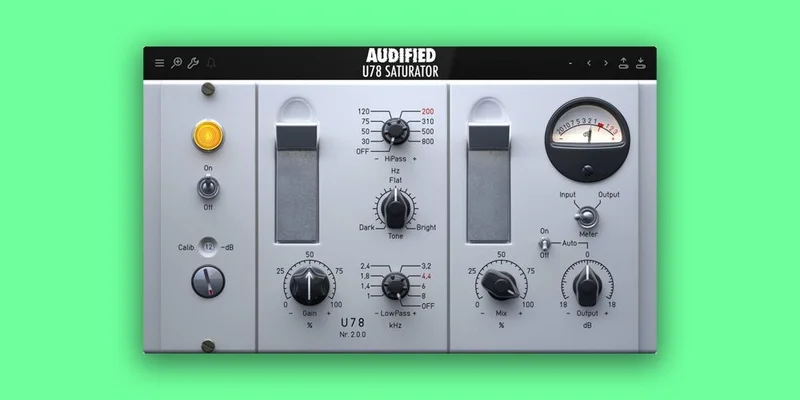
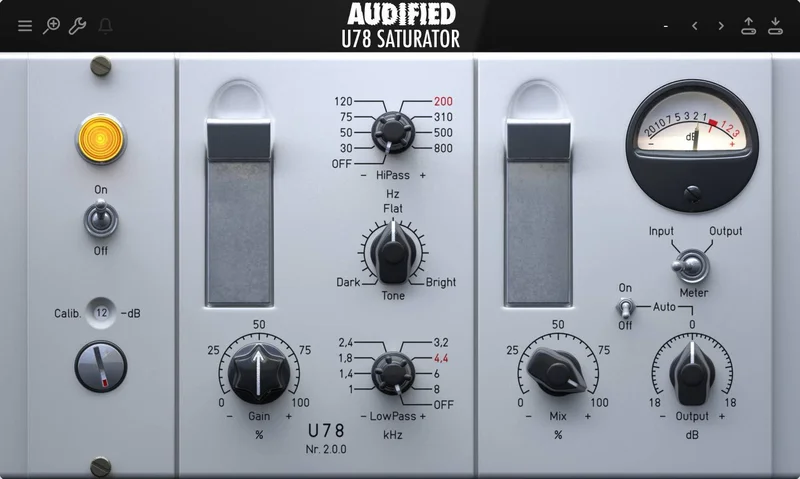
Opening it for the first time, the interface is understated to the point of being slightly disorienting. A drive knob. A calibration control. The filter section. An output level. That's most of it.
We love simple interfaces when the simplicity is intentional. Here it mostly is. The calibration control in particular looks unassuming but changes the harmonic character meaningfully, shifting the bias of the modeled circuitry from cleaner to dirtier through a range that's subtle at lower settings and aggressive past the halfway point.
One irritation: there's minimal visual metering. You're working mostly by ear, which is philosophically fine but practically annoying when you're trying to document a session setting.
Getting It Into a Real Workflow
The U78 fits most naturally as an insert on individual channels or a bus, not a master bus first-pass tool. We'd recommend getting comfortable with it on sources first.
On a drum bus, we ran it with the drive at about 40%, high-pass filter set to 80 Hz, low-pass filter open. The kick and snare picked up harmonic density. The overheads stayed clear. That filter combination is where a lot of the real work happens, and it's underrated in most of the coverage we've seen.
The preset library pulls its weight here. Sixty-plus presets across seven categories covering drums, bass, guitar, keys, vocals, and master bus mean you're not staring at a blank canvas. We used them as starting points, not endpoints. The "Vocal Air" preset on a breathy singer was too aggressive at default, but dialed back to 60% drive it gave the vocal presence without edge.
One friction point: the calibration control has no labeling beyond its rotation arc. Working fast in a session, you'll want to note your exact position manually or save a preset. There's no value readout.
CPU usage under normal conditions is light to moderate. We ran six instances across a mid-size session (48 tracks, 64-sample buffer, Apple M2) with no performance issues. We didn't test oversampling because there isn't an oversampling option, which we'll come back to.
What It's Genuinely Good At
The U73b circuit modeling is the whole story here, and it's a good story. The harmonic content it adds sits naturally in a mix. We ran a snare through it at medium drive, 200 Hz high-pass, and the body of the hit filled in without adding the brittle top-end glare we get from some solid-state saturation emulations.
Bass is where we'd stake the U78's reputation. On a DI electric bass, a modest 2dB boost at drive with calibration at noon gave us harmonic content that translated across laptop speakers, headphones, and monitors. That's the real test. It passed.
The filter section deserves more attention than it gets. High-pass from 30 Hz to 800 Hz, low-pass from 1 kHz to 8 kHz. That's a wide range and it means you can shape exactly which frequency band receives the saturation character. Slamming saturation into the low end while keeping the high-pass above 200 Hz is a clean technique for adding warmth to mids without muddying the sub. Clever design.
On the master bus at conservative settings, it glues better than we expected. Calibration at 9 o'clock, drive at 20%, low-pass closed at 4 kHz. The low mids tightened up without touching the transients. We'd use it there on certain genres, specifically lo-fi, soul, and warm electronic records.
The Rough Edges
No oversampling is a real gap. At high drive settings, we heard aliasing artifacts on bright sources. A snare with a lot of top-end sizzle showed some graininess above 12 kHz that wasn't part of the original signal. This is a known behavior when saturation processing runs without oversampling at standard sample rates.
For most use cases at moderate drive this won't matter. Push the U78 hard on a bright source and you'll hear it.
The price is harder to defend than Audified probably wants it to be. Soundtoys Radiator review offers comparable warmth with better workflow integration at a similar price. The Waves Abbey Road Saturator undercuts it and ships with more detailed metering. Neither of those facts makes the U78 bad. They do make the value proposition tighter than it looks at first.
We also wish there were an A/B comparison slot built in. With a plugin this dependent on subtle harmonic shifts, being able to flip between two settings without saving/l
oading presets would help enormously during a session.
Who This Is Really For
✅ Buy if you mix bass-forward genres. Hip-hop, R&B, soul, lo-fi. This is where the U78 earns its keep fastest.
✅ Buy if you want vintage German console character without routing through outboard. The U73b heritage is real and audible.
✅ Buy if you want a preset-forward saturation tool you can drop on a channel and dial in quickly. The library is well-organized and genuinely useful.
❌ Skip if you work primarily with bright sources at high drive settings. The aliasing issue is real and the absence of oversampling is a hard limit.
❌ Skip if you need deep technical control or internal metering. This is not a plugin for engineers who want to see what's happening.
❌ Skip if you're already well-served by Soundtoys, Waves, or Universal Audio saturation tools in your saturation plugins guide. Owning three good saturators is plenty. The U78 doesn't offer enough difference to justify a fourth unless you're chasing specifically this type of warmth.
Score Breakdown
| Category | Score | Notes |
|---|---|---|
| Sound Quality | 4.3/5 | U73b modeling delivers genuine warmth; filter section extends its usefulness significantly |
| Value for Money | 3.5/5 | The price is defensible but not a clear win given competing options at similar or lower prices. |
| Ease of Use | 4.0/5 | Simple layout and strong preset library make dialing in fast; calibration control needs a value readout |
| Features | 3.5/5 | Filter section is a genuine strength; missing oversampling and A/B comparison are real gaps |
| CPU Efficiency | 4.0/5 | Light footprint across multiple instances; no oversampling option means no CPU spike trade-off either |
| Overall | 4.1/5 | A specialist tool that does its specific job well, held back by pricing pressure and a few missing features |
Alternatives to Consider
Soundtoys Radiator: Based on a Altec 1567A tube mixer circuit, it adds more color and harmonic complexity than the U78 at a similar price point. Better metering and more workflow flexibility. Soundtoys Radiator review
Waves Abbey Road Saturator: More clinical in its approach but ships with better visual feedback and costs less. Works best for transparent warmth rather than vintage character. Waves Abbey Road Saturator review
SPL TwinTube: Hardware emulation with separate tube saturation and harmonic excitement controls. More expensive but gives you finer surgical control over exactly which type of harmonic content you're adding. A better choice if you mix a lot of vocals and acoustic instruments. best saturation plugins
The U78 sits between these three. It's more characterful than Waves, more focused than SPL TwinTube, and arguably simpler than Radiator. Whether that's the right combination depends entirely on what your signal chain is already missing.
Final Verdict
The U78 Saturator is not a plugin we'd put on everything. It's a plugin we'd put on bass, drums, and warm buses, and in those spots it's genuinely satisfying in ways that took us a few sessions to fully appreciate.
At $34.50, it's not a reflex buy. If you work in genres where thick, analog-adjacent low-end warmth is the whole game, the price is justified. If you're a pop or EDM producer who lives above 200 Hz, there are better options. If you already own Soundtoys or a strong UAD saturation suite, you probably don't need this.
But the right producer, dropping this on the right bass bus, at the right moment in a session? It'll feel like finding a piece of gear you didn't know you were missing.
That's the best thing we can say about a plugin at this price. It earns its price in the right hands. Just make sure yours are the right hands before you buy.
Frequently Asked Questions
Does the U78 Saturator require a physical iLok dongle?
No. The U78 uses iLok software licensing only. You need a free iLok account to activate it, but no USB dongle is required. This means you can move it between machines without carrying hardware.
How does the calibration control on the U78 affect the sound?
The calibration knob shifts the bias point of the modeled U73b circuitry. At lower settings it produces cleaner, subtler harmonic content. Past noon it pushes into thicker, more aggressive saturation character. Think of it as adjusting which part of the tube's transfer curve you're working in. It's one of the most useful controls on the plugin and it's easy to overlook.
Is the U78 Saturator good for mastering?
At conservative settings, yes. Drive below 25%, calibration at 9 o'clock, and the low-pass filter used to keep saturation out of the very high frequencies works well for adding gentle warmth to a master bus. We wouldn't recommend it as a heavy mastering tool, and the lack of metering makes precise control harder than it should be at that stage.
What's the difference between the U78 Saturator and the U73b Compressor?
They share the same circuit modeling heritage based on the vintage German Neumann U73b hardware unit, but they're built for different tasks. The U73b Compressor version 3 focuses on compression and dynamic control. The U78 Saturator focuses on harmonic saturation and color without dynamic processing. Many engineers use them together in a signal chain, compressor first, saturator second.