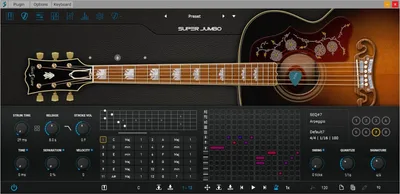
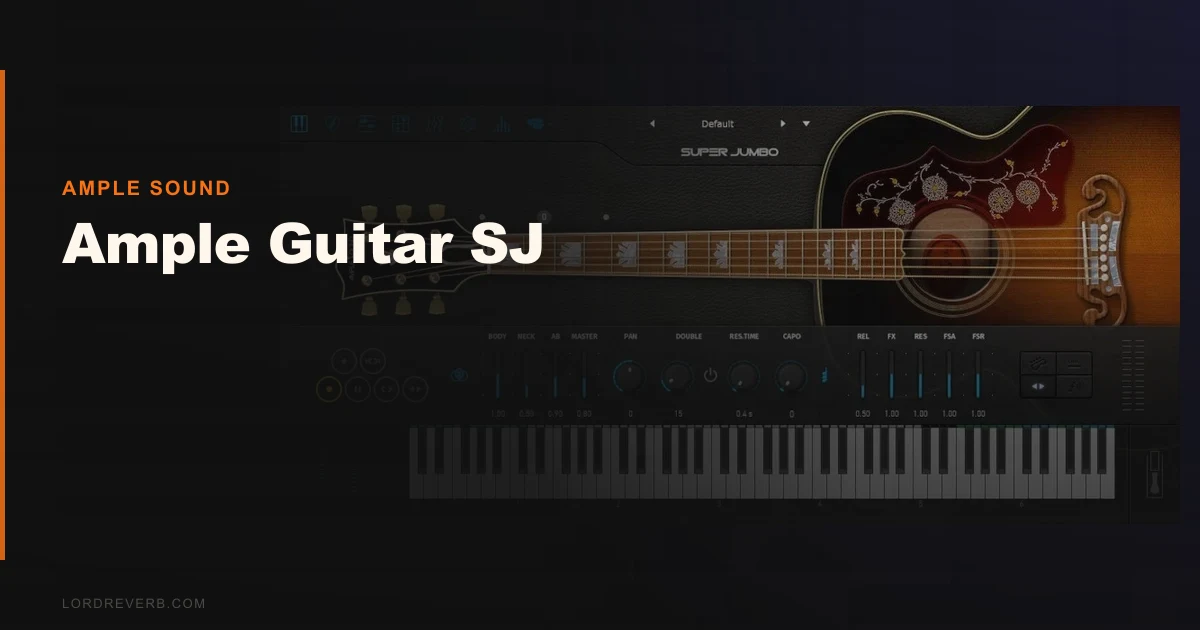
Ample Guitar SJ is a strong, well-sampled virtual instrument built around a Gibson SJ-200, and if you write singer-songwriter demos or produce acoustic-led arrangements in-the-box, it'll solve a very specific problem you've probably been living with for years.
That problem: acoustic guitar samples that sound like acoustic guitar samples. The fake strum. The looped sustain that blooms at exactly the same point every time. The strumming engine that chokes on anything above 90 BPM. You've heard it. You've published tracks with it. You've cringed at it later.
Ample Sound built this plugin specifically for producers who can't (or won't) mic a real guitar every session but need something that holds up next to live vocals in a mix. At $169 standard, it targets the serious home studio owner, not the bedroom beatmaker just starting out. This review tells you whether it earns that price.
The Frustration Behind the Buy
Most acoustic guitar VIs fail at the same thing: strumming. Single-note lines can sound passable on almost anything. But throw a G chord into a strumming pattern and the fake hits every "realistic acoustic sample pack" promise immediately.
The SJ-200 is a big-bodied jumbo. It projects. It's the guitar you hear on classic country and folk recordings where the instrument needs to fill a room without amplification. Getting that size and body resonance into a plugin is hard. Thin samples on a large-body guitar sound worse than thin samples on a dreadnought because the gap between expectation and reality is bigger.
Ample Sound's answer is a 4-mic stereo setup capturing body, neck, and A/B positioning. The 8.6 GB library is the result of that approach, and it's what gives the instrument genuine low-mid weight. This is the problem it exists to solve.
How It Performs in a Real Session
We loaded Ample Guitar SJ into Logic Pro on an M2 Mac Mini, set up a simple country-flavored chord progression in the key of G, and let the Riffer 4 strummer engine run.
The first thing we noticed: the body resonance on open G voicings is satisfying in a way that cheaper libraries aren't. Pull up the body mic channel and roll off above 5kHz. What you're left at around 200-400Hz has real weight. It doesn't need aggressive boosting to sit in a mix. We cut about 1.5dB at 320Hz with a Q of 1.2 to stop it crowding the kick, and that was mostly it.
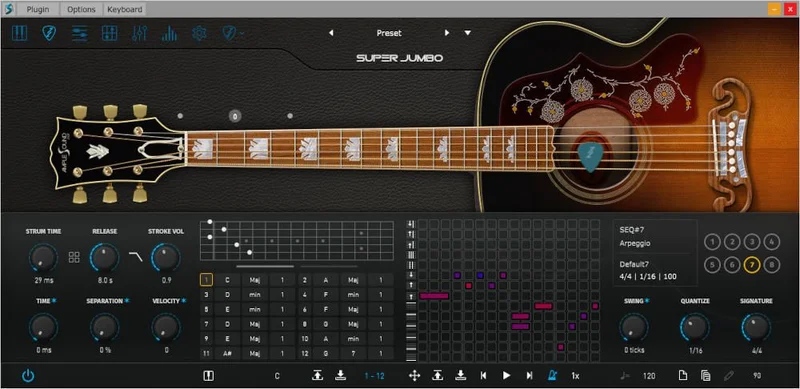
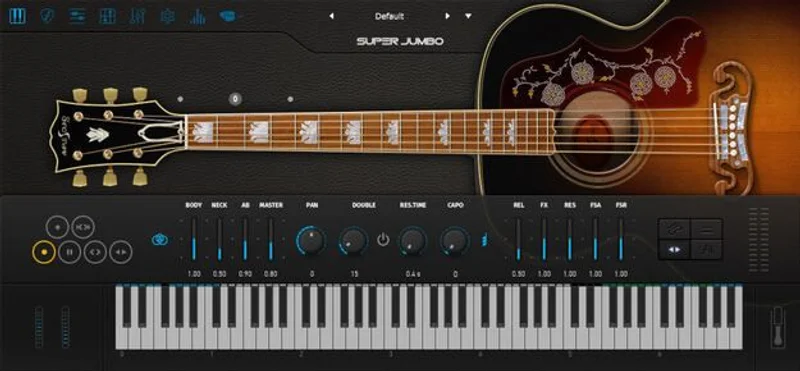
The Riffer 4 editor is the clever part. You can build strumming patterns with individual string-level control, dial in velocity curves per strum direction, and adjust timing humanisation from tight to loose on a single slider. We built a 4-bar fingerpicked pattern in about 12 minutes, which is fast. Comparable editors on competing libraries would've taken twice that.
Where we hit friction: legato slides at tempos below 70 BPM. At slow country ballad tempos, the slide transitions between notes sound mechanical. The pitch movement is there, but the micro-dynamics that a player's hand naturally produces during a slow slide aren't captured convincingly. It's annoying because everything else holds up so well.
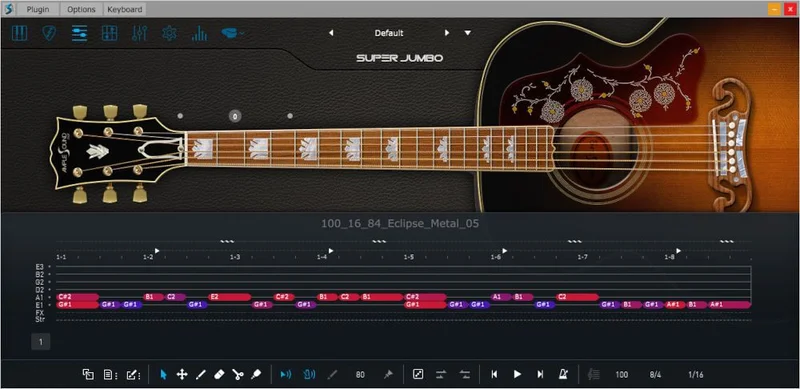
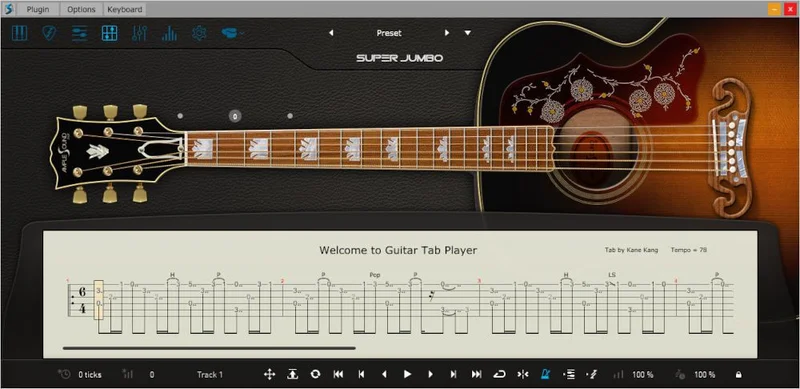
The Tab Reader 4 supports Guitar Pro files from GP3 through GP8. We dropped in a GP7 acoustic arrangement and it played back cleanly, articulations mapped correctly, with only minor velocity adjustments needed. That's a legitimate workflow win for anyone arranging with Guitar Pro files.
CPU draw was medium. On an i5 system it sat around 8-12% per instance in our tests. That's manageable for a single guitar track. Run two instances with the convolution reverb engaged and you'll feel it.
Strengths and Weaknesses
The sound is the strength. We love how the neck mic channel captures the pick attack without turning it into a harsh click. There's a softness to the transient on fingerpicked passages that sounds like a real player's nail-to-string contact. Dial the neck and body mics to roughly 60/40 and you get a balanced mono source that sits well under vocals without needing much EQ work.
The 8 articulations cover the real-world bases: Sustain, Palm Mute, Natural Harmonic, Hammer On and Pull Off, Legato Slide, Slide In and Out, and Pop. That's not an unusually large set, but the implementation is clean. Articulation switching via keyswitches is responsive. We didn't get any misfires during a live MIDI performance test.
The weaknesses are real though. The 8.6 GB install is heavy for a single-instrument library when you consider that other multi-instrument plugins cover far more ground in similar or smaller footprints. The built-in FX chain (8-band EQ, compressor, delay, convolution reverb) is usable but not something you'd reach for over your main reverb plugin. It's there as a quick option, not a replacement for a dedicated quality reverb plugin.
The slow-tempo slide issue mentioned above is a genuine limitation for ballad writers. It's not a dealbreaker, but it's worth knowing before you buy.
Is $169 Justified?
For what it does, yes. You're getting a deeply sampled single instrument with a performance system that actually works. The Riffer 4 editor alone saves enough session time to justify the price over a few projects.
The promotional price appears during Ample Sound's periodic sales. If you can catch that, it's an easy call. At full $169, it's still a fair price for a library this detailed, but we'd check the Ample Sound site before buying at full price since sales happen regularly.
For co
ntext: the market for serious acoustic guitar VIs at this price point is competitive. You’re paying for specialization. This is one guitar, sampled with obsessive care, not a general-purpose acoustic toolkit.
Who Should and Shouldn't Buy This
- ✅ Buy if you produce country, folk, or acoustic rock and need a jumbo-body acoustic that sounds convincing next to live vocals.
- ✅ Buy if you work with Guitar Pro files and want Tab Reader 4 to handle arrangement playback automatically.
- ✅ Buy if you're building singer-songwriter demos where the acoustic guitar is the lead element, not a background texture.
- ❌ Skip if you need a general acoustic guitar library with multiple guitar models. This is one instrument.
- ❌ Skip if your projects run heavily on slow-tempo ballads where legato slides are frequent. The limitation will frustrate you.
- ❌ Skip if disk space is tight. 10 GB of free space minimum is the requirement, and that's before your DAW and other libraries.
Score Breakdown
| Category | Score | Notes |
|---|---|---|
| Sound Quality | 4.5/5 | SJ-200 body character is captured well; 4-mic setup delivers real low-mid weight |
| Value for Money | 4.0/5 | Justified at $169; excellent when on sale |
| Ease of Use | 4.0/5 | Riffer 4 is fast to learn; Tab Reader 4 import is straightforward |
| Features | 4.0/5 | 8 articulations, GP file import, humanisation controls; built-in FX is basic |
| CPU Efficiency | 3.5/5 | Medium draw; two instances with reverb will tax older systems |
| Overall | 4.2/5 | Best single-body acoustic VI at this price for country and folk production |
Alternatives to Consider
Ample Sound Ample Ethno Ukulele: If you want a smaller-bodied acoustic instrument with similar build quality from the same developer, we've covered it in depth. Read our Ample Ethno Ukulele review to see how the same engine performs on a different instrument.
Native Instruments Session Guitarist series: NI's loop-based approach is fundamentally different. It's faster for straightforward strumming patterns but you'll hit the loop ceiling quickly when arrangements get complex. No Tab Reader equivalent. The current price is shown in the buy box on this page.
Strum GS-2 by MusicLab: A direct competitor at a similar price point. Strum GS-2 offers multiple guitar models in one library, which is the argument for choosing it over Ample Guitar SJ. But the per-model sample depth doesn't match what Ample Sound delivers on the SJ-200 specifically. If you need variety, go MusicLab. If you need one guitar done right, Ample wins.
If you're building out a full production toolkit and want to understand where virtual instruments fit in a broader setup, our guide to drum machine sampler plugins covers the companion rhythm side of the same workflow.
Our Verdict
Ample Guitar SJ is an underrated library in a category full of overpromised, underdelivered products. The SJ-200 tone is real, the strummer engine is the best at this price, and the Tab Reader 4 workflow is genuinely useful in a way most competing plugins don't bother to build.
The slow-tempo slide issue is a real limitation. The 8.6 GB footprint asks something of your drive. And if you need more than one acoustic guitar voice, this isn't your library.
But if you've been settling for acoustic samples that sound like acoustic samples? This is the fix. Buy it at $169. Just don't buy it expecting a Strat.
Frequently Asked Questions
What guitar is Ample Guitar SJ based on?
It's built from samples of a Gibson SJ-200 Vintage Custom Shop acoustic guitar. The SJ-200 is a jumbo-body instrument known for its strong projection and full low-mid response. Ample Sound captured it with a 4-mic stereo setup covering body, neck, and A/B positions, resulting in the 8.6 GB library size.
Does Ample Guitar SJ work in Pro Tools?
Yes. It supports AAX format alongside VST2, VST3, and AU. It also runs as a standalone application. System requirements are Windows 7/8/10 64-bit or macOS 10.9 and above. You'll need at minimum an Intel i5 and 10 GB of free hard disk space.
What's the difference between Ample Guitar SJ and other Ample Sound guitar plugins?
Each Ample Sound guitar plugin is built around a specific instrument model rather than a generic "acoustic guitar" concept. Ample Guitar SJ covers the SJ-200 jumbo specifically. Other libraries in the range cover different guitars with different body types, playing characters, and genre targets. The core Riffer 4 engine and Tab Reader 4 system are shared across the range, so if you already own another Ample Sound instrument, the workflow will be familiar.
Is there a free trial for Ample Guitar SJ?
Ample Sound has offered lite demo versions of some instruments in its range, but availability changes. We'd check the Ample Sound website directly for the current trial status before purchasing. It's worth doing: the difference between a good and a great acoustic VI is in the detail, and that's something you want to hear in your own session before committing $169.