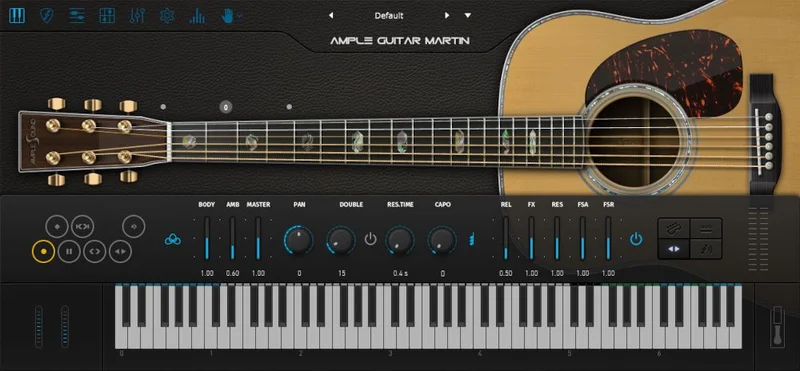
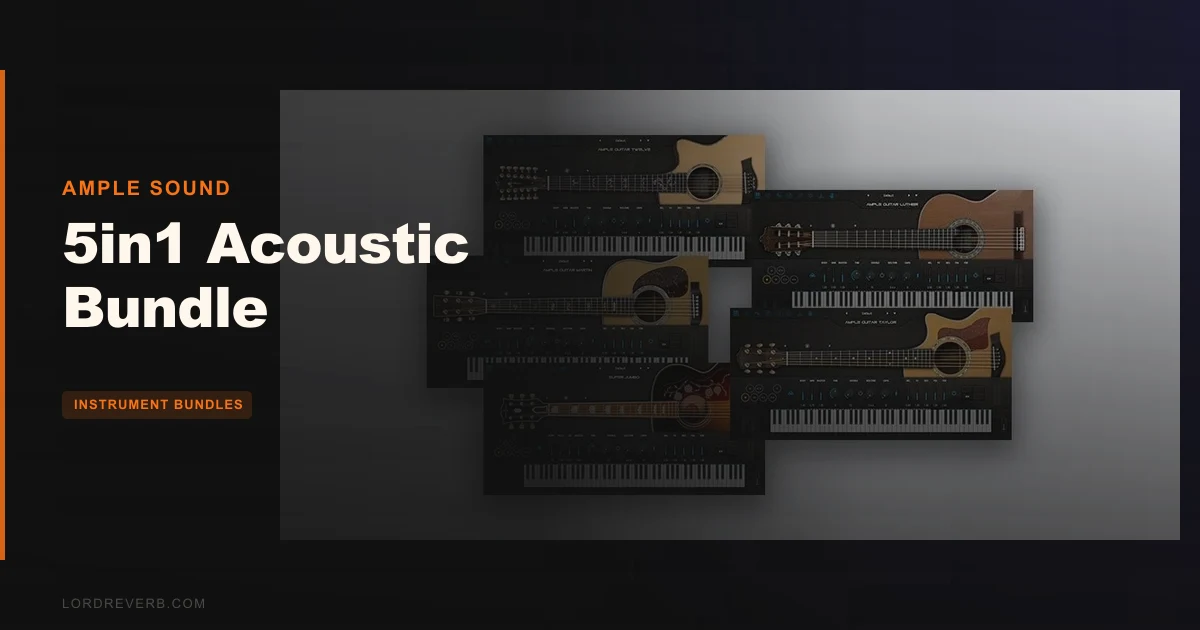
If you've been hunting for a complete acoustic guitar solution that doesn't force you to buy five plugins from five different developers at five different price points, Ample Sound's 5in1 Acoustic Bundle is what that search ends at. At $543, the bundle drops five acoustic instruments onto your hard drive: Ample Guitar SJ (Gibson SJ-200 Vintage Custom Shop), Ample Guitar Twelve (Taylor 956 CE 12-string), Ample Guitar L (Alhambra Luthier classical), Ample Guitar T (Taylor 714CE), and Ample Guitar M (Martin D-41). That's a folk strummer, a parlour fingerpicker, a 12-string shimmer machine, a classical nylon-string, and a workhorse dreadnought, all inside one purchase. This review is for producers who write acoustic parts in the box and can't afford to have three of those five tones covered brilliantly while the other two let the whole track down.
The Problem Every In-the-Box Acoustic Writer Faces
Acoustic guitar is the instrument that sounds most obviously fake when it's wrong. Synths can get away with artificiality. Drums have been replaced with samples for thirty years and nobody flinches. But put a mediocre acoustic guitar plugin on a folk track or a singer-songwriter demo and the client hears it in ten seconds.
The issue isn't just sample quality. It's coverage. You need a bright parlour sound for fingerpicked verse parts. You need a dreadnought for strummed chorus energy. You need a 12-string for that ringing chorus layer that makes listeners feel something before they can explain why. And if your project touches classical or Bossa Nova, you need a nylon string that sits right.
Buying those voices separately gets expensive fast. And stitching together plugins from four different developers means four different interfaces, four different articulation logics, four different signal chains. The 5in1 Acoustic Bundle exists to collapse all of that into one consistent ecosystem. Whether it actually does that well enough to justify $543 is what this review is about.
What You Get: Five Guitars, One Logic
The five instruments share enough interface DNA that switching between them doesn't reset your brain every time. Each one has the same underlying architecture: sample library, articulation engine, strummer or Riffer module, capo logic, and a built-in FX rack. Learning one means you're 70% of the way to knowing all five.
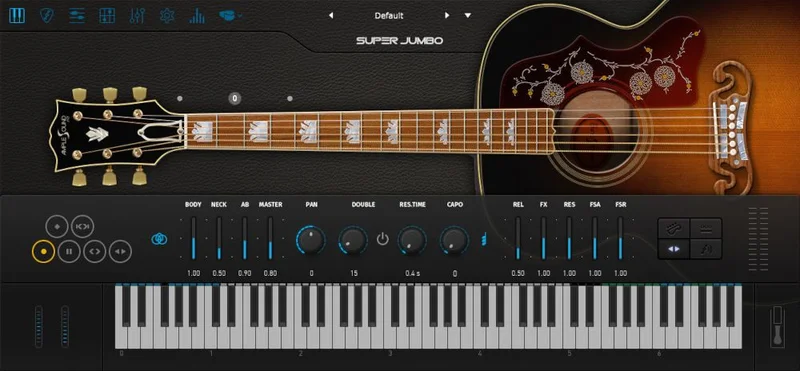
That matters more than it sounds. When you're on a deadline at midnight and you need to swap the Martin for the Taylor because the song changed key and the strumming pattern needs adjusting, you don't want to relearn a plugin.
Ample Guitar SJ: The Big Body Strummer
SJ models the Gibson SJ-200 Vintage Custom Shop, which is a big, projecting jumbo with a lot of low-mid body and a scooped-but-sparkly top end. When you strum it hard in the lower register, it fills the room. That's the vibe the samples chase.
The articulation set is wide. Thumb-pick and strummed articulations cover the two ways most players actually approach a jumbo acoustic. Polyphonic legato and slide smoothing handle the transitions between notes so you don't get the chopped, robotic feel that ruins acoustic guitar plugins in lead contexts. Customisable capo logic means you can tell the plugin where the capo sits and have it remap accordingly, which is a small thing that saves a lot of faff during a session.
The dynamic strummer engine is where the SJ earns its keep. You set the strum pattern, velocity response, and chord voicing, and it handles the mechanical reality of strumming with a level of variation that beats most competitors out of the box. Owners report the strumming engine is convincing enough to fool musicians on playback, and from a purely compositional standpoint, that's what you need a session replacement plugin to do.
Where it gets frustrating: individual notes. Push the SJ into lead or single-note melody territory and some owners notice unevenness. Certain notes jump in level or tone in ways that break the illusion. If your track is 95% strummed parts, you won't care. If you need a melodic guitar line to carry a bridge, you might.
Ample Guitar Twelve: The One That Makes Listeners Feel Something
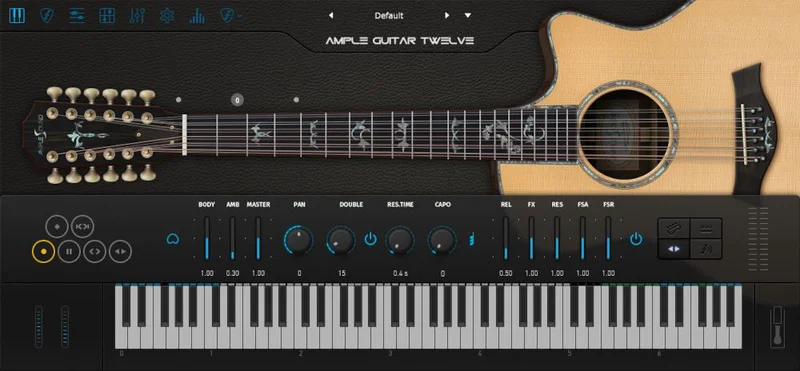
12-string acoustic is an emotional shortcut. There's a physical response that happens when that shimmer comes in on a chorus. Ample Guitar Twelve models the Taylor 956 CE, a cedar-topped 12-string with a wide, balanced spread across the frequency range.
Three playing styles are built in: strum, finger, and thumb-pick. That's the right coverage for 12-string work, where you're often either strumming big open chords or picking out arpeggiated patterns that let the overtones breathe. Advanced legato handles the note-to-note movement, and the flexible strumming engine carries the same logic as the SJ's: pattern, velocity, chord voicing, variation.
The Riffer and Tab Player system deserves its own mention here. Tab Player lets you import guitar tablature and have the plugin interpret it. Owners describe this as a standout feature that no competing product handles as well. If you have a tab for a part you want to replicate, you can import it rather than program it note by note in a piano roll. That's a real workflow advantage for composers who think in guitar terms but write ITB.
Built-in FX are present here as across all five instruments: 4 Send FX (Reverb, Delay, Phaser, Chorus) and 4 Direct FX (Compression, Overdrive, 5-Band EQ, Wah). For 12-string work, the reverb and delay send options let you build that spacious, shimmering sound without routing to a separate bus.
Ample Guitar L: Classical, But Make It Practical
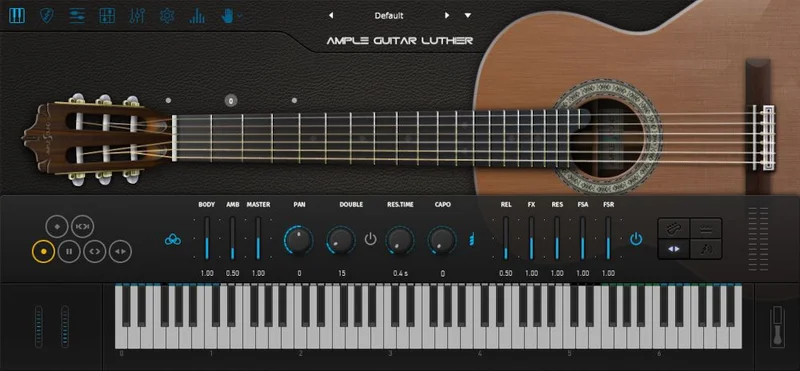
Ample Guitar L models the Alhambra Luthier, a Spanish classical guitar with tight, focused mids and a dry, present tone. This is the instrument you reach for on Bossa Nova pads, classical crossover arrangements, or anything that needs nylon-string warmth without the low-mid weight of a dreadnought.
Fingerstyle and picked articulations are both included. The legato handling applies to the nylon-string context, where hammer-ons and pull-offs are part of the instrument's character. The capo logic and strummer engine are present, though classical guitar players will likely spend more time in the fingerstyle articulations than in the strummer.
The Riffer module works here as it does across the bundle: a phrase-sequencing system that lets you build up repetitive guitar figures without drawing them all in a piano roll. For ostinato patterns in film scoring or texture-building in ambient production, this is where the L becomes a workhorse rather than a colour.
Ample Guitar T: The Versatile Middle Ground
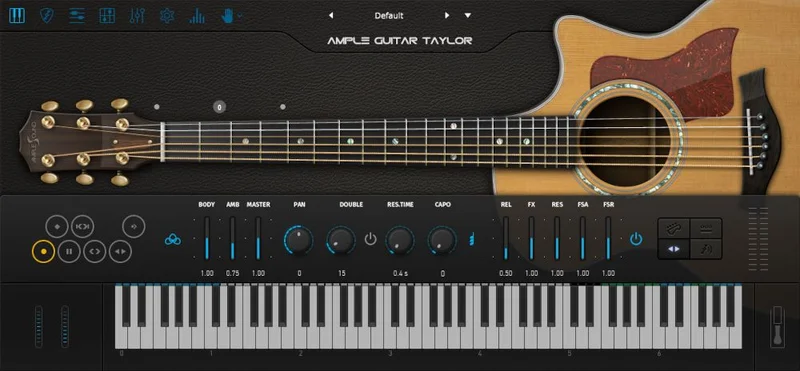
Ample Guitar T models the Taylor 714CE. If the SJ is the bold, boomy strummer and the M is the warm fingerpicking specialist, the T sits between them: a bright rosewood-bodied fingerstyle guitar with more upper-mid presence and a slightly tighter low end.
Three sample libraries cover finger, pick, and strum playing styles. The advanced articulation engine and polyphonic legato mean you can move between chord shapes without the note transitions sounding mechanical. The capo system remaps the instrument's range correctly when you shift positions.
The T is the guitar you'll probably use most across a broad range of commercial writing. It sits in a mix without demanding EQ attention, and the Taylor 714CE's natural voicing translates well to contemporary production contexts where a guitar needs to live alongside programmed drums and synths without taking over.
Ample Guitar M: The Classic Dreadnought
Ample Guitar M models the Martin D-41. That's one of the most recorded acoustic guitars in history. It has a low-mid authority and a mid-range presence that makes strummed parts feel grounded. Finger, Pick, and Strum sample libraries are all included.
Advanced legato and realistic capo logic carry across from the other instruments. Sound-shaping tools let you adjust the timbre without reaching for external EQ. For folk, country, Americana, or any genre where the guitar needs to anchor the arrangement, the M is the bundle's workhorse dreadnought.
Some users perceive the M's sound as overly clinical compared to some competing products. That's a known limitation of sample-based instruments at this price point: the fundamental character is there, but the room sound, the woody resonance, and the micro-dynamics of a live player are always going to be a step back from the real thing. For most production contexts, the M is close enough to be convincing. For purists doing close-mic acoustic recording captures, it'll feel like a compromise.
The Strummer and Riffer: Where the Bundle Actually Earns Its Money
The strumming engine is the reason most people buy Ample Sound guitars over competing products. Put a chord sequence in, set your strum pattern, and the engine handles the variation in pick attack, string timing offset, and velocity that makes strumming sound human rather than quantised.
Owners report that it outperforms competing products out of the box. That's not marketing language from Ample. That's what buyers say after using it in real sessions. The believability comes from the micro-variation the engine applies automatically, the way a real strummer doesn't hit every string at exactly the same moment on every beat.
The Riffer tool is a phrase builder. You draw or import a guitar figure, assign it to a key, and trigger it in your MIDI. For producers writing repetitive guitar hooks or ostinato lines, this collapses what would be an hour of piano roll editing into a few minutes. It's clever design.
The Tab Player is the genuinely surprising one. Import a guitar tab and the plugin interprets it. It's the feature that makes the bundle worth considering even if you already have one or two decent acoustic plugins in your collection.
Mic Positions, Pickup Options, and Built-In FX
All five instruments include mic and pickup options. You can blend mic positions to shape the room character of each guitar without leaving the plugin. For producers who don't have an expensive outboard reverb chain, this is a meaningful workflow shortcut.
The 8 built-in effects across the bundle (Reverb, Delay, Phaser, Chorus on the Send side; Compression, Overdrive, 5-Band EQ, Wah on the Direct side) are functional rather than spectacular. They'll get a guitar sitting in a demo quickly. For final mix work, you'll probably want to route out to your preferred reverb and EQ.
The 5-Band EQ is useful for dialling in the fundamental character before the signal hits your DAW's channel strip. High-shelf boost to bring out pick attack, low-mid cut around 300Hz to reduce body boom, the basic shaping you'd do on a real acoustic mic'd in a live room.
The Overdrive is worth flagging. Pushing it lightly adds harmonic content that makes the guitar feel more present and less sample-library.
The Learning Curve Problem
This is the honest part of the review that the product page won't tell you.
Users report a steep learning curve. That's not unusual for a plugin with this many features, but the documentation makes it worse. Multiple owners describe the documentation as unhelpful. For a bundle at $543, that's an annoying gap. You're paying for a professional-grade tool and then figuring it out through YouTube searches and forum posts because the manual doesn't get you there.
The Tab Player, Riffer, and advanced capo logic all require time to understand. The strumming engine has enough parameters that dialling it in for a specific sound takes experimentation.
If you're migrating from a simpler acoustic plugin where you trigger samples from a keyboard and add reverb, the depth here will feel overwhelming at first. That's not a reason to skip it. It's a reason to budget two weeks of casual exploration before you need it on a deadline.
The First Launch Problem
Plugins require an internet connection on first launch.
For most home studios, that's annoying but manageable. For offline production setups, remote studio builds, or producers in environments where internet access is restricted, this is a real blocker. You need to plan the activation around connectivity.
Once activated, the connection requirement appears to end. But first-time setup in an offline studio is not straightforward. Worth knowing before you buy.
Strengths and Weaknesses
The strumming engine is the strongest argument for this bundle over competitors. It's intuitive once you understand its logic, and the results in a finished mix are convincing enough that listeners assume a real guitar player was involved. That's the goal. When a plugin achieves it, it's satisfying.
The Tab Player is underrated even among owners who already have the bundle. The ability to import guitar tablature and have the plugin interpret it is a workflow advantage with no peer at this price point. Film composers and production music writers who work from tab notation will love this.
The five instruments cover the most common acoustic guitar voices in modern production. Having a consistent interface across all five means you can move between them in a session without resetting. That consistency has real value when you're against a deadline.
On the other side: some guitars have uneven individual notes. That's not a dealbreaker for strumming and chord work, but it matters for lead lines and melodic parts. The documentation failure is a persistent frustration. And the clinical quality that some owners notice on certain instruments is a real thing. The technical precision of these samples occasionally outpaces their warmth.
Some users prefer Indiginus for tonal character, noting that Ample's precision sometimes reads as sterile. That's a legitimate taste difference. If you care more about organic feel than feature depth, that comparison matters.
Value for the Price
At $543 for five instruments, the per-instrument cost is significantly below what you'd pay buying acoustic plugins individually from the same quality tier. The Tab Player alone would justify a price premium over a single-instrument competitor. The strumming engine is best-in-category by owner consensus.
The honest caveat: you're paying for depth and breadth. If you only need one acoustic voice and you need it to sound as warm and natural as possible in solo contexts, a single-instrument specialist plugin might serve you better. The M or the T on their own might not outperform a focused competitor like Indiginus in a head-to-head tonal comparison.
But if your production work spans genres and you need six-string, 12-string, and classical voices consistently available, the bundle economics are hard to argue with. Five professional-grade acoustic instruments for one consolidated purchase, all sharing one interface logic, is a good deal at $543 for the working producer.
Who Should (and Shouldn't) Buy This
- ✅ Buy if you write across multiple genres and need a folk strummer, 12-string layer, classical nylon, and dreadnought workhorse all in one toolkit.
- ✅ Buy if the Tab Player or Riffer workflow fits how you think about composing. These are features that genuinely change how you work ITB.
- ✅ Buy if you need a strumming engine that sounds convincing on playback without hours of manual humanisation work in the piano roll.
- ❌ Skip if you only need one acoustic voice and you need it to sound as warm and organic as possible. A focused single-instrument plugin might win that comparison.
- ❌ Skip if you work in an offline studio and can't plan around the first-launch internet requirement. Activation will be a problem.
- ❌ Skip if you need extensive lead and single-note melodic work from your acoustic guitar plugin. The uneven individual notes on some instruments will frustrate you.
Specs & Technical Details
| Spec | Detail |
|---|---|
| Developer | Ample Sound |
| Price | $543 |
| Plugin Format | VST2 / VST3 / AU / AAX / Standalone |
| OS Support | Mac 10.9 or higher / Windows 7, 8, 10, 11 (64-bit) |
| Activation | Requires internet connection on first launch |
| CPU Usage | N/A |
| Trial Available | N/A |
| Version Reviewed | N/A |
| Minimum Processor | Intel i5 or higher |
| Instruments Included | 5 (SJ, Twelve, L, T, M) |
| Built-in FX | 8 (4 Send: Reverb, Delay, Phaser, Chorus / 4 Direct: Compression, Overdrive, 5-Band EQ, Wah) |
Score Breakdown
| Category | Score | Notes |
|---|---|---|
| Sound Quality | 4.0/5 | Convincing in strummed and chord contexts; some unevenness in single-note lead work |
| Value for Money | 4.5/5 | Five instruments at one price with best-in-class strumming and Tab Player makes the economics work |
| Ease of Use | 3.5/5 | Steep learning curve compounded by poor documentation |
| Features | 4.5/5 | Tab Player, Riffer, polyphonic legato, capo logic, 8 built-in FX: the feature set is deep |
| CPU Efficiency | N/A | No data available |
| Overall | 4.2/5 | A complete, feature-rich acoustic bundle that earns its price for working producers who write across styles |
Alternatives to Consider
Orange Tree Samples is the comparison most owners reach for first. Users who've tested both note that Orange Tree's articulation flexibility is superior, particularly for expressive single-note playing. If articulation switching and nuanced lead work are your priority, Orange Tree is worth looking at before you buy.
Indiginus comes up for buyers who prioritise tonal character over technical feature depth. Some producers find Ample's precision reads as clinical and prefer Indiginus's approach to acoustic timbre. If you've listened to demos of both and the Ample tone feels too polished for your taste, Indiginus is the alternative to investigate.
Native Instruments guitars are described by owners who've used both as 2 to 3 generations behind Ample's capabilities. If you're considering NI as a bundle alternative, the consensus from owners is that Ample wins the feature comparison by a clear margin. NI may work for simpler acoustic parts, but the depth here isn't matched.
Acoustic Samples Guitar Bundle is positioned as a more budget-friendly alternative. If the $543 spend feels like too much and your acoustic needs are simpler, Acoustic Samples is worth checking. You'll likely give up some of the strumming engine sophistication and the Tab Player, but the entry cost is lower.
The honest take on alternatives: for producers who need broad acoustic coverage with a workflow-forward feature set, nothing at this price point matches the bundle's combination of Tab Player, strumming engine quality, and five-instrument breadth. The cases where you'd choose a competitor are specific: lead work priority points to Orange Tree, tonal warmth priority points to Indiginus, budget constraints point to Acoustic Samples.
The Verdict
Five acoustic guitars that share one interface, one strumming logic, and one Tab Player system: for the working producer who lives in the box and writes across genres, that's a genuinely useful toolkit. The Strummer engine is the best in this category by most owner accounts. The Tab Player has no peer at this price. The five instrument voices cover the range of acoustic situations most production work demands.
The complaints are real too. The documentation is a genuine failing for a plugin this complex. Individual note unevenness on some instruments is a known issue, and if you're doing lead work, it'll bother you. The clinical quality some owners report isn't universal, but it's not invented either. The first-launch internet requirement is an inconvenience that becomes a problem in certain studio setups.
You'll find yourself spending significant time learning to use the bundle properly. Plan for that. Don't put it on a session track the day it arrives.
What the bundle is not: it's not the warmest, most organic-feeling acoustic plugin money can buy. It's not the simplest to operate. It's not the right answer if your acoustic writing is 95% single-note lead lines.
What it is: the most complete, workflow-smart acoustic guitar bundle available for producers who need multiple voices and have the patience to learn a deep system. At $543 for five professional instruments with best-in-category strumming and a Tab Player that changes how you work, the value case is strong. If that's your situation, buy it and plan substantial time to learn it properly. If you need one warm acoustic and you need it to sound like a real guitar on the first day, look at the alternatives section above instead.
Frequently Asked Questions
Does the 5in1 Acoustic Bundle require a constant internet connection?
An internet connection is required on first launch for activation. After that initial setup, you don't appear to need ongoing connectivity. If your studio is offline or restricted, plan the activation around a moment when internet access is available, because there's no workaround for first-time setup without it.
Is the 5in1 Acoustic Bundle good for single-note lead guitar work?
It's not the bundle's strongest suit. The strumming engine and chord work are where these instruments shine. Some users report individual notes sounding uneven or inconsistent on certain guitars in the bundle. For lead melody lines that carry a whole section, you may find the results frustrating. For rhythm, chord, and arpeggio work, it performs well.
What does the Tab Player actually do?
The Tab Player lets you import guitar tablature directly into the plugin and have it interpret the tab as MIDI-driven performance. Rather than programming every note and articulation by hand in a piano roll, you import a tab and the plugin handles the translation. Owners describe it as the most useful workflow feature in the bundle, and no competing product at this price point matches it.
How long does it take to learn the 5in1 Acoustic Bundle?
Users report a steep learning curve. The Riffer, Tab Player, strumming engine, and capo logic all require real time to understand. Expect a steep learning curve before you're using it efficiently in a production context. The documentation is widely described as unhelpful, so YouTube tutorials and forum posts will likely be your main learning resource.
How does the 5in1 Acoustic Bundle compare to Orange Tree Samples?
Orange Tree Samples is noted by owners for superior articulation flexibility, especially for expressive lead and single-note playing. Ample Sound's bundle wins on breadth (five instruments versus typically one), the Tab Player system, and the strumming engine quality. If articulation depth for lead work is your priority, Orange Tree is worth comparing directly. If broad coverage and workflow tools matter more, the Ample bundle holds its ground.
Can I use the 5in1 Acoustic Bundle in Standalone mode without a DAW?
Yes. The bundle supports Standalone operation alongside VST2, VST3, AU, and AAX formats.