
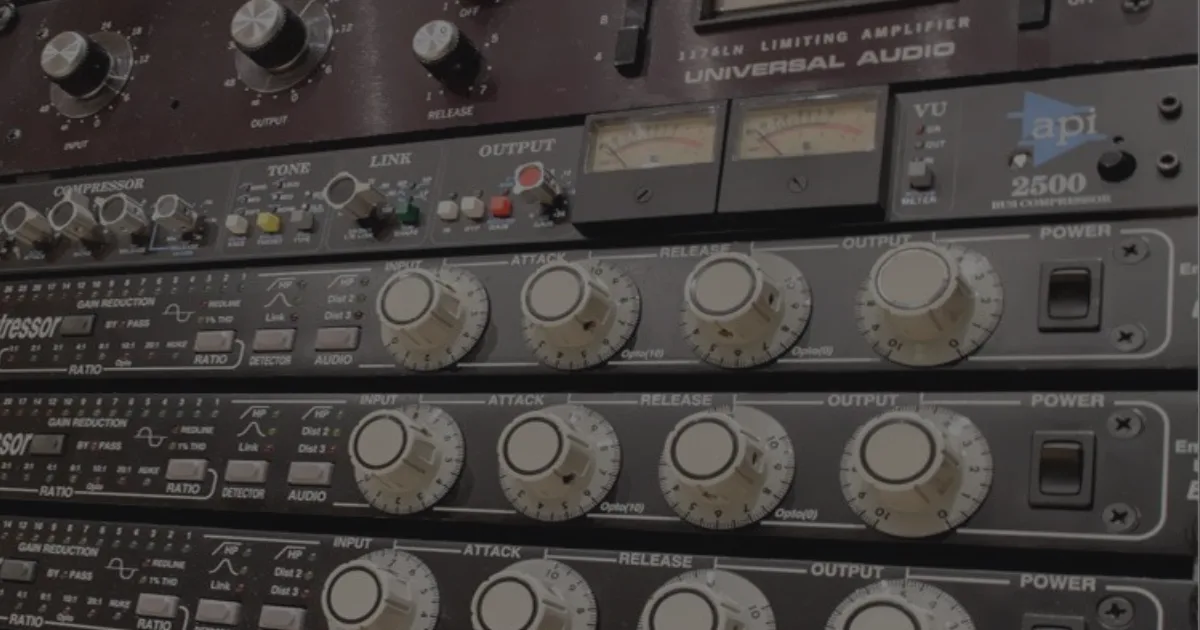
Outboard gear is external hardware equipment that processes audio signals outside of your mixing console or DAW. It includes compressors, equalizers, reverb units, preamps, and delays that sit in your physical signal chain rather than running as software inside your computer.
Outboard gear is any piece of standalone audio hardware that handles signal processing independently from your DAW or mixer. You patch it in. It does its job on the actual electrical signal. Then the audio moves on.
That definition sounds simple. The reality is more interesting.
Outboard gear covers everything from a $200 preamp strip to a $15,000 vintage Neve console section. It covers 19-inch rackmount units bolted into equipment racks, compact 500-series modules slotted into a powered chassis, and tabletop effects boxes wired into patch bays. The format changes. The fundamental idea stays the same: the processing happens in hardware, not in a plugin.
We've worked with outboard gear across tracking sessions, mixing rooms, and mastering suites. Some of it is brilliant. Some of it is overrated. A lot of it is misunderstood by producers who've only ever worked inside the box. This guide covers what it actually is, how it fits in a signal chain, and when it's worth your money and rack space.
What Types of Outboard Gear Exist?
Five categories cover the vast majority of outboard gear you'll encounter.
Preamps
Preamps amplify a microphone's weak output signal up to line level. Every interface has preamps built in. Outboard preamps are standalone units that do this job with more circuit character, more headroom, or more control than a budget interface can offer.
The Neve 1073SPX ranked as the top-selling outboard unit in 2025 for the second consecutive year. That tells you something. Producers are still paying $1,800+ for a specific flavour of transformer-coupled gain that no plugin has fully replicated. The saturation starts around 18dB of gain and adds 2nd and 3rd harmonic content that thickens a vocal without a separate processor.
Compressors
Outboard compressors control dynamic range. They come in four main circuit types, and each sounds different.
VCA compressors (dbx 160, SSL G-Bus) are fast and transparent. FET compressors (Universal Audio 1176) are fast and aggressive. Optical compressors (LA-2A) are slow and smooth. Vari-Mu compressors (Manley Variable Mu) are program-dependent and musical. Knowing the circuit type tells you where the compressor will work before you hear a note through it.
The dbx 160 introduced VCA compression technology in 1976. Nearly 50 years later, the circuit is still in production. That's not nostalgia. That's a proven tool.
Equalizers
Outboard EQs come in parametric, graphic, and shelving designs. The Neve 1073 EQ section, the API 550, and the Pultec EWS-1MS have specific filter topologies that create frequency curves no digital EQ can exactly match because the interaction between passive components produces phase relationships that aren't mathematically straightforward to model.
We're not saying plugins are useless here. We are saying the Pultec curve at 100Hz with boost and cut simultaneously engaged produces a low-end shape that still confuses the people who try to recreate it in software. It's a quirk of the passive circuit. We love it.
Reverbs and Delays
Hardware reverbs produce the longest tails in the business. The EMT 140 plate reverb is a physical steel plate suspended in a frame. The spring reverb in a Fender amp is a coiled spring. Neither of these is digitally generated. The sound reflects through real physical materials.
Digital outboard reverb units like the Lexicon 480L or the Bricasti M7 are also outboard gear. They're hardware boxes that run dedicated processing chips rather than sharing CPU with your DAW. The M7 retails at check the manufacturer's site for current pricing, but its algorithm runs on hardware with no latency compensation required.
Other Signal Processors
Outboard gear also includes hardware de-essers, transient shapers, exciters, saturators, noise gates, and channel strips (which combine preamp, EQ, and compression in one unit). The Empirical Labs Distressor, released in 1995, fits here as a hybrid: it's a compressor that crosses VCA and optical characteristics and adds harmonic distortion options. It became a studio standard because it sounds right on almost everything.
What Format Does Outboard Gear Come In?
The two dominant formats are 19-inch rackmount and 500-series.
19-Inch Rackmount
The 19-inch rackmount standard follows the EIA-310 specification. Units are measured in "U" (rack units), where 1U equals 44.45mm of vertical space. A single rack unit is about the height of a thick book spine. Most compressors and preamps occupy 1U to 2U. Some large reverb units take 2U to 4U.
You bolt them into a rack, run cables to your patch bay, and route signal through them. It's satisfying in a way that clicking a plugin insert never quite is. There's something about physically patching audio through a chain that makes you listen differently.
500-Series Modular
The 500-series format uses a powered chassis (called a "lunchbox") with individual module slots. Each slot has a 15-pin connector that carries power and audio. A standard lunchbox holds between 3 and 11 modules depending on the chassis. API popularised the format. It's now an open standard with hundreds of manufacturers making compatible modules.
The advantage is cost and flexibility. A 500-series EQ module might cost $400 where the full 19-inch version costs $1,800. You mix and match modules across brands. The API 500-6B Lunchbox holds six modules and runs about $500 for the chassis itself.
The trade-off is power density. Running too many high-current modules in one chassis can cause noise or thermal issues. Not every module from every manufacturer plays nicely in every chassis. We've seen frustrating incompatibility issues in certain third-party lunchboxes with high-current preamp modules. Research the power specs before you buy.
How Does Outboard Gear Fit Into a Signal Chain?
Signal flow determines everything. The same piece of gear sounds different depending on where you put it.
At the Tracking Stage
During recording, you'd typically run microphone into preamp, then optionally through a compressor or EQ before hitting your interface's line input. The preamp sets your gain and adds its characteristic colour. The compressor controls peaks before they hit your converter. You're printing those decisions to your recorded track.
We ran a dynamic microphone through a BAE 1073 preamp at 35dB of gain into an 1176 running 4:1 compression with about 4dB of gain reduction on a snare. The attack was set to position 7, release to position 3. The crack hit first. The body came through clean. The room tails didn't pile up because the compression held them back. That track needed almost no EQ in the mix. That's the point of getting it right at the source.
As Hardware Inserts During Mixing
Most modern audio interfaces and DAWs support hardware inserts. You route audio out of your DAW through an interface output, through your outboard unit, and back in through an input. The DAW's hardware insert plugin compensates for the round-trip latency.
In Pro Tools, Logic Pro, and Ableton Live, this is done through the I/O plugin or hardware insert function. Latency compensation in Pro Tools automatically handles the delay for most modern interfaces. In Ableton, you need to measure the round-trip latency yourself and set the delay compensation manually. Annoying, but manageable once you know the specific latency of your interface at your working buffer size.
On the Mix Bus
Running your stereo mix through an outboard compressor before your mastering chain is one of the most common uses for high-end hardware. The SSL G-Bus compressor at 2:1 with slow attack (30ms), medium release (0.3s), and around 2dB of gain reduction adds cohesion to a mix that's hard to define but immediately audible when you bypass it.
We've compared the SSL G-Bus plugin against the hardware on the same session. The plugin is excellent. The hardware is different. Not always better, but different in ways that matter to certain clients. The plugin costs $299. The hardware costs several thousand dollars. You get to decide if the difference justifies the gap for your work.
Analog vs. Plugin: Where Do We Actually Stand?
This debate is old. We're going to give you a direct answer instead of a diplomatic one.
Plugins have closed the gap dramatically. Waves, Universal Audio, Slate Digital, and Plugin Alliance have invested millions in hardware capture technology. UAD's Unison preamp emulations model transformer saturation at the gain-staging level. Slate's Virtual Mix Rack sounds legitimately close to the hardware on a blind test for most material.
But there are three places where hardware still wins outright.
First: impedance interaction. When you plug a guitar directly into a hardware DI or preamp, the actual electrical interaction between the source impedance and the input impedance of the hardware shapes the signal in ways that happen before any amplification. Plugins don't see that interaction. UAD's Unison technology addresses this at the preamp stage, but it only works with their own interfaces.
Second: tactile workflow. This is underrated. Reaching up to a hardware compressor and physically adjusting the ratio knob during playback changes how you make decisions. You feel the threshold. You hear the release time change under your hand. We've watched producers find settings on hardware in 90 seconds that they'd chase for 20 minutes on a plugin interface. The hands-on control isn't just satisfying; it's faster.
Third: parallel hardware paths. Running two outboard units simultaneously on the same signal, then blending the outputs, creates mix options that are clunky to replicate with plugin parallel processing because you're actually dealing with two separate electrical paths with their own gain staging and transformer character.
Where plugins win: recall, CPU-free operation once you've printed the effect, zero patchbay noise, and accessibility at $50 instead of $5,000.
Our position: if you're mixing entirely ITB and your clients are happy, don't let anyone guilt you into buying hardware. If you're running a tracking studio and want to capture specific tonal character at the source, a good preamp and a versatile compressor will change what you can do.
Worth Bookmarking
- Gearslutz (Gearspace), The deepest forum archive for real-world outboard gear shootouts, user mods, and purchase advice from working engineers.
- Sweetwater, Detailed spec sheets, user reviews, and side-by-side comparisons for current outboard gear, with accurate pricing and stock info.
- Vintage King, The most reliable source for used and vintage outboard gear with condition grades, service history, and fair market pricing.
What Does Outboard Gear Actually Cost?
The range is wider than most guides admit.
Entry-level outboard starts around $150 to $300 for a basic single-channel preamp or a budget 500-series module. A Used dbx 160A compressor runs $300 to $500 on Reverb.com. A new Neve 1073SPX is approximately $1,800. A vintage Fairchild 670 compressor in working condition is $30,000 to $60,000.
The sweet spot for most project studios is $400 to $1,500 per unit. That range gives you genuinely characterful gear without requiring a major investment decision every time you add a piece.
Used gear is almost always the right move. Hardware doesn't expire. A well-maintained 1176 from 1975 sounds exactly as good as a new one. Check Reverb.com, Vintage King, and Gearspace's classified section. Ask for service records. Test with pink noise and a scope if you're spending more than $1,000.
Budget for cables, a patch bay, and rack space. A 12U rack case costs $100 to $300. A TRS patch bay costs $80 to $300. A set of balanced cables for 8 sends and returns costs $80 to $200 from a decent manufacturer. These aren't optional. They're part of the total cost of owning outboard gear.
Is Outboard Gear Worth It in 2025?
Outboard gear is more popular than ever in 2025. That's not nostalgia talking. There's a real shift happening as more producers hit a ceiling with plugin-only setups and start looking for what's missing.
What they're missing is usually one of three things: tactile control, specific harmonic character at the source, or the mix bus glue that hardware compression provides.
The new wave of hybrid interface hardware, including units from companies like Cranborne Audio and others building direct hardware insert routing into small-format interfaces, is making outboard integration less painful. You don't need a full patch bay to use a single outboard compressor anymore. You need two cables and a latency measurement.
We'd recommend starting with one piece. A good preamp if you track a lot. A versatile compressor if you mix a lot. Master one piece of hardware before you start filling rack space. The producers who get the most out of outboard gear are the ones who understand each unit deeply, not the ones with the fullest racks.
Summary
Outboard gear is external hardware audio processing: preamps, compressors, EQs, reverbs, and more, running in your physical signal chain rather than inside your DAW. It comes in 19-inch rackmount and 500-series formats. It fits into a signal chain at tracking, mixing, or mastering stages. Plugins have improved dramatically, but outboard gear still wins on impedance interaction, tactile workflow, and specific harmonic character. Entry-level outboard starts at $150 to $300. One good piece used wisely beats a full rack of impulse buys every time.
Related guides: outboard gear guide
Frequently Asked Questions
What is the difference between outboard gear and plugins?
Plugins are software that runs inside your DAW on your computer's CPU. Outboard gear is physical hardware that processes audio as an electrical signal outside your computer. Plugins offer total recall and low cost. Outboard gear offers specific harmonic character, tactile control, and signal processing that happens before or independently of your digital conversion.
Do I need outboard gear to make professional-sounding music?
No. Professionally released music is made entirely in the box every day. Plugins from Universal Audio, Waves, and Slate Digital are used on major releases. Outboard gear offers specific advantages, but a great plugin chain beats a mediocre hardware chain. Start with strong monitoring and accurate room treatment before investing in hardware.
What does "insert" mean in the context of outboard gear?
A hardware insert is a routing setup where audio leaves your DAW via an interface output, passes through an outboard unit, and returns through an interface input. Your DAW compensates for the round-trip latency automatically in Pro Tools and manually in Ableton Live. The outboard unit processes the signal in real time in your signal chain.
What is a 500-series lunchbox?
A 500-series lunchbox is a powered chassis that accepts modular audio processing units (called 500-series modules). Each slot in the lunchbox provides power and audio connectivity via a 15-pin connector. Lunchboxes typically hold 3 to 11 modules. The format lets you mix preamps, EQs, and compressors from different manufacturers in one compact unit.
Is vintage outboard gear better than modern gear?
Not automatically. Vintage gear has specific character from component aging and manufacturing tolerances that can sound brilliant or require expensive maintenance. Modern reissues from Neve, API, and Universal Audio are built to tighter tolerances and come with warranties. We'd buy a well-serviced vintage unit over a poorly made modern clone, but a quality modern unit over a vintage piece with unknown service history.
How do I connect outboard gear to my DAW?
You need an audio interface with enough inputs and outputs to handle the send and return. Run a balanced cable from your interface output to the input of your outboard unit. Run a balanced cable from the outboard unit's output back to your interface input. In your DAW, use the hardware insert or I/O plugin function to route signal through that send/return path and compensate for latency.