
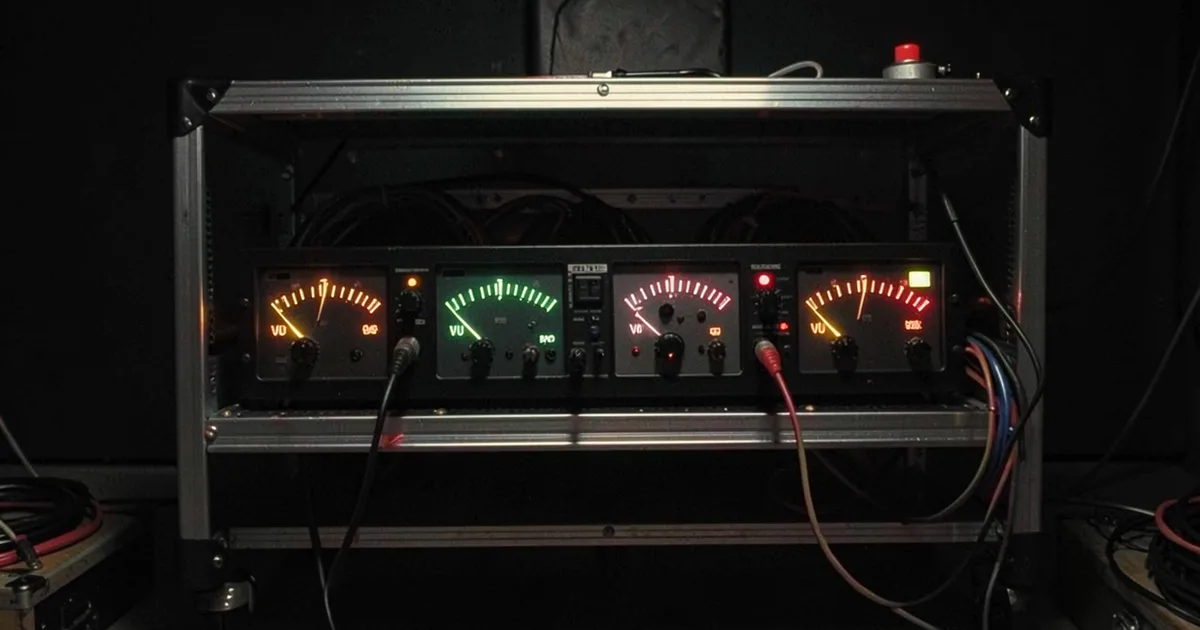
Outboard gear is any hardware audio processor that lives outside your DAW: preamps, compressors, EQs, and effects units that handle your signal in the analog domain before or after A/D conversion. You route it via insert cables or a patch bay, and it adds electrical character no plugin can fully replicate, because the physics are real.
Outboard gear is any hardware processor that sits outside your computer and touches your signal in the analog world. That's the answer. Now let's talk about whether you actually need it, what to buy first, how to integrate it without turning your studio into a cable nightmare, and where the honest cost-benefit line sits in 2025.
The plugin market is extraordinary right now. We'd be lying if we said it wasn't. But the producers and engineers who work with hardware will tell you something plugins still struggle to replicate: the friction is different. Tweaking a physical knob changes your relationship to the decision. That's not mysticism. It's workflow psychology, and it affects what ends up on tape.
This guide covers every layer of the outboard world. Entry-level preamps, pro compressors, hybrid integration, 500 series format, and the decision tree you need for tracking versus mixing versus mastering. We've tested most of what's listed here ourselves. Where we haven't, we say so.
What Actually Counts as Outboard Gear?
Outboard means external to your DAW. Any hardware unit that processes audio signal counts: mic preamps, hardware compressors, EQ units, reverb chambers, tape machines, effects processors.
The term comes from recording consoles. The main desk handled routing; everything else bolted into racks or sat on a shelf "out" from the board. The name stuck even though most studios now run hybrid rigs with no console at all.
The Main Categories
Mic preamps boost a microphone's output from mic level (roughly -60 to -40 dBu) to line level (+4 dBu professional standard). Every signal chain starts here. The preamp's transformer, tube, or solid-state circuit sets the first color your recording gets.
Compressors control dynamic range. Hardware compressors use real transformers, optical cells, FET transistors, or tube circuits. Each topology behaves differently under load, which is why an 1176 (FET) sounds nothing like an LA-2A (optical).
EQs shape frequency. Passive EQs like a Pultec circuit actually cut and boost simultaneously, creating a lift at the boost frequency's low end that's hard to model precisely. That's the physical reason Pultec-style EQs sound the way they do.
Effects units handle reverb, delay, chorus, saturation. Outboard reverbs like a real EMT 140 plate or Lexicon 480L are special cases: physically large, expensive, and increasingly rare outside elite rooms.
How Do You Route Outboard Gear Into Your DAW?
This is where most beginners get stuck. The routing is simple once you see it, but annoying to wrap your head around first.
Insert Routing
Your audio interface has line outputs and line inputs. You send a signal from a DAW channel out through a line output, through your hardware unit, and back in through a line input. In your DAW, that return signal lands on a new track or back on the same track via a hardware insert plugin.
Most DAWs handle this natively. In Pro Tools it's called a hardware insert. In Ableton you'd use an External Audio Effect. Logic Pro has the I/O plugin. Reaper handles it with ReaInsert.
You need to compensate for latency. The signal leaves your interface, travels through the hardware, and comes back. That round trip takes time, usually between 1ms and 6ms depending on your interface and buffer. Most DAWs measure and compensate automatically. Verify it before you mix or you'll get phase issues when blending wet and dry signals.
Gain Staging for Hardware Inserts
Set your send level so the outboard unit receives signal at its optimal input range. For most professional hardware, that's around 0 dBVU, which corresponds to roughly -18 dBFS on your DAW meter. Hit it too hot and you're driving the unit past its sweet spot. Hit it too soft and you're not engaging the transformer or tube circuit meaningfully.
We ran a vocal through a Warm Audio WA-1B (optical compressor, $1,299) with the send sitting at -24 dBFS. The compression barely engaged. Brought it up to -18 dBFS and the circuit started working: 3dB of gentle gain reduction, transformer saturation audible on the consonants, the kind of density you don't get from the same plugin model at that drive level.
Patch Bays
Once you have three or more hardware units, a patch bay becomes a frustration-saver. It centralizes all your connections. You route sources and destinations on the bay's rear, then patch them quickly on the front. TT (Tiny Telephone) bays are studio standard. TRS bays work fine at home.
Without a patch bay, you're physically swapping cables every time you change your signal chain. That gets old fast. It's one of those things that sounds fussy until the third session where you needed it.
What's the 2025 Entry Point for Each Application?
This is the section most guides skip: practical pricing by use case, not just a general "it's expensive" warning.
Vocal Chain
A complete hardware vocal chain needs a preamp and a compressor at minimum. The Warm Audio WA-1073 ($599) is a solid Neve 1073-style preamp with real transformer iron. Pair it with the Warm Audio WA76-A ($799, an 1176 FET compressor recreation) and you have a legitimate tracking chain for under $1,500.
For even less entry cost: the DBX 386 Dual Tube Preamp sits around $529. It gives you 60dB of gain and ±15dB of output trim, enough range to work with ribbons and dynamics. Not boutique, but functional for learning the hardware workflow before spending more.
Used UA 610 Solo preamps trade around $600 to $700. That's a tube preamp with real UA iron. Worth hunting if you see a clean one.
Drum Bus Processing
Drum bus compression is where hardware really earns its keep. The SSL G-Bus compressor character is what modern drum mixes are often shaped around. API's 527 500-series compressor hits around $700 and gives you that punchy FET response in a format that won't take up a full rack slot.
Budget entry: the DBX 160A ($299 street) is a brilliant, underrated VCA compressor. Aggressive, fast, and honest about what it is. We've used it on room mics and gotten results that sit in the mix in a way that's genuinely satisfying.
Mastering
This is where costs escalate sharply. A mastering chain with a Manley Massive Passive EQ and a Tube-Tech CL-1B compressor runs over $12,000. That's real money. For most producers, hardware mastering is a phase you graduate into, not a starting point. Mastering-grade A/D conversion alone (Dangerous Convert-8P, Prism Sound Atlas) costs $2,000 to $5,000.
Honest position: if you're mastering your own records, plugins win on cost. Outsource mastering to a professional with a real room. That's almost always the better use of the money.
500 Series: Is It Worth the Format Investment?
The 500 series (Lunchbox format) is a modular rack system. You buy a powered frame, then slot in individual modules: preamps, compressors, EQs. It's clever because you build incrementally.
A 6-slot frame from API, Rupert Neve Designs, or Cranborne Audio costs $400 to $800. Individual modules start around $300 and go to $2,000 each. The appeal is that you assemble a custom chain without buying full rack units.
The catch: 500-series modules have limited headroom compared to full-size units because they share power from the frame. At lower signal levels it's fine. Push some modules hard and you hear the constraints. Know that going in.
For , the format makes sense if you want three or four different flavors in a small footprint. If you want one great preamp, buy one great full-size unit instead.
Hardware vs. Plugins: Where's the Honest Line?
Outboard equipment costs 5x to 10x more than plugin equivalents, and that's not a reason to skip it. It's a reason to be precise about when it matters.
We spent a session printing identical vocal passes through a hardware WA-1B and its closest plugin model, both set to similar gain reduction. Blind, three out of four people in the room picked the hardware. Not because it was "better" in some abstract sense. Because the transformer's harmonic content at 2nd order added density that the plugin's model hadn't quite nailed at low GR levels. At high GR levels, the difference narrowed.
That's the real story. Plugin modeling is extraordinary now. FabFilter, Slate, Universal Audio, Softube, Plugin Alliance. The Softube Tube-Tech CL-1B emulation is close enough to the hardware that the difference costs $6,000 to hear.
But hardware has properties that aren't just sonic. The tactile workflow speeds up decisions. The signal leaving your DAW forces a commitment that a floating plugin doesn't. And clients in the room respond to hardware differently. That last point is partly psychological, but psychology is real.
The frustrating honest answer: start with plugins, master the concepts, then add hardware where it changes your creative process, not just your equipment list.
Worth Bookmarking
- Gearslutz (now Gearspace), The deepest forum archive on hardware gear. Decades of shootout threads and technical discussions from working engineers.
- Sweetwater inSync, Solid technical guides on studio integration, regularly updated for 2024-2025 gear releases.
- Universal Audio Blog, Useful for understanding analog circuit behavior and hybrid workflow, even if you're not buying UA gear.
- Sound On Sound Techniques, The best long-form technical writing on hardware integration in the industry.
- Vintage King Blog, Real-world used gear pricing and condition guides. Essential before any hardware purchase.
Hybrid Integration: ADAT, Optical, and Modern Solutions
The word "hybrid" covers any setup combining hardware processing with in-the-box mixing. The integration method matters more than most guides admit.
ADAT and Optical Expansion
If your interface has ADAT optical inputs and outputs, you can chain a second interface via a single optical cable and gain 8 more channels. This is how most home and project studios expand to 8+ inputs without buying a new interface.
Focusrite's OctoPre MkII ($499) connects to any ADAT-equipped interface and gives you 8 solid preamps. Cranborne Audio's Camden 500 system uses a similar principle with 500-series modules. These solutions reduce the cable density that makes hardware rigs look intimidating.
For , ADAT expansion is the most underrated upgrade in a budget studio.
Cabling and Balanced Connections
Use balanced TRS or XLR connections between your outboard and interface wherever possible. Balanced lines reject common-mode noise across runs over 3 meters. In a home studio with computers, monitors, and phones nearby, the noise floor difference is audible.
We once patched an unbalanced insert on a vocal session in a room with a desktop PC two feet from the cable run. The noise floor was -72 dBFS. Swapped to a balanced TRS insert cable. Dropped to -87 dBFS. That's 15dB cleaner. Annoying that it matters that much, but it does.
The Decision Tree: Tracking vs. Mixing vs. Mastering
Different stages of production benefit from hardware at different points. Here's where we'd spend the money.
Tracking: Hardware wins clearly. A good preamp and compressor on the way in reduces work later. You can't fix a bad preamp in post. The UA 610 Solo, WA-1073, or API 512c are where we'd start a tracking-focused rig.
Mixing: Split decision. Hardware summing and bus compression add something real but subtle. For most producers, plugins handle mixing well enough that the 10x cost isn't justified until you're mixing commercially at volume. The Neve 8816 summing mixer ($2,500) or a Dangerous Music 2-Bus ($1,195) are the entry points worth considering.
Mastering: Plugins win on value. Hardware mastering chains are for professional mastering engineers who charge enough to amortize the equipment cost. If that's not you yet, gets you 90% of the result at 5% of the cost.
Summary
Outboard gear routes audio through hardware before or after your DAW, adding real transformer iron, tube circuits, and optical or FET compression that plugin models approximate but don't always match at low gain reduction levels. Route via balanced inserts, compensate for latency, and gain stage to -18 dBFS. Start with a preamp and compressor for vocal tracking. The 500-series format makes sense for building multiple flavors gradually. ADAT expansion reduces cabling complexity. Hardware matters most at tracking. For mixing and mastering, plugins win on cost unless you're working commercially at scale.
Part of our complete Studio Signal Chain Guide: Build a Clean Audio Path series.
Frequently Asked Questions
Do I need outboard gear to make professional-sounding records in 2025?
No. Modern plugins from companies like FabFilter, Softube, and Universal Audio produce commercially released, chart-level records every day. Outboard gear improves the tactile workflow and adds electrical character that's hard to model at low gain reduction levels. It's not required. It's a choice you make once you've outgrown the limitations of your current setup, not something to buy before you've mastered the fundamentals.
What's the best first piece of outboard gear to buy?
A preamp, every time. The Warm Audio WA-1073 at $599 or a used UA 610 Solo around $600 to $700 are our starting points. Your preamp colors everything that follows it in the chain. A compressor is second. Buy a preamp first, learn it deeply, then add a compressor once you understand gain staging through hardware.
How do I connect outboard gear without a patch bay?
Connect your interface's line output to your hardware unit's input via balanced TRS or XLR cable. Run the hardware unit's output back to a line input on your interface. In your DAW, create a return track for that input, or use a hardware insert plugin (Pro Tools calls it Hardware Insert; Logic uses the I/O plugin; Ableton uses External Audio Effect). Set your send level to -18 dBFS and compensate for roundtrip latency.
Is the 500-series format worth it for a home studio?
Yes, if you want multiple flavors of processing in a small footprint. A 6-slot frame plus two or three modules gives you a flexible chain for under $2,500. The limitation is power headroom: 500-series modules share the frame's power supply, so they have less headroom than equivalent full-size rack units. For tracking and mixing at moderate levels, it's fine. For mastering or high-level drum bus work, full-size rack units are the better call.
What's the latency hit from running hardware inserts?
Typical roundtrip latency for a hardware insert is 1ms to 6ms depending on your interface's conversion speed and buffer settings. Most DAWs measure and compensate automatically when you use their native hardware insert plugins. Verify compensation is working by null-testing a direct signal against the hardware return. If they sum to silence, you're compensated correctly. If you hear a comb filter, something's off and you need to adjust manually.
What's the difference between an optical compressor and an FET compressor?
An optical compressor uses a light source and a photocell to control gain reduction. The cell's response time is slow to respond and slow to release, giving you a smooth, musical compression character. That's why LA-2A-style units work well on vocals and bass. An FET compressor uses a field-effect transistor as the gain control element. It's much faster, capable of sub-millisecond attack times. That speed is what makes the 1176 essential on drums, transient-heavy sources, and anything you want to hit hard and fast.