
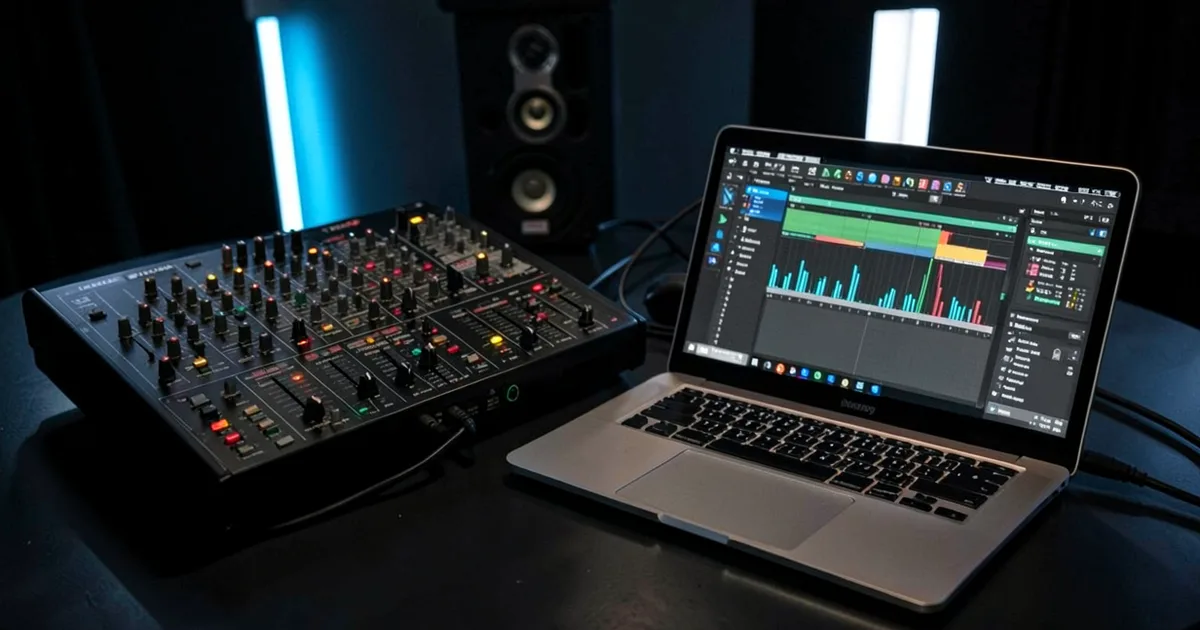
Hardware synths give you tactile control, zero-latency response, and gear that still works in 20 years. Plugin synths give you unlimited instances, instant recall, and professional-quality sound for a fraction of the price. Most producers in 2025 use both, strategically.
Plugin synths win on paper. Hardware synths win in the room. That tension is what makes this one of the most satisfying debates in production, and also one of the most practically important decisions you'll make when building your signal chain.
We've worked in setups running 40 plugin instances with zero hardware, and setups where a single Moog sat in the corner and did more for the track than everything in the box combined. Neither approach is right by default.
What matters is understanding what each actually does for your workflow, your sound, and your budget. Not in theory. In practice.
This guide lays out the real differences, the honest trade-offs, and a hybrid approach that most producers land on once the ideology fades away.
What Does Hardware Actually Give You That Plugins Don't?
The honest answer is three things: tactile control, physical presence in your signal chain, and longevity.
Tactile Control Changes How You Play
There's something that happens when you reach for a real filter knob. You stop thinking about the sound and start feeling for it.
We ran a session using Arturia's MiniFreak plugin against the MiniFreak hardware unit, playing the same patch, recording both. The notes were identical. The performance wasn't. The hardware version had micro-variations in filter sweeps, tiny velocity inconsistencies that made the part breathe. The plugin version was cleaner. Too clean.
That's not nostalgia. That's workflow affecting output. Hardware makes you perform rather than program.
Controllers help, but they don't fully replicate it. You're still one layer of abstraction away from the sound source.
Latency Is Real, Even When You Can't Hear It
Plugin synths run through your audio interface, your buffer, your driver stack. Even at a 64-sample buffer, you've got 1.5ms to 3ms of roundtrip latency depending on your system.
That's not audible in a mix. It is noticeable when you're playing keys live. Hardware is zero latency, always. For live performance or real-time recording sessions, that difference matters more than any sonic comparison.
Hardware Lasts. Software Has an Expiry Date.
This is the underrated argument for hardware that almost no one talks about honestly.
A Korg Minilogue from 2016 still works today. It'll work in 2035. Your DAW project from 2014 using a plugin that's been discontinued, updated out of compatibility, or locked to an expired license? That's gone. Possibly forever.
We've lost sessions to this. It's genuinely frustrating.
Hardware synths have a near-zero obsolescence rate if maintained. Plugin synths depend on the health of the company that made them, the OS you're running, and the plugin format your DAW supports. That's three potential failure points per plugin.
Where Do Plugin Synths Actually Win?
Everywhere that hardware is impractical. Which, for most producers, is a lot of places.
Cost Per Sound Is Absurd in Software's Favour
Serum costs $189. It ships with 450+ presets and an unmatched wavetable editor. Hardware that competes sonically with Serum's wavetable engine starts at $600 and doesn't give you the same visual editing workflow.
Arturia's V Collection 9 bundles over 30 virtual instruments for around $599. Those instruments include emulations of the Minimoog, the Jupiter-8, the CS-80, and the Prophet-5. Buying the originals in working condition costs tens of thousands of dollars, and you'd still need to maintain and calibrate them.
The value case for plugins is overwhelming. Especially at the entry level.
Instant Recall Is a Studio Workflow Superpower
This is one of the things we genuinely love about working in the box.
You close a project on Thursday, open it Monday, and every plugin is exactly where you left it. Every parameter, every automation lane, every modulation assignment. That took us 20 minutes with hardware routing per session. Now it's a double-click.
For professionals billing by the hour, instant recall isn't a convenience. It's money.
Unlimited Instances Change Arrangement Thinking
Run eight instances of Massive X on a modern CPU. Done. Try running eight analog synths simultaneously in a home studio. You need eight synths, eight DI boxes, eight mixer channels, and cables everywhere.
The ability to layer sounds freely, send them to different buses, automate parameters independently, all without touching physical gear, changes how you write music. Your arrangements get more complex because the barrier to complexity drops to zero.
Vital is free. lists it alongside other zero-cost options that genuinely compete with paid alternatives.
Does Hardware Actually Sound Better?
Careful. This is where the debate gets ugly fast.
Blind Tests Say No. Sessions Say Maybe.
Properly controlled blind listening tests consistently show that most trained listeners cannot reliably distinguish between a well-recorded hardware synth and a quality emulation. The Moog Model D versus Arturia Mini V? In a mix, at similar levels, through the same monitoring chain? Most people can't tell.
But here's the complication. The hardware version sounds different at different temperatures. Its filter drifts slightly. Two notes held simultaneously interact in ways that aren't fully modelled. None of that is "better" by measurement. Some of it is audible in ways that feel brilliant rather than technically accurate.
Analog circuitry introduces harmonic saturation that sits around 0.1% to 0.5% THD in vintage gear. Digital oscillators without intentional saturation are cleaner. Whether that's better depends entirely on what the track needs.
Recording Hardware Introduces Room and Chain Colour
A DX7 patched through a Neve preamp on the way in sounds warmer than the same DX7 direct, not because the synth changed, but because the chain coloured it. That's not the synth sounding better. That's production choices stacking up.
Plugins can replicate that chain too. Arturia's preamp emulations, UAD's tape emulations, even free options like CHOW Tape Model, add the same colour in the box. The hardware advantage here is real but reproducible.
What About Resale Value and Long-Term Investment?
Hardware wins here. Clearly.
A Korg Minilogue retails around $519. Used prices hold at $350 to $400 consistently. A Roland Boutique series unit holds 60% to 70% of its new value after two years. A Moog Subsequent 37 has appreciated in value since launch.
Plugins depreciate to zero the moment the company folds. You can't sell a licence in most cases. You can't list it on Reverb. It just stops working.
For producers treating their studio as an asset, hardware has a balance-sheet argument that software doesn't. That's not the only reason to buy gear. But it's a real one.
The Jupiter-8 originally retailed around £3,999 in the early 1980s. Working originals now trade for between £10,000 and £25,000. That's a holding. Not just a synth.
How Do You Build a Hybrid Setup That Actually Works?
This is what most guides miss. The goal isn't hardware vs. plugins. It's using each for what it does best.
One Hardware Synth, Everything Else in the Box
We tested this setup for three months. One Moog Grandmother as the sole hardware unit, running into a pair of UAD Apollo inputs. Every other instrument was software: Serum, Pigments, Omnisphere, Phase Plant.
The result was satisfying in a way that a fully ITB setup wasn't. The Grandmother handled every lead and bass that needed character. The plugins handled pads, textures, and anything requiring multiple layers. The workflow felt balanced. Nothing was fighting for attention.
Start with one piece of hardware you'll play every session. Not one that sits in the corner because it's cool to own.
Use Plugins for Sound Design, Hardware for Performance
Design patches and textures in Serum or Pigments. Export stems. Then import those stems and process them through hardware if you have it, or through high-quality saturation and filter plugins in the box.
Softube's Model 72 Synthesizer System and Moog's own IOS software (Moog Model 15) let you get analog-adjacent workflows without the hardware cost. They're not identical. They're close enough for most contexts.
For hybrid workflow tools, the guide covers the practical side of routing, latency compensation, and CV-to-MIDI bridging.
The Budget Reality Check
If your budget is under $500, buy plugins. Full stop.
A $300 hardware synth at the entry level, like the Yamaha Reface DX, gives you one specific character. $300 in plugins gives you Serum plus several high-quality effects, plus a sample library, plus room for experiment. The creative range per dollar is not even close.
At $500 to $1,000, a used hardware synth starts making sense if you value the tactile experience or perform live. The Korg Minilogue XD at around $550 new is the most recommended entry-level analog for a reason. Four voices, digital multi-engine, real knobs, and it sounds clean in a way that means tight, low-noise oscillators with controllable filter resonance up to self-oscillation.
Above $1,000, you're buying character and craft. Moog, Sequential, Elektron. These are tools that reward the producers who'll actually use them every day.
Synthtopia and Matrixsynth are the best places to track current hardware pricing and demo content for making this call. The breaks down the best options by budget tier.
Worth Bookmarking
- Synthtopia, news, demos, and pricing on new hardware releases
- Matrixsynth, vintage hardware tracking, sales, and resale value reference
- KVR Audio, plugin database, user reviews, and developer forums
- VST4Free, curated free plugin directory
- Gearspace (Gearslutz), forum threads for head-to-head hardware vs. plugin comparisons
- Reverb.com, real-world resale pricing on hardware synths
- Sweetwater, detailed spec comparisons and buyer guides
- ModularGrid, for eurorack and modular planning (hardware-adjacent)
Summary
Plugin synths win on cost, flexibility, instant recall, and CPU-over-space convenience. Hardware synths win on tactile control, longevity, resale value, and the kind of performance feel that changes how you play.
The binary debate is the wrong frame. Most producers benefit from one or two hardware pieces they genuinely reach for, backed by a strong plugin setup doing the heavy lifting. Start in the box. Add hardware when you know exactly what gap it fills. Build both sides deliberately.
Related guides: outboard gear guide
Frequently Asked Questions
Do hardware synths actually sound better than plugin synths?
In blind tests, most listeners can't reliably tell the difference. Hardware introduces analog drift, slight harmonic saturation (typically 0.1% to 0.5% THD in vintage gear), and oscillator interaction that modelling doesn't fully replicate. Whether that's better or just different depends on the track. In a mix at loud volumes, it rarely matters as much as the playing and the arrangement.
What's the cheapest hardware synth worth buying?
The Korg Minilogue XD at around $550 new is the most honest entry point for analog hardware. It gives you four voices, real filter knobs, and a digital multi-engine for extra sound design range. The Yamaha Reface DX at $300 is a solid FM option if that's the character you're after. Below $300, plugin alternatives are stronger value almost every time.
Can plugin synths replace hardware completely?
For recording and production purposes, yes. Arturia, U-He, and Xfer make plugins that compete directly with hardware on sound. What they don't replace is the live performance feel, the tactile workflow, and the physical longevity. If you never perform live and you work fully ITB, plugins alone are a completely viable professional setup.
Why do some producers insist on hardware even though plugins are cheaper?
Because playing hardware changes the performance. Reaching for a real knob, hearing the filter respond immediately, feeling the instrument rather than clicking through a GUI: those things affect the music you make. It's not irrational. It's a workflow preference with measurable creative output differences. It's also partly about ownership and resale value that software doesn't provide.
Do hardware synths hold their value?
Yes, most quality hardware synths retain 60% to 75% of their new value after two to three years. Vintage and rare units often appreciate significantly. Software licences, by contrast, typically can't be resold at all. For producers treating gear as an asset, hardware is the only side of this debate with financial upside.
Will my plugin synths stop working one day?
Likely yes, eventually. Plugin synths depend on the company staying active, the plugin format remaining supported by your DAW, and your OS staying compatible. We've lost access to plugins due to company closures, format deprecation (32-bit VST2 is already dead in several DAWs), and licence server shutdowns. Hardware doesn't have this problem if it's maintained.
What's the best way to combine hardware and plugin synths?
Use one or two hardware pieces for the sounds you want to perform and record with real-time feel. Use plugins for layering, sound design, pads, and anything requiring multiple simultaneous instances. Route hardware into your DAW via a quality audio interface, dial in latency compensation in your DAW settings, and treat hardware recordings as audio stems once committed. That hybrid approach covers both worlds without doubling your costs.
Is latency a real problem with plugin synths?
For mixing and production, no. At a 64-sample buffer you're looking at 1.5ms to 3ms roundtrip, which is inaudible in playback. For live keyboard playing, yes, it's noticeable. If you play keys live and feel the timing is slightly off, drop your buffer to 32 or 64 samples, or switch to hardware for live performance and record it as audio. Hardware has zero latency by default.
Which plugin synths are closest to their hardware counterparts?
Arturia's V Collection is the most comprehensive hardware emulation suite available, covering Minimoog, Jupiter-8, CS-80, Prophet-5, and more. U-He Repro-1 and Repro-5 are widely considered the most accurate Prophet-5 emulations in software. For Moog-style ladder filter sound, Arturia's Mini V and U-He Diva (which models multiple analog filter topologies) are our picks.
Should a beginner start with hardware or plugins?
Start with plugins. Get Vital (free), learn synthesis principles without spending money on gear you might not click with. Once you know what sounds you return to constantly, that's your hardware shortlist. Buying hardware before you know your workflow means buying the wrong thing. Plugins are forgiving. Hardware is a commitment.