
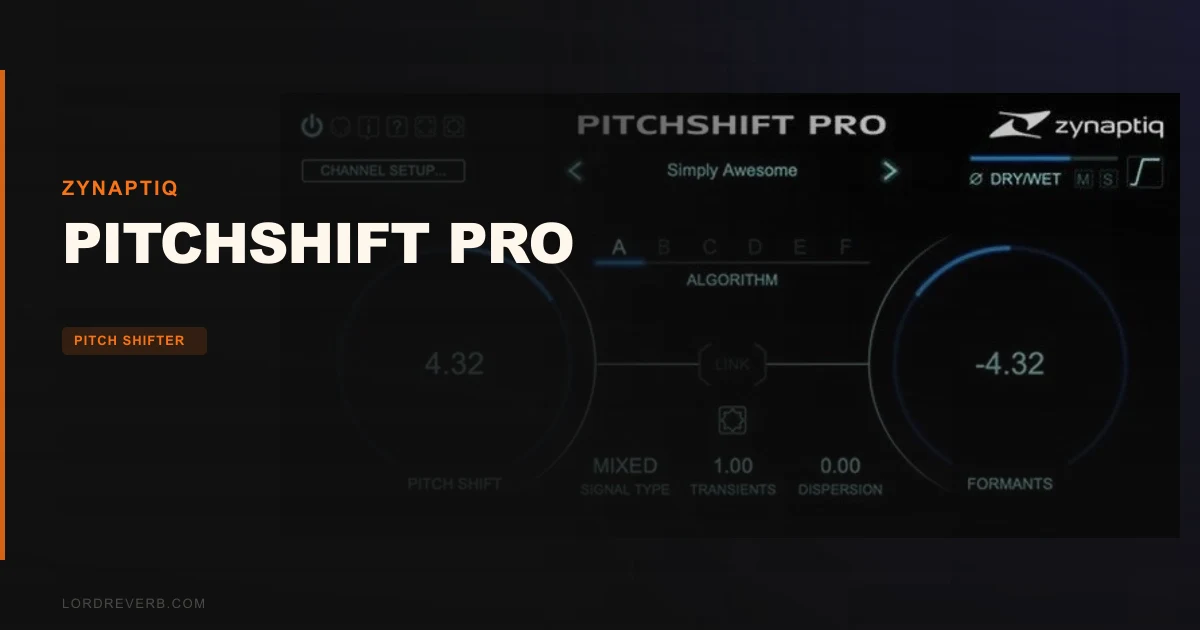
Pitchshift Pro is most often stacked against Serato Pitch 'n Time and Elastique Pitch v2, and that's exactly where this review is going to land: it's a legitimately capable pitch-shifter, priced at $269, that earns its place in certain workflows and falls short in others. It is not the automatic choice. Whether it belongs in your signal chain depends on what you're shifting and how much latency you can live with. This is built for sound designers, post engineers, and producers who need wide-range pitch-shifting with formant control. If you're mainly correcting vocals in real time, there are better tools for less money.
How Does PITCHSHIFT PRO Compare Out of the Box?
The first thing that separates Pitchshift Pro from the crowd is its six algorithms. You get a classic delay-line design, advanced resynthesis, time-stretching, a state-of-the-art hybrid mode, and two additional options. That breadth matters when one algorithm cracks on a full drum bus but another tracks cleanly.
Serato Pitch 'n Time, its closest real competitor, chases transparency above everything else. Pitchshift Pro trades some of that neutrality for formant control and creative range. Neither approach is wrong. They're just different priorities.
Elastique Pitch v2 covers similar ground, and owners report results that are comparable overall. On some exotic material, Pitchshift Pro edges ahead. On general content, it's roughly a coin flip between them.
What you notice immediately is the range. Four octaves in either direction is a wide sandbox. Monster voices, alien textures, full-mix pitch correction for frame-rate conversion: this is where Pitchshift Pro looks at home.
Performance Deep Dive
Owners report processing sounds cleaner than standard pitch-shifters on vocals, drums, synths, and full stereo mixes. Metallic artifacts that plague cheaper algorithms are noticeably reduced. That's not a small thing at this price point.
Shifting a full stereo mix 2-3 semitones is a real-world stress test. Owners report acceptable fidelity using Algorithm A for exactly this task. That's useful for post-production work where picture lock changes key.
Formant preservation is where vocal producers will find the most satisfying results. Slightly off-pitch takes stay natural-sounding rather than turning chipmunk or hollow. You're not reaching for a separate formant tool on top.
But here's the frustrating part. Owners report Pitchshift Pro underperformed against NuRo XPitch, Logic Flex Pitch, Waves Vocal Bender, and Manipulator in comparative testing. That's a long list of losses. The latency compounds this: Manipulator and Vocal Bender offer zero latency, and Pitchshift Pro doesn't match that.
CPU usage ranges from moderate to heavy. With multiple high-quality instances running in a large session, bouncing to audio becomes necessary, not optional. Plan around that.
Where PITCHSHIFT PRO Wins
Four octaves of pitch-shifting range with formant control and six algorithm choices is a genuinely wide toolkit. For sound design work, that combination is hard to beat at this tier.
Say you're building a creature voice from a recorded human. You push the pitch down an octave, dial in formant compensation, and switch algorithms until the texture sits right. That workflow feels native here in a way it doesn't in tools built primarily for music correction.
Immersive audio support is a real differentiator. Up to 16-channel phase-synchronous processing is not a feature you find everywhere. If you're working in Atmos or any multi-channel post context, this matters.
Compatibility is broad: AAX Native, AU, and VST 3, Intel and Apple Silicon, 44.1kHz through 192kHz. You're not fighting the plugin to fit your session. It just fits.
Where the Competition Wins
Latency is a genuine problem if your workflow needs real-time monitoring. Manipulator and Vocal Bender both offer zero latency. Pitchshift Pro doesn't. That's annoying for live vocal processing or any tracking scenario where the singer needs to hear themselves pitch-shifted in the headphone mix.
On vocals specifically, the competitive picture is ugly. Melodyne isn't a direct rival because it's doing something different, but NuRo XPitch, Vocal Bender, Manipulator, and even Logic's built-in Flex Pitch reportedly outperform Pitchshift Pro in head-to-head vocal testing. At $269, that's a hard result to ignore.
The tooltip behavior is a small thing that becomes a recurring irritation. Controls that don't consistently show tooltips slow down the learning curve. Not a dealbreaker. Still worth knowing before you buy.
iLok account required. If you've made peace with PACE copy protection, fine. If you hate it, that's one more activation step between you and your session.
Who Should Buy Which?
- ✅ Buy if you work in post-production and need reliable full-mix pitch correction across frame-rate conversions
- ✅ Buy if sound design is your main use case and you need four octaves of range with formant control in one plugin
- ✅ Buy if you're running immersive audio sessions and need phase-synchronous multi-channel pitch-shifting
- ❌ Skip if vocals are your primary target and low latency monitoring matters to your workflow
- ❌ Skip if you're running large mix sessions with multiple pitch-shifting instances and CPU headroom is tight
- ❌ Skip if you're chasing maximum transparency on broad material: Serato Pitch 'n Time is built for that job
Specs & Technical Details
| Developer | Zynaptiq |
| Price | $269 |
| Plugin Format | VST3 / AU / AAX Native |
| OS Support | macOS 10.15.x or newer / Windows 10 or newer |
| Activation | PACE / iLok account required; hard drive or iLok 2+ USB dongle; 2 activations per license |
| CPU Usage | Moderate to heavy |
| Trial Available | N/A |
| Version Reviewed | N/A |
Score Breakdown
| Category | Score | Notes |
|---|---|---|
| Sound Quality | 3.5/5 | Clean results on exotic and wide-range material; underperforms rivals on straight vocal work |
| Value for Money | 3.0/5 | At $269, the vocal performance gap against cheaper or included tools is hard to justify for most producers |
| Ease of Use | 3.5/5 | Broad compatibility and clear algorithm choices offset by inconsistent tooltip behavior |
| Features | 4.0/5 | Six algorithms, four-octave range, 16-channel immersive support: genuinely broad |
| CPU Efficiency | 3.0/5 | Moderate to heavy load forces audio bouncing in larger sessions |
| Overall | 3.5/5 | A strong specialist tool that falls short of its price promise for general vocal work |
Alternatives to Consider
Serato Pitch 'n Time is the closest direct competitor. It prioritizes transparency over creative range, which makes it the better call for broadcast and mastering work where you want pitch correction that leaves no fingerprint. If you love clean and invisible, look there first.
Elastique Pitch v2 covers similar ground to Pitchshift Pro at a comparable level. Owners find them roughly equal across most material, with Pitchshift Pro pulling ahead on certain exotic content. If you're deciding between just these two, the algorithm character is worth auditioning side by side if a trial is available.
Melodyne is not a pitch-shifter in the same sense. It's a correction and melodic editing tool that excels at fixing individual notes and reshaping performances. If what you actually need is detailed melodic surgery rather than creative whole-signal pitch-shifting, Melodyne is the smarter purchase. Different job, different tool.
The Honest Verdict
Pitchshift Pro at $269 is a specialist plugin wearing a generalist price tag. For sound designers building creature voices, post engineers correcting a film mix for frame-rate conversion, or anyone pushing pitch across four octaves in an immersive session, it earns its keep.
For vocal producers who want the best possible quality on lead vocals and need zero-latency monitoring, it doesn't. The comparative testing results from owners are consistent enough that we'd point those buyers toward Manipulator or Vocal Bender first.
The six-algorithm selection and 16-channel support are clever design choices that solve real problems in specific contexts. The CPU load and latency are real costs that land harder in some sessions than others.
If sound design or post-production accounts for more than half your work, this is worth serious consideration. If you produce primarily vocal-driven music, spend that budget elsewhere and revisit Pitchshift Pro when a sale or bundle brings the entry cost down.
Frequently Asked Questions
Does PITCHSHIFT PRO require a physical iLok dongle?
No, a physical dongle is not required. You need a free iLok.com account, but activation can be stored on your hard drive. The iLok 2 or newer USB dongle is a supported option, not a requirement. Each license allows two activations.
How many semitones can PITCHSHIFT PRO shift?
Pitchshift Pro supports pitch-shifting up to four octaves in either direction. That covers 48 semitones up or down from the source pitch. Owners report acceptable fidelity shifting full stereo mixes 2-3 semitones using Algorithm A specifically.
Is PITCHSHIFT PRO good for live vocal pitch-shifting?
It's not the strongest choice for real-time vocal monitoring. Owners report higher latency than Manipulator and Vocal Bender, both of which offer zero latency. If a singer needs to hear pitch-shifted audio in their headphone mix during tracking, the latency will be a problem.
Does PITCHSHIFT PRO work on Apple Silicon Macs?
Yes. It's compatible with both Intel and Apple Silicon processors, and runs on macOS 10.15.x or newer. It's available in AU, VST 3, and AAX Native formats, covering the main DAW hosts used on Mac.
How does PITCHSHIFT PRO handle multi-channel immersive audio?
It supports up to 16-channel audio with phase-synchronous multi-channel processing. That design keeps channels time-aligned when pitch-shifting, which matters in immersive formats where phase relationships between speakers affect spatial imaging. It's one of the stronger use-case arguments for choosing it over narrower alternatives.