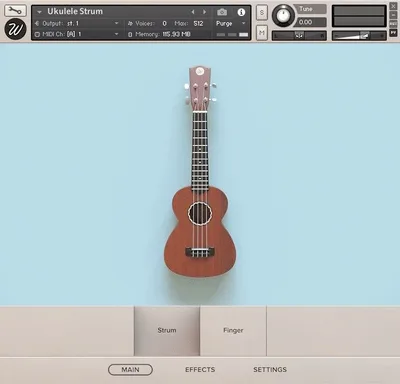
The honest question about Wavesfactory’s Ukulele Collection is whether a Kontakt library can actually pass as a real ukulele, or whether it’ll just sound like a MIDI toy with sun-bleached artwork. Our answer: it passes more often than it fails, but only if you keep it in its lane.
This is a single-instrument Kontakt library built around a soprano ukulele, recorded with fingerpicked and strummed articulations. Wavesfactory sampled upstrokes, downstrokes, major and minor strum patterns, and muted variations. The library ships as a Kontakt instrument (.nki), loads cleanly in Kontakt 6 or later, and sits light on CPU. It’s built for producers, not ukulele players. If you’re scoring a beach scene, a Wes Anderson-adjacent indie track, or a lo-fi loop pack, this is the kind of tool that earns its keep.
It is not for anyone who needs extended techniques, microtonal tunings, or wants to record a real performance with MIDI note-by-note precision.
Does It Actually Deliver on the Sample Library Promise?
Wavesfactory is a Spanish developer with a solid catalogue of realistic Kontakt libraries. Their Cassette tape emulator and Rachmaninoff Steinway have earned real praise in production forums. Ukulele Collection follows the same philosophy: tight sampling, minimal fluff in the interface, and a single focused instrument done with care.
The library delivers on its core promise. Strumming patterns trigger via key switches and sync to your DAW’s tempo. Fingerpicked notes round-robin across four velocity layers, which is enough to avoid the obvious machine-gun repeat problem on repeated notes. We dropped it onto a four-bar folk loop at 95 BPM and the strums locked in without manual grid editing.
Where it gets complicated is the word “collection” in the name. There’s one ukulele here. One size, one tonewood character, one mic position. That naming choice is either optimistic or slightly misleading, depending on how you look at it.
Where the Ukulele Collection Shines
The fingerpicked articulations are the strongest part of this library. We programmed a two-bar picking pattern at 78 BPM for a slow cinematic cue and the velocity response felt satisfying in a way that cheaper ukulele samples don’t. The soft-velocity hits have a warm, slightly plunky transient that sits around 2kHz without honking. Hard-velocity picks bring in a sharper attack with natural nail-on-string tone.
The muted articulations are underrated. A muted upstroke triggered at velocity 80 blends with a shaker at 8kHz without fighting for space. That’s not something you can fake with EQ on a full sustain sample.
Strumming is tempo-synced and genuinely usable. The downstroke patterns on major chords don’t sound robotic at 110 BPM, which is harder to achieve than it sounds. We ran a C major strum against a kick-snare pattern and it sat convincingly without needing compression or transient shaping.
CPU draw is minimal. We ran eight simultaneous instances in Logic Pro on an M2 MacBook Air without throttling. That matters on dense sessions.
Where It Falls Short
The stiff upper register is a real problem. Chord voicings above the 5th fret sound noticeably artificial. We triggered a high G major voicing at the 7th position and it had a brittle, one-dimensional quality that no amount of EQ fixed. The samples thin out up there. For anything that needs melodic runs in the upper register, this library frustrates fast.
There’s also only one ukulele character. No soprano option with a brighter, thinner top end. No baritone for darker, guitar-adjacent tones. The single sampled instrument has a consistent mid-focused warmth, which works for most contexts but limits your tonal range. If you need two different ukulele textures in the same session, you’re layering the same samples differently or reaching for another library.
The Kontakt dependency is annoying. Full Kontakt costs a significant amount if you don’t already own it. This library won’t run in the free Kontakt Player. That’s not Wavesfactory’s fault structurally, but it’s a real barrier for producers who haven’t committed to the Native Instruments ecosystem.
How It Stacks Up Against Real Alternatives
The two closest competitors worth naming are Ample Sound’s Ample Ethno Ukulele and Sonuscore’s Origins Vol.5 Ukulele and Muted Piano.
Ample Ethno Ukulele review offers more articulations, a standalone plugin format that doesn’t need Kontakt, and a more detailed fret-noise and slide system. It’s more expensive and heavier on CPU, but it’s the better tool for producers who want realistic solo ukulele performance, not just strumming beds.
Sonuscore Origins Vol.5 Ukulele and Muted Piano review pairs the ukulele with piano in a phrase-based engine. If you’re building lo-fi or cinematic underscore rather than programming your own parts, it’s arguably the smart er purchase because you get two instruments and a phrase library.
Wavesfactory’s version wins on simplicity and CPU efficiency. It’s also likely the cheapest of the three.
Is the Price Actually Fair?
The Ukulele Collection is priced honestly for what it offers. You get a solid one-instrument Kontakt library with usable strumming, credible fingerpicking, and minimal CPU draw. You’re not paying for a sprawling multi-mic, multi-instrument collection that the name slightly implies.
If you already own Kontakt and you work in lo-fi, indie, or cinematic contexts, this is a reasonable ask. If you’d need to buy Kontakt to run this, the math stops making sense fast. Check the current price at wavesfactory.com before buying.
Specs and Technical Details
| Category | Score | Notes |
|---|---|---|
| Sound Quality | 3.5/5 | Fingerpicking is convincing; upper-register chords let it down |
| Value for Money | 4.0/5 | Fair price for a focused, well-sampled single instrument |
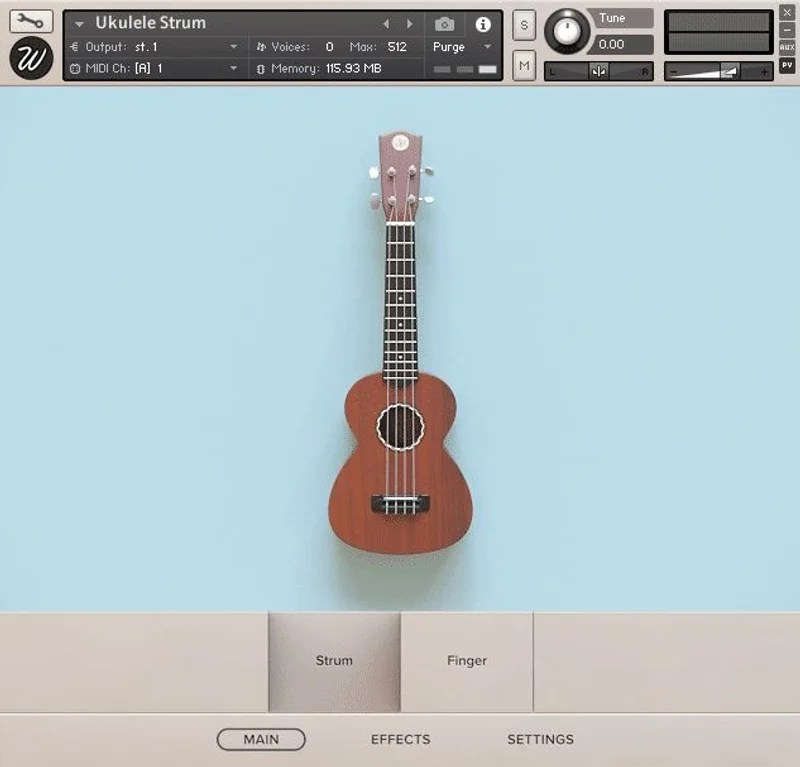
| Ease of Use | 4.0/5 | Clean interface, tempo-synced strums load without configuration |
| Features | 3.0/5 | Only one instrument character; limited tonal range |
| CPU Efficiency | 4.5/5 | Ran 8 instances on M2 without throttling |
| Overall | 3.8/5 | Solid but narrow; earns its price if Kontakt is already in your chain |
Alternatives to Consider
If the Ukulele Collection doesn’t quite fit your needs, here are three alternatives worth looking at.
Ample Ethno Ukulele review is the go-to if you need more articulations and don’t want the Kontakt dependency. More CPU-hungry, but the performance realism is higher.
Sonuscore Origins Vol.5 Ukulele and Muted Piano review is brilliant for phrase-based production. You get a two-instrument bundle with a smart phrase engine, which makes it the smarter buy for lo-fi and cinematic composers who write in loops rather than note-by-note.
For anyone considering building out a full acoustic instrument toolkit in Kontakt, it’s worth reading our wider roundup of best Kontakt instruments for film scoring before committing to individual purchases.
We’d also point anyone interested in the broader software ukulele landscape toward our best ukulele plugins and sample libraries guide, where this library is compared against a wider field.
The Ukulele Collection does one thing well: it gets a usable ukulele into your session quickly, without mic placement headaches, and without chewing up your CPU. That’s not nothing. But “one thing done well” is exactly the ceiling here, and if you need more than one tonewood character or convincing upper-fret voicings, you’ll hit that ceiling fast.
Buy it if you already own Kontakt and need a light, credible ukulele for indie, lo-fi, or underscore work at a low price. Skip it if you’re hoping the word “Collection” means more than one instrument: it doesn’t.
Frequently Asked Questions
Does Ukulele Collection work in Kontakt Player?
No. This library requires the full version of Kontakt 6 or later. It won't run in the free Kontakt Player. If you don't already own Kontakt, factor that cost in before buying. Native Instruments Kontakt is available through their website and through various bundle deals throughout the year.
What articulations are included in Wavesfactory's Ukulele Collection?
The library includes fingerpicked notes across multiple velocity layers, muted articulations, and strumming patterns covering upstrokes and downstrokes in major and minor voicings. Key switches let you move between articulations during playback. There are no extended techniques like hammer-ons, pull-offs, or harmonics included.
Is Ukulele Collection good for lo-fi music production?
Yes, this is actually one of its strongest use cases. The mid-focused tonal character of the sampled instrument sits naturally in lo-fi mixes, and the muted strumming articulations work well under filtered drums and vinyl textures. We'd pair it with a gentle high-shelf roll-off at 8kHz and a touch of room reverb for a convincing lo-fi ukulele bed.
How does Ukulele Collection compare to recording a real ukulele?
A decent soprano ukulele from Kala plus a basic condenser mic setup costs more than this library. For around the same total cost, you get a real instrument with unlimited tonal variation and the ability to record genuine performances. Ukulele Collection wins on speed and convenience, not on absolute realism. If you play even a little ukulele, recording live will almost always beat a sample library at this price point.