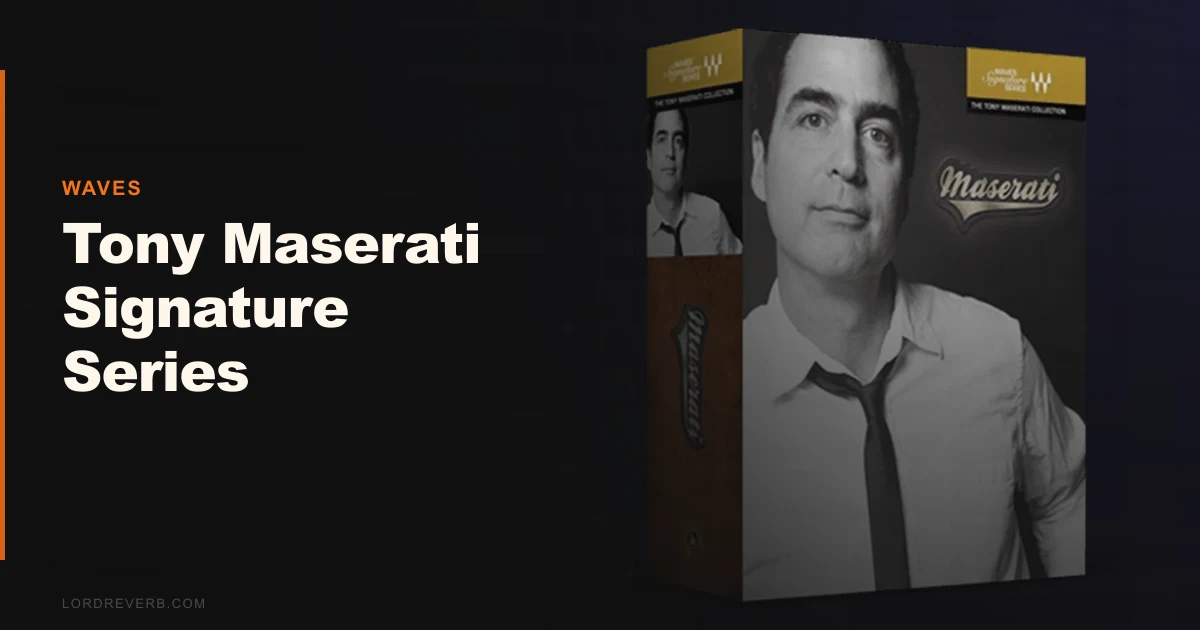
The real question about the Tony Maserati Signature Series isn't whether it sounds good. It does. The question is whether you're buying a professional toolkit or a very expensive set of training wheels you'll outgrow in six months.
After testing all seven plugins across vocal sessions, drum buses, and acoustic guitar tracks, we have a clear answer. This bundle earns its place in specific workflows and earns a hard skip in others. Which side you land on depends entirely on what you're actually trying to do.
The Signature Series includes VX1 Vocal Enhancer, B72 Bass Phattener, DRM Drum Slammer, GTi Guitar Toner, ACG Acoustic Guitar Designer, HMX Harmonics Generator, and the newer GRP Group Processor. Seven plugins. MSRP is much higher, but it has sold for far less on Thomann. Right now the price varies depending on where you shop.
It's built for producers who mix their own material, home studio engineers who want fast results, and anyone who has ever spent 45 minutes on a vocal chain and ended up further from the mix than when they started.
Does It Actually Deliver on the Maserati Promise?
Tony Maserati has mixed Beyoncé, Jay-Z, and David Bowie. That's not marketing filler. That's a signal chain you'd pay to sit in front of.
The premise of this bundle is that Waves reverse-engineered Maserati's personal hardware chains, verified results through studio comparison, and packaged them into minimal interfaces. The hardware referenced includes SSL 4000 consoles, V-series and Helios units. These aren't imaginary vintage references.
We ran a lead vocal through the VX1 on a pop production. Three knob moves. The top end opened up above 8kHz without the harshness that usually comes from amateur high shelf boosts. Presence arrived without sibilance. That result would have taken us significantly longer on a blank channel strip.
So yes. For what it promises, which is fast, professional-grade processing with minimal setup, it delivers. The caveat is that it delivers a specific version of "professional," and that version belongs to one mixer's taste, not yours.
Where the Maserati Series Actually Shines
The VX1 is the standout. Seriously. We've tested a lot of vocal plugins and this one earns its reputation.

On a breathy female vocal sitting in a dense pop mix, we found the sweet spot in under two minutes. The low-cut behavior is musical rather than surgical. There's harmonic content being added somewhere in the 2-4kHz range that makes the vocal cut without needing to be louder. We pushed it harder than we expected to and it didn't collapse.
The ACG Acoustic Guitar Designer is the processor that sets this bundle apart from the CLA and JJP equivalents. Neither of those competing series offers a dedicated acoustic guitar plugin. It handles the honky 200-300Hz buildup that plagues acoustic guitars in dense arrangements with a single control rather than requiring you to find the frequency by ear.
We dropped the ACG on a dreadnought tracked in a treated room. Body fullness came up, the boxy midrange came down, and it sat next to a piano without fighting it. That took maybe 90 seconds.
The B72 also deserves credit. On a fingerstyle bass with heavy pick attack, the low-end definition held through laptop speakers, which is the test that matters for most streaming content.
Speed is the honest strength here. If you're mixing 10 to 20 tracks in an evening, shaving two or three minutes per track adds up to something real.
Where It Falls Short, and We're Not Being Polite About It
The black-box design is genuinely frustrating. Not annoying in a minor way. Frustrating in a way that actively prevents growth.
There's no way to know if the DRM Drum Slammer is applying parallel compression, transient shaping, EQ, saturation, or all four at once. You can hear something happening. You cannot learn from it. You cannot adapt it. You cannot route around it when it's doing something wrong.
We put the DRM on a sparse hip-hop kit and it over-processed the room sound in a way we couldn't fix with the available controls. No way to tell whether the problem was a transient stage or a low-mid frequency buildup or something else entirely. We had to bypass it and start over.
The GTi Guitar Toner is the weakest processor in the set. On two different electric guitar sessions, we preferred what we got from a Waves PuigTec EQP-1A and a single saturation plugin. The GTi's character felt generic in a way the other processors don't.
And if you already own the Waves Mercury bundle or anything close to it, the GRP Group Processor and HMX Harmonics Generator both cover territory you've likely already got handled. You're effectively paying for redundancy.
How It Stacks Up Against the CLA and JJP Series
The Chris Lord-Alge Signature Series covers similar territory. CLA-76, CLA-2A, CLA-3A are individual processors based on hardware units. They're more transparent by design. You know what they're doing because they're emulations of known gear.
The JJP series by Jack Joseph Puig is closer in philosophy to Maserati. Minimal interface, fast results, instrument-specific. But JJP doesn't have an acoustic guitar processor and the vocal processor h as less character than VX1 in our direct comparisons.
Maserati wins for speed and for the ACG specifically. CLA wins when you want to understand your signal chain and build skills while you mix. Pick based on where you are in your development, not which name you recognize.
For vocal-specific processing, the W.A. Production Deluxe Vocal Bundle also competes at a lower price point with more transparent controls if VX1 is the main draw for you.
Is the Price Fair?
At $399 MSRP, no. You're paying for a name.
If you wait for a Waves sale and catch it at a low price, yes. That works out to a small amount per plugin for processing built from hardware chains most people can't afford to own. The VX1 alone at that price is worth it for anyone who records vocals regularly.
Check the Waves Restoration plugins sale page for context on how aggressively Waves discounts. The Maserati bundle follows the same pattern. Never buy it at full price.
Score Breakdown
| Category | Score | Notes |
|---|---|---|
| Sound Quality | 4.0/5 | VX1 and B72 genuinely hold up; GTi is the weak link |
| Value for Money | 3.5/5 | Strong at sale price; overpriced at MSRP |
| Ease of Use | 4.5/5 | As fast as it gets; minimal interface works exactly as intended |
| Features | 3.0/5 | No transparency, no modulation routing, no learning curve by design |
| CPU Efficiency | 4.0/5 | Light footprint, runs cleanly across a full session |
| Overall | 3.8/5 | Strong tool for the right user; wrong tool if you want to understand your mix |
Alternatives to Consider
If the VX1 is the main draw, look at the W.A. Production Deluxe Vocal Bundle first. More knobs, more transparency, lower price. Better for producers who want to dial in rather than just drop in.
For harmonic generation specifically, the MWaveShaperMB by MeldaProduction gives you six-band waveshaping with full visual feedback. It takes longer to learn but you'll understand exactly what's happening. The HMX can't say the same.
If transient shaping and dynamic texture are what you're chasing for drum and bass buses, the Sound Particles InShaper is worth a look before committing to the DRM as your primary solution.
The JJP Vocals by Waves is also worth comparing directly to VX1 before buying the full Maserati bundle. If vocals are your main need, don't pay for seven plugins to get one.
Our Verdict
The Tony Maserati Signature Series is a love-it-or-hate-it bundle based entirely on what stage you're at.
If you're producing, recording your own vocals, and mixing 10 to 20 songs a month, you'll love how fast this moves. Drop VX1 on a vocal. Done. Move on. That speed has real value when you're running a home studio with no assistant engineer and a deadline.
If you want to understand why your mix sounds the way it does, you'll hate the black box. There's no way to audit what's happening, and that feeling of not being in control gets old faster than you'd expect.
Buy it at a low sale price. It's worth it there. Skip it at MSRP.
It's wrong for you if you're an intermediate engineer trying to build ears. You need to hear what compression does to a transient. You need to feel where the EQ curve sits. The Maserati series hides all of that. It's brilliant for speed. It's a terrible teacher.
The real Tony Maserati would probably tell you the same thing.

Frequently Asked Questions
How many plugins are in the Tony Maserati Signature Series?
The current bundle includes 7 plugins: VX1 Vocal Enhancer, B72 Bass Phattener, DRM Drum Slammer, GTi Guitar Toner, ACG Acoustic Guitar Designer, HMX Harmonics Generator, and GRP Group Processor. Earlier versions shipped with 6 plugins before the GRP was added. All seven are included in the current SKU (TMSIGSG, version 12.7).
What's the best price to pay for the Tony Maserati Signature Series?
MSRP is $399, which we'd avoid. The bundle has hit a historical low on Thomann. It regularly appears in Waves sales at a reduced price. We'd set a price alert and wait for a good dip before buying. Never pay full price for a Waves bundle.
Is the Tony Maserati Signature Series good for beginners?
Yes, with a caveat. The minimal interface and instrument-specific design make it fast and accessible. A beginner will get professional-sounding results quickly. The downside is that the black-box design doesn't teach you anything about why it sounds the way it does, so it can slow your development as an engineer if it's your only tool.
How does the Tony Maserati series compare to CLA or JJP series plugins?
The CLA series covers similar territory but uses individual hardware emulations with visible parameters. You learn more from the CLA tools but they take longer to dial in. The JJP series is closer in philosophy to Maserati's approach. Maserati's main advantage over both is the ACG Acoustic Guitar Designer, which neither competing series offers. For pure vocal work, the VX1 edges out the JJP equivalent in character and presence.