The most repeated claim about MOJO: Upright Bass is that it’s the most lifelike upright bass you can load into a sampler, and for plucked playing that mostly holds up. At $187.46, the question is whether its quirks matter for how you write. If you program walking lines with constantly moving pitches, some of the realism leaks out. If you play sparse, repeated-note grooves, you’ll hear what the fuss is about.
So this review is a split decision. The sound earns its reputation. The scripting has gaps that owners keep running into.
We’ll walk through what the library promises, what survives contact with a real project, and which kind of player should buy it. Some of you should. Some of you should wait.
The Claim: "The Most Advanced, Lifelike Upright Bass Available"
Vir2 pitches this as the most lifelike upright bass virtual instrument around. The pitch rests on a 150-year-old double bass with a “uniquely resonant” body, recorded at 24bit/96kHz through a Studer A900 analog console and Lynx Aurora 16 A/D converters.
That’s a serious front end. Whether it’s the best is a matter of taste, but nobody can call the capture chain cheap.
The library runs to over 35GB of uncompressed samples. It layers six dynamic ranges with up to eight round-robins per articulation. Marketing language aside, those are real numbers, and they’re the right ones to chase for a bass that has to survive exposed solos.
The second half of the claim is “genuine feel of human playing” and “every requirement for composing, programming, and recording realistic bass lines.” That’s a bigger promise than a good recording. It’s a promise about the scripting, and that’s where things get complicated.
Does It Actually Sound Like the Real Thing?
Mostly, yes. Owners call it the best plucked double bass they’ve heard in a virtual instrument, and one compared it favourably to the Larry Seyer library. Another praised the sound for matching the Reid Anderson tone from The Bad Plus era: woody, a bit rough, a lot of finger.
That’s the character you want from a 150-year-old instrument. Not a polished studio sheen. A bass with some wood grain in it.
One reviewer put the sound at 80 percent there, with certain limitations. Take that as the honest ceiling. It’s very good, and it doesn’t fool anyone on every phrase.
What Holds Up: The Sample Set and Articulations
Start with the articulations, because there are eight and they cover the right ground. You get performable repetitions, percussive hits, genuine played chords, sustains, legato, hammer-ons, pull-offs and staccato.
Genuine played chords are a rare find. Most libraries make you stack single notes and hope.
Percussive hits matter more than they sound on paper. A slapped body knock on beat two is half of what makes a bossa or rockabilly line feel played rather than programmed.
Dynamic layers and round-robins
Six dynamic layers means the jump from a soft thumb to a hard pluck is gradual rather than a cliff. Push the velocity curve control until the middle layers carry your normal playing, and the dynamics start to feel like a hand rather than a switch.
Up to eight round-robins per articulation is generous on paper. Hold that thought, because the scripting limits where you’ll hear them.
Five microphone positions
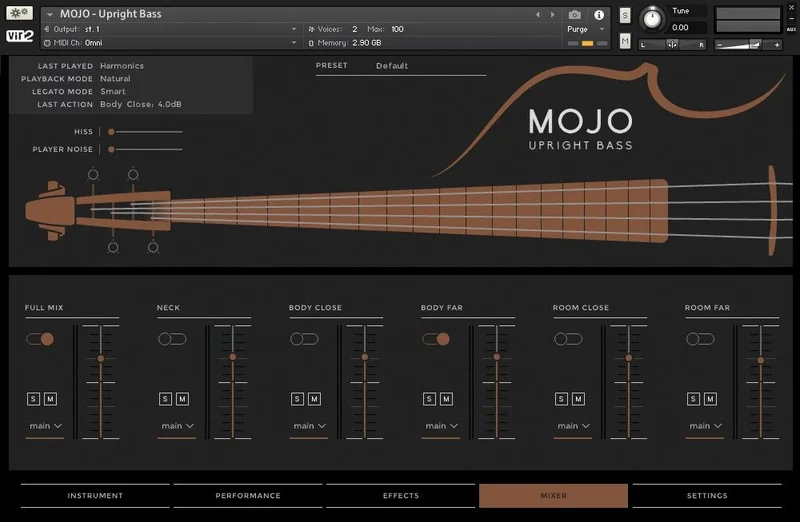
You get neck, body close, body far, and stereo room close and far. That’s five distinct perspectives on one instrument, and each position can be routed to its own output.
Here’s the scene. You’ve got a jazz trio session open and the bass is mushy against the kick. Pull the room mics down, bring the neck mic up, and the definition of each note comes back without touching an EQ. That’s the right way to fix it.
The catch is cost. Five live mic positions load a lot of sample data. Vir2 includes a pre-mixed mic option for reduced CPU usage, and you’ll want it for dense projects.
Legato, Vibrato and Playing Realism
True legato with automatic recognition of overlapping notes is the feature that decides whether a bass line sounds played. Overlap two notes and the library picks the transition itself. No keyswitch, no fuss.
That’s the right way to do it. Keyswitching legato in the middle of a fast line is a good way to lose your flow.
Vibrato comes two ways: authentic vibrato sustains, and simulated vibrato built from real vibrato curves. The recorded sustains are the natural choice for long, singing notes. The simulated option is handy when you need vibrato on a note that wasn’t sampled with it.
You can also pick specific bass strings and adjust the string buzz layer. Choosing strings is a small thing that makes a big difference for voice leading. A line that stays on the E string sounds different from the same pitches spread across the neck.
There’s a capo, too, plus speed-dependent articulation switching for note repetitions. Play fast repeated notes and the library changes how it handles them depending on tempo. Clever, and it’s the kind of detail a real player would notice missing.
The FX Suite and Presets
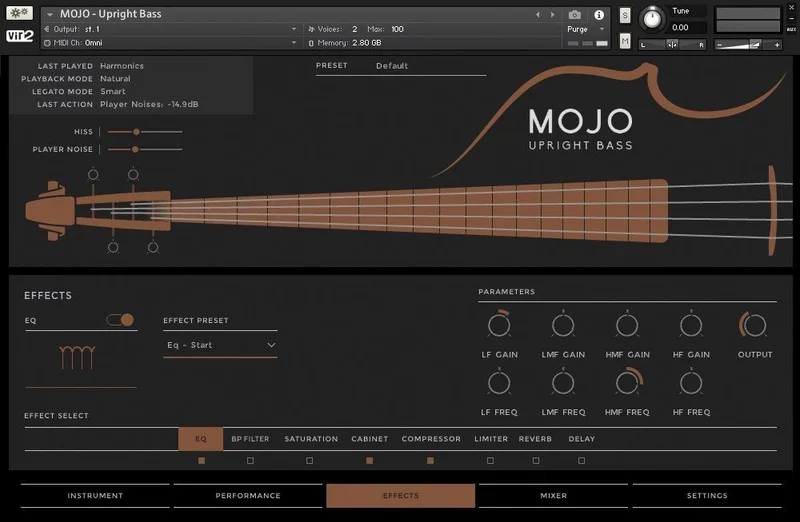
The built-in FX Suite has eight effects: EQ, BP Filter, Saturation, Cabinets, Compressor, Limiter, Reverb and Delay. The cabinets and saturation are the interesting ones. They let you dirty the upright up for a rock or rockabilly sound without leaving the instrument.
Twenty presets give you starting points. That’s a modest number, and there’s a snag we need to flag now: owners report that saved preset names display incorrectly.
Annoying, not fatal. It won’t change a single note of audio. But if you build a personal library of patches, you’ll be squinting at wrong labels, and that wears on you over a long project.
The MIDI Performances: A Shortcut or a Crutch?
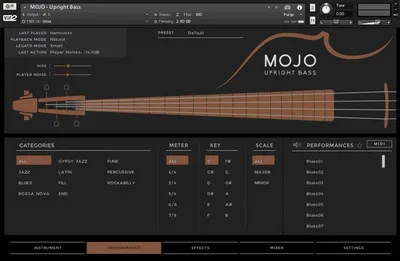
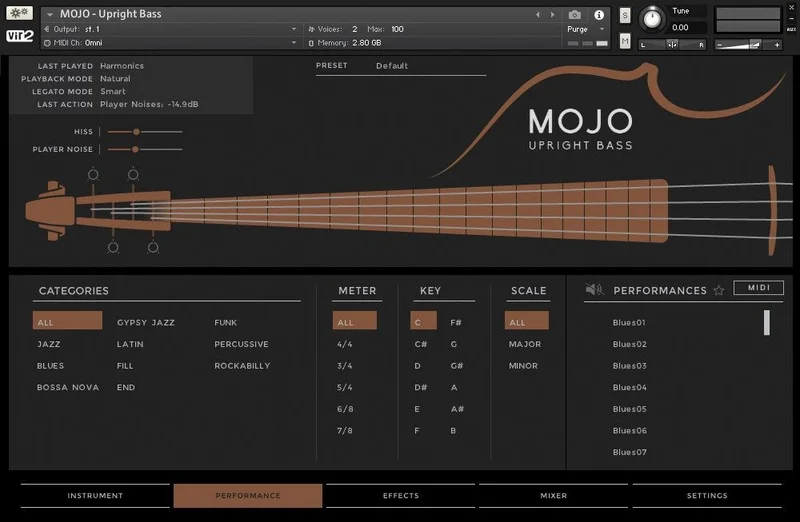
Hundreds of custom MIDI performances ship with the library. You filter them by category, meter, key and scale. Styles include Jazz, Blues, Bossa Nova, Latin, Funk and Rockabilly, and there are fills, ends and percussion categories on top.
For a composer on a deadline, this is the feature you’ll use first. Drag in a bossa groove, set the key, and you’ve got a bass line that already sounds like someone’s hands made it.
It’s also a trap if you lean on it. Patterns from a library are a starting point. Edit them. Change a few notes, shift the ghost hits, move the fills. Otherwise your track sounds like every other track that used the same pattern.
The performances are editable, and owners praise the library as extensively editable for shaping sound. That’s the right instinct: treat the MIDI as clay.
You can also stack articulations into a velocity stack. Assign a percussive hit to high velocities and a sustain to low ones, and a single keyboard gives you a whole range of playing styles.
What Doesn't: The Round-Robin Problem
This is the big one. Owners report that round-robin triggering only activates on repeated same notes with no intervening notes. It doesn’t rotate across a varying line.
One owner called this a very disappointing limitation. We agree.
Think about what you do with a bass. You play a walking line. Notes move constantly. If the round-robins only fire when you hit the same pitch twice in a row, a walking line barely uses them. You’ll hear the same sample come back when the line revisits a pitch, and that’s exactly the machine-gun effect round-robins exist to prevent.
The notes call it a limit of the instrument: round-robin articulations only trigger on repeated identical notes. That’s a design choice that works against a bass’s most common job.
For sparse, repeated-note grooves, it’s fine. Hold a pedal tone and hit it eight times, and the rotation does its work. For melodic walking lines, it’s a real hole.
What Doesn't: Humanize Pitch and the String Buzz Layer
The humanize pitch function doesn’t affect the string buzz layer. Owners report this causes dissonance inside a single note on low G.
Here’s the scene. You switch on humanize to loosen the intonation, play a sustained low G, and the main note drifts a few cents while the buzz layer stays locked. You get two pitch centres inside one note, and your ear catches it as something off.
The fix is simple but unsatisfying. Turn humanize pitch down, or turn the string buzz layer off on those notes. You’re trading away one of the library’s selling points to dodge a bug. Frustrating.
What Doesn't: Player Noise That Won't Quit
Owners report that player noise samples keep playing after the bass stops. You release the note, the bass goes quiet, and a tiny handling noise tails on behind it.
On a busy mix, you won’t hear it. On a solo bass intro, or a sparse arrangement with room to breathe, it’s the kind of thing that catches you out at the worst moment.
You can work around it by trimming or muting the noise layer where it intrudes. But a library at this level shouldn’t make you do that.
CPU, RAM and Disk: What It Asks of Your Machine
The notes give a clear spec sheet. You need Kontakt 7 Player or full Kontakt 7, version 7.10.2 or higher. On macOS that means macOS 12 or higher, 64-bit only, with an Intel Core i5 or later, and Apple Silicon is supported. On Windows it’s Windows 10 or higher, 64-bit only, with an Intel Core i5 or equivalent.
Vir2 recommends 4GB of RAM or more and asks for 18.4GB of free disk space for the installation. That’s well below the 35GB of uncompressed content, so the installed size comes from compression, which is worth knowing before you clear a drive.
The Kontakt requirement matters. This isn’t a standalone-only product you can drop into any host without Kontakt behind it. Formats listed are Stand-alone, VST3, AU and AAU.
For CPU, the live mic positions are what you’ll pay for. Use the pre-mixed mic option when your session gets heavy, and save the individual mic routing for the final pass. We can’t give you a measured CPU number here, because we don’t have one, so test it on your own machine with the trial of your own project before you commit.
Hardware Integration
MOJO: Upright Bass is built to work with Komplete Kontrol keyboards and Maschine, and it’s compatible with all NKS-compatible hardware. If you already play through a Komplete Kontrol keyboard, browsing and tweaking happens from the hardware without mouse-diving.
That’s a quiet win. A bass instrument with this many articulations and mic options is easier to play when the controls sit under your hands.
Who It Suits (And Who Should Walk Away)
This is where the 50/50 split becomes concrete. The library is excellent for some people and a poor fit for others.
The film and media composer
You need a believable plucked upright, fast, for cues that sit under dialogue or sparse jazz underscore. The tone is there, the MIDI performances speed you up, and the round-robin gap matters less when the bass is texture.
Buy it.
The jazz or blues producer writing walking lines
You live and die by moving bass lines. The round-robin limit hits you in the exact place you spend your time, and the humanize-buzz bug lands on low G, where walking lines love to sit.
Wait. See whether a Vir2 update fixes the scripting, or test it hard first.
The singer-songwriter or band demo maker
You want a good upright under a song without hiring a bassist. Sparse, repeated-note patterns fit this library well, and the grooves in the MIDI folder will carry a demo.
Buy it, with the caveat that you’ll want to avoid heavy humanize on low notes.
Skip it. Nothing in our notes points to bowed articulations. The eight articulations listed are plucked and played techniques, and sustains and vibrato don’t make this a bowed instrument. Look elsewhere.
The budget-conscious hobbyist
At $187.46, with a Kontakt requirement on top, this isn’t a casual impulse buy. If you only need a bass part now and then, a simpler library will do the job for less.
Wait, or choose something simpler.
MOJO Versus Premier Upright Bass
The one rival our notes name is Premier Upright Bass. Premier users prefer its raw sound and character, though Premier is considered simpler and more basic next to MOJO’s advanced scripting.
That’s the trade in a sentence. Premier gives you a rawer voice with less to configure. MOJO gives you scripting depth, five mic positions, string selection and a built-in FX Suite, at the cost of the quirks above.
If you want to dial in fewer things and just play, Premier might suit you. If you want control and don’t mind the scripting rough edges, MOJO has more to offer.
Is It Worth $187.46?
Value depends on how you play. If your music leans on a lead-quality plucked upright, a library that owners rank above competitors is worth real money. The mic options, legato and MIDI performances add up to a lot of instrument.
If your music leans on walking lines, the round-robin limit eats into that value. You’re paying for eight round-robins that mostly don’t rotate where you need them.
At $187.46, you’re paying a premium for the sound. We’d say the premium is justified for the right player and wasted on the wrong one.
Specs & Technical Details
| Spec | Detail |
|---|---|
| Developer | Vir2 Instruments |
| Price | $187.46 |
| Plugin Format | Stand-alone / VST3 / AU / AAU (requires Kontakt 7 Player or Kontakt 7, version 7.10.2 or higher) |
| OS Support | macOS 12 or higher (64-bit, Intel Core i5 or later, Apple Silicon supported) / Windows 10 or higher (64-bit, Intel Core i5 or equivalent) |
| Activation | N/A |
| CPU Usage | N/A |
| Trial Available | N/A |
| Version Reviewed | N/A |
Score Breakdown
| Category | Score | Notes |
|---|---|---|
| Sound Quality | 4.5/5 | Owners rank the plucked tone above rival upright libraries |
| Value for Money | 3.0/5 | Strong sample set, but round-robin gaps dent the price |
| Ease of Use | 3.5/5 | Clever legato and MIDI performances, held back by preset-name and noise bugs |
| Features | 4.0/5 | Eight articulations, five mics, FX Suite, string selection |
| CPU Efficiency | N/A | No measured figure available; pre-mixed mic option eases load |
| Overall | 3.5/5 | A superb plucked upright with scripting quirks that cost it points |
Alternatives to Consider
Premier Upright Bass
The one rival our notes name. Its users prefer its raw sound and character, and it’s simpler and more basic than MOJO. Pick it if you want less configuration and a rougher voice.
The Larry Seyer library
An owner of MOJO rated it above the Larry Seyer library. That’s all our notes say about it, so we won’t claim more. If you already own it, the comparison is worth a careful listen before you spend again.
Which route to take
If you want depth and mic control, MOJO leads. If you want simplicity, look at Premier. If you already have a serviceable upright, think hard about whether the upgrade solves a problem you actually have.
Our Call: Buy It for the Tone, Not for the Walking Lines
Buy MOJO: Upright Bass at $187.46 if you write sparse, repeated-note grooves, underscore, or singer-songwriter arrangements where the tone is the star and the round-robin limit hardly shows. The recording is the real thing.
Wait if you program constantly moving walking lines. The round-robin behaviour and the humanize-versus-buzz clash on low G land right on your daily work. Check for updates or test it against your own lines before you pay.
Skip it if you need a bowed upright, a simple no-fuss bass, or you don’t own Kontakt and don’t want to. It’s a plucked-bass specialist with a Kontakt tax, and it’s wrong for anyone who needs anything else.
A beautiful bass with a few loose screws in the scripting.
Related reviews: TAPED Reversed & Hiss Review · Glasis
Frequently Asked Questions
Does MOJO: Upright Bass need the full version of Kontakt?
No. It needs Kontakt 7 Player or full Kontakt 7, version 7.10.2 or higher. It's offered in Stand-alone, VST3, AU and AAU formats.
How much disk space does MOJO: Upright Bass need?
Vir2 lists 18.4GB of free disk space for installation, with the instrument holding over 35GB of uncompressed sample content. Make sure you have room before you start the download.
Do the round-robins work on a walking bass line?
Not well. Owners report round-robin triggering only activates on repeated same notes with no other notes between them. A line that keeps moving pitch won't get the full benefit of the up to eight round-robins.
Can I use it with Komplete Kontrol or Maschine?
Yes. It's designed to integrate with Komplete Kontrol keyboards and Maschine, and it's compatible with all NKS-compatible hardware. You can browse and control it from the hardware.