
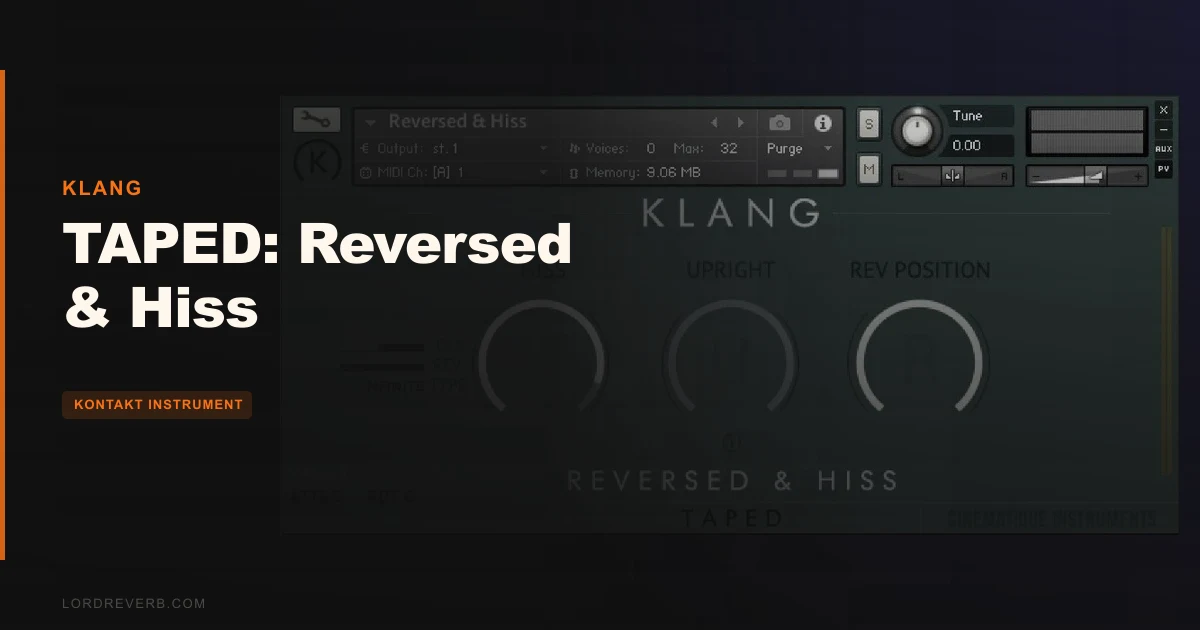
TAPED: Reversed & Hiss is a $6 Kontakt instrument from KLANG built around a detuned Blüthner grand piano recorded in a real living room, layered with tape hiss, wow & flutter saturation, and a reversed vibraphone, and yes, it sounds as strange and satisfying as that list implies. It's for lo-fi producers, ambient composers, and anyone who wants a piano that already sounds like it came off a deteriorating cassette, no post-processing required.
The Moment We Knew Exactly Who This Was Built For
We dropped a simple four-bar chord progression into a lo-fi hip-hop session. Dry piano, 83 BPM, C minor. The first note hit and the pitch already had a slow, irregular drift to it, not a vibrato you'd dial in, but the kind of instability you get when tape speed can't hold steady across a worn capstan.
The hiss sat underneath at roughly -40 to -38 dBFS, not loud enough to be annoying at normal listening levels, but present enough to fill the spectral space between notes. The reversed vibraphone layer swelled in just behind each attack, arriving slightly after the fundamental, adding a ghost shimmer in the 2-5 kHz range that no standard piano sample would give you.
We didn't touch an EQ. We didn't reach for a tape emulator. The character was already there, baked into every sample. That's the whole point of this instrument, and for the right producer in the right session, it's a brilliant idea.
Honest Positioning: What This Is and What It Isn't
This is not a general-purpose piano instrument. Say that loud. It's a pre-degraded texture tool. KLANG recorded a slightly out-of-tune Blüthner piano at a friend's house, captured the room noise, ran everything through tape gear, and built a Kontakt instrument out of the result.
You can't turn off the hiss. You can't bypass the wow and flutter. You can't dial in a cleaner tone for a bright pop ballad. The saturation and imperfection are the instrument, not a layer you add on top.
If you need a pristine, velocity-sensitive concert grand, skip this. Hard pass. Go look at something like Spitfire Audio's LABS Soft Piano or Native Instruments' Una Corda. TAPED: Reversed & Hiss is for when you want the tape to do the emotional heavy lifting.
Living With It: Setup, Quirks, and Daily Use
Setup is straightforward, but there's one wall you'll hit immediately if you're not expecting it: you need the full, paid version of Kontakt 5.6.8 or higher. Not Kontakt Player. The full version. That's a non-trivial ask since Kontakt 7 is now the current release and can cost real money if you don't already own it.
The 4.2 GB download size is also worth flagging. For a single-character instrument with one core source, that's heavy. For comparison, some full orchestral Kontakt libraries clock in around that size. We'd like to have seen that more compressed, but the sample resolution is presumably what justifies it.
Once it's loaded, the workflow is frictionless. We ran it through a few different sessions over a week: a downtempo R&B track, a short-film score cue, and an ambient pad piece. It sat in all three mixes with minimal channel-strip work. A gentle high-shelf cut at 8 kHz by about 1.5 dB pulled it back slightly in brighter mixes. That was it.
The reversed vibraphone layer is where things get interesting. Play a sustained chord and hold it. Around the 1.5-second mark, the reversed element swells forward in the high-mids. It creates a natural swell that works incredibly well under film dialogue or as a transitional texture between sections.
We did wish there were at least a couple of macro knobs on the front panel: one to control hiss level and one to control the wow & flutter depth. Without them, you either love the baked-in character or you don't. There's no middle ground, and that's a frustrating design choice for the money.
The Trade-Offs
The beauty-of-imperfection angle isn't just marketing copy, it's a real sonic philosophy, and KLANG commit to it completely. That commitment is both the instrument's greatest strength and its hardest limitation.
What you get is a sound that takes real effort and skill to achieve from scratch: a piano that sounds lived-in, recorded in an imperfect space, with tape artifacts that feel organic rather than processed. Getting that result manually, finding a detuned acoustic, recording it with a decent room mic, running it through real tape gear, layering in a reversed mallet hit, takes time, equipment, and a lot of failed takes. TAPED short-circuits all of that for $6.
What you lose is flexibility. The Chow Tape Model plugin (free) can get you in the same sonic territory with full control over tape speed, bias, and saturation level. You'd need to supply your own piano sample, but you'd have adjustable parameters. TAPED: Reversed & Hiss trades all that control for instant gratification, one drag-and-drop, one baked sound.
For a $6 instrument, we can live with that. For a pricier one, we would feel differently.
Against the Field
Chow Tape Model (free) is the honest comparison for the tape degradation side of this sound. It models wow, flutter, bias, and saturation with real physical-modelling depth. It's CPU-light and works on any piano sample you feed it. It wins for control and flexibility. But it requires more work and you still need a source instrument.
Spitfire Audio LABS Soft Piano (free) is the alternative if it's the intimate, slightly worn piano sound you're after, without the tape chaos. It's a detuned upright with felt preparation, recorded in a small space. Less hiss, more playability, zero commitment to tape artifacts.
TAPED: Reversed & Hiss wins specifically when you want the reversed vibraphone ghost layer baked in and you want the whole thing to feel like it was found on an unlabeled cassette from 1987. Nothing else in this price range does that specific combination out of the box. Check out KLANG's Landscape Kontakt instrument and TAPED: Blooming Vibes if you want to see how far KLANG's tape-centric philosophy extends.
The Real Verdict
At $6, TAPED: Reversed & Hiss is one of those tools we'd buy without overthinking it, but only if we already own the full version of Kontakt. That Kontakt requirement is the real cost here. If you're already in the ecosystem, this is an underrated texture grab with a genuinely unusual source recording and a sonic identity that would take hours to replicate manually.
If you're a producer who needs flexibility, wants to control the tape character, or works in genres that demand a cleaner piano tone, skip it. It won't bend. But if lo-fi, ambient, or cinematic work is your lane and you want a piano that already sounds like a memory, this earns its $6 without argument.
Score Breakdown
| Category | Score | Notes |
|---|---|---|
| Sound Quality | 4.0/5 | The Blüthner source and reversed vibraphone layer are genuinely distinctive; tape artifacts feel organic, not synthetic |
| Value for Money | 5.0/5 | $6 is barely a risk; even a 20-minute session that yields one usable chord makes this worth it |
| Ease of Use | 3.0/5 | Straightforward once loaded, but the Kontakt full-version requirement creates a real barrier for entry |
| Features | 2.5/5 | No user-facing controls for hiss, flutter, or saturation depth, what you hear is all you get |
| CPU Efficiency | 4.0/5 | Runs light inside Kontakt at standard buffer sizes; no noticeable load spikes on our test sessions |
| Overall | 3.5/5 | A genuinely clever, purpose-built texture tool let down only by its inflexibility and Kontakt dependency |
Alternatives to Consider
Chow Tape Model (free) gives you full parametric control over the same class of tape artifacts, wow, flutter, saturation, and bias, but you'll need to supply your own piano sample and do your own layering. It's the right call if you want to dial in the degradation yourself. Pair it with any lo-fi Kontakt instrument for a more flexible workflow.
Spitfire Audio LABS Soft Piano (free) is the gentler, more playable option. No tape chaos, but the intimate, slightly imperfect character is there. Works in Kontakt Player, which TAPED: Reversed & Hiss notably does not.
Other KLANG TAPED instruments are worth considering if this one sounds appealing. The TAPED collection shares the same tape-centric philosophy across multiple source instruments. Check out the TAPED: Blooming Vibes review or the broader KLANG Landscape review to see how the rest of their catalogue sits next to this one.
If TAPED: Reversed & Hiss clicks with your workflow, buy it immediately. If you're still not sure, grab Chow Tape Model first, layer it over a free piano sample, and see if that character speaks to you. If it does, the $6 is a no-brainer. If it doesn't, no amount of pre-baked magic will change your mind.
Related reviews: Noire Review · Can Mercury Symphonic Boyschoir Replace a Real Choir?
Frequently Asked Questions
Does TAPED: Reversed & Hiss work with the free Kontakt Player?
No. This is one of the most important things to know before buying. TAPED: Reversed & Hiss requires the full, paid version of Native Instruments Kontakt 5.6.8 or higher. The free Kontakt Player will not load it. If you only have Kontakt Player, this instrument won't run regardless of what you paid for it.
Can you control the amount of tape hiss or wow and flutter?
Not through any front-panel macro controls. The saturation, hiss level, and wow & flutter depth are baked into the samples at the recording and processing stage. You can manage hiss downstream with a noise-reduction plugin or a high-pass filter set around 40-60 Hz, but you can't reduce the wow and flutter without time-correcting the audio after the fact. What you hear is what you get.
What makes the source material different from other lo-fi piano instruments?
KLANG recorded a real, slightly detuned Blüthner grand piano in an actual living room rather than a treated studio. They captured the natural room noise alongside the piano, then layered in a reversed vibraphone sample and ran everything through physical tape gear. That combination of a real detuned acoustic, genuine room ambience, and an unusual reversed mallet layer is what separates it from most lo-fi piano samples, which typically start with a clean studio recording and add degradation digitally.
Is 4.2 GB a reasonable size for this instrument?
Honestly, it's on the heavy side for a single-character instrument with one primary sound source. For context, some multi-articulation orchestral Kontakt libraries sit around the same size. The library size is presumably driven by the sample resolution and the number of velocity layers used to capture the piano's dynamic range. You'll want it on an SSD rather than a spinning drive to keep streaming smooth during playback.