
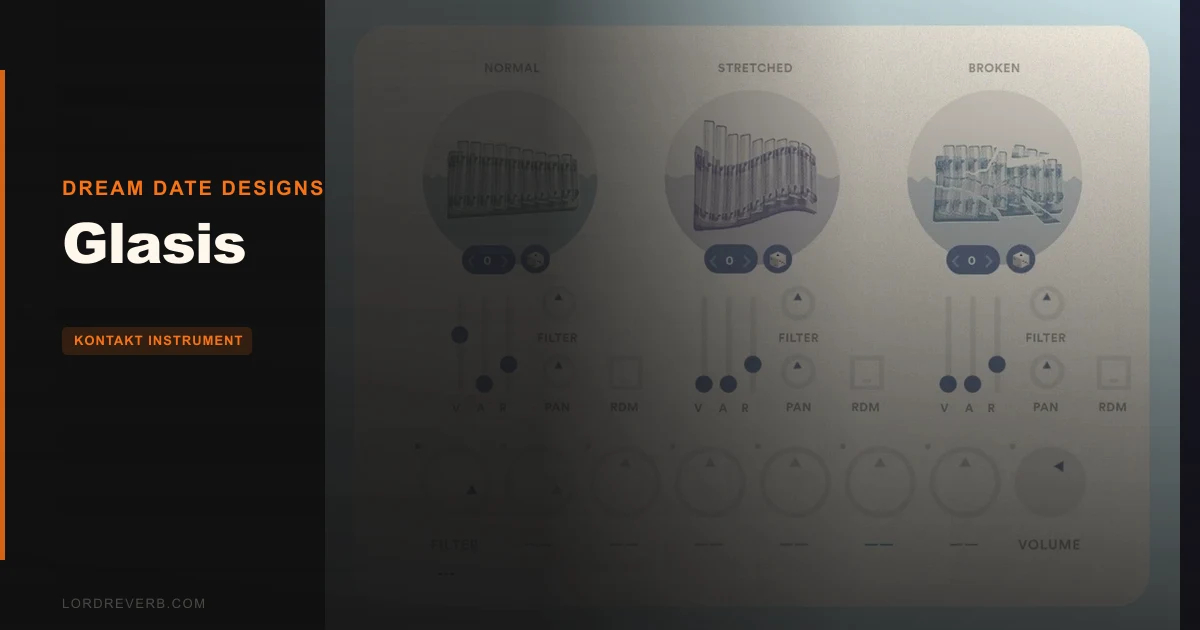
Glasis sits closest to Spitfire LABS Glass Guitar and Native Instruments’ Ethereal Earth in the “weird, fragile tuned-object” corner of the Kontakt instrument world, and this review is going to land clearly on its side. It’s not trying to do what those do. It wins in a different room.
Built by Dream Date Designs from a real 1950s R.D. Russell glass xylophone they pulled out of a rural antiques shop, Glasis comes in at $29 and runs on the free Kontakt 8 Player. It’s a very specific thing: three voices, one source instrument, zero padding. If you need a glass texture that feels genuinely vintage and slightly haunted, this is the one. If you want a full glass percussion kit with velocity layers and a built-in arp, keep moving.
How It Compares Out of the Box
LABS Glass Guitar is free and beautiful, but it’s guitar harmonics processed into glass tones. Ethereal Earth is richer, bigger, and costs significantly more. Glasis costs $29 and offers something neither of those deliver: a single, real, mid-century glass xylophone captured with vintage ribbon and tube microphones, then split into three very different characters.
The Normal voice lands where you’d expect. Clean, pure, slightly aged.
The Stretch voice is where Glasis separates itself. The sustain becomes something physically impossible, each note blooming outward past any natural decay. Reviewers describe it as sitting somewhere between a wine glass drone and a science-fiction string pad.
The Broken voice has no equivalent in the LABS or Ethereal Earth range. It’s processed through two half-functioning Walkmans, a broken space echo, and lo-fi effects pedals. That’s not a sales description. That’s actually what it sounds like.
Performance Deep Dive
We loaded all three voices in a session running at 48kHz, 256-sample buffer on macOS 14. CPU load stayed in the light-to-medium range throughout. Dream Date Designs haven’t published hard sample count figures, which is annoying, but the instrument loads fast and the round robin behaviour on the Normal voice is convincing enough that we stopped noticing it.
The round robin sampling on Normal means you can run melodic lines without the machine-gun repeat that makes cheaper Kontakt instruments painful to program. That’s the technical floor for any tuned instrument at this price point. Glasis clears it.
The Stretch voice does something clever with time-stretching hardware and software in combination. The result isn’t the clean spectral stretch you’d get from a modern algorithm. There’s texture in it. A slight roughness. That’s a feature, not a flaw.
The Broken voice sits at a lower fidelity by design. We put it on a solo piano line in a scene that needed nostalgia and slight wrongness. Best Kontakt Instruments for Cinematic Scoring It worked on the first pass. No tweaking. That’s satisfying.
Where It Wins
The source instrument is real and rare. You’re not playing a synthesised approximation of glass. You’re playing a 1950s instrument captured at multiple points in its natural resonance cycle with microphones that don’t exist in most modern signal chains.
That specificity shows. Drop the Normal voice into a sparse piano arrangement and it adds shimmer without drawing attention to itself. It sits in the mix naturally because it was recorded naturally.
The free Kontakt 8 Player compatibility is the other genuine win. Kontakt Player vs Full Kontakt: What You Actually Need At $29, the fact that you don’t need a Kontakt full licence to run it removes the biggest barrier in this category.
The Broken voice is underrated. Seriously underrated. It’s the voice that makes Glasis a character instrument rather than a texture library.
Where the Competition Wins
LABS Glass Guitar is free. That’s hard to argue against if budget is tight. It’s a different sound, yes, but for producers who need one glass texture and nothing more, free wins the first conversation.
Ethereal Earth offers more range. More voices, more modulation, more paths through the sound. If you’re building a whole palette of ethereal textures, Ethereal and Cinematic Kontakt Instruments Compared one instrument with that breadth makes workflow sense. Glasis doesn’t try to be that.
The lack of published technical specs is frustrating. No stated polyphony cap, no sample count, no explicit velocity layer information. We wish Dream Date Designs were more transparent here. At this price it’s not disqualifying, but it’s an unnecessary gap.
Who Should Buy Which
- ✅ Buy if you score for film, games, or ambient music and need a glass texture that feels genuinely old and slightly wrong.
- ✅ Buy if you want a character instrument at a reasonable price that runs on the free Kontakt 8 Player.
- ✅ Buy if the Broken voice description made you want to hear it immediately. Trust that instinct.
- ❌ Skip if you need a full glass percussion toolkit with multiple dynamics and articulations.
- ❌ Skip if you're on Kontakt 6 or 7 and don't want to update your setup right now.
- ❌ Skip if you want a transparent, neutral glass tone with no lo-fi personality.
Specs & Technical Details
| Developer | Dream Date Designs |
| Price | $29 |
| Plugin Format | Kontakt Instrument (.nki) |
| OS Support | macOS 12, 13, 14 / Windows 10, 11 (64-bit) |
| Activation | Plugin Boutique licence |
| CPU Usage | Light to Medium |
| Trial Available | No |
| Version Reviewed | 1.0 |
Score Breakdown
| Category | Score | Notes |
|---|---|---|
| Sound Quality | 4.5/5 | Real vintage source, ribbon and tube capture, genuine character in all three voices |
| Value for Money | 4.0/5 | Narrow scope, but the Broken voice alone justifies the price for the right producer |
| Ease of Use | 4.0/5 | Three voices, simple interface, loads fast; nothing to overthink |
| Features | 3.5/5 | Three distinct voices is clever design; lack of modulation or FX routing is a real limitation |
| CPU Efficiency | 4.0/5 | Light-to-medium load, no performance issues in our session |
| Overall | 4.0/5 | A character instrument that earns its place in the right signal chain |
Alternatives to Consider
If the Broken voice is what drew you in, you should also look at Spitfire LABS Glass Guitar (free). It's a different texture but shares that fragile, processed quality.
For a broader ethereal palette, Native Instruments Ethereal Earth gives you more modulation depth and a wider sound library. It costs considerably more, but if you're building a full cinematic toolkit, the range justifies it.
If the vintage piano-adjacent end of the glass spectrum interests you, the Palm Mute Piano Review from Loot Audio scratches a similar "old, intimate, slightly imperfect" itch for a close price point.
For producers new to this end of the Kontakt world, our Kontakt Instruments Guide: 5 Things Beginners Must Know will save you from a few expensive wrong turns before you buy anything.
Glasis at $29 is a precise tool for a precise job. If that job is yours, it's an easy call. If you're hoping it'll cover a wider range of textures, you'll end up frustrated and reaching for something else by the end of the session. Know what you're buying. That vintage glass xylophone in a rural antiques shop wasn't built to do everything. Neither is this.
Related reviews: SYMPHONIC · AVANT Modern Keys
Frequently Asked Questions
Does Glasis require the full version of Kontakt?
No. Glasis runs on the free Kontakt 8 Player, so you don't need a full Kontakt licence to use it. You do need to be on Kontakt 8 specifically. Older versions of Kontakt, including Kontakt 6 and 7, are not supported.
What are the three voices in Glasis and how different do they actually sound?
Normal is the clean, round-robin sampled glass xylophone as recorded through vintage ribbon and tube microphones. Stretch extends the sustain of each note into something physically impossible in the real world. Broken processes the sound through degraded hardware for a lo-fi, nostalgic, slightly unsettling character. They're genuinely distinct, not just filter variations.
Is Glasis good for film scoring or ambient production?
It's well suited to both. The Normal voice layers well under sparse melodic lines without competing for space. The Stretch voice works as a pad or texture layer in ambient contexts. The Broken voice is the one that'll show up most in film and game scoring where you need something evocative and slightly off.
How does Glasis compare to free glass texture instruments like LABS Glass Guitar?
LABS Glass Guitar is free and worth having regardless. But it's a guitar processed into glass tones, not a sampled glass instrument. Glasis is a real 1950s glass xylophone captured with period-appropriate microphones. The source material is different, and the Broken voice has no equivalent in the free market. At $29, they're complementary rather than competing.