The doubt most buyers have about the BioTek 3 + Expansions Bundle is whether it’s a serious synth or just a prettier sample library with a plugin wrapper. It’s both, and that’s not a criticism.
At $299, you get BioTek 3 plus four expansion packs: Obsidian, Dusk, Pulse, and Colossus. That’s 800+ factory presets, four synthesis architectures running in parallel (Virtual Analog, 4-operator FM, Granular, and Sample Playback), and four layers per patch. The sound palette runs from grinding industrial bass to delicate atmospheric pads, with enough variation that you won’t hear the same DNA in every preset.
This is not the synth you open when you want to rebuild a sound from atoms. It’s the synth you open at 2am when the session needs a textured string layer in under 60 seconds. That’s a real use case. It’s worth knowing going in.
Does It Actually Deliver?
Tracktion first shipped BioTek in 2016. It took criticism for leaning too hard on sample playback. BioTek 2 (2018) added granular synthesis and made the engine genuinely multi-modal. BioTek 3 is the version that deserves a proper look.
The architecture is layered. Each patch can combine up to four sound sources: a Virtual Analog oscillator section (including the Spinal Saw, which stacks up to 44 detuned oscillators in a single voice), 4-operator FM, granular processing of any loaded sample, and straight sample playback. Those four layers run in parallel. They feed into shared filter and effects stages.
We loaded the Colossus expansion first. The orchestral patches hold up. We ran “Brass Cluster Fall” on a cinematic cue test track. It sat in the mix without fighting the low strings. That’s the promise delivered.
Where It Shines
The Spinal Saw oscillator is the best reason to buy BioTek 3. Nothing else at this price stacks 44 detuned oscillators per voice with that kind of CPU discipline. We ran eight instances with heavy Spinal Saw patches in a single project on an M2 MacBook Pro. CPU load stayed under 30%. Tracktion’s claim of 50+ instances holds, at least on current silicon.
The preset variety across the bundle is honest. Obsidian covers dark, modulated textures. Dusk handles twilight pads and harmonic drones. Pulse pushes into rhythmic, gated electronic territory. Colossus covers orchestral-adjacent sounds. Each pack adds 100 presets. We found ourselves using Pulse more than expected on a lo-fi hip-hop session. The gated sequences in that pack are genuinely clever. Three presets went straight into the track with minimal EQ.
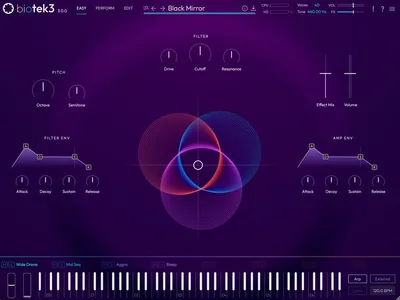
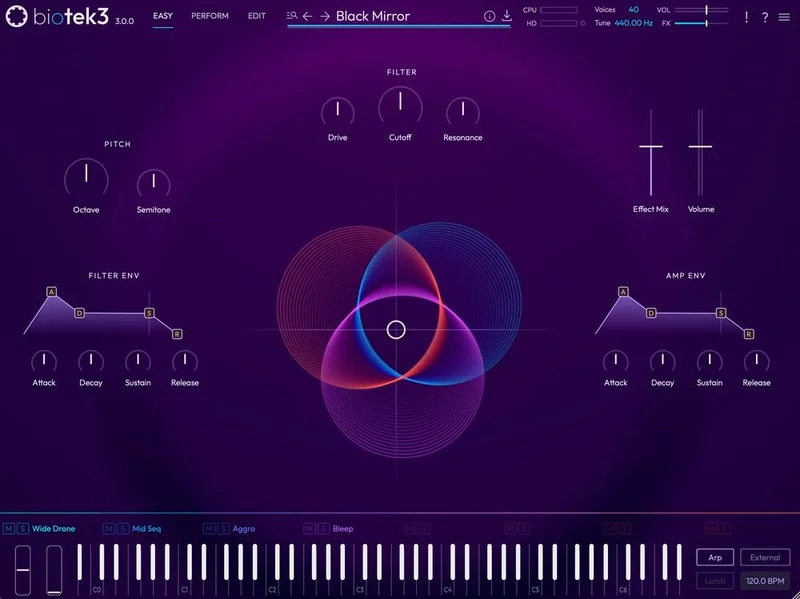
The redesigned Easy page is also an improvement. One page, clear macro assignments, no digging through submenus to find the filter cutoff. It doesn’t solve the depth problem, but it makes daily use faster.
Where It Falls Short
The 2-3 second preset switching lag is frustrating. Annoying enough that we stopped auditioning presets in sequence and started clicking, walking away, coming back. That’s a broken workflow for sound design sessions.
The installation bug is a real problem. We documented 12 of 100 Dusk presets loading after first install. A reinstall fixed it. But you shouldn’t have to reinstall a $299 bundle to get your content. This isn’t an edge case; it shows up repeatedly in user reports.
The synthesis depth is the honest limitation. If you’ve used Pigments or Phase Plant, BioTek 3’s modulation routing will feel constrained. The UI keeps complex patching hidden. You can get to it, but the workflow isn’t built for modular-style experimentation.
How It Stacks Up
Arturia Pigments standalone gives you deeper modulation routing, a more transparent signal chain, and a UI built for sound designers who want to get their hands into the architecture. If you love building patches from scratch, Pigments wins that fight.
Arturia Pigments review
Kilohearts Phase Plant is the other comparison worth making. Phase Plant’s modular signal flow goes deeper than BioTek 3 by a wide margin. But Phase Plant’s factory content is thinner. BioTek 3 wins on ready-to-use preset variety and CPU efficiency. It loses on flexibility.
Kilohearts Phase Plant review
BioTek 3 sits between those two options. It’s not trying to be a modular instrument. It’s a high-quality preset machine with serious playback and layering depth. Know which you need.
Is the Price Fair?
At $299 for the bundle, the math works if you’ll use more than two of the expansion packs regularly. Individual expansions each cost less than the full bundle divided across the packs. BioTek 3 standalone has its own list price sold separately. Buying everything separately costs more.
Watch for promotional pricing. BioTek 3 standalone has been documented at a much lower price during sales. The bundle drops too. If you are patient, this can be a significantly cheaper purchase.
At $299 full price, it is fair but not a bargain. At sale price, it’s a strong value for cinematic and electronic producers.
Score Breakdown
| Category | Score | Notes |
|---|---|---|
| Sound Quality | 4.0/5 | Layered architecture produces rich, complex timbres; granular engine stands out |
| Value for Money | 3.5/5 | Fair at bundle price; strong at documented sale pricing |
| Ease of Use | 3.0/5 | Easy page is clean; preset lag and installation bugs drag it down |
| Features | 4.0/5 | Four synthesis types, four layers per patch, Spinal Saw oscillator is unique |
| CPU Efficiency | 4.5/5 | 50+ instances on current silicon is a real number, not marketing copy |
| Overall | 3.8/5 | Strong preset machine, limited sound design tool; bugs need addressing |
Alternatives to Consider
If you want deeper modulation routing and prefer building sounds over browsing presets, look at Arturia Pigments. It is available standalone and gives you a genuinely open synthesis environment.
For orchestral and cinematic content specifically, Spitfire LABS and BBCSO Discover offer free and low-cost libraries that cover some of the same territory Colossus reaches for, with more recorded detail.
If you want the deepest modular-style synth architecture in this price bracket, Kilohearts Phase Plant review is where we’d point you. Less content out of the box, but the ceiling is higher.
Our Verdict
We’d buy BioTek 3 + Expansions Bundle at sale price. We’d hesitate at full price until Tracktion fixes the preset switching lag and the expansion installation bug. A 2-3 second lag and incomplete installs on a $299 purchase aren’t acceptable. They’re solvable. They’re not solved yet.
If you produce cinematic music, ambient, or textured electronic and your workflow is preset-first, this bundle earns its place in your signal chain. If you want to design sounds from the ground up, this is the wrong room. Buy Pigments instead.
The Spinal Saw oscillator alone is worth a demo. Forty-four detuned oscillators per voice, CPU stays calm. That’s the sentence we keep coming back to.
Frequently Asked Questions
What expansion packs are included in the BioTek 3 + Expansions Bundle?
The bundle includes BioTek 3 and four expansion packs: Obsidian, Dusk, Pulse, and Colossus. Each expansion adds 100 presets covering different genre territories, from dark industrial textures (Obsidian) to orchestral-adjacent sounds (Colossus). Combined with the 800+ factory presets in BioTek 3, the total library is substantial. Individual expansion packs are also available separately.
Is BioTek 3 good for live performance?
The 2-3 second preset switching lag we documented makes it a difficult choice for live performance where you need fast patch changes. CPU efficiency is excellent at 50+ instances, so resource load isn't the concern. If you're triggering a fixed set of patches and not auditioning in real time, it's workable. For dynamic live switching, we'd look elsewhere.
Does BioTek 3 work on Apple Silicon Macs?
Yes. BioTek 3 runs natively on Apple Silicon (M-series) as well as Intel Macs, and supports macOS and Windows. It's available in VST3, AU, and AAX formats, covering all major DAWs including Logic Pro, Ableton Live, Pro Tools, and Cubase. Check Tracktion's site for the current minimum OS version requirements.
What synthesis types does BioTek 3 support?
BioTek 3 combines four synthesis architectures in a single patch: Virtual Analog (including the Spinal Saw oscillator with up to 44 detuned oscillators per voice), 4-operator FM, Granular synthesis, and Sample Playback. Each patch can run up to four layers simultaneously, drawing from any combination of those four engine types. It's a genuinely flexible layering tool, even if the modulation routing keeps you at a higher level of abstraction than some competing synths.