
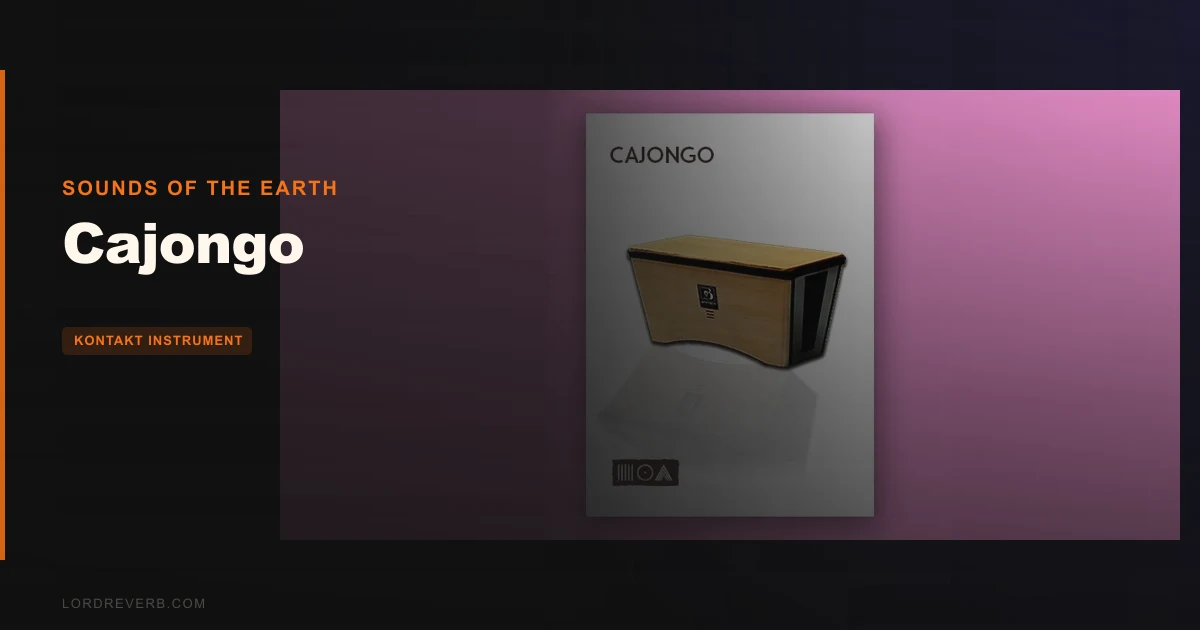
Cajongo by Sounds of the Earth is a legitimate, affordable cajon-bongo hybrid Kontakt instrument that earns its $9.90 price tag for world music and cinematic producers, though the full Kontakt 7 requirement will immediately disqualify a chunk of its potential audience.
The cajongo is a genuinely clever instrument that exists in real life, not just as a sample-library marketing angle. It fills a specific tonal gap that regular cajons and bongos leave open. At under ten dollars, the question isn't whether it's cheap. The question is whether the sounds inside are actually usable on a record.
We loaded it up, routed it through a Reaper session, and put it through a flamenco arrangement, a lo-fi beat, and a cinematic underscore. Here's what happened.
Inside the Cajongo Library
The cajongo itself is a hybrid between a bongó and a Peruvian cajón. It's lighter than bongos, more portable than a cajón, and played with the hands while seated with the instrument between the legs. Sound resonates through the hollow bottom. The instrument produces three main sonic zones: a female section for lower sounds, a male section for higher sounds, and a middle section that corresponds to the wooden bridge on traditional bongos.
The library ships with 57 audio files, 884 Kontakt sample files, 8 mic options, and installs at 180MB. That's a compact footprint. It won't bloat your sample drive or fight your session for RAM.
Five articulation types are covered: Fingers, Brushed, Muted, Sticks, and Scraps. That's enough to build grooves that feel varied without constantly reaching for velocity layers as a substitute for real technique.
Full Kontakt 7 (or higher) is required to use this instrument. The free Kontakt Player will not work and will run in demo mode only. That's not a footnote. That's a deal-breaker for a lot of people, and we'll say so plainly.
The Good
Those 8 mic positions are the library's best feature. Most percussion libraries at this price give you one blended stereo position and call it done. Here, you can place the cajongo close and dry, pull it back for a roomier picture, or blend positions on separate aux channels. That kind of staging control is satisfying to work with.
We set up a flamenco-adjacent arrangement: nylon guitar, palmas, and the cajongo in the low-female zone through a send with about 18ms of pre-delay into a plate reverb. The fundamental sat around 160Hz, the slap transient cracked cleanly at the front of each beat, and the tail decayed without clouding the upper mids where the guitar lived. We didn't need to touch the EQ.
The tonal separation between the three zones is real and usable. The female zone sits noticeably lower than a standard cajon tone, somewhere in the 120–180Hz range. The male zone cuts through around 400–600Hz. The middle bridge section produces a dry, woody click that layers brilliantly under a kick for world-fusion grooves.
For $9.90, the articulation coverage is impressive. Five techniques means you can write a full groove pattern with tonal variety that reads as human rather than looped. That's harder to achieve than it sounds at this price point.
The Not-So-Good
The Kontakt Player restriction is annoying. Not frustrating in a vague way. Annoying in the specific way that means a producer who bought Kontakt Player through a Komplete bundle can't use this at all without buying a full Kontakt license on top of that. Sounds of the Earth built this for a niche inside a niche.
884 sample files across 57 audio stems is modest. Compare that to where the original Tonehammer version of this instrument sat, with over 7,500 samples and a 1.26GB installed footprint. This Plugin Boutique edition is leaner, which cuts both ways: faster loading, but less round-robin variation per hit. On repeated patterns, machine-gun effect becomes audible if you're not staggering velocity manually.
There's no standalone mode. No VST3. No AU. Every session requires Kontakt as the host. If you're building a live set or a template that needs to load fast, that dependency adds a layer. It's not a dealbreaker for ITB composers, but it's worth knowing before you build a template around this.
Installation requires the Pulse installer, which is an extra step. Not complicated, but not as simple as dragging an NKI onto a drive either.
Compared to the Alternatives
8Dio offers free hand percussion content within larger bundles, and some of that is excellent. Free is hard to argue with. But 8Dio's free cajon content doesn't give you the hybrid cajongo tone or the three-zone tonal design. You get a standard cajon, which is a different instrument with a different character.
Spitfire LABS has released various world percussion snapshots. Clean, well-recorded, free. But no cajón-type instrument, no mic options, and zero articulation depth at the hit level. LABS is a first-call tool for textures and pads, not for rhythmically precise percussion work.
Rhythmic Robot has hand-percussion libraries that sit in a similar price bracket, with more round-robin variation and broader sample counts. If the round-robin concern above bothered you, Rhythmic Robot is worth comparing. See our Sounds of the Earth Udu Review for a broader look at what Sounds of the Earth does well as a developer.
At $9.90, Cajongo wins on price and instrument uniqueness. It loses on sample depth. Pick based on what matters more to your session.
Who Should Buy This
- ✅ Buy if you own a full Kontakt 7 license and need an authentic cajongo/cajon-bongo hybrid that doesn't appear in any other major library.
- ✅ Buy if you're scoring world music, flamenco-adjacent, or Latin cinematic cues and need a percussion texture that sits between a cajon and bongos with real mic staging options.
- ✅ Buy if your signal chain already includes Kontakt as a standard instrument host and you want to add hand-percussion depth at a low price.
- ❌ Skip if you only have the free Kontakt Player. It will not run this. Full stop.
- ❌ Skip if you need dense round-robin variation for machine-gun-proof patterns. The sample count won't cover you at fast tempos.
- ❌ Skip if you want a plug-and-play percussion tool in VST3 or AU format. This lives entirely inside Kontakt.
Also check our Palm Mute Piano Review if you're building out a broader world and acoustic instrument toolkit in Kontakt.
Score Breakdown
| Category | Score | Notes |
|---|---|---|
| Sound Quality | 4.0/5 | Three-zone tonal design is well-recorded; 8 mic positions give real placement flexibility |
| Value for Money | 4.5/5 | $9.90 for a unique instrument with usable articulations is hard to argue with |
| Ease of Use | 3.0/5 | Pulse installer, Kontakt-only workflow, and full license requirement add friction |
| Features | 3.0/5 | 5 articulations and 8 mic positions are solid; round-robin depth is limited at 884 samples |
| CPU Efficiency | 4.5/5 | 180MB and light CPU draw; won't stress a busy template |
| Overall | 3.5/5 | A clever, well-priced instrument with one hard technical wall you need to clear first |
Alternatives to Consider
Sounds of the Earth Udu, If you love what Sounds of the Earth does with hand percussion, the Udu library is the next step. Same developer philosophy, similar price bracket, and the Udu's clay-pot tone sits in a completely different register to the cajongo. Sounds of the Earth Udu Review
Spitfire LABS (free), If your Kontakt situation is complicated (Player only, or no license), LABS gives you world percussion snapshots at zero cost. No cajongo, no mic options, but no license headaches either.
8Dio Cajon libraries, More sample depth, more round-robin per articulation, and a broader cajon family. If the machine-gun concern is real for your workflow, 8Dio is worth a look before committing here. Check our Kontakt Instrument Reviews for a broader comparison of Kontakt hand-percussion options.
The Bottom Line
At $9.90, Cajongo is a low-risk buy for anyone who already owns full Kontakt 7 and needs a percussion texture they won't find anywhere else at this price.
The three-zone tonal design, 8 mic positions, and five articulations give you real compositional options. The limited round-robin depth is the thing we wish they'd fixed. Drop the same instrument with 3,000+ samples and a velocity-randomisation script and this becomes a permanent fixture in every world music template we build.
As it stands: buy it if you own the full Kontakt license and the cajongo tone solves a specific problem in your sessions. Skip it if you're Kontakt Player-only, or if you need deep machine-gun-proof round robins for repetitive patterns at speed.
Nine dollars and ninety cents. You've spent more on coffee that tasted worse.
Frequently Asked Questions
Does Cajongo work with the free Kontakt Player?
No. The free Kontakt Player will not run Cajongo properly. It loads in demo mode, which means it times out after a short period and is not usable for recording or production. You need the full retail version of Kontakt 7 or higher. This is the most important thing to confirm before purchasing.
What is a cajongo and how does it differ from a regular cajon?
The cajongo is a hybrid instrument combining elements of the Peruvian cajón and the Afro-Cuban bongó. It sits between the player's knees like bongos, features a wooden drumhead, and has two distinct resonant chambers producing high and low pitches. A standard cajón is a single-chamber box drum played while seated on top of it. The cajongo's dual-chamber design gives it a tonal complexity a regular cajon doesn't have.
How do I install Cajongo after purchasing from Plugin Boutique?
After purchase, download the files from your Plugin Boutique account. The installation uses the Pulse installer, so you'll need to run that first. Once installed, open full Kontakt 7 in your DAW, navigate to the Files tab, locate the .nki file, and drag it into the Kontakt window. It's a manual load process, not an auto-populated library, keep that in mind when organising your template.
Is Cajongo useful for genres outside of world music?
Yes, more than you'd expect. The dry woody click from the middle bridge zone layers cleanly under an electronic kick for lo-fi and downtempo productions. The female zone's 120–180Hz fundamental sits in a register that complements both acoustic and electronic arrangements. Film and TV composers working on Latin, Mediterranean, or broadly organic cinematic cues will get the most from it, but it's not genre-locked.