We were halfway through scoring a quiet scene, two characters, rain on glass, nothing else needed, and Grand Harp by Cinematique Instruments was already doing 80% of the job with minimal fuss.
That’s the honest pitch. This is a focused, lightweight Kontakt library built around a sampled concert grand harp. It’s designed for composers who need convincing solo harp textures without owning a top-tier Lyon and Healy or committing to a deep, CPU-heavy orchestral package. It won’t replace Elysium or a live session player, but for ambient beds, film sketches, and intimate chamber cues, it earns its place in a signal chain. Check the Cinematique Instruments site for current pricing.
Opening It for the First Time
Installation is through Native Access or manual Kontakt library drag-and-drop, depending on your version. Load time in Kontakt 7 is roughly 8 to 12 seconds on an M2 MacBook Pro. That’s fast.
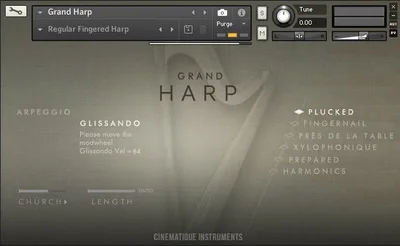
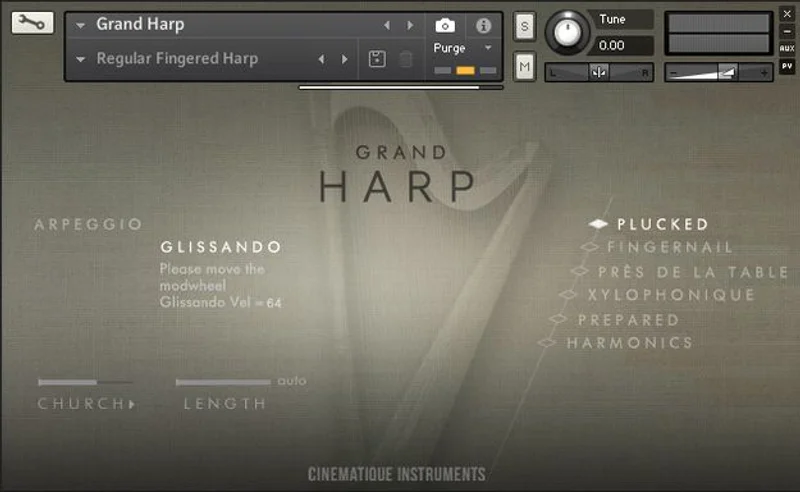
The interface is clean. One main page, a handful of knobs for dynamics, reverb tail, and attack. No 14-tab GUI with sub-pages for articulation matrices. We appreciated that. It feels like Cinematique Instruments made a decision about what this library is and stuck with it.
The default patch loads with a gentle room reverb baked in at roughly 1.8 seconds. It sounds pleasant immediately. That’s either a selling point or the beginning of your frustration, depending on how you like to work.
Getting It Into a Real Workflow
Here’s where we started finding the edges.
We dropped Grand Harp onto its own instrument track in Logic Pro, routed it through a dedicated reverb bus, and killed the internal reverb to work with our own room. Simple enough. The dry signal sounds clean, with each string articulation carrying a believable mechanical thump in the low-mid range around 250 to 300Hz. That detail is satisfying. It tells you the samples were recorded close and carefully.
Dialing in dynamics via the mod wheel felt natural for single-note lines. We wrote a simple arpeggio figure across two octaves, recorded it live, and the velocity response tracked without obvious jumps between layers.
The friction came when we tried glissandos. There’s no dedicated glissando patch, which is a real gap for harp writing. You’re building them by hand with MIDI rolls, and they never quite land with the same breathless urgency a real gliss has. Annoying, but not a dealbreaker if your cue doesn’t rely on them.
Latency in live playback was negligible at 64-sample buffer. No complaints there.
What It's Genuinely Good At
Solo lines. Full stop. This is where Grand Harp lives.
We wrote a 16-bar melodic line sitting above a string pad, something in the range of C4 to C6. Every note had its own character. The attack transient was present without being harsh. The decay behaved like a real harp string: a slow, warm bloom that softens by around -18dB within three seconds. That bloom sits beautifully in a mix without fighting the mids.
Compared to the ha•pi harp library, Grand Harp’s tone is warmer and less clinical in the upper register. Ha•pi has more articulations. Grand Harp has better foundational tone for melody writing.
For ambient and cinematic writing specifically, the sustain pedal behavior is clever. Hold a chord and the sympathetic resonance between strings is audible at a low level, maybe 20dB below the fundamental. It’s subtle and it’s right. That kind of detail is what separates a library you reach for from one that sits on a shelf.
We also tried it under a film dialogue scene, panned slightly right, at -12dB in the mix. It disappeared perfectly into the background without muddying the vocal frequency range. Underrated for underscore work.
The Rough Edges
Repeated sustained notes. This is the real problem.
Play the same note twice in succession and you’ll hear it. The sample repeats without variation. No round-robin on sustains means that any passage requiring repeated single notes in a rhythm sounds mechanical. We tried a simple pattern on D4, eighth notes at 90BPM. By bar three, the repetition was obvious. In a solo context, that’s a mix-busting flaw.
The range tops out at what feels like a practical 33-string equivalent. A full concert grand harp covers 47 strings across six and a half octaves, from C1 to G7. Grand Harp doesn’t cover that full range convincingly. Go below C2 and the samples start to feel thin, losing the chest of a real bass harp string.
No pedaling system exists here either. You can’t simulate the tonal shift of changing pedal positions mid-phrase. For classical writing, that’s a real limitation.
Who This Is Really For
- ✅ Buy if you write intimate film scores, ambient music, or chamber cues and need a fast, playable harp that sits in a mix without heavy editing.
- ✅ Buy if you're a solo producer who doesn't own any harp library and wants a CPU-light starting point.
- ✅ Buy if you sketch quickly and need something that sounds good on first pass, not something you'll spend three hours programming.
- ❌ Skip if your writing involves repeated rhythmic harp figures. The lack of round-robin will frustrate you quickly.
- ❌ Skip if you already own Elysium or a comparable deep-sampled harp library. Grand Harp won't add anything you don't have.
For context on what a well-developed orchestral instrument library can offer at a higher budget point, see our best Kontakt instruments for film scoring guide.
Score Breakdown
| Category | Score | Notes |
|---|---|---|
| Sound Quality | 4.0/5 | Warm, organic tone on solo lines; bass range thins out below C2 |
| Value for Money | 3.5/5 | Solid for the scope, but gaps limit long-term utility |
| Ease of Use | 4.5/5 | Clean interface, fast load, plays immediately |
| Features | 3.0/5 | No glissando patch, no round-robin sustains, no pedal simulation |
| CPU Efficiency | 4.5/5 | Light footprint; comfortable running three instances simultaneously |
| Overall | 3.8/5 | Brilliant for narrow use cases, frustrating for anything outside them |
Alternatives to Consider
Elysium Harp (Strezov Sampling) is the serious upgrade. It’s built on a Lyon and Healy 47-string bronze concert harp with full round-robin sampling, glissando patches, and pedal mode simulation. If harp is a regular instrument in your palette, Elysium is worth the price jump. See our best orchestral sample libraries for Kontakt roundup for a full comparison.
ha•pi covers more articulations than Grand Harp at a comparable price tier, including harmonics and muted techniques. The tone is brighter, which works better for contemporary and pop contexts. It’ll win on versatility. Grand Harp wins on foundational warmth.
Spitfire LABS Harp is free and worth downloading as a baseline comparison before you spend anything. It’s limited, but knowing exactly where it falls short tells you what you’re actually paying for in a premium library. Check our best free Kontakt instruments list for more no-cost options.
We’d also point you toward our EFEKTOR GrandMaster Review 2026: 3 Marshall Tones Tested if you’re building out your plugin collection across categories.
The Bottom Line
Grand Harp does one thing well: it puts a believable, warm, solo harp tone in your track fast. Load it, play it, move on.
The limitations are real and specific. No round-robin on sustains. No glissando patch. A range that doesn’t stretch to the full 47-string concert harp spectrum. If your music lives in those gaps, this library will annoy you within a week.
But if you write quiet film scores, ambient music, or need a harp texture that sits under dialogue without demanding three hours of programming? This is a smart, low-friction tool.
Check the Cinematique Instruments site for current pricing before committing. If the price feels low, it’s an easy yes for the right composer. If it’s priced alongside deeper libraries like Elysium, the math gets harder to justify.
The library that does one narrow thing beautifully is still useful. Just know the width of that lane before you buy.
Frequently Asked Questions
Does Grand Harp by Cinematique Instruments require the full version of Kontakt?
Yes. Grand Harp runs in the full version of Native Instruments Kontakt. It won't run in the free Kontakt Player because it hasn't been through NKS certification as a Player-compatible library. Make sure you have a Kontakt license before purchasing. Kontakt 6 or later is recommended for stability.
How does Grand Harp compare to the Elysium Harp for classical orchestral writing?
Elysium is the stronger choice for classical work by a clear margin. It covers the full 47-string concert harp range from C1 to G7, includes round-robin sampling on sustained notes, and has dedicated glissando and harmonic patches. Grand Harp is warmer and faster to use, but its range and articulation depth don't compete with Elysium for serious orchestral scores.
Can Grand Harp handle glissandos convincingly?
Not natively. There's no dedicated glissando patch. You can approximate a gliss by building rapid ascending or descending MIDI runs, but the result lacks the fluid, continuous sweep of a real glissando. For any cue where glissandos are a central gesture, look at Elysium or ha•pi instead.
Is Grand Harp a good choice for ambient and film underscore music?
Yes, and it's one of the better use cases for this library. The sustained tone decays naturally, the sympathetic resonance between strings adds realism at low volumes, and the CPU footprint is light enough to run alongside a full template. For intimate underscore and ambient beds, it earns its spot without complaint.