You need the sound of a stainless steel water bottle in your track, and recording it yourself is a nightmare you don't want to solve with a mic, a preamp, and an afternoon of improvised percussion. Soundiron's Steel Water Bottle is a Kontakt instrument library built around exactly that problem: 1,722 stereo WAV samples captured from a real, well-worn bottle with actual dents and dings, playable at $4.50 through the Kontakt full version. It's aimed squarely at sound designers, composers working in film or media, and producers who want percussive oddities without the hassle of a DIY session. The question isn't whether the concept is clever. It is. The question is whether the execution is worth pulling out your wallet.
Why Recording This Yourself Is a Worse Idea Than It Sounds
Water bottles, in theory, seem easy to record. In practice, owners and home recordists report that capturing clean, usable tones from a water bottle is genuinely frustrating. The pitched rings decay fast and uneven. Slosh and liquid movement bleeds into everything. Close-mic placement exaggerates handling noise. And if you want round-robin variation to avoid the machine-gun effect in your track, you're looking at dozens of controlled takes per articulation.
That's not an afternoon's work. It's a session.
Soundiron's approach is to do that session for you, capture something with actual character, and hand you the result as a mapped, velocity-layered, round-robin instrument. The bottle they used isn't a pristine prop: it's described as a well-loved flask with the character of a weather-worn old sailor, dents and all. Each imperfection changes the resonance, and that's exactly what makes the source material interesting rather than sterile.
If you've ever needed organic percussive texture in an ambient track, a sound design pass for a game, or a foley bed for a scene involving outdoor adventure kit, you'll understand why a library like this exists. The DIY alternative isn't just inconvenient. It's genuinely hard to do well.
What You Actually Get Inside the Library
The core of Steel Water Bottle is 1,722 stereo WAV files at 24-bit/48kHz, uncompressed PCM. Installed, that's 765 MB on your drive. Manageable.
Sound types span eight categories: grabs, knocks, pokes, rings, ring mutes, slaps, sloshes, and pings. That's more variety than you might expect from a single object. Rings and pings are the obviously musical ones, but the knocks, pokes, and slaps are where the percussive texture lives. Sloshes are their own category entirely, which tells you the developer took the liquid element seriously rather than discarding it as noise.
Up to 12 round robins per sound set mean repeated hits cycle through real variations rather than triggering the same sample. Up to 5 velocity layers per note give you dynamic response from a soft tap to a full smack. That combination is what separates a usable instrument from a sample pack you'll stop reaching for after two sessions.
Two microphone perspectives are included. The wide stereo close mic gives you a detailed, present sound. The tetrahedral binaural mic option is the more interesting one: it creates a first-person playing experience where the bottle feels like it's physically in your hands. For headphone-based work or immersive audio, that's a genuinely clever capture option that adds depth without reverb tricks.
The Interface: Controls That Actually Do Something
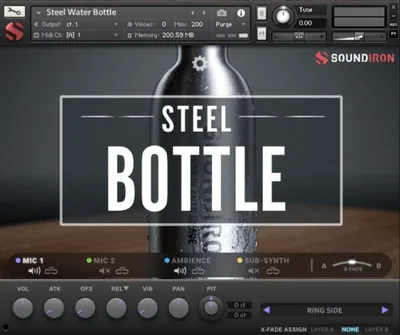
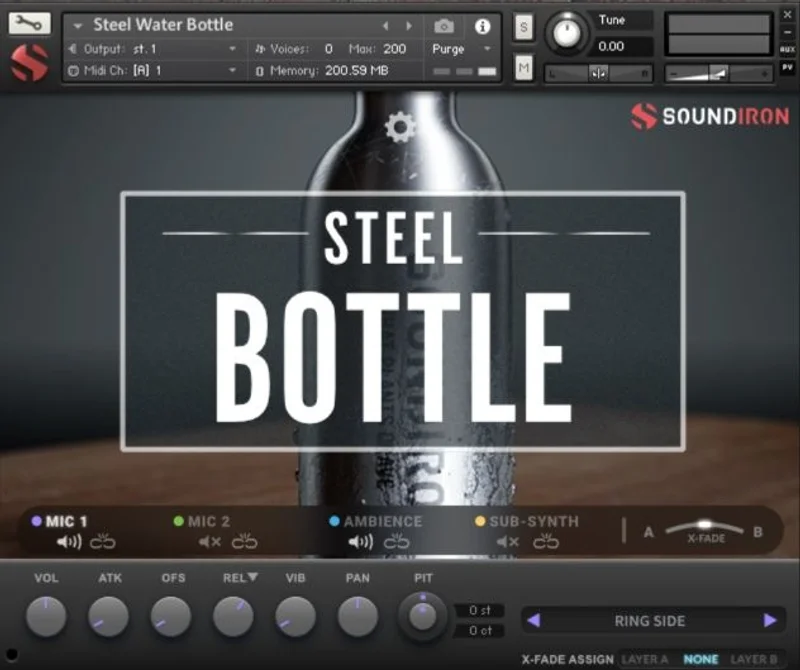
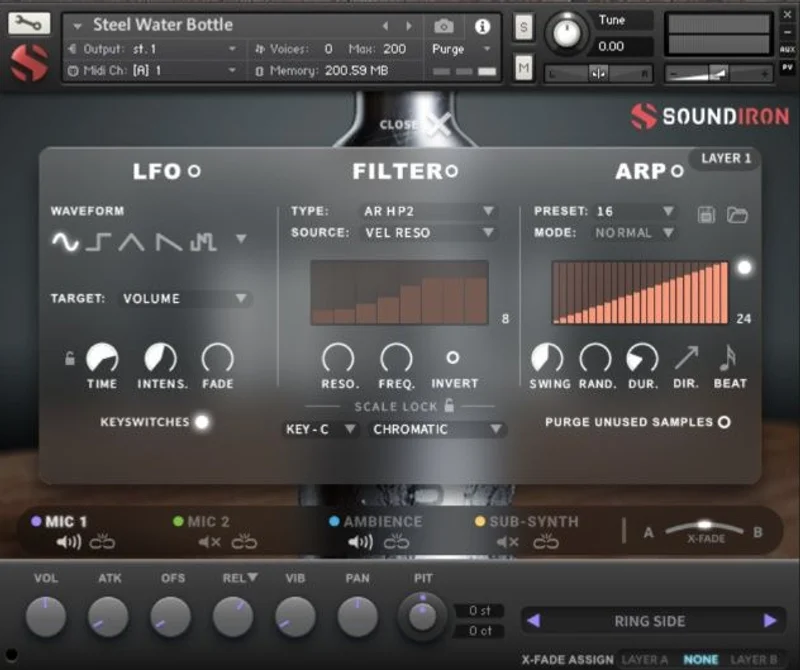
The single NKI instrument bank opens inside Kontakt with a set of playback controls that go well beyond basic sample triggering. Swell, attack, release, offset, vibrato, and filter controls are all present. Pitch adjustment gives you coarse and fine tuning. You also get articulation switching, cross-fading, and layering controls so you can blend between sound types.
The LFO system is adaptable. You choose the shape, set speed and intensity, and optionally sync it to your host tempo. Modulation targets include velocity, modwheel, expression, aftertouch, key position, and a step-sequencer. That's a wide routing system for a library in this price range.
Twelve lowpass, high-pass, and FX filters are on board. The arpeggiator is customizable with its own velocity table and swing control. A key and scale lock constrains your notes to a chosen scale, which is satisfying when you're sketching ideas fast and don't want to land on a wrong note mid-flow.
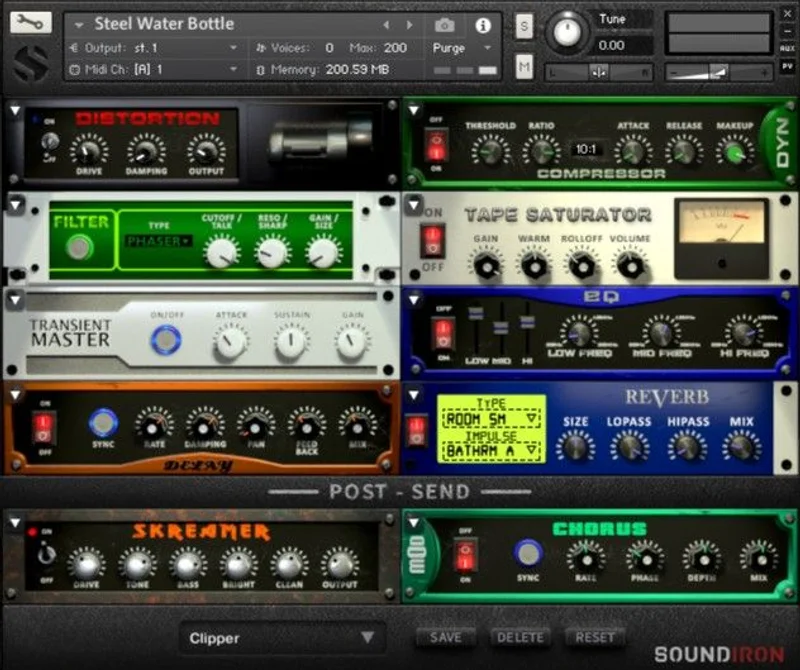
The FX rack is modular: 18 DSP effect modules across 10 assignable slots with adjustable order. Phaser, flanger, delay, distortion, amp and cab simulators, compressors, EQ, and a rotator are all in there. The convolution reverb pulls from 99 rooms, halls, chambers, and outdoor environments, plus 40 custom FX impulses. Twenty ambient soundscape patches are included separately, alongside 20 sound-designed FX presets.
Honestly? That's a lot of infrastructure for a water bottle.
Whether you use it all depends on what you're after. If you want quick, playable bottle sounds, you'll dial in the basic articulations and move on. If you're building pads and drones from unusual organic sources, the full modulation system becomes the actual instrument.
Putting It in a Real Workflow
Imagine you're scoring a short film with a wilderness scene. You need percussive texture under a sparse ambient bed, something that feels handmade without sounding like a kit. Load up the knocks and pings, set a slow LFO on the filter with the tempo synced to your session, and cross-fade between the ring and ring-mute articulations as the scene builds. Lock the notes to a minor pentatonic with the scale lock, run it through the convolution reverb with one of the included impulse responses, and you have something that sits in the mix as a texture rather than a hit.
Or you're making sound design passes for a game and you need a metallic impact layer that isn't a standard foley cliché. Stack the slap articulations at multiple velocity layers, run the signal through the distortion and amp simulator in the FX rack, and push the pitch down with the coarse tuning control. What comes back is metallic and alive in a way that stock libraries often aren't.
Push the arpeggiator with swing control against a pitched ring sample and set the velocity table to accent every third step. You'll end up somewhere between a marimba pattern and a wind chime that's had a rough year. Whether that's useful is up to your project, but it's the kind of happy accident that makes unusual source material worth having.
Strengths and Weaknesses, Honestly
The round-robin implementation is a strength you'll appreciate fast. Twelve variations per sound set means you can play rapid repeated hits on a knock or slap without that annoying mechanical flutter that betrays a shallow sample library.
The binaural mic option is a genuine differentiator. Most percussion libraries at this end of the market offer one mic position. Two mic perspectives, one of them tetrahedral binaural, is a smarter capture approach than the category usually delivers.
The FX rack depth is impressive. Overkill for some users. A brilliant playground for others. At $4.50, the included infrastructure would cost real money to replicate with equivalent standalone plugins, even budget ones.
But here's the frustrating part: Kontakt Player compatibility is off the table. You need the full version of Kontakt 5.5 or later. That's a wall for plenty of producers who own the free Player but haven't bought the full license. Soundiron made a choice here that narrows the audience.
Third-party review depth is thin. Beyond the developer's own marketing and a small number of owner comments, independent critical analysis of this library is scarce. That makes it harder to verify claims about specific behaviors or report on edge cases. For a library at this price, that's annoying but not a dealbreaker.
The subject matter itself is the real limiting factor. This is a water bottle. It's a niche tool for a niche need. If that need never shows up in your work, this sits unloaded forever.
Value for the Price
At $4.50, this is priced in the impulse-buy zone. The question isn't whether you can afford it. It's whether the specific sounds justify even a small purchase when your library is already full.
The honest answer: if you've ever reached for a metal percussion sound and had to fake it with pitch-shifted kit hits, $4.50 is cheaper than the time you spent on that workaround. The 1,722 files, two mic positions, 12 round robins, and the full modular FX system represent genuine value for sound designers and media composers.
If you're a producer who hasn't encountered a brief that needed water bottle sounds yet, there's a real chance this collects virtual dust. Buy it when you have a session in front of you that needs it. Don't buy it on the assumption that someday it'll be useful.
The Kontakt full version requirement does affect the value calculation. If you don't own full Kontakt, the entry cost to use this library multiplies fast. That changes the math significantly.
Who Should (and Shouldn't) Buy This
- ✅ Buy if you work in sound design, game audio, or film scoring and need organic metallic percussion without a recording session.
- ✅ Buy if you already own full Kontakt and regularly build instruments from unusual sources.
- ✅ Buy if you have an active brief that needs this exact texture and $4.50 is easier than a DIY afternoon that might not work.
- ❌ Skip if you only have Kontakt Player. The library won't load.
- ❌ Skip if your work is strictly sample-based EDM or genres where this type of organic oddity never appears.
- ❌ Skip if your library is already overwhelming you. Adding more niche tools without a clear use isn't discipline, it's hoarding.
Specs & Technical Details
| Specification | Detail |
|---|---|
| Developer | Soundiron |
| Price | $4.50 |
| Plugin Format | Kontakt Instrument (NKI), requires full Kontakt 5.5 or later |
| OS Support | Mac OSX 10.9 or higher / Windows 7 or higher |
| Activation | N/A |
| CPU Usage | N/A |
| Trial Available | N/A |
| Version Reviewed | N/A |
| Sample Format | 24-bit / 48kHz uncompressed stereo WAV |
| File Count | 1,722 stereo WAV files |
| Installed Size | 765 MB |
| Minimum RAM | 2 GB |
| Minimum CPU | Dual-Core |
Score Breakdown
| Category | Score | Notes |
|---|---|---|
| Sound Quality | N/A | N/A |
| Value for Money | N/A | N/A |
| Ease of Use | N/A | N/A |
| Features | N/A | N/A |
| CPU Efficiency | N/A | No data available from notes |
| Overall | 3.5/5 | Clever concept, serious sample depth, and a genuinely useful niche tool, held back only by the full Kontakt requirement and thin independent review record |
Steel Water Bottle is one of those libraries that earns its place the moment you need it and collects dust every other week. That's not a flaw in the product. That's what a specialist tool does. At $4.50 with full Kontakt on your machine, the barrier to adding it is low enough that the specific-need calculus lands in its favour for sound designers and media composers. If you're chasing organic metallic percussion with actual character and you don't want to spend a session with a mic stand and a Nalgene, this is the smarter move. Just don't buy it on speculation. Buy it for the brief in front of you.
Frequently Asked Questions
Does Steel Water Bottle work with the free Kontakt Player?
No. It requires the full version of Kontakt 5.5 or later. The free Kontakt Player will not load it. If you only have the Player, this library is inaccessible without upgrading to the full version of Kontakt first.
What kinds of sounds does the library include?
The library covers eight articulation types captured from a stainless steel bottle: grabs, knocks, pokes, rings, ring mutes, slaps, sloshes, and pings. It also includes 20 ambient soundscape patches built from the same source material, alongside 20 sound-designed FX presets for more processed, atmospheric results.
What is the tetrahedral binaural microphone recording, and why does it matter?
It's a four-capsule microphone configuration that captures spatial audio from a first-person perspective. When you listen through headphones, the result feels like the bottle is physically in your hands rather than on a stand across the room. It's useful for immersive audio work, headphone mixing, and any context where the close, intimate character of the source matters.
How much hard drive space does Steel Water Bottle require?
The installed library takes up 765 MB. The 1,722 stereo WAV files are stored in uncompressed 24-bit/48kHz PCM format, which keeps audio quality high at the cost of a larger footprint than compressed alternatives. Your system also needs at least 2 GB of RAM and a dual-core CPU to run it.