The Canjo review starts with one question: is a library built around a tin-can-and-stick instrument worth $29 of your production budget? The honest answer is yes, but only for a specific kind of creative problem.
Picture this: you're scoring a short film set in the rural South, or building an Americana-inflected indie track, and every mandolin and banjo library you own sounds too polished, too Nashville. You want something that sounds like it was recorded in a barn in 1947 by someone who built the instrument that morning. That's exactly the gap Canjo fills.
At $29, this is a low-stakes buy. It's built for composers, producers and sound designers who want a genuinely odd tonal character they can't fake with EQ.
What It Is (and What It's Not)
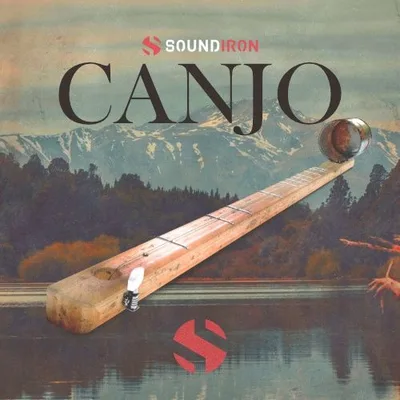
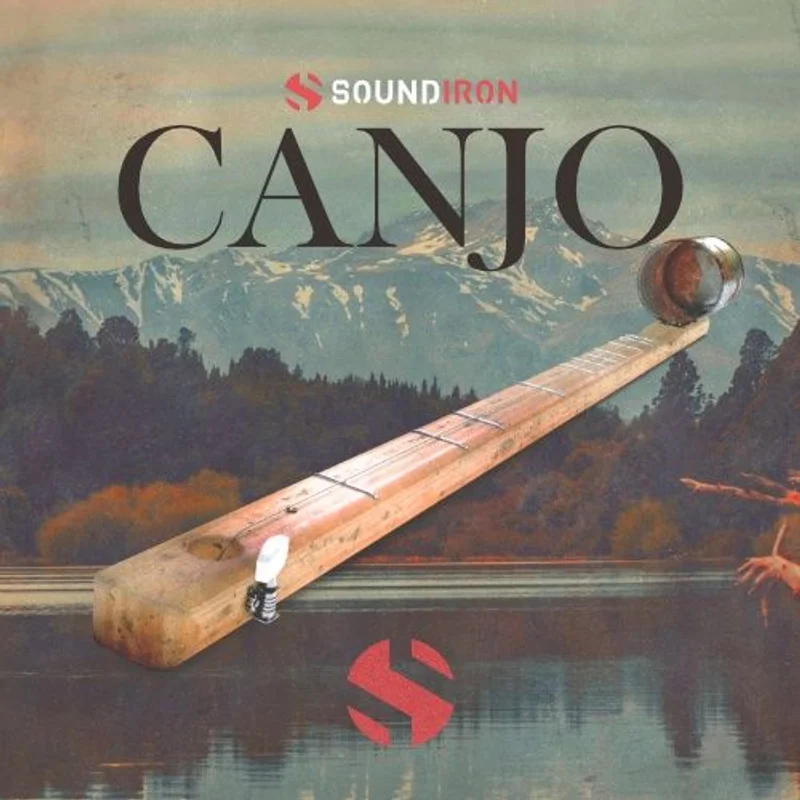
Canjo is a Kontakt instrument library by Soundiron. The source instrument is exactly what it sounds like: a homemade single-stringed fretted instrument built from a wood stick, a string tuner and a tin can. The result sits tonally between a banjo and a mountain dulcimer, with a twangy, metallic edge that's hard to describe and harder to replicate with standard folk libraries.
What it's not: a chromatic workhorse. The playable range is 12 notes diatonic. That is a real constraint. You won't build complex melodic lines across multiple octaves. If you need a fully chromatic stringed instrument with broad melodic range, this isn't it.
It's also not a Kontakt Player instrument. You need the full version of Kontakt, 5.5 or later. That's a deal-breaker for some setups. Know that before you buy.
Where It Fits In Your Session
You're working on an ambient or folk-adjacent track and you want a lead line that sits in the mix with real character rather than library sheen. Load Canjo's picked plucks articulation, dial your attack control back toward the front edge of the transient, and keep the release tight. The result is a clipped, metallic pluck that cuts through a dense low-mid arrangement without needing a high-shelf boost.
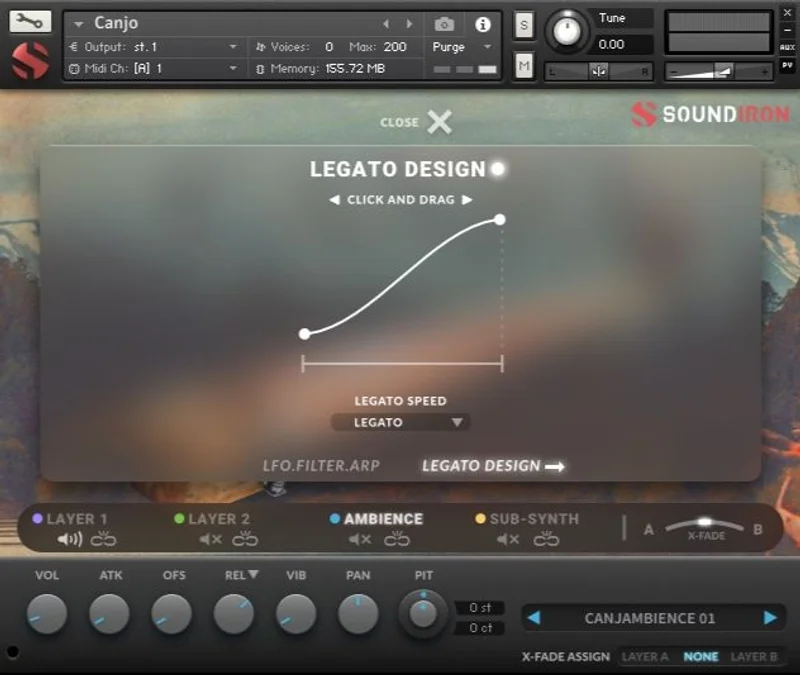
The bowed sustains open up a different world. Push the swell control to bring notes in slowly and the tone shifts toward something mournful, almost erhu-like. Soundiron's own comparison to a melancholy erhu is actually fair here. Layer that with the smooth plucks and you've got a lead texture that genuinely sounds like nothing else in most producers' sessions.
The 22 custom FX and ambient presets are worth your time too. They take the raw source material into darker, stranger territory. If you're working on a horror score or an experimental electronic project, these patches are where Canjo earns its keep beyond the folk niche.
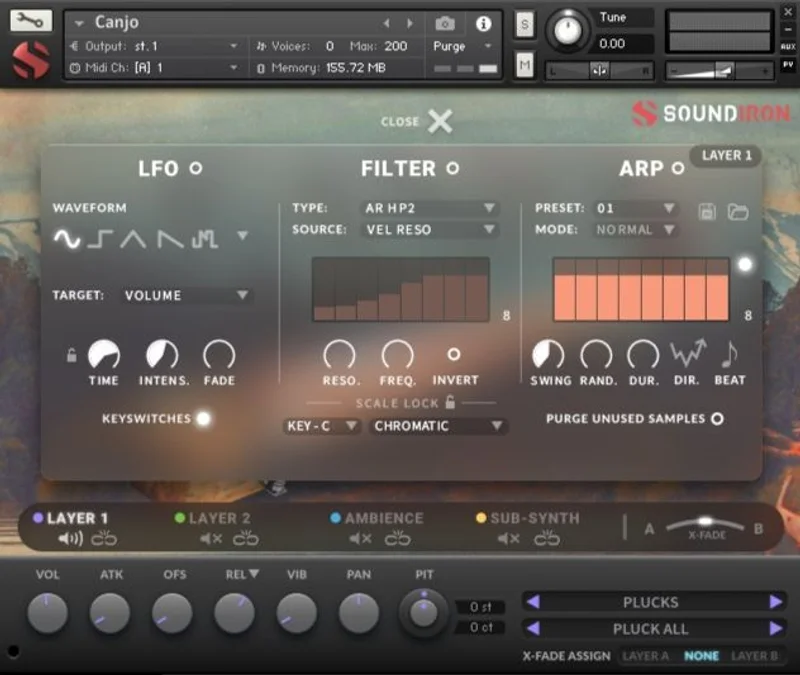
The key and scale lock system is a clever addition. Constrain your notes to a specific scale and you can play freely without worrying about hitting a wrong note. That's satisfying when you're sketching quickly and don't want theory to slow you down.
The Trade-Offs
The diatonic 12-note range is the big one. You can feel the ceiling. If your melody pushes past it, you're stuck. There's no workaround inside the instrument itself. Some composers will hit that wall on the first session and find it frustrating.
The Kontakt Full requirement is annoying in a market where most modern libraries target Kontakt Player for broader reach. If you're running the free Player, this doesn't open. Full stop.
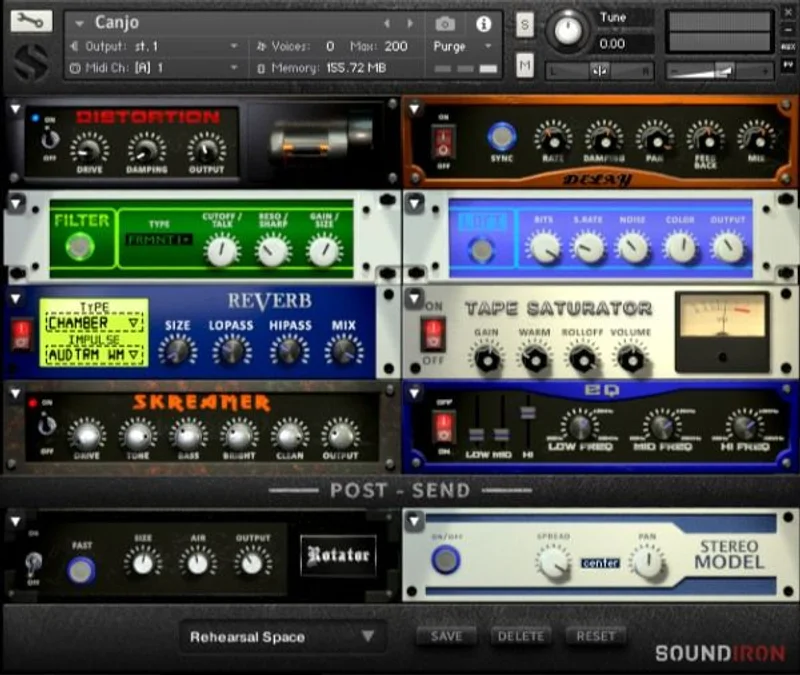
That said, what you get for the money is genuinely deep. The modular FX rack alone, with 18 DSP modules across 10 slots, would justify a higher price in a different library. The convolution reverb with 99 rooms and 40 custom impulses is a real asset, not a checkbox feature. The LFO system with tempo-syncing and fade-in time control gives you expressive movement that most instrument libraries at this price don't offer.
The value equation is good. Not brilliant, but good. You're buying a niche sound with a surprisingly capable engine wrapped around it.
The Real Verdict
At $29, Canjo is underrated as a sound design tool and fairly priced as a folk instrument library. If you've been looking for something with genuine tonal ugliness, a sound that feels hand-built and imperfect, this delivers it with a proper production infrastructure underneath.
Skip it if you need chromatic range, or if you're running Kontakt Player. Skip it if your music never touches folk, Americana, ambient or experimental territory. But if any of those styles land in your sessions even occasionally, $29 is a genuinely easy call.
Specs & Technical Details
| Developer | Soundiron |
| Price | $29 |
| Plugin Format | Kontakt NKI (requires Kontakt Full 5.5+) |
| OS Support | Mac OS X 10.9 or higher / Windows 7 or higher |
| Activation | N/A |
| CPU Usage | N/A |
| Trial Available | N/A |
| Version Reviewed | N/A |
| Installed Size | 801 MB |
| Sample Format | 24-bit / 48 kHz uncompressed PCM WAV |
| Sample Count | 859 stereo WAV files |
| RAM Requirement | 2 GB recommended |
| Storage Requirement | SATA or SSD recommended |
| CPU Requirement | Dual-Core recommended |
Score Breakdown
| Category | Score | Notes |
|---|---|---|
| Sound Quality | 4.0/5 | Genuinely distinctive tonal character that no amount of EQ replicates |
| Value for Money | 4.5/5 | Deep engine and 859 samples for the asking price makes this hard to argue with |
| Ease of Use | 4.0/5 | Kontakt-standard workflow; scale lock and arpeggiator reduce friction in sessions |
| Features | 4.0/5 | 18-module FX rack, 99-room reverb and LFO system punch well above this price tier |
| CPU Efficiency | N/A | No benchmark data available |
| Overall | 4.0/5 | A niche instrument with a serious production engine behind it |
We love what Soundiron did with the source material here. A tin-can instrument could have been a gimmick library with a handful of dry samples and a convolution reverb slapped on top. Instead, you get a complete modular system with real expressive control. The arpeggiator alone, with its velocity table, swing and randomization controls, turns a simple plucked note into something rhythmically alive.
The wish list is short but real. Chromatic range would open the library to a much wider set of use cases. Kontakt Player support would remove the biggest barrier to purchase for a lot of producers.
Neither of those gaps undercuts the core value at $29. If you've got Kontakt Full and you work in any genre that touches folk, ambient or experimental sound design, this is one of those libraries you load once and keep reaching for.
Frequently Asked Questions
Does Canjo work with Kontakt Player?
No. Canjo requires Kontakt Full version 5.5 or later. It will not open in the free Kontakt Player. If you're running Player only, this library is not compatible with your setup.
What does a canjo actually sound like?
The source instrument sits tonally between a banjo and a mountain dulcimer, with a twangy, metallic edge. The library can masquerade as cheap slide guitar, brittle viola or melancholy erhu depending on how you play and process it. It's physically resonant in a way that feels hand-built and imperfect.
Is the 12-note diatonic range a serious limitation?
It depends entirely on your use case. For melodic folk lines, short phrases and textural work it's enough. If you need to build complex, wide-ranging melodic lines, you'll hit the ceiling fast. The key and scale lock system helps you work within the range efficiently, but it doesn't expand it.
What genres is Canjo actually useful for?
It fits Americana, folk, roots music and acoustic indie most directly. The 22 ambient and FX presets push it into experimental, ambient and film score territory too. Soundiron positions it as equally comfortable in traditional and experimental contexts, and the preset range backs that up.
How much hard drive space does Canjo need?
The installed size is 801 MB. All 859 samples are 24-bit / 48 kHz uncompressed PCM WAV files. Soundiron recommends a SATA or SSD drive for playback performance. By modern library standards, the footprint is modest.