Soundiron’s Cosmic Hand Pans is a Kontakt instrument worth buying at $59 if you compose cinematic, ambient, or world-influenced music and need a handpan that plays convincingly without a four-figure instrument purchase.
We loaded it mid-session on a sparse cue. Sparse cue, solo piano, a gap where the arrangement needed breathing room but not another pad. We dropped in the finger tap articulation on a D minor chord, ran a gentle LFO on the filter cutoff, and the handpan locked into the space like it had been there from bar one. That was the moment we understood what this library is for.
It’s not a deep-sampled, every-dynamic-layer handpan library. It’s a practical, fast-loading texture tool built around a real D minor handpan recorded with care. If that’s what your sessions need, keep reading.
First Impressions When You Open It
Installation is painless. Download through Native Access, open in Kontakt 6.2.2 or the free Kontakt Player, and you’re in.
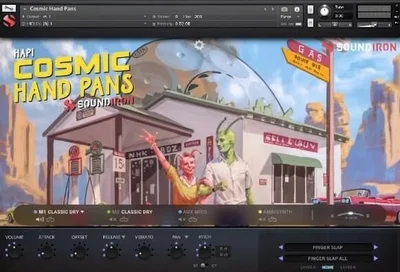
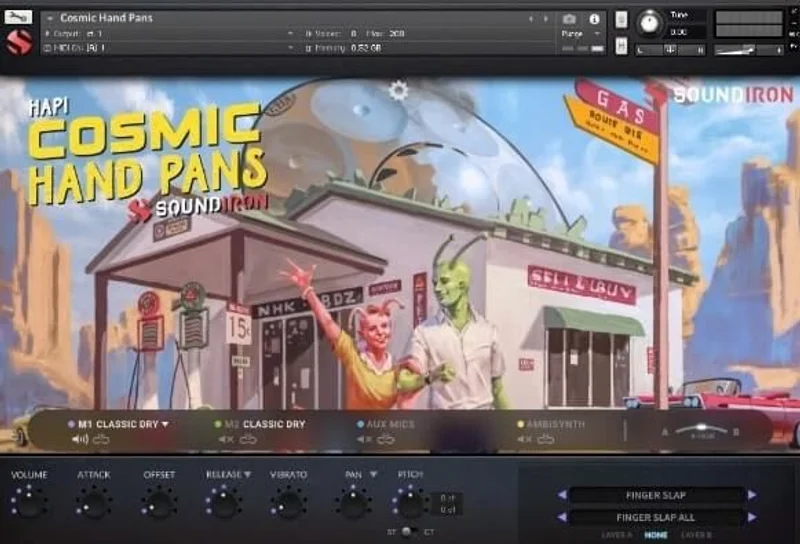
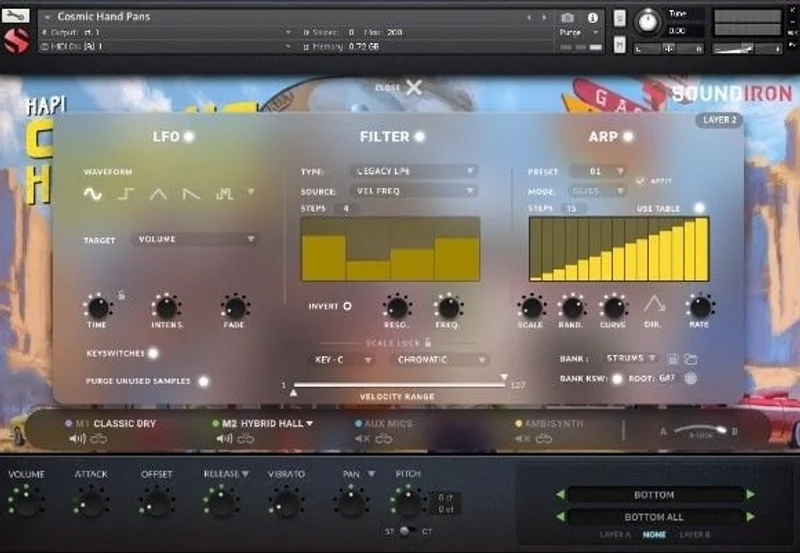
The UI is clean. Not flashy, but organised. You get your articulation selectors across the top, mic mix options below that, and the modular FX rack and arpeggiator tucked in a secondary panel. Nothing feels buried.
We appreciated seeing multiple microphone options on a library at this price. Blending close and room mics takes about 20 seconds to dial in. First sound out of the box is satisfying. The soft mallet articulation in particular has a round, sustained quality with natural harmonic overtones that sit around 800Hz to 2kHz. It doesn’t sound processed out of the gate.
Getting It Into a Real Workflow
Here’s where we hit the first friction point. The instrument is locked to D minor source material.
If your track is in G minor or F# minor, you’re pitch-shifting inside Kontakt or relying on your DAW to do the heavy lifting. Pitch-shifting a handpan more than a minor third starts to expose the samples. The sustain tails stretch in ways that reveal the seams.
We ran a test on a track sitting in A minor. Shifting the library down a fifth sounded fine for stabs. Sustained notes started sounding like a slightly drunk pan. Annoying, and a real limitation if you work across multiple keys regularly.
The arpeggiator is a genuinely useful addition for building rhythmic patterns fast. We built a 16-step pattern in about three minutes for a percussion layer on a downtempo track. The LFO on filter cutoff added a breathing quality without needing to automate manually. That saved real time.
The three articulations handle different roles cleanly. Finger tap for tight, percussive hits. Jazz brush for something softer and blurred at the attack. Soft mallet for long, singing notes. We used all three in a single cue, bused them separately, and treated them with light reverb at different pre-delay settings to create front-to-back depth.
What It Does Really Well
The source recording is the strongest thing here. Grahm Doe’s handpan has a character that cheaper virtual handpans don’t capture. There’s a natural inharmonicity in the overtones that makes single notes feel alive.
We A/B tested the soft mallet articulation against a competing handpan library at a higher price point. Cosmic Hand Pans held up on sustained single notes. The transient attack felt more natural, less punchy in an over-processed way.
The 20 evolving soundscapes are clever rather than padding. We love that Soundiron didn’t just ship 20 reverb-drenched pads and call them bonus content. Several of the soundscapes use pitch-modulated handpan layers processed into something genuinely hybrid. One preset had a texture we’d describe as bell-meets-synth-pad, sitting perfectly at around 3kHz with natural high-frequency roll-off below 8kHz. We kept it.
The FX rack handles basic convolution reverb, chorus, and delay. Nothing you couldn’t do in your DAW. But having it self-contained means you can bounce a printed version quickly without building a separate FX chain.
The Rough Edges
The D minor limitation is the biggest problem. Handpans exist in Hijaz, Pygmy, Celtic Minor, and a dozen other scales that each carry distinct emotional identities. Delivering only D minor in 2026 feels like leaving half the instrument on the floor.
We wish Soundiron had sampled even one additional scale at this price point. Pygmy scale would have tripled the stylistic range.
The mallet articulation naming is slightly misleading. “Soft mallet” suggests a physically struck instrument. What you get is closer to a bowed or smoothed-attack handpan sound. Not wrong, but not what producers who’ve played real handpans expect.
The soundscape presets go synthetic-ambient quickly. Three of the twenty sounded nearly identical to us on first pass. If you don’t edit them, your track will sound like stock music. That’s not a dealbreaker. It’s a warning.
CPU usage is light. We ran six instances across a session with no throttling o
n an M2 MacBook Pro. No complaints there.
Who This Is Really For
- ✅ Buy if you score for picture and need a quick, convincing handpan texture in D minor without spending session time building one
- ✅ Buy if you produce ambient, downtempo, or world-influenced electronic music and want a library that layers well with synth pads
- ✅ Buy if you're working in the free Kontakt Player and don't own the full version of Kontakt
- ❌ Skip if you work in multiple keys and don't want to deal with pitch-shifting artefacts
- ❌ Skip if you need a musically diverse handpan library covering different scales and tunings
- ❌ Skip if you already own a well-sampled handpan instrument and are looking for an upgrade
Score Breakdown
| Category | Score | Notes |
|---|---|---|
| Sound Quality | 4.0/5 | Source recording is genuine and the transient character holds up on close listening |
| Value for Money | 4.0/5 | At $59, it's hard to argue against it for a single well-recorded instrument with FX and soundscapes included. |
| Ease of Use | 3.5/5 | Clean UI, but the scale limitation creates unnecessary workflow friction in non-D-minor sessions |
| Features | 3.0/5 | LFO, arpeggiator, and FX rack are useful; D minor only and no scale variety hurts the score |
| CPU Efficiency | 4.5/5 | Light footprint across multiple instances with no performance issues |
| Overall | 3.9/5 | Solid source material let down by limited scale range; best treated as a D minor specialist tool |

Alternatives Worth Considering
If the D minor limitation is a dealbreaker, Spitfire LABS Hang is a free option worth installing before you spend anything. It’s a single velocity layer, less playable, but it costs nothing and covers basics well.
For producers who want a handpan library with multiple scales and deeper round-robin sampling, Evolution Steel Tongue from Orange Tree Samples covers more tuning variety and handles legato phrasing more convincingly. It sits higher in price but justifies the difference for composers working across varied keys.
If you’re after the hybrid, processed end of handpan sounds rather than acoustic realism, Native Instruments Ethereal Earth covers similar emotional territory with broader synthesis tools underneath.
We’d try the free LABS option first. If it falls short, Cosmic Hand Pans is the smarter next step before committing to a pricier library.
The bottom line: Cosmic Hand Pans is a well-recorded, single-scale handpan instrument that earns its keep in the right session and falls short in the wrong one. If your next cue is in D minor, buy it tonight. If you work across keys and scales regularly, the pitch-shifting frustration will cost you more time than the money saves.
It’s a specialist tool, not a general-purpose one. Use it like that, and it’s worth having in the folder.
Frequently Asked Questions
Does Cosmic Hand Pans work with the free Kontakt Player?
Yes. It's fully compatible with the free Kontakt Player (version 6.2.2 or higher) so you don't need a full Kontakt licence to run it. It's also NKS compatible, which means it integrates with Native Instruments hardware controllers like the Komplete Kontrol keyboards without extra setup.
Is Cosmic Hand Pans only available in D minor?
The source recordings are captured on a D minor handpan. You can pitch-shift inside Kontakt or your DAW to reach other keys, but shifting more than a minor third starts to introduce artefacts on sustained notes. If you work consistently in other scales, this is a real limitation to factor into your buying decision.
What's the difference between the finger tap, jazz brush, and soft mallet articulations?
Finger tap gives you a tight, percussive attack with a short sustain, best for rhythmic patterns. Jazz brush softens the attack into something blurred and organic, sitting further back in a mix. Soft mallet produces long, singing notes with prominent harmonic overtones in the 800Hz to 2kHz range, which works well for melodic lead lines or slow harmonic movement.
How does Cosmic Hand Pans compare to a real handpan for production use?
A real handpan carries a steep purchase price and requires recording time, room treatment, and microphone placement to capture usably. Cosmic Hand Pans delivers a pre-recorded version of that process at a fraction of the cost. For production purposes, the soft mallet articulation gets close enough on sustained lines that most listeners won't distinguish it from a recorded instrument in a full mix. For live performance or solo acoustic use, there's no substitute for the real thing.