
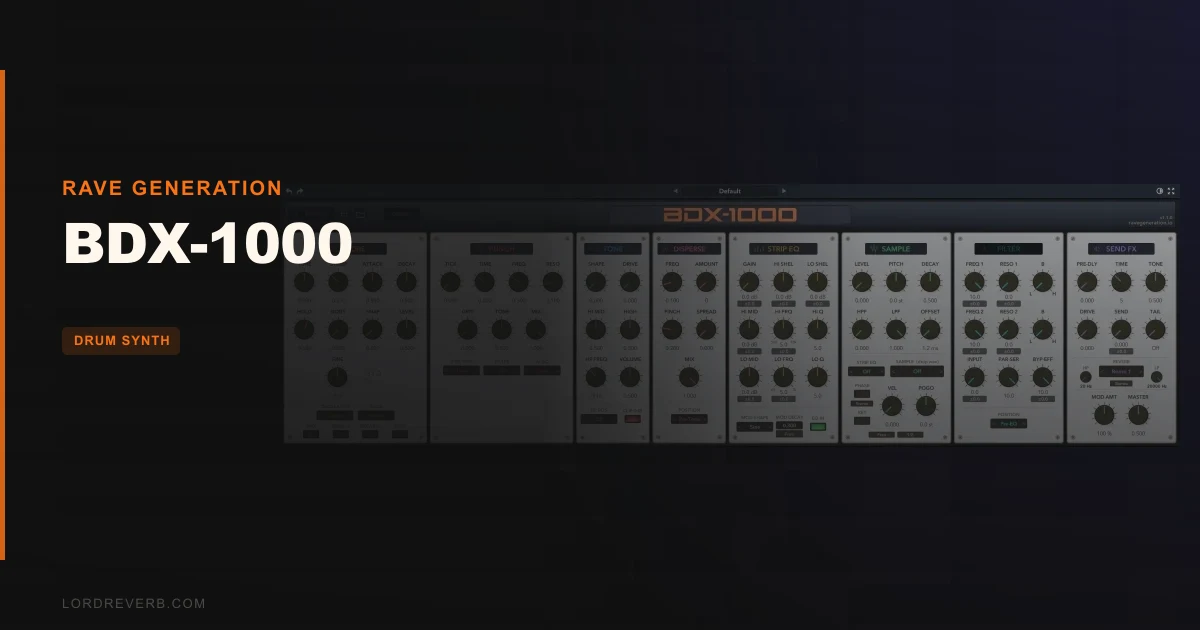
Will a TR-909 kick synth sound like the real thing, or like a cheap tribute that needs three more plugins to be usable? BDX-1000 answers it by modeling the original bassdrum circuit’s triangle tone, then handing you the processing to push well past it. At $56.22, it’s built for house and techno producers who want one plugin to cover everything from a soft vintage thump to a hard, distorted kick.
If you only ever want a single dusty 909 sample, skip it. You’re paying for depth.
Does It Actually Deliver on the 909 Promise?
Rave Generation built BDX-1000 as a TR-909-based bassdrum synthesizer. The pitch is simple: classic house kicks and hard-hitting techno bassdrums in one plugin.
Classic mode uses the triangle tone modeled on the original 909 bassdrum circuit. ALT mode swaps that for a cleaner, sine-like tone.
That pair matters. One gives you the grit. The other gives you a clean sub foundation.
Owners say it’s easy to operate and that the sonic combinations feel endless. We love that. A synth with this many knobs usually punishes you with menu diving. Reports say this one doesn’t.
Where It Shines
The tick section is the clever part. Six transient types: Classic, FM, Noise, HP, Chirp, and Metal. The Classic tick is a 2 kHz sine burst. The FM tick uses two-operator FM that tracks oscillator pitch, so the click moves with the body. Chirp is a fast downward sweep. Metal gives inharmonic, bell-like partials.
Picture a techno kick that vanishes under a rolling bassline. Swap in the Metal tick and the front edge cuts through without you touching the low end. Satisfying.
Then there’s the Mod Ring. One shared envelope with five shapes (Exp, Lin, Log, Bump, Sine) drives eight configurable targets across the EQ controls and reverb send. Every hit gets its own movement.
The sample layer is the third reason to care. 50 samples plus custom WAV support, pitched across ±24 semitones, with HPF/LPF, decay, timing offset, phase flip, velocity sensitivity and a pogo pitch envelope. Phase flip alone saves you a trip to a separate utility.
Owners also report the highs come out full and the lows stay controlled, so the kick sounds huge and clear. Zero latency and low CPU use are on the plus list too.
Where It Falls Short
The preset system annoys us. The 24 hardware kick presets map to the top two MIDI octaves, but only when chromatic MIDI tracking is off. Want to play a melodic kick and recall hardware presets? You can’t have both. Plan your MIDI clips around that before you commit.
Allpass Dispersion is capped at 256 cascaded second-order allpass filters. That’s a lot of smear, and most kicks won’t need more. Still, if you’re chasing extreme phase-based laser zaps, you’ll hit the ceiling.
Sample pitch stops at ±24 semitones. Two octaves each way is plenty for most drums. Pitch a sample further for a sound-design experiment and you’ll need to process it elsewhere first.
The Signal Chain After the Oscillator
This is the underrated half of the plugin. The Strip EQ gives you a gain stage, high and low shelves, and two parametric mid bands. A switchable Pre/Post highpass sweeps 5 to 200 Hz.
Punch FX adds an LP/HP/BP filter and four distortion algorithms: Tube, Tape, Clip, and Fold. Controls cover frequency, resonance, grit, tone and mix.
Try a hard kick with Fold distortion and the HP filter set post-chain. The sub stays put while the mids go aggressive. That’s the kind of fix you’d normally build with three separate plugins.
The RRV-10 reverb send has nine modes: Room 1/2, Hall 1/2, Plate 1/2, M Tap 1/2, and Gated. Tail behavior is Off, Reset, or Duck, and Duck sidechains the tail so it doesn’t smother the next hit. Brilliant for rolling techno where reverb usually turns to fog.
The output stage finishes things off with one-knob tube-style drive, analog console saturation from 0 to 40 dB, and two-stage transparent limiting on Clip 0dB. Master level gives up to +6 dB of headroom boost.
Is the Price Fair?
At $56.22, yes. You’re getting an oscillator, tick designer, sample layer, EQ, distortion, reverb and limiter in one instance. Buying separate tools for each job would cost more and eat more of your session’s CPU.
A free alternative is enough if you want a basic kick and nothing else. Paying more only makes sense if you need something far outside this design.
Where it costs you is time. A synth this deep rewards an afternoon of tinkering, and you’ll want to spend it.
Specs & Technical Details
| Spec | Detail |
|---|---|
| Developer | Rave Generation |
| Price | $56.22 |
| Plugin Format | N/A |
| OS Support | N/A |
| Activation | N/A |
| CPU Usage | N/A |
| Trial Available | N/A |
| Version Reviewed | N/A |
Score Breakdown
| Category | Score | Notes |
|---|---|---|
| Sound Quality | 4.5/5 | Classic 909 triangle tone plus a clean ALT mode; owners report full highs and controlled lows |
| Value for Money | 4.5/5 | Oscillator, ticks, samples, EQ, distortion, reverb and limiter in one plugin |
| Ease of Use | 4.5/5 | Owners describe it as easy to operate despite the depth |
| Features | 4.5/5 | Six tick types, 50 samples plus custom WAV, nine reverb modes, four distortion algorithms |
| CPU Efficiency | 4.0/5 | Low CPU use and zero latency reported by users |
| Overall | 4.4/5 | A deep, well-equipped kick designer held back only by a few hard caps |
Buy It or Skip It?
Buy it if kicks are the backbone of your tracks. House and techno producers get a 909 foundation plus the processing to take it somewhere harder, all for $56.22. The reverb ducking and per-hit modulation alone make it feel more thought-through than a typical drum synth.
Skip it if you want a quick one-shot and never plan to touch a knob. The preset octave limit and the capped dispersion and pitch ranges are real, though small. Everything else is a kick designer that earns its slot.
Frequently Asked Questions
What does the BDX-1000 do?
It's a TR-909-based bassdrum synthesizer plugin from Rave Generation. It offers Classic and ALT oscillator modes, six tick transient types, a sample layer, Strip EQ, distortion, and a built-in reverb send.
Can I play BDX-1000 melodically?
Yes. Chromatic MIDI tracking enables melodic playing. Keep in mind the 24 hardware kick presets only map to the top two MIDI octaves when chromatic tracking is off.
Can I load my own samples into BDX-1000?
Yes. The sample layer engine includes 50 samples plus custom WAV support. You can pitch samples ±24 semitones and shape them with HPF/LPF, decay, timing offset and phase flip.
Is BDX-1000 heavy on CPU?
Owners report low CPU consumption and zero latency. That's useful for sessions that stack several drum instances alongside bass and synth parts.