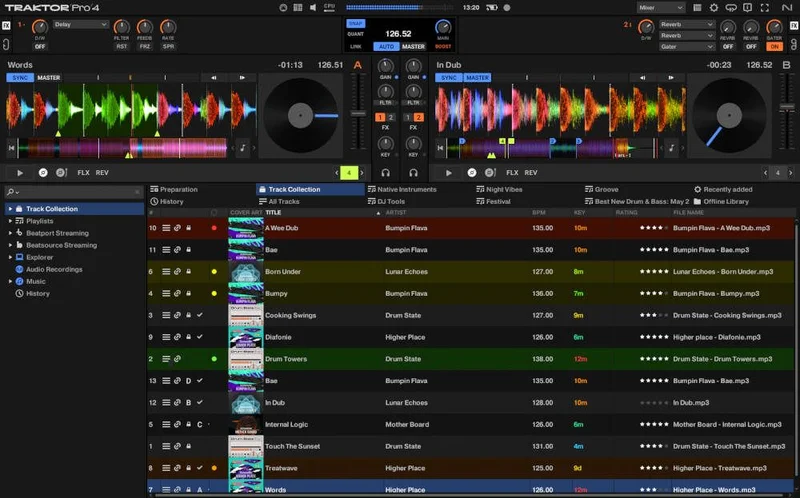
The real question Traktor Pro 3 owners are asking isn't "what's new?" It's "is this actually worth $74.50, or is Native Instruments just repackaging features Serato and rekordbox already had?" The honest answer: yes, it's worth it, specifically because of flexible beatgrids and stem separation, and the fact that you own it outright with no subscription attached.
Traktor Pro 4 landed in July 2024. The upgrade path from Pro 3 costs $74.50. A fresh purchase runs more than the upgrade price. Native Instruments also bundles it free with their S4, S3, X1, and Z1 hardware, which changes the calculus if you're shopping controllers anyway.
This review is for existing Traktor Pro 3 users deciding whether to upgrade. If you're coming from Serato or rekordbox, check our full Traktor Pro 4 platform review instead.
Does It Actually Deliver What Pro 3 Was Missing?
Traktor Pro 3's biggest liability was fixed beatgrids. If you mixed disco, jazz, or any live-recorded music where the tempo drifts, sync would drift with it. Pro 4 fixes that with flexible beatgrids that track tempo changes throughout a track automatically. Sync hits correctly. Loops don't drift. Beat-jump lands where it should.
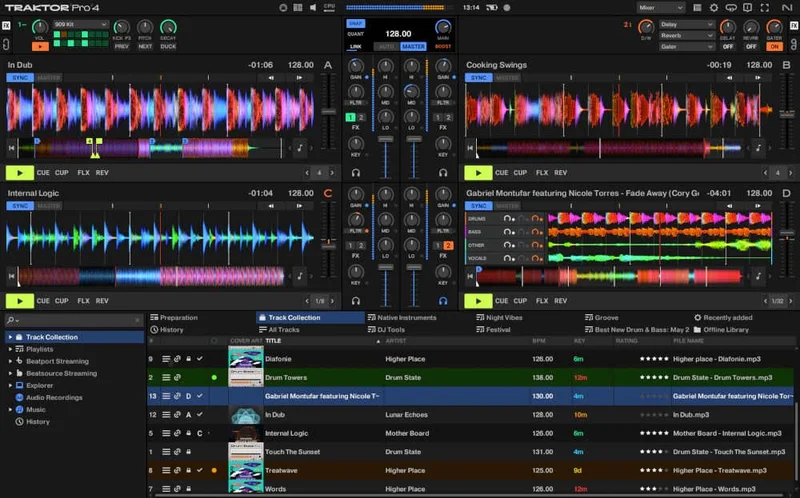
We tested this on a Harold Melvin track where the tempo wanders between 103 and 107 BPM over six minutes. Pro 3 would have drifted out by bar 32. Pro 4 held the grid through the whole track. That alone justifies the upgrade for DJs who play anything outside four-on-the-floor.
The Ozone Maximizer integration handles output loudness with iZotope's Intelligent Release Control, meaning you can push the master louder without the transient smear you'd get from a basic limiter. That's a real workflow addition, not decoration.
Where It Shines
Flexible beatgrids are the headliner. But stem separation is the feature that's going to change how people actually mix.
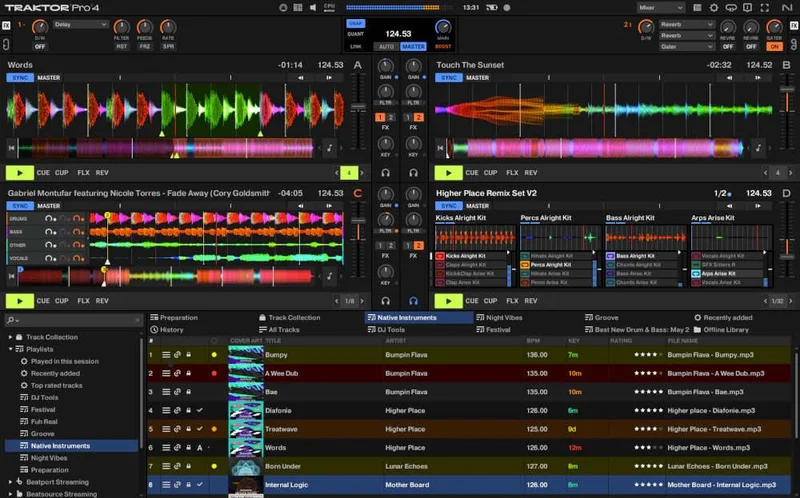
Powered by iZotope's RX technology, the stem engine splits any track into four stems: drums, bass, instruments, and vocals. Each gets its own waveform display in the deck. We ran a DnB track through it and pulled the vocal completely out mid-mix to layer it over an instrumental. Clean isolation. No significant bleed from the bassline into the vocal stem.
For comparison, this level of stem quality would cost you a separate iZotope RX subscription for post-production work. Here it is baked into the DJ software at the upgrade price. That's a satisfying value calculation.
The 40+ effects chain is unchanged from Pro 3 in concept, but the routing flexibility across four assignable effect processors is well-implemented. We love that you can chain a Reverb into a Delay into a Filter and assign it per deck. Nothing about that is new, but it still beats rekordbox's internal effects depth at this price point.
Beatport and Beatsource streaming integration with two free months included sweetens the package. how DJ streaming integrations work in 2026
Where It Falls Short
Stem analysis is annoyingly slow. We're not being vague: on an M2 MacBook Pro with 16GB RAM, a four-minute track took roughly 3 to 4 minutes to fully analyze stems. That's a near 1:1 ratio. If you're prepping 200 tracks for a set, you're looking at hours of analysis time.
This is the biggest practical limitation for live use. You cannot load an unfamiliar track mid-set and expect stems to be ready before your current track ends. You have to pre-analyze your library. Plan ahead or don't rely on stems in the moment.
On lower-spec systems (an Intel Core i5 Windows 10 machine at the minimum spec), stem playback introduced audible stuttering above 60% CPU load when running two stem decks simultaneously with effects active. Native Instruments recommends i5 minimum, but real-world stem use wants more headroom than that.
Pattern Player, the drum machine mode with kits from artists like Rebekah and Len Faki, feels like a features list bullet point. It works. The patterns are genuinely cool for techno and industrial sets. But it's not deep enough to replace a proper drum machine, and it's not simple enough to reach for mid-set without practice.
The UI refresh is conservative. Dark and light mode options are welcome. But the layout won't shock anyone who knows Pro 3. Not a complaint exactly, more a note that "redesign" is generous marketing language.
How It Stacks Up Against Serato and rekordbox
Serato DJ Pro runs as a yearly subscription. rekordbox has free and paid tiers, with the Performance Plan running as a monthly fee. Traktor Pro 4 is a one-time purchase, with a lower price for upgraders. That's the first and most important competitive fact.
Serato's stem separation (introduced via its own AI engine) is faster to analyze than Traktor's iZotope-powered version. That's a real trade-off. Serato's stems process closer to 2x real-time on comparable hardware. Traktor's stems sound cleaner on vocals and complex arrangements, but you pay for that quality in analysis time.
rekordbox wins on hardware compatibility with Pioneer CDJs in a club context. If you're playing clubs with Pioneer booths, rekordbox is still the path of least resistance. Traktor's DVS and plug-and-play CDJ support is solid, but the preparation-to-CDJ pipeline isn't as seamless.
Traktor wins on effects depth and creative flexibility ITB. It wins on one-time pricing. It wins if flexible beatgrids matter to your genre choices.
Is the $74.50 Upgrade Price Fair?
Yes. Straightforwardly yes.
You're getting flexible beatgrids, iZotope-powered stem separation, Ozone Maximizer integration, and Pattern Player for $74.50. Any one of those could justify a paid update on its own.
The upgrade is also perpetual. You own it. No subscription. That is worth factoring against Serato's yearly cost over two years, which adds up to well above Traktor's full purchase price. The math favors Traktor for anyone with a 24-month horizon.
It's wrong for you if you're on minimum-spec hardware and want to rely on live stem use. And it's wrong if your club workflow is built around Pioneer CDJ prep.
Score Breakdown
| Category | Score | Notes |
|---|---|---|
| Sound Quality | 4.5/5 | Elastique 3 time-stretch is clean; Ozone Maximizer preserves transients better than basic limiters |
| Value for Money | 4.5/5 | $74.50 perpetual upgrade against annual Serato/rekordbox subscriptions is a clear win |
| Ease of Use | 3.5/5 | Familiar to Pro 3 users; stem prep workflow demands planning; Pattern Player has a learning curve |
| Features | 4.5/5 | Flexible beatgrids, iZotope stems, Ozone Maximizer, 40+ effects, streaming integration: strong set |
| CPU Efficiency | 3.5/5 | Stems are heavy; minimum-spec hardware struggles with two stem decks plus effects |
| Overall | 4.2/5 | A meaningful upgrade that earns its price, with one real-world limitation that depends entirely on your hardware |
Alternatives to Consider
Serato DJ Pro is the main rival. Faster stem analysis, broader hardware partnerships, stronger club ecosystem. But it is subscription-only. If you play three or more nights a week and your venue is Pioneer-heavy, Serato is the pragmatic call. Traktor vs Serato comparison
rekordbox is the Pioneer DJ native software. Free at basic tier, with paid performance plans. If you're prepping music for CDJ booths, nothing touches it for that specific workflow. It doesn't have Traktor's creative effects depth or stem quality, but it has the widest club compatibility on the planet. DJ tools explained
Virtual DJ is worth mentioning for laptop-only DJs on a budget. Its AI stem separation is faster than Traktor's on equivalent hardware, and the subscription tiers start lower. It's not as credible in a professional hardware context, but the feature set is underrated.
If you're a Traktor Pro 3 user who plays genres with variable tempo, live recordings, or wants stems without paying subscription fees, the $74.50 upgrade is the easiest recommendation we've made this year.
Skip it if you're on a bare minimum i5 system and want stems in your live set. You'll frustrate yourself. Get the upgrade when you can run it properly.
Frequently Asked Questions
Is the Traktor Pro 4 upgrade worth it if I barely used stems features before?
Yes, because flexible beatgrids alone justify the $74.50 for anyone who mixes outside strict 4/4 territory. Stems are a bonus you can grow into. The Ozone Maximizer and reliable sync improvements apply to every set you play regardless of genre.
How slow is stem analysis in Traktor Pro 4 really?
On an Apple M2, expect roughly 3 to 4 minutes of analysis per 4-minute track. On a minimum-spec Intel i5, it's slower. You need to pre-analyze your library before a set. Real-time stem loading mid-set isn't practical unless the track is already analyzed and cached.
Does Traktor Pro 4 work with Pioneer CDJs?
Plug-and-play CDJ support is included, and DVS timecode control vinyl works for mixing your Traktor library through physical decks. However, if your workflow relies on USB stick preparation for Pioneer CDJ booths, rekordbox still handles that more directly. Traktor is better for laptop-based and hybrid setups.
Do I need a Native Instruments controller to run Traktor Pro 4?
No. Traktor maps to any MIDI-capable hardware, and deep MIDI mapping lets you configure third-party controllers. NI's own hardware (S4, S3, X1, Z1) includes the software free and gets tighter integration, but the software runs standalone with a keyboard, mouse, or any compatible controller.