
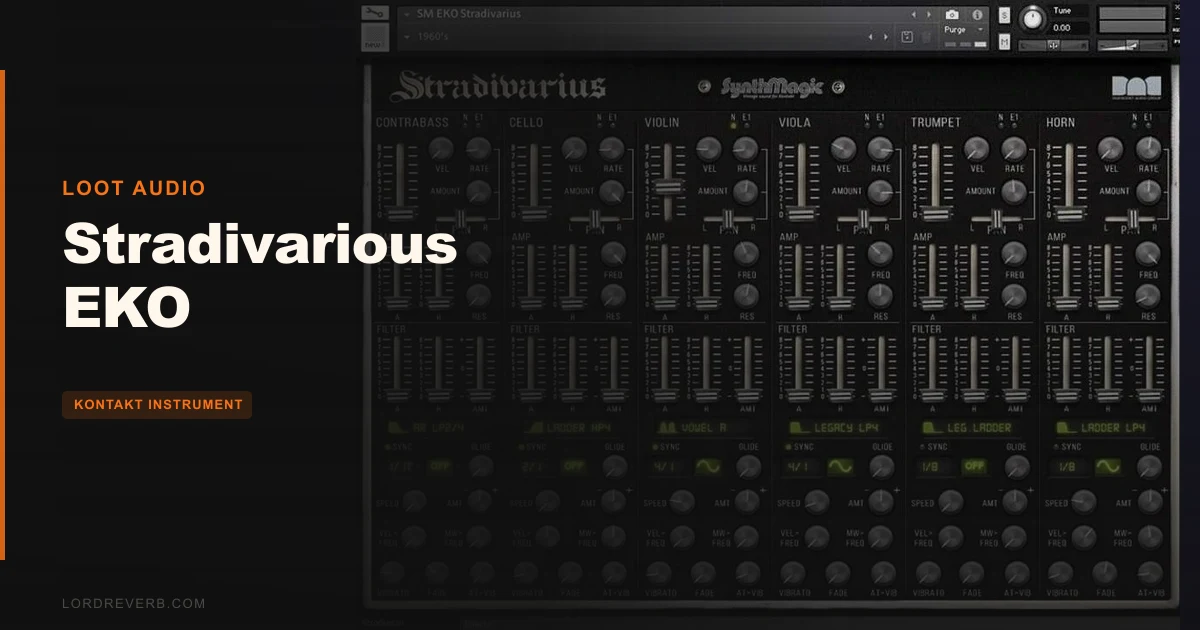
The real question about the Stradivarious EKO is simple: can a Kontakt instrument built around one of the rarest string synths of the 1970s actually deliver something you couldn't fake with a generic string library? Based on what Loot Audio has put together here, yes, and it earns that answer through specificity, not hype.
The EKO Stradivarius hardware is genuinely obscure. The developer calls it one of the rarest and hardest-to-find string synthesisers from the 1970s, and that's not marketing noise. These units rarely surface. Vangelis used one in his live setup during the 70s. That pedigree matters when you're chasing a particular era of haunted, slightly unstable string texture that modern libraries sand smooth.
At $35, this is built for a specific kind of producer: someone scoring something dark and cinematic, building a retro-electronic track, or layering vintage string pads under modern EDM. If that's your lane, read on. If you want a general orchestral strings library, this isn't it.
Does It Actually Deliver?
Loot Audio sampled all 6 original sections of the EKO Stradivarius in detail. That's the foundation. They didn't just sample one articulation and call it done.
On top of the raw samples, they built a second Ensemble-processed sample set. The developer describes it as producing a "very rich and vibrant sound." Both sample sets can run simultaneously and mix freely. That's a clever design choice. You get the raw, slightly raw-edged original character and a thicker, chorused version, blend between them to taste.
The effects chain is where the instrument earns its keep beyond a straight sample playback tool. Chorus, Phaser, Flanger, a convolution reverb with 37 impulse choices, and a Sync Delay. Each synth section has its own bus send to that effects chain, which means you can dial the reverb deep on one section and keep another dry and close. That's proper mixing logic baked into the instrument itself.
The developer says this version lets you create sounds well beyond what the original hardware could do. Given the filter options, the vowel filters, the phaser filters, and the per-section panning, that's believable on paper.
Where It Shines
The per-section architecture is where this instrument separates itself. Six sections. Each with independent panning, independent filter shapes, and a full range of filter types including vowel filters and phaser filters. That's not a typical string library setup.
Put the instrument on a new MIDI track and layer two sections against each other. Pan one 30 degrees left, one 30 right, run different filter shapes on each. You get a stereo string texture that moves without automation. That kind of built-in spatial complexity is genuinely satisfying to dial in.
The convolution reverb with 37 impulse responses is a real asset. Most Kontakt instruments bundle three or four IRs and leave it there. 37 gives you real flexibility between close rooms, long halls, and stranger spaces. If you're scoring something with a specific acoustic environment in mind, you've got options without reaching for an external reverb plugin.
The snapshots are worth mentioning. They ship with a range of presets that are actually meant to be modified, not just auditioned and left alone. Load one, push the vowel filter open on section 3, tighten the Q on section 5's filter. The architecture rewards that kind of hands-on adjustment.
The Vangelis connection isn't just trivia. That 70s live-show texture, slightly unstable, wide, harmonically complex, is exactly what this instrument is built to reproduce and extend. For Blade Runner-adjacent scoring work, it's a frustratingly specific tool in the best possible way.
Where It Falls Short
The Kontakt Player restriction is the first wall you'll hit. Full Kontakt 5.8.1 minimum. No Player support. If you don't already own full Kontakt, that's an additional cost sitting on top of $35. That's a real barrier for producers just starting out with Kontakt instruments.
The user community around this instrument is thin. There's almost no third-party documentation, no active forum threads to dig through when something doesn't behave. You're largely on your own. That's annoying for a tool with this much depth in the filter and effects routing.
The plugin format question is also worth raising. This runs inside Kontakt, so your DAW compatibility depends on Kontakt's own format support rather than a standalone VST3 or AU build. Worth checking your version of Kontakt before buying.
No trial version appears to be available. At $35 the risk is low, but a demo would help buyers confirm the sound character matches what they're after before committing.
How It Stacks Up
The obvious comparison is the ARP Solina. The Solina is the string synth everyone knows: it's been sampled to death, and you'll find Solina emulations everywhere from free downloads to premium Kontakt libraries. The Solina has a warmer, more rounded character and a much larger community of users and patches around it. If you need the familiar 70s string sound that's already all over records, a good Solina emulation is the safer, better-documented choice.
The EKO Stradivarius sits differently. It's rarer, stranger, and the Loot Audio build gives it deeper per-section control than most Solina-based instruments bother with. For vintage string synth plugins work where you specifically don't want the Solina sound, this is the more interesting tool.
If you want a broader vintage keyboard and synth library, something like Kontakt string instruments roundup might cover more ground at a similar or lower price. But none of them give you the EKO's specific character.
Is the Price Fair?
At $35, this is a niche purchase that earns its cost if the niche fits you. The 6-section sampling depth, the per-section effects routing, and the 37-impulse reverb all represent real development work.
If you're a film scorer who wants that Italian horror or early electronic score texture, this is underrated at the price. If you're a general producer looking for strings to sit under a pop track, it's the wrong tool regardless of cost. Don't buy specificity you won't use.
Specs & Technical Details
| Developer | Loot Audio |
| Price | $35 |
| Plugin Format | Kontakt Instrument (requires full Kontakt 5.8.1 or above) |
| OS Support | Mac / Windows (via Kontakt) |
| Activation | N/A |
| CPU Usage | N/A |
| Trial Available | No |
| Version Reviewed | N/A |
Score Breakdown
| Category | Score | Notes |
|---|---|---|
| Sound Quality | 4.0/5 | Rare source hardware sampled in detail; developer claims rich, vibrant character unique to the EKO |
| Value for Money | 4.0/5 | Deep feature set for the price; full Kontakt requirement adds cost for some buyers |
| Ease of Use | 3.5/5 | Snapshot system helps, but six-section routing takes time to learn; thin documentation |
| Features | 4.5/5 | Per-section filters, vowel filters, 37-IR reverb, dual sample sets: genuinely deep for the category |
| CPU Efficiency | 3.5/5 | Runs inside full Kontakt; actual CPU load unknown, but 6 sampled sections with effects will add up |
| Overall | 4.0/5 | A brilliantly specific tool for vintage string synthesis; wrong purchase if you want general orchestral strings |
Alternatives to Consider
If the full Kontakt requirement is a dealbreaker, it's worth looking at best string synth plugins with free player support before committing here.
For the ARP Solina character specifically, there are dedicated Solina emulations available as standalone VST3/AU plugins that don't need a full Kontakt license. Check our ARP Solina plugin alternatives roundup for the current options.
If you're building out a broader vintage synthesis toolkit, our best vintage synth Kontakt instruments list covers several instruments in this price range that cover more sonic ground, even if none of them are as specific or as strange as the EKO.
Who Should Buy This, and Who Should Skip It
The film and game scorer. You're building a cue with a 70s Italian horror vibe, or you need a Vangelis-adjacent pad under a synth-heavy scene. This is a brilliant choice. Buy it.
The retro-electronic producer. You're layering vintage string textures into abstract electronics or 70s disco-influenced tracks. The dual sample sets and vowel filters give you more texture options than most dedicated string instruments. Buy it, then spend an hour on the filter routing.
The EDM producer looking for something different. The developer flags modern EDM as a valid use case, and the ensemble processing and sync delay support that. Try it, but go in with the expectation that this takes more dialling in than a typical one-shot sound design tool.
The beginner on a budget without full Kontakt. Hard pass. The Player restriction means you can't run this without spending more money first. Look at free or Player-compatible string instruments until you're committed to the full Kontakt ecosystem.
The mixing engineer looking for a general string bus. Wrong tool. This is a sound design and composition instrument, not a broad orchestral library. Skip it.
The Stradivarious EKO is a love letter to one of the weirder corners of 1970s synthesis. At $35, it's not an expensive letter. But you have to want what it's saying.
Related reviews: Meloreed
Frequently Asked Questions
Does the Stradivarious EKO work with the free NI Kontakt Player?
No. This instrument requires the full version of NI Kontakt 5.8.1 or above. It will not load or function in the free Kontakt Player. If you don't own full Kontakt, factor that into your total cost before buying.
What are the 6 sections in the Stradivarious EKO?
The instrument recreates the 6 original sections of the EKO Stradivarius hardware, each sampled in detail. Loot Audio doesn't break down the individual section names on the product page, but each section has its own independent panning, filter shapes, and effects bus routing.
Can the Stradivarious EKO be used for modern music production styles?
The developer says it suits abstract electronics, 70s disco, and modern EDM, not just vintage or cinematic work. The ensemble processing and sync delay in particular push the sound toward contemporary applications. That said, this is a niche texture tool, not a do-everything string library.
Is there a trial version of the Stradivarious EKO available?
No trial or demo version appears to be available for this instrument. At its current price the risk is relatively low, but if you're unsure about the EKO's sound character, search for any available demos or audio previews on the product page before purchasing. Check what the per-section filtering does to the tone at different filter types before you commit.