
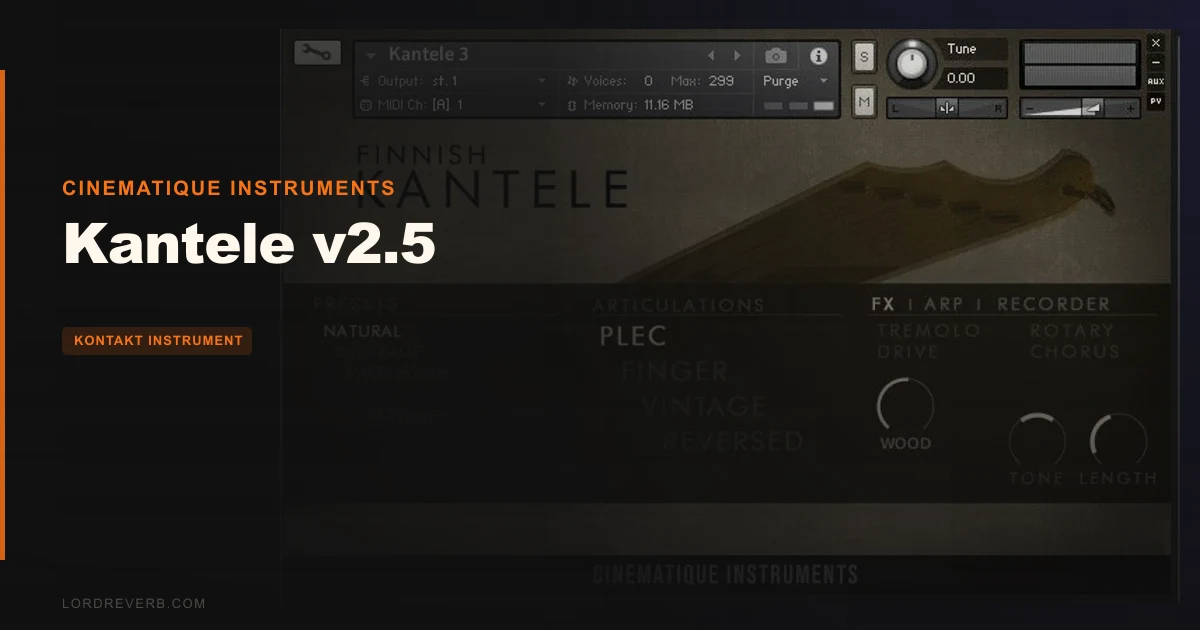
Kantele v2.5 by Cinematique Instruments is a well-recorded, genuinely usable Kontakt instrument that delivers the traditional Finnish kantele's distinctive bell-like character for $31, making it the most accessible option if you need this specific sound in your productions.
Here's the problem it solves first.
You're scoring a short film set in Scandinavia. The director wants something ancient and resonant, not a generic pizzicato strings patch. You Google "kantele plugin" and land in a dead end. Most of what exists is either buried in obscure developer sites, poorly sampled, or costs more than the gig. The kantele is one of those instruments that sits in a frustrating niche: too distinctive to fake with other plucked strings, too niche to justify expensive library coverage.
That's the gap Cinematique fills here. And at $31, they fill it well enough to stop you from reaching for a lap harp patch and hoping nobody notices.
The Specific Problem This Instrument Exists to Fix
Native to Finland and Estonia, the kantele is a traditional plucked string instrument, part of the Baltic Psaltery group related to the zither, with a distinctive bell-like sound and diatonic tuning. That sound sits somewhere between a dulcimer and a music box, airy, metallic, with a decay that rings longer than you'd expect from something so small.
For film and game composers, that character is irreplaceable. No amount of EQ on a harp patch gets you there. You either have the real samples or you don't.
Cinematique's kantele has five strings tuned in G-A-B-C' and D', but they've built a Kontakt patch to play it in chromatic tuning. That's the practical decision that makes this library usable rather than just interesting. Without the chromatic patch, you'd be locked into folk-specific harmonic territory. With it, you can sit the kantele anywhere in a contemporary score.
There's no other library at this price point that addresses this gap with this level of recording quality. That's not marketing. That's just the state of the kantele plugin market in 2026.
How It Performs in a Real Session
We loaded Kantele v2.5 into Kontakt 7 inside Logic Pro. First patch up: the standard diatonic preset. We played a slow melodic phrase around C major and let the notes ring.
The attack is immediate, which is correct for a plucked instrument. The fundamental sits around 1–3kHz with a strong harmonic shimmer above 5kHz that gives the instrument its signature brightness. It's not harsh. The decay trails naturally for roughly 3–4 seconds on sustained notes at moderate velocity, which means you're not fighting an unnatural cutoff in your reverb send.
Cinematique recorded the kantele with two completely different microphones: a dynamic Sennheiser MD 421 and a condenser Neumann U-87. In practice, this matters. The MD 421 capture is tighter, with a more focused midrange, good for when the kantele needs to cut through a busy arrangement. The U-87 capture opens the sound up, adding more room and top-end air. You can blend between them inside the GUI, which is a satisfying way to dial in exactly how present you want the instrument to feel.
We ran the blended output through a short room reverb at 0.8 seconds and sent it to a bus alongside a sparse string pad. The kantele sat in the mix without fighting for space. No high-pass filter needed. It naturally fades below around 200Hz, so it won't cloud your low-mid range.
A reverse sample set adds a more artificial character if you want it, and you can still access the older samples via the "Vintage" articulation, which has a different sound timbre that can make the kantele sound brighter. We love the Vintage option for ambient work. It has a slightly thinner, more ghostly quality, put a long tail reverb on it and it sounds like an instrument being played in another room, which is exactly what some cues need.
Updated in 2022 to version 2.5, Cinematique added new presets and effects along with the Arp and Recorder features, and created a new GUI design. The Arp is genuinely useful. We programmed a repeating 8th-note figure in a minor pattern and adjusted the rate to sync with our project tempo. The pattern locked cleanly. The Recorder mode, which lets you capture and loop phrases inside the instrument itself, is clever for building textural beds without leaving Kontakt.
Strengths and Weaknesses
The library runs to approximately 1,200 samples and 600MB of compressed data. For a single ethnic instrument, that's a thorough sample count. The Round Robin variations do enough work to prevent the "machine gun" repetition effect on fast passages, you'll notice the cycling occasionally on rapid runs, but it's not annoying at moderate tempos.
CPU usage is light. We saw under 3% CPU draw on an Apple M2 MacBook Pro at a 256-sample buffer. Load time from an SSD is around 12 seconds. It won't stress your session.
The weaknesses are real, though. There are no legato transitions. Play a slow melody and you'll hear each note as a discrete pluck rather than a connected phrase. For fast, decorative passages that's fine. For a slow, expressive solo line, it's frustrating. A legato patch would make this library twice as useful for melodic writing.
There's also no sul ponticello or muted articulation. The tonal palette you get is essentially: bright pluck, softer pluck, reverse, and vintage. That's it. For a $31 library it's fair. For a cheaper library it would be thin. Know where this sits.
The full version of Kontakt 5.6.8 or higher is required. Using the free Kontakt Player puts you in DEMO mode. This is the single biggest barrier. If you don't already own Kontakt full, you're looking at an additional cost that dwarfs the price of the library itself. Factor that in before you buy.
Value for the Price
Thirty-one dollars for this library is hard to argue against. It's a niche instrument, recorded with a Neumann U-87, with dual-mic blending, chromatic playability, and production-ready presets. The 2.5 update added real features, not cosmetic ones.
The caveat: if you need to buy Kontakt full just to run this, the value calculation collapses. The library is worth $31. It is not worth the asking price plus the extra cost of software to host it. If Kontakt full is already in your signal chain, this is an easy, underrated buy. If it isn't, either wait for a Kontakt sale or look at whether any of Cinematique's other libraries justify the combined spend.
For what it does, at the price it charges, this earns its place in any film or ambient composer's toolkit.
Who Should (and Shouldn't) Buy This
- ✅ Buy if you already own Kontakt full and score Nordic, folk, or cinematic ambient music regularly.
- ✅ Buy if you need a convincing kantele sound for a one-off project and don't want to hire a session player.
- ✅ Buy if you produce ambient electronic music and want organic, bell-like plucked texture that sits above your pads without clashing.
- ❌ Skip if you don't own Kontakt full, the free Player won't run this properly.
- ❌ Skip if you need expressive solo melodic writing with legato transitions. This library won't deliver that.
- ❌ Skip if you want a deep multi-articulation ethnic instrument. This is a single-instrument specialist library, not a broad world music toolkit.
Score Breakdown
| Category | Score | Notes |
|---|---|---|
| Sound Quality | 4.5/5 | Dual-mic recording sounds natural and clean; bell-like character is authentic |
| Value for Money | 4.5/5 | $31 for a Neumann U-87-recorded ethnic instrument is hard to beat |
| Ease of Use | 3.5/5 | GUI is clean but Kontakt-only workflow adds friction; no legato patch to figure around |
| Features | 3.5/5 | Arp, Recorder, reverse samples, and Vintage articulation are useful; articulation count is limited |
| CPU Efficiency | 4.5/5 | Light footprint; no issue running multiple instances in a template |
| Overall | 4.0/5 | A niche library that earns its price for the right user, less useful without Kontakt full already in your setup |
Alternatives to Consider
If Kantele v2.5 isn't quite the right fit, here are three real alternatives worth looking at.
Cinematique Instruments Bowed Kantele, If you want a more sustained, drone-friendly version of this sound, a bowed kantele library gets you longer note tails and a darker timbre. It's a different instrument, but the overlap is significant. Cinematique Instruments full catalogue overview
Soundiron Dulcimer and Zither, Broader in scope, covering related plucked string instruments from the same family. More articulations, bigger library, higher price. Worth it if you need more variety across the Baltic psaltery sound family. Best ethnic plucked string Kontakt instruments
Loot Audio Palm Mute Piano, Not a kantele, but if what you love about the kantele is its percussive attack and metallic decay, the Palm Mute Piano offers a similarly unique plucked-string character in an ITB-friendly Kontakt instrument. Palm Mute Piano Review: A Unique Kontakt Instrument 2026
If you're deep in world music or Scandinavian folk scoring, you'll also want to bookmark best world music Kontakt instruments 2026 as a broader resource for instruments in this category.
For most composers building a boutique library toolkit, Kantele v2.5 is the pragmatic pick. Thirty-one dollars is a lunch, not a budget line. If you already own Kontakt full, buy it without overthinking it. If you don't, sort that problem first. The kantele will wait.
Frequently Asked Questions
Does Kantele v2.5 work with the free Kontakt Player?
No. You need the full version of Kontakt 5.6.8 or higher. If you load it in the free Kontakt Player, it runs in DEMO mode, which times out after a set period and becomes unusable in a professional session. This is a hard requirement, budget for Kontakt full if you don't already own it.
What's actually new in version 2.5 compared to version 2?
The 2022 update added new presets, an Arp mode, a Recorder mode, and a redesigned GUI. The underlying sample set (recorded for v2 in 2015 with the Sennheiser MD 421 and Neumann U-87 dual-mic setup) remains the foundation. The Vintage articulation from the original version is still accessible.
Can I use Kantele v2.5 for chromatic melodies, or is it locked to a diatonic scale?
Both options are available. The instrument's five physical strings are tuned diatonically in G-A-B-C'-D', but Cinematique built a dedicated chromatic patch inside Kontakt that maps the samples across all 12 semitones. This makes it usable in any key and compatible with standard MIDI composition workflows.
How does the dual-mic setup affect the sound in practice?
The Sennheiser MD 421 (dynamic) gives you a tighter, more focused midrange, useful when the kantele needs to cut through a dense arrangement without extra brightness. The Neumann U-87 (condenser) opens up the high end and adds natural room character. Inside the GUI you can blend between the two captures, which gives you a meaningful tonal range from a single instrument without any additional processing in your signal chain.