If you're comparing Meloreed to recording a real melodica yourself, it wins on convenience and almost breaks even on realism. If you're comparing it to other Kontakt melodica libraries, there's almost nothing sitting in the same price bracket with this level of recording care. At $10, it's the kind of instrument you grab without much deliberation, as long as you already own the full version of Kontakt.
Quick verdict: Meloreed is a focused, well-recorded melodica library built by film composer Guillermo Guareschi, the same developer behind The Ronroco and The Bandoneon. The sampling is naturalistic, the controls cover the expressive details that matter, and the price makes hesitation feel ridiculous. It's not for everyone: you need full Kontakt, and it's built for emotional melodic lines, not complex sound design. Score: 4.2/5.
How Does It Compare Out of the Box?
Most composers reaching for a virtual melodica are choosing between recording their own, hunting for obscure sample packs, or landing on a library that was recorded as an afterthought inside a bigger world instruments bundle.
Meloreed sits outside all of that. It's a dedicated melodica instrument, built by someone who clearly cared about how reeds actually behave. The developer's claim that it "sounds undistinguishable from the acoustic one" is a bold line, but owners report the same thing: the naturalistic reed movement and breath response read as genuine, not synthesised.
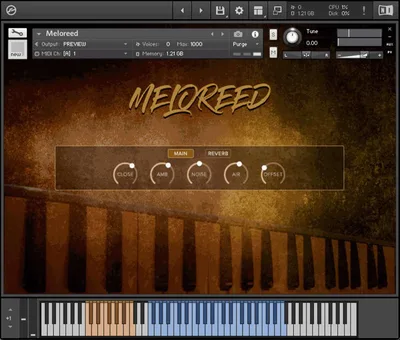
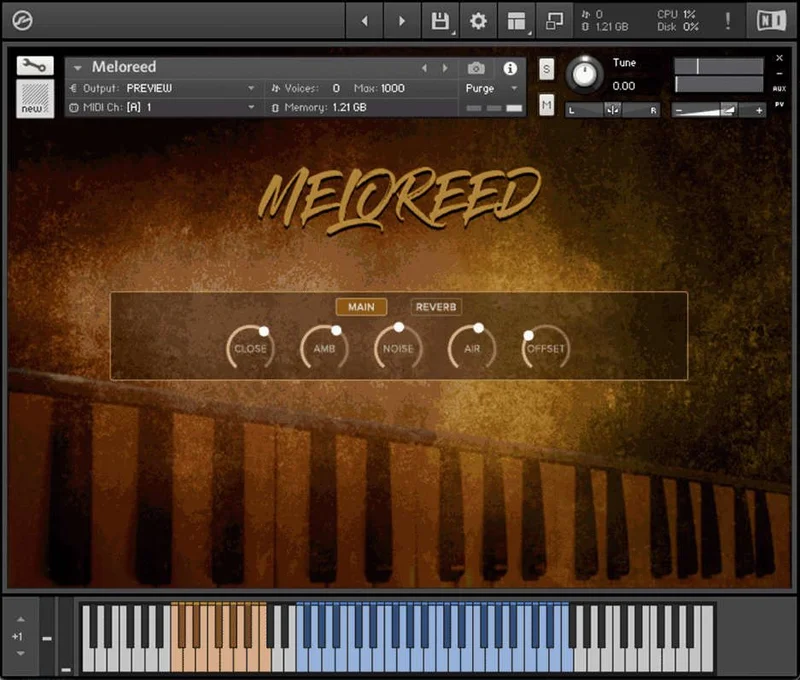
Out of the box, the interface puts mic blend, air volume, attack, and key noise on the surface. Nothing buried. For a $10 instrument, that's a clever approach. You're not wading through menus to find the one knob that makes it sound right.
Performance Deep Dive
The core recording philosophy here is worth understanding. The developer used microphones with low self-noise, ran the signal through a mix of tube vintage and solid-state preamps, applied no EQ cuts or destructive processing, and recorded at high resolution with a minimal signal path. That's a chain most budget library producers skip entirely.
The result, according to the developer, is that all the harmonics are present and unaltered. That matters with a melodica because the instrument's character lives in those upper partials: the slight breathiness, the reed rattle on attack, the slow bloom as the note acquires volume.
Round robins and dynamic layers are included, which handles the repetition problem that plagues simpler sample libraries. Load it on a solo melodic line and push the mod wheel through a phrase. The developer built a natural crescendo response into that controller, so the line breathes rather than just gets louder.
The offset control is the clever part. Set it short for quasi-staccato arpeggios. Set it long for slow, aching emotional lines. That's two very different musical characters from a single instrument, and it maps to real melodica technique rather than arbitrary synth parameters.
Where Meloreed Wins
The recording quality is the argument. Low self-noise mics, no destructive EQ, hi-res capture with Krystalos Audio Technology: that's an honest signal chain, and owners report it translates. One user describes the instrument as sounding "undistinguishable from the acoustic one." That's a satisfying result at any price, let alone $10.
The mic control is genuinely useful. Blending close and ambient positions inside the instrument means you're not reaching for a separate reverb send before the melodica sits in a film cue or a lo-fi beat. The built-in impulse response reverb handles the rest for simple sessions.
Owners consistently flag what they call a "unique soulful loneliness vibe." That's not a feature you can spec out, but it's the thing that makes a melodica worth having in the first place. If the emotion isn't there, none of the controls matter.
And the breath and air control is underrated. Most virtual instruments strip that out. Here it's a dial on the surface, which means you can push it for rawness or pull it back for cleaner doubling under a lead vocal.
Where the Competition Wins
Full Kontakt is required. Kontakt 5.6 or later, full retail version. The free Kontakt Player won't load it. If you don't already own Kontakt, this $10 instrument suddenly becomes expensive. That's a real barrier and it's worth saying plainly.
There's also no AU, VST3, or AAX version. It lives entirely inside Kontakt's ecosystem. For producers who've moved away from Kontakt-heavy workflows, that's an annoying constraint.
Beyond format, the public record on Meloreed is thin. Two user reviews, both five stars, is a clean sheet but a small sample. A library that's been around longer with hundreds of placements and detailed forum posts gives you more confidence before committing, even at a low price. No independent coverage shows how it holds up across genres beyond film scoring.
And if you need the melodica to take serious sound design punishment: layering, spectral processing, heavy granular stretching, a purpose-built wavetable instrument will give you more to work with.
Who Should Buy Which
- ✅ Buy if you score for picture and need a melodica that reads as real without booking a session player.
- ✅ Buy if you already own full Kontakt and want an emotionally direct melodic instrument at a low price point.
- ✅ Buy if you produce lo-fi, indie, or folk-adjacent music and want natural breath and reed character rather than a clean, lifeless sample.
- ❌ Skip if you only have the free Kontakt Player. It won't run.
- ❌ Skip if your workflow is entirely outside Kontakt. There's no standalone or alternative format.
- ❌ Skip if you need an instrument built for aggressive sound design or synthesis. This is a naturalistic recorder's tool, not a modular source.
Specs & Technical Details
| Developer | Guillermo Guareschi / Loot Audio |
| Price | $10 |
| Plugin Format | Kontakt Instrument (.nki) |
| OS Support | Mac / Windows (via Kontakt) |
| Activation | N/A (Kontakt library) |
| CPU Usage | N/A |
| Trial Available | N/A |
| Version Reviewed | N/A |
Score Breakdown
| Category | Score | Notes |
|---|---|---|
| Sound Quality | 4.5/5 | High-resolution, no destructive EQ, natural reed behaviour; owners report genuine acoustic realism |
| Value for Money | 5.0/5 | Hard to argue with this price for this level of recording care |
| Ease of Use | 4.0/5 | Controls are sensibly surfaced; full Kontakt requirement adds friction for some setups |
| Features | 3.5/5 | Covers the expressive essentials well; nothing modular or deep on the sound design side |
| CPU Efficiency | N/A/5 | No public data available; typical Kontakt instrument behaviour applies |
| Overall | 4.2/5 | A brilliantly priced, honestly recorded melodica library with one hard requirement: full Kontakt |
Alternatives to Consider
If you don't own full Kontakt and can't justify adding it, look at Spitfire Audio LABS. The LABS range is free, runs on their own player, and covers unusual melodic instruments with a similar lo-fi emotional character. It's not a melodica, but some entries land in the same sonic territory.
If you do own Kontakt and want a broader world instruments library that includes melodica alongside other folk instruments, Native Instruments Symphony Series and related Kontakt libraries occasionally cover that ground, though rarely with this level of dedicated focus on a single instrument.
For producers who want the melodica sound but inside a self-contained plugin without Kontakt dependency, it's worth searching current releases on Plugin Boutique and Splice's instrument marketplace. The field is thin. That scarcity is, honestly, part of what makes Meloreed easy to recommend at its price point.
If Guareschi's other instruments interest you, The Bandoneon and The Ronroco are worth checking. Same developer, same recording philosophy.
The Verdict
Meloreed is a love letter to a weird, underrepresented instrument, recorded properly and priced like the developer wanted people to actually use it. The full Kontakt requirement is the one real frustration. It cuts off a chunk of potential buyers who'd otherwise grab it without thinking twice.
But if you're already in the Kontakt ecosystem and you've ever wanted a melodica that doesn't sound like a toy keyboard run through a cheap mic, this is the answer. Load it on a solo line, bring up the breath control, slow the offset down, and let the reed movement do the work. That's the instrument's natural habitat.
At $10, the only people who should skip it are the ones who can't run it. Everyone else: just buy it.
Related reviews: Stradivarious EKO
Frequently Asked Questions
Does Meloreed work with the free Kontakt Player?
No. Meloreed requires the full retail version of Kontakt 5.6 or later. The free Kontakt Player won't load it. If you only have the Player, this instrument isn't compatible with your setup. Check your Kontakt version before buying.
What kind of music is Meloreed built for?
The developer describes it as a tool for composers of every genre, and the offset control lets you dial between slow emotional lines and fast quasi-staccato arpeggios. In practice, owners and film composers reach for it most. But the breath and air controls make it workable for lo-fi, indie, and folk production too.
How realistic does Meloreed actually sound?
The developer says the result is "undistinguishable from the acoustic one," and owners report the same experience. The recording used low self-noise microphones, a mix of tube vintage and solid-state preamps, no EQ cutting, and high-resolution capture with minimal signal path. Round robins and dynamic layers handle variation across repeated notes.
What controls does Meloreed give you over the sound?
You get individual control of close and ambient microphones, a mod wheel for natural crescendo, and separate dials for breath and air volume, key noise volume, and note attack. There's also a built-in impulse response reverb. That covers the main expressive parameters without overcomplicating the interface.