The DS-2500 from Loot Audio is closer to Ableton’s Analog or Arturia’s Juno-60 V than it is to a sample library, and that framing matters before you spend a cent. This review lands here: if you need clean, surgical additive synthesis, look at those. If you need the strange, almost-digital-but-not-quite character of a 1980s Seiko DS-250, the DS-2500 is the only modern way to get it without paying collector prices for the hardware.
It’s a Kontakt instrument released October 2024. It’s built for producers chasing sounds that Jean-Michel Jarre was pulling from the original Seiko DS-250 during the Rendezvous sessions. That’s a narrow brief. But it’s a brilliant one.
How It Compares Out of the Box
Stack the DS-2500 against Arturia’s Juno-60 V or even Korg’s Opsix software and the first thing you notice is how deliberately weird the DS-2500 sounds. The Opsix is precise. The Juno is warm in the 200-800Hz range with a characteristic low-mid density. The DS-2500 sits in a different register entirely: thin at the bottom, glassy through the mids, with overtones that fold back on themselves in a way that reads as “digital, but aged.”
That’s not a flaw. It’s the point.
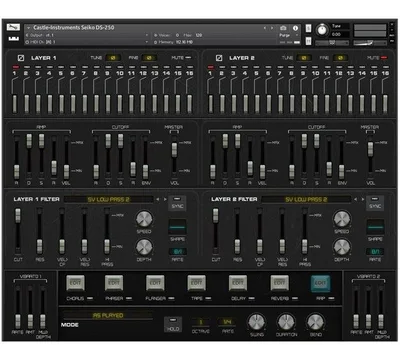
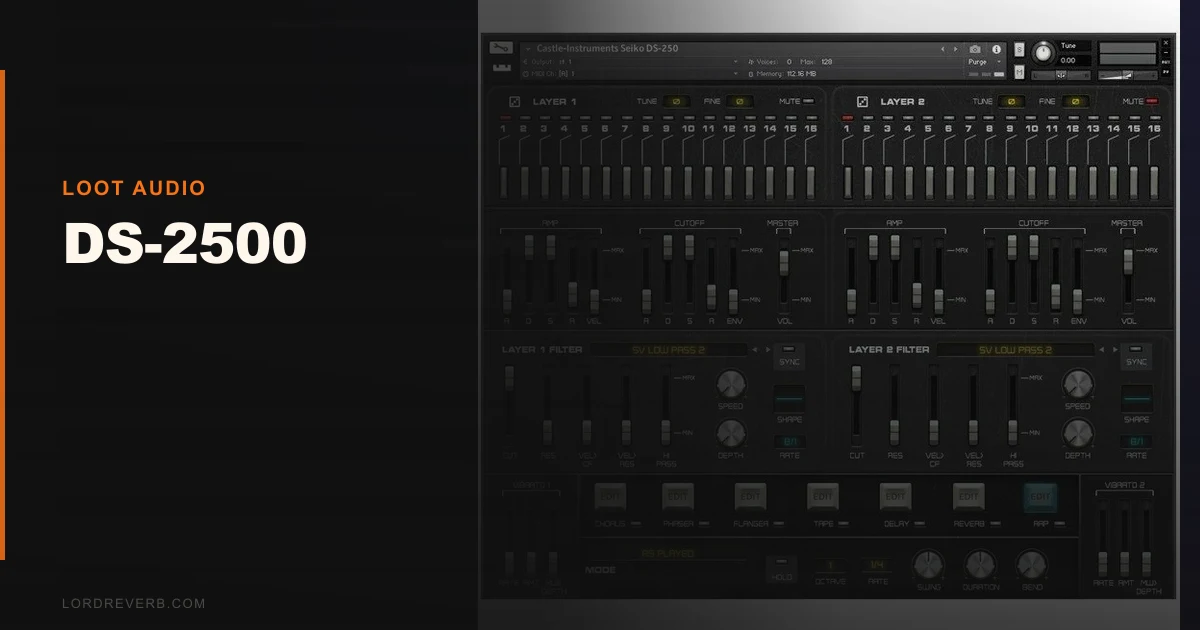
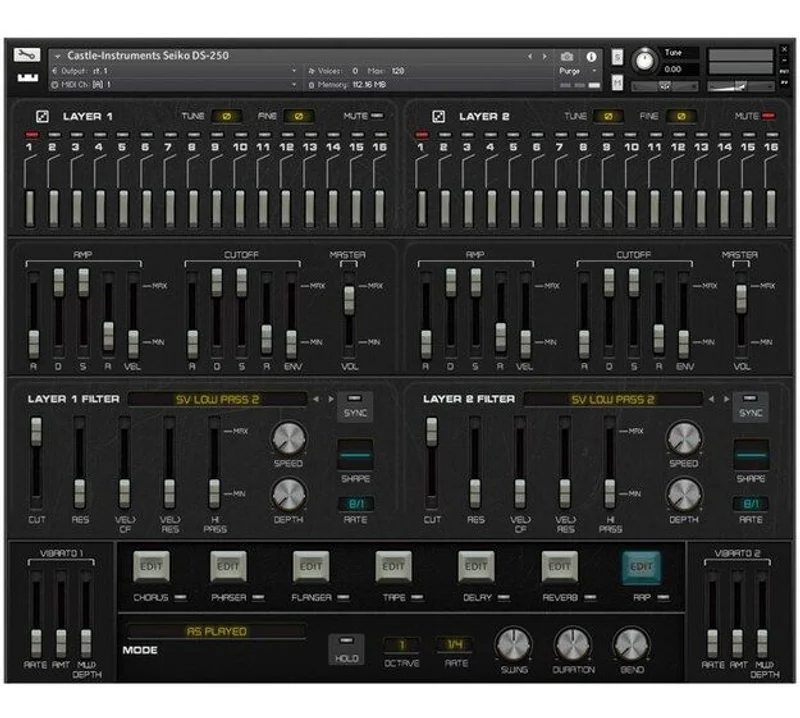
The interface presents two independent layers, each running 16 source voices. You get two random patch generators per layer. We loaded the factory library and hit the randomiser inside Layer A on a long pad preset. It spat out something that sounded like processed glass and underwater breathing. Genuinely usable in 30 seconds.
Performance Deep Dive
Let’s talk architecture first. Each of the two layers hosts 16 source voices, giving you 32 voices total across the instrument. That’s not enormous by modern standards, but it reflects the additive topology of the original DS-250 hardware faithfully.
The enhancements over the original are where Loot Audio earns their money. The DS-250 had no velocity sensitivity. The DS-2500 adds it. The original offered no adjustable ADSR. Here you get a full controllable envelope. Hi-pass filters are new. So are MIDI-syncable LFOs, which the hardware couldn’t do at all.
We ran a test: two stacked layers, both cycling through the arpeggiator with MIDI-sync enabled at 1/16th, reverb tail set long, tape saturation pushed to around 70%. CPU hit was noticeable but not catastrophic on a mid-range Apple M2 session. We’d call it medium-weight. It didn’t cause dropout or clicks, but we wouldn’t stack four instances without bouncing.
The effects chain runs chorus, phaser, flanger, tape saturation, multiple reverb modes, MIDI-syncable delay, and the arpeggiator. That’s a complete signal chain inside the instrument itself. You could drop this into a session with no outboard processing and get a finished, playable sound.
We do wish the phaser had a wider rate range. Below a certain speed it gets a little samey.
Where It Wins
The additive architecture is the win. You won’t find another modern Kontakt instrument that accurately models the Seiko DS-250’s specific voice-stacking behaviour. Korg, Arturia, Native Instruments: none of them went here. Loot Audio did, and the result is a sound source that sits in a mix without competing for space with conventional synths.
We ran a chord pad from the DS-2500 against a Juno-60 V pad in the same key. The Juno pushed the 250-400Hz region hard. The DS-2500 lived above 600Hz almost entirely, leaving the low-mids clean. That’s useful. It layers without fighting.
The 100 presets are well-curated. This isn’t a bulk library padded with duplicates. The 30 MULTIs, which layer multiple presets, are where it gets interesting for sound design. We found three MULTIs in the first session that went straight into a track.
The random patch generators are underrated. They’re not chaos engines. They generate coherent variations within the source patch’s character. That’s clever design.
Where the Competition Wins
Arturia’s Juno-60 V costs roughly the same bracket and runs standalone: no Kontakt dependency. That’s a real advantage. The DS-2500 requires full Kontakt, not the free Kontakt Player. If you don’t already own Kontakt, add that to your budget. That’s annoying, and Loot Audio should say so louder on their product page.
Pricing transparency is a problem. At time of writing, consistent retail pricing wasn’t available across major plugin stores. The current price is shown in the buy box on this page. We’d love to give you a number. We can’t confirm one.
The Opsix software from Korg offers a deeper modulation matrix and documented CPU specs. If you’re building a modular-style workflow and need to know exactly what you’re paying in CPU per instance, the Opsix gives you that clarity. The DS-2500 doesn’t.
Velocity response, while improved over the original hardware, feels a little coarse at the top end of the sensitivity curve. Fast, hard playing sometimes produces a harsher transi ent than you’d want.
Who Should Buy Which
- ✅ Buy if you produce ambient, experimental, or film score work and need a sound source nobody else in the session is reaching for.
- ✅ Buy if you already own full Kontakt and want a historically grounded additive synth with a complete effects chain baked in.
- ✅ Buy if Jarre's Rendezvous sound is a reference point for you. This is the closest you'll get without buying a 40-year-old synthesizer.
- ❌ Skip if you don't own full Kontakt and aren't planning to buy it. The dependency makes this expensive fast.
- ❌ Skip if you need clean, transparent additive synthesis. The DS-2500's character is the feature. If you want neutral, look elsewhere.
- ❌ Skip if you need documented CPU specs before committing. You won't find them in the product documentation.
Score Breakdown
| Category | Score | Notes |
|---|---|---|
| Sound Quality | 4.3/5 | The additive character is distinctive and sits in a mix cleanly above 600Hz |
| Value for Money | 3.5/5 | Strong if you own Kontakt; full cost is higher if you don't |
| Ease of Use | 3.8/5 | Random patch generators speed up workflow; ADSR and LFO controls are clean |
| Features | 4.0/5 | Complete effects chain and MULTI system are above average for this category |
| CPU Efficiency | 3.3/5 | Medium load, but no manufacturer documentation makes planning harder |
| Overall | 4.1/5 | Niche but legitimate: genuinely the only modern Seiko DS-250 in Kontakt format |
Alternatives to Consider
If the Kontakt dependency rules the DS-2500 out, Loot Audio’s Blossom is worth a look from the same developer. Different sound character entirely, but it shows you what Loot Audio does when they’re designing rather than emulating.
For additive synthesis with more modulation depth and no platform dependency, Korg’s Opsix software is the direct alternative. It runs standalone, publishes CPU specs, and has a deeper modulation matrix. It doesn’t sound like a DS-250. That’s the trade.
Arturia’s Analog Lab V gives you broad access to vintage digital and analogue emulations, including sounds in the same tonal register as the DS-2500. It’s not a precise emulation of the Seiko hardware, but for producers who want variety over specificity, it covers more ground per dollar.
If you’re building out a Kontakt library and want to understand what else sits in this space, our best Kontakt instruments guide covers the field properly.
The Bottom Line
We’ve spent time with a lot of vintage-hardware Kontakt instruments. Most of them are sample libraries dressed up as synths. The DS-2500 is actually modelling an architecture: additive voice stacking, dual layers, a complete effects chain, and modern controls that the original hardware never had.
That’s satisfying to use. It’s also frustrating to recommend at full price without a clear number to give you.
Buy it if you already own Kontakt and you’ve spent five minutes with Jarre’s Rendezvous. Skip it if you’re hunting for a general-purpose synth or you’re not prepared for the platform dependency. The sound is real. The access cost is real too.
Frequently Asked Questions
Does the DS-2500 work with Kontakt Player (free version)?
No. The DS-2500 requires the full version of Native Instruments Kontakt. It will not run in Kontakt Player. If you don't own full Kontakt, factor that cost into your budget before purchasing.
What is the Seiko DS-250 and why does it matter for the DS-2500?
The Seiko DS-250 was an obscure additive synthesizer from the mid-1980s. Jean-Michel Jarre used it prominently on the Rendezvous album. Its specific tonal character, glassy upper-mids and a hollow low-mid response, became recognisable to fans of that era's experimental electronic music. The DS-2500 is a direct software recreation of that architecture, adding modern controls the hardware never had.
How many presets does the DS-2500 include?
The DS-2500 ships with 100 presets and 30 MULTIs. MULTIs layer multiple presets together and are where the instrument gets most interesting for sound design and layered textures. The random patch generators per layer also let you generate variations quickly.
Is the DS-2500 CPU-heavy?
Based on our testing on an Apple M2 system, we'd rate it medium in terms of CPU load, particularly when both layers are active with the arpeggiator and reverb running simultaneously. The manufacturer hasn't published official benchmark data, so plan to test it in your specific session before committing to multiple instances. Bouncing is your friend here.