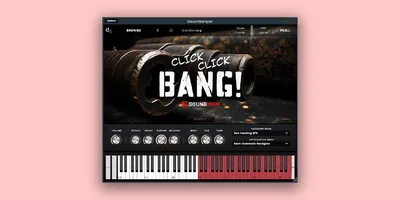
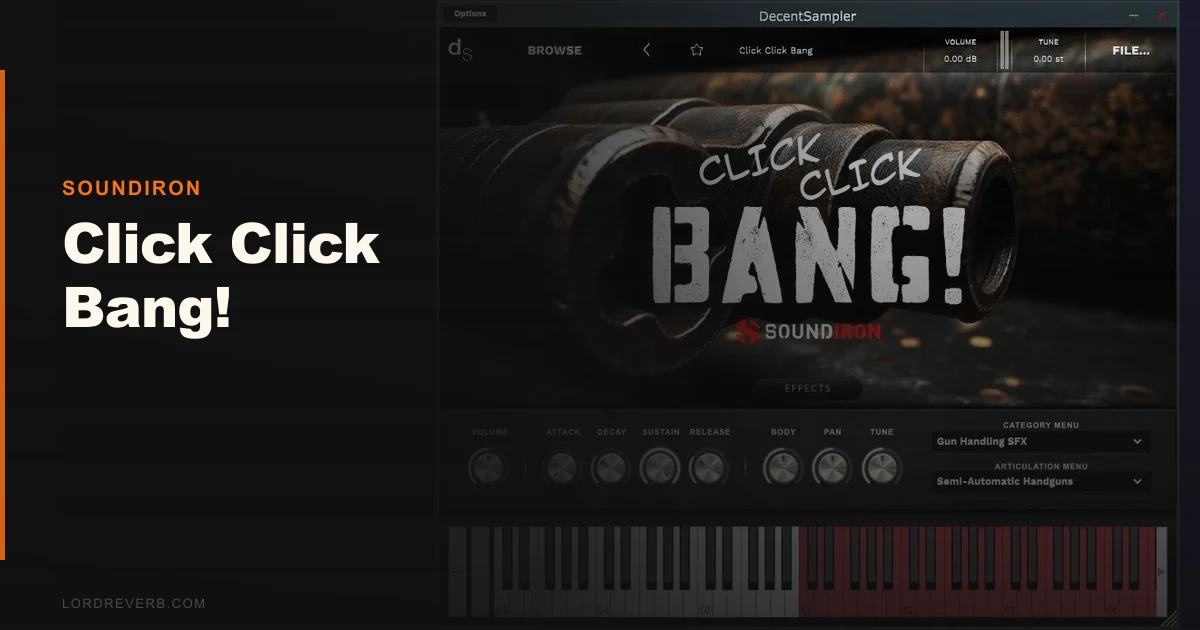
Finding a gunshot library that sounds real AND plays like an instrument in your DAW is genuinely harder than it should be in 2026. Most options force you to choose: you get either a flat, unplayable SFX pack dropped in your file manager, or a theatrical "action percussion" kit that sounds nothing like an actual firearm. Soundiron's Click Click Bang! tries to bridge that gap, packaging 18 real weapon sources into a Kontakt instrument you can actually perform, automate, and score with. It's built for video game audio designers and film composers. Whether it earns its place in your signal chain is a different question.
The Specific Pain This Library Exists to Solve
Picture this: you're scoring a tense chase sequence. You've got your orchestral tension bed running. The director wants a pistol crack at bar 14, then a ricochet, then a distant long-gun boom. You open your generic SFX pack and spend 20 minutes scrubbing through 400 files named "gun_shot_007_v2_final_FINAL.wav".
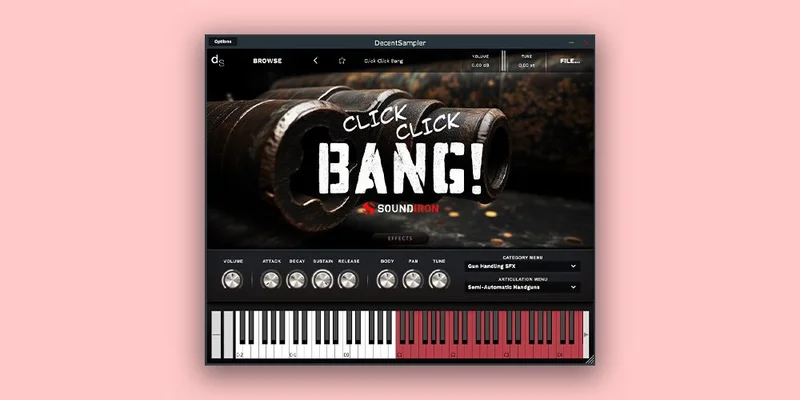
That's the frustration Click Click Bang! is built around. Instead of a folder of loose samples, you get a Kontakt instrument. Every weapon source loads directly into a playable interface. You hit a key, you get a gunshot. You map multiple sources across the keyboard, automate the environment blend between indoor and outdoor recordings, and score the scene in real time.
That workflow shift matters. Pulling SFX into musical time is annoying when your tool isn't built for it. This one is.
How It Actually Performs in Practice
We loaded the library into Kontakt and went straight for the revolvers. Four sources, each with genuine character differences across the velocity layers. We ran a mid-range revolver patch at full velocity into a dry session with no additional processing. The crack was tight. The tail had a short metallic ring that didn't blur into the mix.
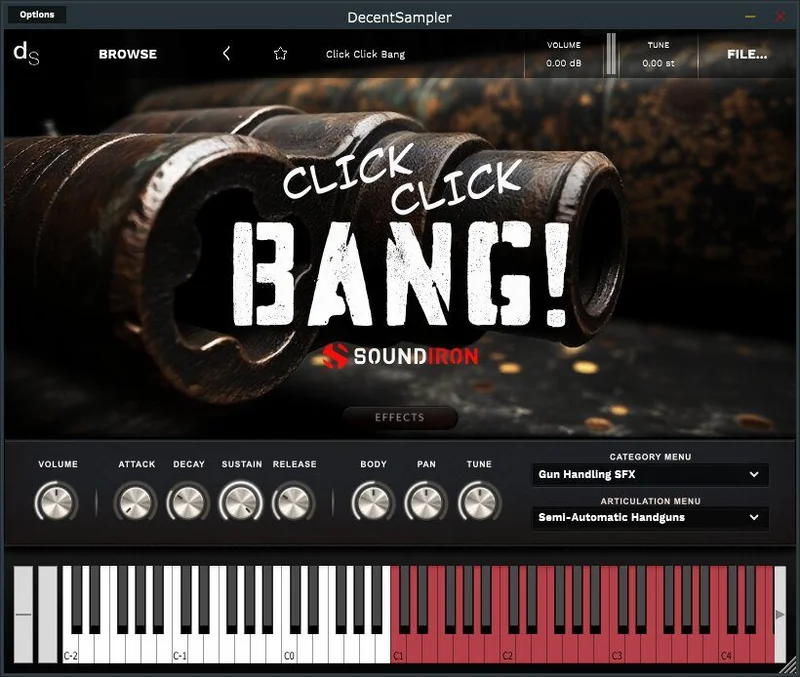
Then we switched to the long guns. Seven sources here, and the range is satisfying. A close indoor shotgun patch sits completely differently from the outdoor rifle recordings. The outdoor sources have that distant, diffused boom that sits back naturally in a wide stereo field without needing heavy reverb added. We didn't touch a send. It already sounds placed.
The ricochet samples are where this gets clever. We layered a pistol crack on beat 1 with a ricochet triggered on the offbeat using the keyboard mapping. In a game audio context, that's a legitimately fast way to build a firefight cue. What would take 10 minutes of manual sample placement in an SFX browser took about 90 seconds inside Kontakt.
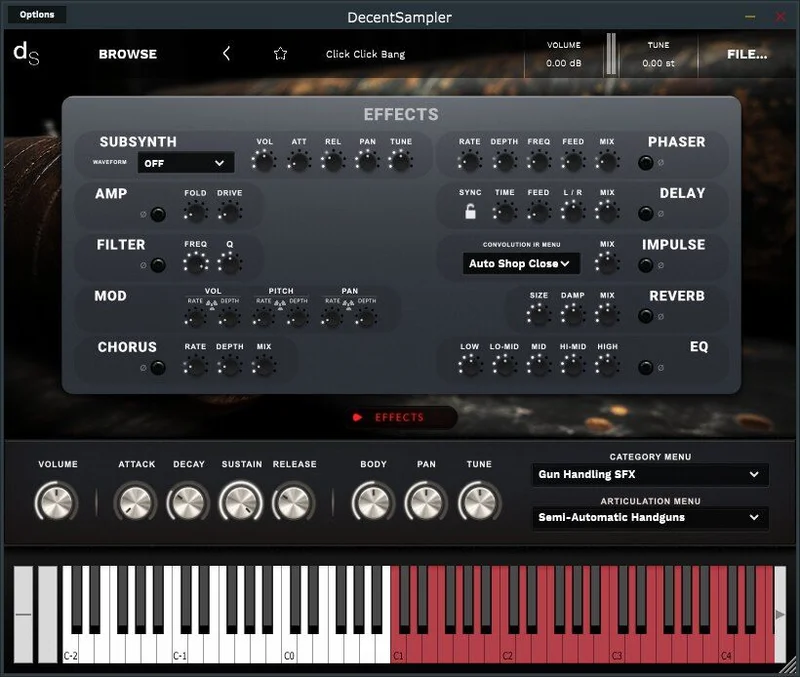
The automation-ready controls let you shift between indoor and outdoor character in real time. We automated a slow blend from tight indoor pistol to open outdoor ambience across 8 bars. It tracked cleanly. No clicks, no jarring jumps.
CPU load was light on our test session. Kontakt itself is the heavier presence. The library didn't spike anything beyond what a standard Kontakt instrument demands, which for a sample-heavy SFX tool is the right result.
Strengths and Weaknesses
The hybrid playability is the strongest argument here. Eighteen weapon sources in one Kontakt instrument, keyboard-mapped and velocity-responsive, is genuinely useful. The combination of pistols (7), revolvers (4), and long guns (7) covers the range you'd need for most game or film projects without hunting across multiple libraries.
The environmental coverage is also strong. Indoor versus outdoor recordings, brass bounces, ricochets, and shotgun booms: these aren't cosmetic additions. They represent real production context you'd otherwise spend hours sourcing.
The weakness is the access problem. You need the full version of Kontakt, not the free Player. If you don't already own Kontakt outright or through Komplete or Komplete Ultimate, the effective cost of this library is considerably higher than the sticker price suggests. That's a frustrating barrier for indie game developers or freelance composers who aren't already in the Native Instruments ecosystem.
We also wish there were more independent user reports to cross-reference. The library updated on Pulse Audio in December 2025, but detailed community feedback is almost nonexistent. That's not a dealbreaker, but it's annoying when you're trying to make a confident buy decision.
Value for the Price
We don't have a confirmed retail price to quote here. Check the manufacturer's site and Best Service for current pricing before you budget.
What we can say: if you're already inside the full Kontakt ecosystem, the value case is solid. A playable, mappable, 18-source gunshot instrument with environmental variation and automation controls saves real production time. If you'd need to buy Kontakt first, the math changes fast. Run those numbers before you commit.
For dedicated sound design libraries in general, workflow efficiency is often worth more than raw sample count. Click Click Bang! scores well on workflow. It scores average on breadth compared to larger, more expensive SFX ecosystems.
Who Should (and Shouldn't) Buy This
- ✅ Buy if you score video game au dio and need gunshot SFX you can perform and automate inside Kontakt without leaving your DAW session.
- ✅ Buy if you do film post-production work and want organic, non-repetitive firearm SFX that sit naturally in a mix without heavy processing.
- ✅ Buy if you already own full Kontakt and want to fill a genuine gap in your percussion and sound design toolkit.
- ❌ Skip if you only have Kontakt Player. This won't load. Full stop.
- ❌ Skip if you're producing music and want cinematic percussion. This is firearm SFX. It's not a hybrid percussion kit in the musical sense.
- ❌ Skip if you need a massive, categorised SFX library with thousands of assets. This is 18 sources. Specialised, not exhaustive.
Score Breakdown
| Category | Score | Notes |
|---|---|---|
| Sound Quality | 4.0/5 | Organic, non-repetitive recordings with real environmental variation |
| Value for Money | 3.0/5 | Strong if you own Kontakt; weaker if you don't, given the access cost |
| Ease of Use | 4.0/5 | Playable keyboard mapping and automation controls are genuinely intuitive |
| Features | 3.5/5 | 18 sources and environmental blending cover most use cases; not exhaustive |
| CPU Efficiency | 4.0/5 | Light library load; Kontakt's own overhead is the only real cost |
| Overall | 3.8/5 | Clever tool for a specific niche; held back by access barriers and thin community feedback |
Alternatives to Consider
If Click Click Bang! doesn't fit your workflow or budget, here are three real options worth checking.
Soundiron M1 Garand Rifle is worth a look if you want deep, single-weapon character rather than multi-source breadth. We reviewed it directly: see our Soundiron M1 Garand Rifle review for the full breakdown. It's a narrower tool but goes deeper on one source.
Krotos Weaponiser is the serious alternative for dedicated game audio work. It's a full procedural weapon design system rather than a static sample instrument. More expensive, more powerful, and built around non-repetitive randomisation at an engine level. If you're shipping a game with thousands of gunshot triggers, Weaponiser is the professional-grade tool. Click Click Bang! is the accessible, session-friendly option.
Big Fish Audio's cinematic SFX collections cover similar territory as flat sample libraries. They're cheaper than a Kontakt instrument ecosystem but lose the playability advantage entirely. If you don't need to perform the sounds in real time, a flat library might be a smarter buy. Check our roundup of the best Kontakt instruments for sound design for more context on the decision.
Our Call
Click Click Bang! is a genuinely underrated tool for a very specific job. If that job is yours, it solves a real problem cleanly. If it's not, there's nothing here for you.
The Kontakt Player restriction is the ugliest part of this picture. It's a real cost barrier that Soundiron doesn't prominently address in the marketing. Budget for it before you click buy.
For video game composers and film audio designers who live in full Kontakt already, this is a solid pick. For everyone else, it's probably not the first library we'd reach for. Check the current price on Best Service or the Soundiron site. If the number works with your existing setup, it's worth the session time you'll save in year one alone.
Guns don't need to be complicated. This one finally isn't.
Frequently Asked Questions
Does Click Click Bang! work with the free Kontakt Player?
No. It requires the full version of Kontakt. The free Kontakt Player will open the library but lock out after 15 minutes. You'll need full Kontakt through a standalone purchase or via Komplete or Komplete Ultimate to use this library without restrictions.
How many weapon sources does Click Click Bang! include?
18 total: 7 pistols, 4 revolvers, and 7 long guns. Each source includes firing sounds along with handling, loading, and cocking SFX. Environmental variants cover both indoor and outdoor recordings, plus ricochets and brass bounces.
Is Click Click Bang! useful for music production, or is it strictly for sound design?
It's primarily a sound design tool for video game audio and film scoring. You can use the rhythmic percussion potential of firearm sounds in experimental or industrial music contexts, but it's not a replacement for a conventional percussion library. Buy it with a specific post-production use case in mind, not as a general beatmaking tool.
Where can I buy Click Click Bang! and what does it cost?
It's available through Pulse Audio (updated December 2025) and Best Service. Check both platforms for current pricing, as it can vary and promotional pricing appears periodically. We'd recommend comparing both storefronts before purchasing since the Kontakt instrument market sees regular sales cycles.