The honest doubt about FIELD RECORDING: Floatation is whether paying anything for a Kontakt instrument containing exactly two sound sources makes any sense at all. It does, but only if you own the full version of Kontakt and you're making ambient, cinematic, or drone-adjacent music. If either of those conditions is false, stop reading and close the tab.
KLANG built Floatation around a specific creative premise: field recordings from ordinary environments, kitchens, train carriages, electrical appliances, aren't just texture. They're seeds. Floatation takes two of those seeds, a frozen minor chord and a deep resonating drone, and hands them to you as playable Kontakt instruments.
We loaded it into a dark, slow-moving ambient session and left it running. That's the real test for something like this. Not a quick A/B against a reverb plugin. A full track-build, start to finish, with Floatation as a load-bearing element.
Does It Actually Deliver on a Two-Source Promise?
KLANG is a small instrument developer whose catalogue sits firmly in the "micro-library" corner of the Kontakt ecosystem. Floatation (version 1.0) is exactly what it advertises: two sources, no more.
The frozen minor chord is a sustained, harmonically stable pad. It doesn't shimmer aggressively or move. It just holds. The deep resonating drone sits below it, with a low-frequency weight that pushes air without becoming a subby mess.
Both sources load cleanly in Kontakt 5.6.8 and above. The Kontakt Player limitation is real and annoying: you get 15 minutes in demo mode before the instrument goes silent. If you don't own the full version of Kontakt, this product is effectively unusable for production work.
What it promises is atmospheric material rooted in real-world acoustic events. What it delivers is close enough to that promise that we didn't feel cheated. It's a thin product. But it's an honest one.
Where Floatation Actually Shines
We dropped the frozen minor chord under a vocal take sitting around 220Hz. It filled the space between the vocal and the bass without crowding either. That's harder than it sounds. Most pad instruments either fight the vocal or disappear below it. This one found a shelf and stayed there.
The drone source is the more interesting of the two. We pitched it down a perfect fifth from its root position and ran it through a long reverb send with a pre-delay of 40ms. The tail spread over about 6 seconds without smearing the transient information from the kick underneath. That's a satisfying result for something that cost less than a takeaway coffee.
CPU draw is genuinely light. In a session with 47 other tracks and four instances of a convolution reverb running, Floatation added nothing measurable to our CPU meter. For an ambient producer who already has a busy template, that matters.
The field-recording philosophy behind the sound design is also cleverer than the product page suggests. The drone has a slight mechanical irregularity in its sustain, the kind of human imperfection you get from a real resonating object. It stops the texture from sounding synthesised and dead.
Where It Falls Short
Two sources is the ceiling, and you'll hit it within a session.
We tried building an entire ambient piece using only Floatation's two instruments. By the third arrangement section, we were recycling the same two sounds in different octaves. That's not a workflow. That's treading water.
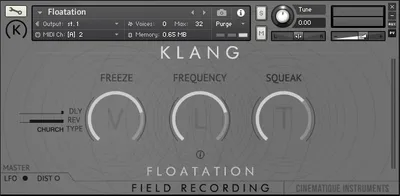
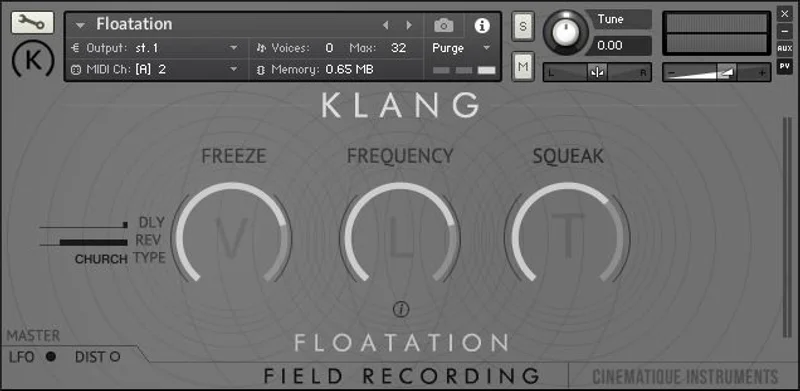
There's no macro layer built into the instrument interface. You're working with whatever Kontakt's standard controls give you: volume, envelope, and whatever the NKI file exposes. At $6 we're not expecting a full modulation matrix, but a single filter cutoff macro mapped to the mod wheel would have cost KLANG nothing and added real usability.
The rating on Plugin Boutique sits at 5.01 out of 5, which tells us either very few people have rated it, or the people who bought it were already predisposed to love it. We'd call it a 3.8. Solid for the price, not exceptional by any measure.
How It Stacks Up Against Similar Micro-Libraries
The closest direct comparison is Interakt + 3 Soundbanks, which we've reviewed separately. Interakt gives you a full sample playback engine alongside multiple soundbanks and costs considerably more. If your budget allows it, Interakt wins for depth and long-term usability. Floatation wins only on price and instant deployment.
Within KLANG's own catalogue, Floatation sits at the entry point. Their other instruments follow the same micro-library m odel, and the value accumulates if you build a collection of them rather than relying on any single one.
For field-recording-based pads specifically, we'd also point you toward BLEASS Alpha All Preset Packs Bundle, which takes a different route through synthesis but lands in a similar sonic territory with far more programmability. Different tool, different workflow, worth knowing about.
Floatation is not the deepest option in this space. It's the cheapest one that doesn't sound cheap.
Is $6 a Fair Price?
Yes. Barely, but yes.
At this price point, the only question is whether the two sounds are ones you'd actually reach for. We did reach for them. The frozen minor chord in particular earned a permanent slot in our ambient template after the first session.
If you're expecting a library, you'll be frustrated. If you're expecting two well-recorded, immediately usable atmospheric sources for under a fiver, you'll be fine with the purchase.
Score Breakdown
| Category | Score | Notes |
|---|---|---|
| Sound Quality | 3.5/5 | Both sources are clean and usable; the drone has real character |
| Value for Money | 4.0/5 | Hard to argue with $6 for two genuinely useful sounds |
| Ease of Use | 3.5/5 | Instant load, no setup beyond Kontakt; no custom macros or interface |
| Features | 2.0/5 | Two sources. That's it. The ceiling is low. |
| CPU Efficiency | 4.5/5 | Added nothing measurable to a 47-track session |
| Overall | 3.8/5 | A fair micro-tool for ambient producers who already live in Kontakt |
Alternatives to Consider
If you need more depth than two sources, Interakt + 3 Soundbanks is the next logical step. It costs more, but the soundbank depth means you won't exhaust it in a single session the way you will with Floatation.
For producers working in the synthesis space rather than pure sample playback, the BLEASS Alpha All Preset Packs Bundle covers similar sonic ground with far more programmability. If you want to sculpt the atmosphere rather than just place it, that's your tool.
If you're building a full template and want to understand how micro-libraries fit into a wider instrument chain, our MPC Expansion Bass Thrill review talks through that workflow in a different context but with transferable logic.
Floatation is the right answer only if the question is: "What's the cheapest way to add a frozen pad and a resonant drone to my Kontakt rig right now?" If the question is anything bigger than that, look at the alternatives above.
Buy it if you own full Kontakt and make ambient or cinematic music. Skip it if you're on Kontakt Player, need more than two sounds, or want any real sound-design control. The two sounds are good. There are just only two of them. That's the whole review.
Frequently Asked Questions
Does FIELD RECORDING: Floatation work with the free Kontakt Player?
No, not in any practical sense. The free Kontakt Player runs Floatation in demo mode, which cuts out after 15 minutes. For a production environment, that's unusable. You need the full version of Kontakt 5.6.8 or higher to use it properly.
What exactly are the two sound sources in Floatation?
KLANG describes them as a frozen minor chord and a deep resonating drone, both derived from field recordings of real-world acoustic events. The frozen chord is a sustained, harmonically stable pad. The drone sits in the low-mid to sub range with a slight mechanical irregularity that keeps it from sounding purely synthetic.
Can you layer both sources simultaneously in Kontakt?
Yes. They're separate instruments within the library, so you can load both into a Kontakt multi and layer them across the same MIDI channel or split them across a keyboard range. That's where most of the useful complexity in this micro-library comes from, since each source alone is fairly one-dimensional.
Is FIELD RECORDING: Floatation worth buying if I already have large ambient libraries?
Probably not. If you've got a well-stocked ambient template with a range of pads, drones, and textural instruments, Floatation doesn't add anything you'd urgently miss. It's best suited to producers building their Kontakt library from scratch on a tight budget, or those specifically drawn to the field-recording aesthetic behind KLANG's sound design philosophy.