
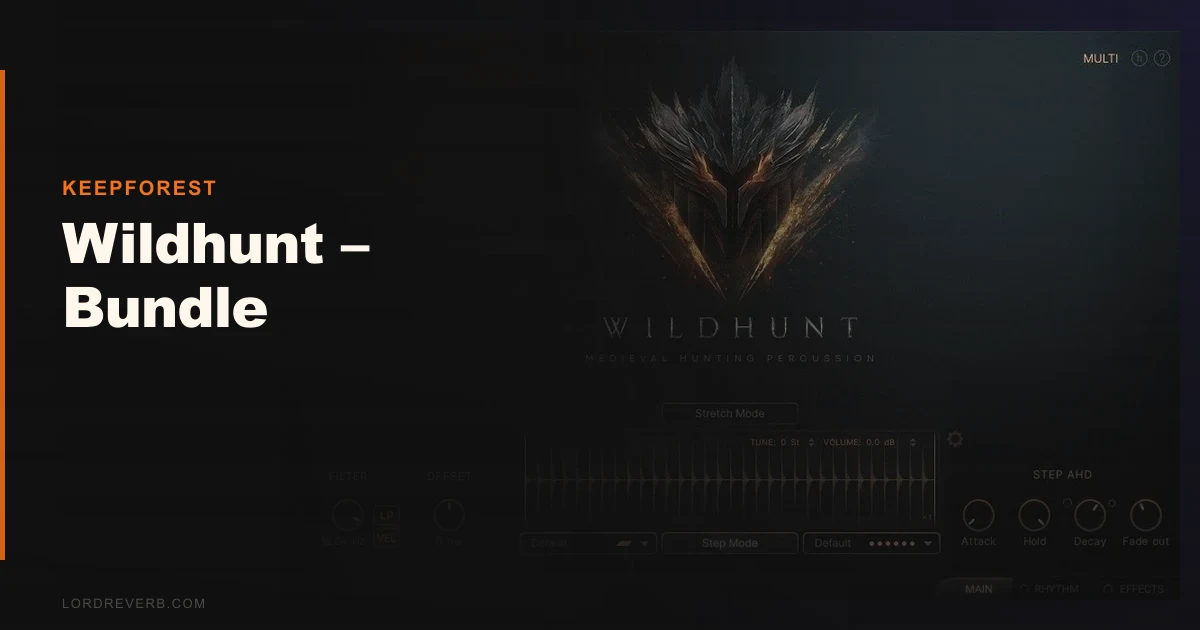
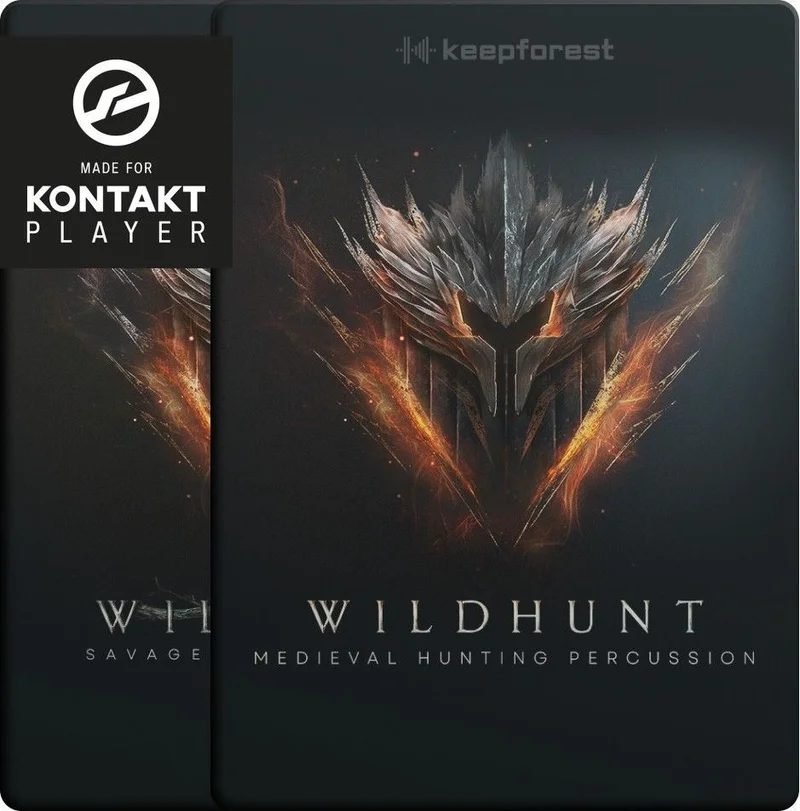
The Wildhunt Bundle is two Kontakt libraries bundled together: Medieval Hunting Percussion and Savage Ritual Tension, both by Keepforest, priced at $340 intro and built for composers scoring feral, primitive, high-stakes scenes.
We were three weeks into a trailer cue. The picture locked on a hunt sequence, torches, dark forest, something closing in fast. Our go-to library gave us clean orchestral hits and nothing else. We needed something that felt like it was made from bone and fear, not polished mahogany.
We pulled up Wildhunt on a recommendation from a colleague who'd used it on a post-apocalyptic short. Within fifteen minutes, we had a rhythmic framework that matched the edit. That speed matters in trailer work. The question is whether it holds up past the first fifteen minutes.
This review is for cinematic composers, trailer producers, and game audio designers working in primitive, survival, or feral settings. If you're scoring a chamber orchestra piece or a lo-fi beat record, keep walking.
First Impressions After Install
Installation runs through Native Access. No surprises there, Keepforest has used this pipeline before, and it's clean.
You need Kontakt 8.7.1 or newer, but critically, the free Kontakt Player works. That's a meaningful barrier removed for composers who haven't paid for the full Kontakt license.
The browser opens and both libraries share an immediately recognisable structure: MAIN patches, RHYTHM patches, and EFFECTS patches. This isn't accidental. Keepforest built both libraries to sit beside each other architecturally, which means the workflow muscle memory you build in Medieval Hunting Percussion transfers directly to Savage Ritual Tension.
First sound we loaded was a MAIN patch from the Hunting Percussion side. Big. Dense. Immediately useful. We didn't touch a single knob for the first pass.
Getting It Into a Real Workflow
The shared MAIN/RHYTHM/EFFECTS structure is the bundle's biggest practical win. We ran the Hunting Percussion's RHYTHM patches as the backbone of a cue, then layered Savage Ritual Tension's EFFECTS patches over the top for atmosphere. They sat together without phase fighting or tonal clashing. That's the organic complementarity Keepforest marketed, and they delivered it.
But here's where friction appeared. When we started stacking four or more patches simultaneously, two MAIN, one RHYTHM, one EFFECTS, CPU usage climbed faster than we'd like. On an M2 MacBook Pro running Logic Pro at a 128-sample buffer, we started seeing strain around the third concurrent instance. Not a dealbreaker, but you'll want to bounce stems as you build rather than running everything live through a full session.
The Kontakt instrument workflow guide we've covered before applies here: freeze tracks, bounce wet, and keep active instances lean.
Navigating the browser to find a specific texture mid-session can be annoying. The patch naming is descriptive but not always intuitive. We spent longer than we wanted hunting for a specific vocal texture in Savage Ritual Tension. A tagging or search system would fix this immediately.
What Wildhunt Actually Does Well
The percussive character is the honest strength. Medieval Hunting Percussion delivers tight impacts with fast transient attack, we're talking hits that sit in a mix without needing 3dB of presence boost or heavy EQ. The low-end on the larger frame drums sits around 60-80Hz without turning into mud, which means they layer cleanly under orchestral brass without masking.
Savage Ritual Tension earns its name. The beastly vocal textures are genuinely unsettling. We ran a sustained vocal pad under a scene cut and it created dread without being melodramatic. That's a harder trick than it sounds.
The FX chains between both libraries are reusable. We pulled an FX patch from Hunting Percussion and applied the same rhythmic logic to a Savage Ritual tension swell. It clicked. That's the bundle's real value: not two libraries that happen to share a price tag, but two libraries designed to interlock.
For productions in the vein of The Northman, The Last of Us, or Raised by Wolves, the sonic palette is close to perfect. The best cinematic percussion plugins article covers the broader category, but for primitive-world scoring specifically, Wildhunt holds its own against much more expensive options.
The Rough Edges
The sonic range is narrow. That's not a flaw exactly, narrow focus done well beats broad focus done poorly, but you need to go in knowing it.
Outside of primal, feral, or primitive tension cues, Wildhunt struggles to find a role. We tried it on a sci-fi action cue with a clean, modern feel. It sounded wrong. Forced. The organic character that makes it brilliant for ancient or savage settings becomes a liability in anything sleek or futuristic.
No trial version is frustrating. At $340, we'd want to test the sonic character before committing. Keepforest offers demos on their site but there's no playable trial inside Native Access.
The CPU behaviour when stacking patches isn't catastrophic, but it's a real workflow consideration on older machines. Anyone running an Intel machine from 2018 or earlier should factor in bounce time.
Patch naming, as mentioned, could use a revision. Some of the EFFECTS patches in Savage Ritual Tension are named in ways that don't tell you much until you load them.
Who This Is Really For
- ✅ Buy if you score trailers, games, or film in primitive, post-apocalyptic, or survival genres regularly
- ✅ Buy if you want two libraries that work together without EQ gymnastics to make them coexist
- ✅ Buy if you need production-ready cinematic percussion that doesn't require hours of sound design to be usable
- ❌ Skip if your projects skew contemporary, electronic, or orchestral-only, the palette won't transfer
- ❌ Skip if you're on an older, lower-powered machine and frequently stack many plugin instances
- ❌ Skip if you need a demo before buying, there isn't one, and $340 is a serious commitment
Score Breakdown
| Category | Score | Notes |
|---|---|---|
| Sound Quality | 4.3/5 | Transients hit clean; low-end sits well; vocal textures are genuinely menacing |
| Value for Money | 3.8/5 | Intro pricing is fair; no trial makes it a harder sell at full price |
| Ease of Use | 3.5/5 | Shared patch structure helps; browser navigation and patch naming need work |
| Features | 3.8/5 | Shared MAIN/RHYTHM/EFFECTS architecture is clever; limited outside its lane |
| CPU Efficiency | 3.3/5 | Fine for light use; stacking patches on older hardware gets uncomfortable |
| Overall | 4.1/5 | A focused, well-engineered bundle for a specific need, and honest about what it isn't |
Alternatives to Consider
If the lack of a trial is a dealbreaker, or you want something with a wider sonic range, here's what we'd look at instead.
Spitfire Audio DRUMS OF WAR covers similar territory with a more established brand, broader documentation, and an occasional introductory price worth watching. We've covered Spitfire Audio cinematic drums overview separately, it's worth reading if you're undecided between the two.
EastWest Stormdrum 3 sits in the same cinematic percussion category but goes wider: global percussion sources, more tonal variety, and a substantial patch count. It costs more to access via the Composer Cloud subscription model. See our EastWest Composer Cloud review for the full picture on whether the subscription makes sense for your workflow.
Native Instruments ACTION STRIKES is worth considering if you're primarily a Kontakt user wanting cinematic percussion with NI's full ecosystem integration. We break down the best Native Instruments percussion libraries in more detail if you want to compare the full field.
Final Word
The intro price expires January 1, 2026. At $340 before that date, you're getting two libraries that were clearly designed to work together, and they do. The percussive transients are tight, the tension textures are satisfying in the right context, and the shared patch architecture saves real time on sessions where you need both libraries simultaneously.
But we'd love a trial. At $399 post-promo, that's a significant ask without one.
If you're scoring something feral, primitive, or survival-driven right now, buy it before January. If you're working outside that world, this isn't your library. Nobody who needs clean modern orchestral percussion will get their money's worth here.
Primal is a feature, not a bug. Know which you need before you commit.
Frequently Asked Questions
Do I need the full version of Kontakt to run the Wildhunt Bundle?
No. Both libraries are compatible with the free Kontakt Player, so you don't need a full Kontakt license. You do need at least version 8.7.1 of Kontakt or the Kontakt Player, and activation runs through Native Access.
Is there a trial version of the Wildhunt Bundle available?
No trial is currently available through Native Access or Plugin Boutique. Keepforest provides audio demos on their site and at Plugin Boutique, but there's no playable demo to test before purchasing. That's our biggest hesitation about recommending it at full price without hands-on time first.
How long is the intro pricing available for the Wildhunt Bundle?
The $340 intro price is valid until January 1, 2026, available at Plugin Boutique and the Keepforest store. After that date, the bundle reverts to its regular price of $399. Individual libraries return to $199 and $299 respectively after the promo ends.
Can the two libraries in the Wildhunt Bundle be used independently, or do they require each other to work?
Both libraries function completely independently. You can load Medieval Hunting Percussion or Savage Ritual Tension on their own without the other installed. The benefit of owning both is the shared MAIN/RHYTHM/EFFECTS architecture, which lets you port rhythms and FX chains between the two, but neither requires the other to operate.