The worry with Portal isn't whether it sounds good. It's whether 64 synth loops justify buying a dedicated Kontakt instrument at $10 when your DAW already ships with a sample library. It does, but only for a specific kind of producer.
Quick verdict: Portal is a tightly designed loop instrument built for one job: dropping warm, tempo-synced chord movement into a track fast. At $10, it's an easy yes if you're regularly building lo-fi, ambient, or cinematic beds and want pre-processed "Aura" textures that sit without hours of shaping. It scores 3.5/5. It's not deep. But it doesn't pretend to be, and that honesty is part of the value. Skip it if you want playable, note-by-note multi-sampled instruments.
Does It Actually Deliver?
Portal comes from Iamlamprey, a boutique Kontakt library developer with a clear design philosophy: build tools that serve a specific creative moment, not an entire studio. Portal's premise is loop-based chord textures, called "Auras," built from rhythmic, tempo-synced synth loops designed to add movement to a dry arrangement.
It contains 64 loops total. 32 Major Auras and 32 Minor Auras, each split between open (full chord) and muted (single-note, low-velocity) variants. Every loop syncs to your DAW's tempo. The transposition script lets you shift the root chord in real time.
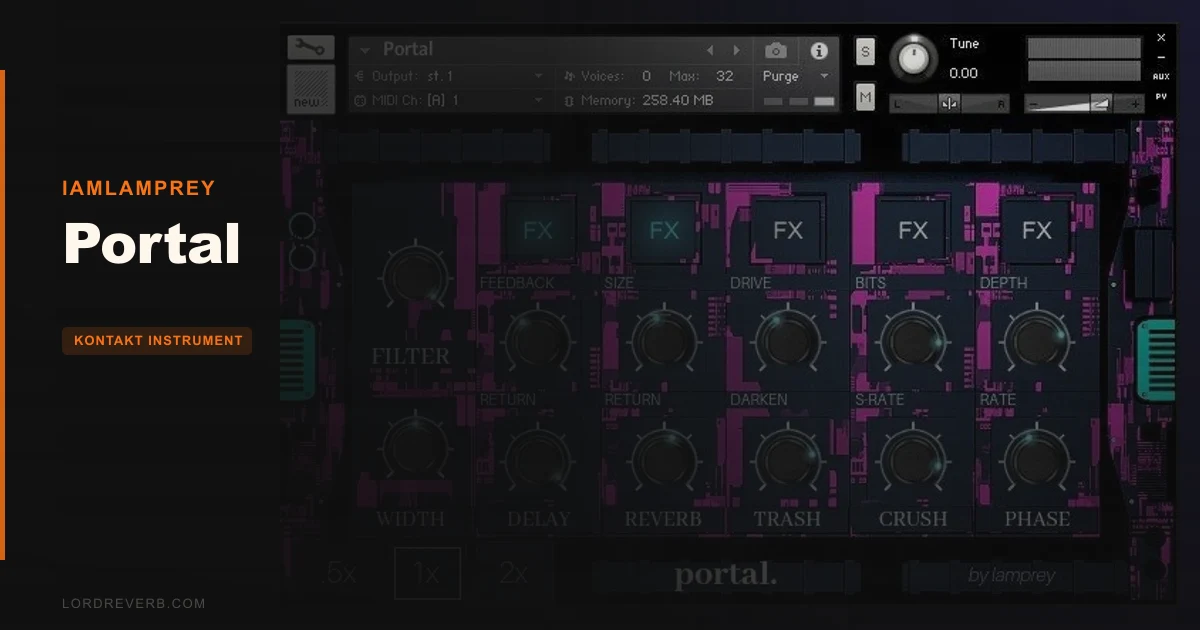
What it promises is colour and space, fast. And that's mostly what it delivers. The built-in FX chain, which includes Filter, Width, Delay, Reverb, Trash, Crush, and Phase, means you're not routing to five separate plugins just to dial in a vibe. For $10, the promise holds up.
Where It Shines
Load a muted Minor Aura into a sparse beat and push the Reverb and Width controls. You'll get a shimmering mid-layer that fills space without competing with your melody. That's the use case Portal was built for, and it genuinely nails it.
The tempo-sync is the real draw. Drop Portal into a 90 BPM lo-fi session and switch to a 140 BPM future bass track by halving the playback rate. The loops lock in without any manual time-stretching. That workflow is satisfying in a way that generic sample packs never quite match.
The muted variants are clever. Instead of full chords, they play single notes at low velocity, which gives you a rhythmic, percussive texture you can layer under a pad without harmonic clutter. We'd use those far more than the open chords on anything busy. And the transposition script means one loop covers every key, so 64 loops stretch further than that number suggests.
The built-in FX are a genuine time-saver. The Crush and Phase controls especially. Run a Major Aura through Crush at around 30 to 40 percent and you get a lo-fi crunch that would otherwise take three plugins to replicate. For producers building Kontakt-based instrument chains, that kind of consolidation matters.
Where It Falls Short
The Kontakt Player restriction is annoying. You need the full version of Kontakt 5.8 or later. If you're already in the Native Instruments ecosystem with a full Kontakt licence, fine. But if you're newer and bought Portal expecting to run it in the free Player, you'll hit a wall fast.
The palette exhausts itself. Sixty-four loops sounds like enough until you've been working on an album for two weeks. The muted and open split helps, and the transposition script buys you flexibility, but Portal is still a single-texture instrument. It does one mood well. Broaden your project and that limit becomes obvious.
There's also no true playability. You're triggering loops, not playing notes. If you want something that responds to finger pressure, velocity layers, or articulation changes, look elsewhere. Portal is a colour tool, not an instrument in the traditional sense. That's a real limitation worth naming.
How It Stacks Up
The obvious comparison is Loot Audio Palm Mute Piano, another Kontakt instrument at a similar price point. Palm Mute Piano gives you a playable multi-sampled instrument with real dynamic response. Portal gives you pre-built loop textures. Different jobs.
If you want something closer in concept, consider NI's own Session Guitarist range or stacked loop libraries from Splice. Session Guitarist offers guitar loops in a similar trigger-and-transpose format, but at a higher price and with more content depth. Splice loop packs are cheaper and broader but need manual tempo-fitting inside your DAW.
Portal sits in the middle. More curated than raw sample packs. Less playable than a true instrument. At $10, it's cheaper than most of those alternatives, and that price difference does a lot of the arguing for it.
Is the Price Fair?
At $10, Portal is an easy impulse purchase if the concept fits your workflow. You're getting 64 professionally processed loops, a live transposition script, playback rate controls, and a full FX chain in one compact instrument. The value math works. The real question isn't whether $10 is fair. It's whether you'll actually use a loop-based chord texture tool enough to justify owning it. If you build ambient, lo-fi, or cinematic tracks regularly, yes. If you don't, skip it.
Specs & Technical Details
| Developer | Iamlamprey |
| Price | $10 |
| Plugin Format | Kontakt Instrument (.nki) |
| OS Support | Mac / Windows |
| Activation | Download via Plugin Boutique account |
| CPU Usage | Light to Medium |
| Trial Available | No |
| Version Reviewed | N/A |
| Kontakt Requirement | Full Kontakt 5.8 or later (Kontakt Player not supported) |
| RAM | 4 GB minimum, 8 GB recommended |
| HDD Space | 200 MB |
| Loop Count | 64 Auras (32 Major, 32 Minor, open and muted variants) |
Score Breakdown
| Category | Score | Notes |
|---|---|---|
| Sound Quality | 4.0/5 | Professionally processed loops that sit in a mix without heavy EQ work |
| Value for Money | 4.0/5 | At $10 the FX chain and transposition script alone justify the ask |
| Ease of Use | 4.0/5 | Fully automatable interface, simple controls, low learning curve |
| Features | 3.0/5 | Good FX suite but loop-only design limits creative range |
| CPU Efficiency | 3.5/5 | Kontakt overhead applies, but 200 MB library keeps demands manageable |
| Overall | 3.5/5 | A focused tool that does its one job well, but runs out of ideas on longer projects |
Alternatives to Consider
If you want a playable Kontakt instrument at a similar price point, check out the Loot Audio Palm Mute Piano. It's a fundamentally different kind of instrument, multi-sampled rather than loop-based, but worth knowing about if Portal's one-texture approach feels too narrow.
For producers brand new to Kontakt instruments in general, our Kontakt Instruments beginner guide covers what to look for before spending anything. Worth reading before pulling the trigger on Portal or any NKI library.
If you want more content at a higher price, NI's Session Guitarist series covers loop-based chord textures with a far larger loop count and more tonal variety. And if you just want raw loop material to manipulate yourself, Splice's subscription catalogue will give you more flexibility, though you'll do all the tempo-fitting manually.
Portal sits below all of those in price. That's the honest tiebreaker.
You're building an ambient bed and need chord movement in three minutes. Load a muted Minor Aura, push the Width control to around 70 percent, add reverb until the tail bleeds across two bars, and transpose to your key. Done. That's exactly what Portal is for, and it's frustrating how few tools at this price handle that moment this cleanly. We'd love a version with double the loop count. We wish the Kontakt Player restriction wasn't there. But for $10, and for that specific three-minute moment, Portal earns its place in the library.
If you want texture, skip buying. If you want that texture fast, with a built-in FX chain that actually works, buy it. Just don't buy it expecting a playable instrument. That's not what it is.
Related reviews: Valves Pro · Cajongo Review 2026
Frequently Asked Questions
Does Portal work with the free Kontakt Player?
No. Portal requires the full version of Kontakt 5.8 or later. It will not load in the free Kontakt Player. If you only have the Player, you'll need to upgrade before Portal works. That's a real cost to factor in if you're not already in the Native Instruments ecosystem.
How many loops does Portal include?
Portal includes 64 Aura loops in total: 16 open Major, 16 muted Major, 16 open Minor, and 16 muted Minor. The transposition script lets you shift any loop to a different root chord in real time, which extends the usable range considerably beyond the raw loop count.
Is Portal suitable for live performance use?
It can work in a live context. The fully automatable interface and real-time transposition script mean you can map controls to a MIDI controller and shift chords on the fly. The tempo-sync also means it'll lock to a master clock. That said, it's designed as a production tool first, not a stage instrument.
What genres is Portal best suited to?
Portal fits best in lo-fi, ambient, cinematic, and chillout production where textured chord movement and spatial depth matter more than precise note articulation. It's less useful in genres where you need tight, dry, or highly dynamic performances. Think background movement and colour, not front-of-mix leads.