You've got a film cue to deliver. You load up a piano library, play a chord, and it sounds exactly like a piano. Clean, accurate, and completely emotionally inert for what you're trying to do. That's the frustration FOUNDATIONS | Piano by Heavyocity exists to solve. It's a free Kontakt instrument that treats the grand piano as a launchpad into cinematic hybrid territory, not as the destination itself. It's built for film composers, trailer producers, and bedroom beatmakers who need emotionally charged sounds without a budget to match.
What Problem Does This Actually Solve?
Most free piano libraries fall into one of two traps. They're either stripped-down demos for a paid upgrade, or they're basic sample sets with no character.
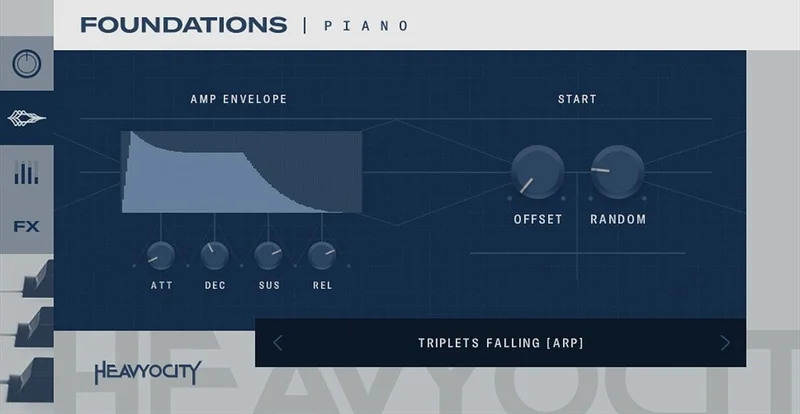
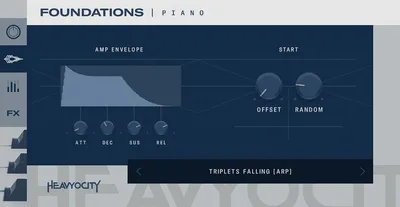
FOUNDATIONS | Piano sidesteps both. It stacks a soft grand piano source against a custom ambient texture layer, and puts real mixing and processing tools in the same interface. ARP, Gate, ADSR envelope control, and a Master FX section with Punch, Delay, and Reverb all live inside the instrument.
That means you can go from a plain piano note to a swelling, rhythmic cinematic texture without touching your DAW's insert chain. For composers working quickly on spec, that workflow collapse is worth a lot.
The piano source itself is a Kawai grand, sampled at soft dynamics. It's not a full dynamic range library. Heavyocity made a deliberate choice here: lean into intimacy, not power.
How It Performs in Practice
We loaded FOUNDATIONS | Piano into Kontakt Player 7 on a MacBook Pro M2 and pulled up the default preset. First impression: the piano sits back in the mix naturally. No harsh upper mids jumping out. The attack is soft and the sustain is smooth, sitting around a natural decay that doesn't need taming with EQ.
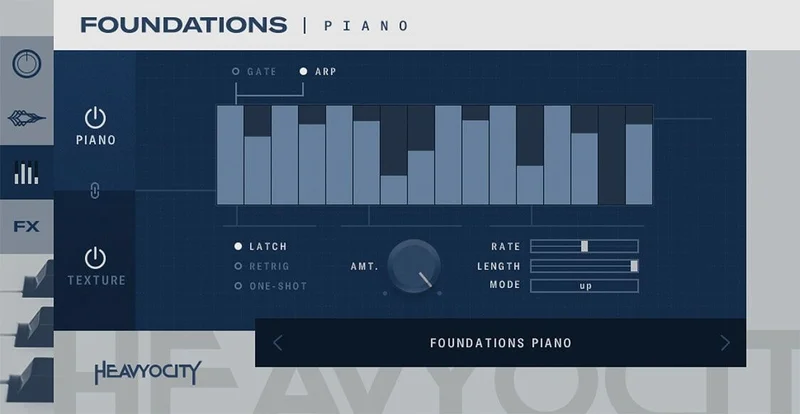
We then blended in the texture layer using the 2-channel mixer, pushing it to about 60% alongside the piano. The ambient layer added a low-frequency swell and some subtle high-frequency shimmer. We ran the Gate at a 1/8th note division with moderate depth. The result was a rhythmic, breathing quality that transformed a static chord voicing into something that felt like it belonged under a title card.
We dialled in the Reverb at a medium room size, then added just a touch of Punch to bring back some transient definition the Reverb had softened. Three moves. Under two minutes. The cue had a usable bed.
CPU draw was light. We saw under 5% on a single instance, and running three simultaneous instances for layered arrangement work kept us well under 20% total. That's lean enough for a bus-powered laptop session.
Reviewers consistently report that the ARP is the standout feature. Users keep running into the same happy accident: set the ARP to a long note division, blend the texture high, and you get a slow-moving, evolving pad that sounds like it took hours to design. It didn't.
We do wish there were more presets. Ten is honest, not generous. It's enough to demonstrate the range, but you're going to be building your own patches quickly.
Strengths and Weaknesses
The hybrid design is clever. Combining a real piano with a processed ambient layer inside one interface removes a whole decision layer from your workflow. You're not bouncing between Kontakt instances or juggling aux sends just to get piano-plus-atmosphere.
The Punch processor is an underrated inclusion. It's a transient shaper in effect, and having it in the Master FX means you can restore attack after heavy reverb without reaching for a separate plugin. Satisfying to use.
On the weakness side: this is not a classical piano library. At all. If you're a pianist who wants to hear every nuance of a soft touch versus a firm strike, you'll find the single dynamic layer frustrating. The Kawai grand sounds beautiful in the range it covers, but that range is narrow by design.
The 10 presets do a reasonable job of spanning gentle to dramatic, but there's a noticeable gap in the preset list around mid-tempo rhythmic patterns. You'll feel that absence when you're searching for something specific and have to build it yourself instead.
Installation is also worth flagging. Users keep running into confusion around the Kontakt Player requirement. If you don't already have Kontakt Player 6.6.1 or later installed, that's an additional download and Native ID registration step before you hear a single note. Annoying, but a one-time cost.
Is Free Actually Good Value Here?
It's free. The value question almost answers itself, but let's be precise: what Heavyocity is giving away here would cost real money in a lesser form from most developers.
The 528 samples, the built-in FX chain, the ARP and Gate engine, packaged as a paid instrument, this would be a reasonable buy. As a free entry point into Heavyocity's approach to cinematic sound design, it's a genuinely strong offer.
The honest caveat: it functions as a taste of the Heavyocity sound. If you want the full Heavyocity Keys & Synth Bundle, this is your on-ramp. That's a commercial reality, not a criticism. The instrument stands on its own.
Who Should (and Shouldn't) Download This
- ✅ Buy if you need a cinematic hybrid piano that produces emotional results in under five minutes.
- ✅ Buy if you're already in the Kontakt ecosystem and want a free, high-quality addition to your instrument library.
- ✅ Buy if you score to picture and want something that sits naturally under dialogue without heavy EQ work.
- ❌ Skip if you need a fully expressive acoustic piano with multiple velocity layers for realistic performance.
- ❌ Skip if you don't want to install Kontakt Player and manage a Native Instruments account for a single instrument.
- ❌ Skip if you're building a jazz or classical piano track where authentic dynamics matter more than texture.
Specs & Technical Details
| Developer | Heavyocity |
| Price | Free |
| Plugin Format | VST, AU, AAX (via Kontakt Player) |
| OS Support | macOS 10.14 or later / Windows 10 or 11 |
| Activation | Native Access / NKS |
| CPU Usage | Light (under 5% per instance in our tests) |
| Sample Count | 528 samples |
| Installed Size | 1.21GB (NI lossless compression) |
| Presets | 10 custom presets |
| Requires | Kontakt Player 6.6.1 or later |
| NKS Compatible | Yes |
| Trial Available | N/A (free instrument) |
| Version Reviewed | FOUNDATIONS | Piano v1 (2026) |
Score Breakdown
| Category | Score | Notes |
|---|---|---|
| Sound Quality | 4.0/5 | The Kawai grand sounds honest and warm at soft dynamics; single velocity layer limits expression |
| Value for Money | 5.0/5 | Free. Genuinely usable. Hard to argue with that. |
| Ease of Use | 4.0/5 | Interface is clean once Kontakt is running; installation friction keeps it from a perfect score |
| Features | 4.0/5 | ARP, Gate, ADSR, and Master FX in one instrument is a strong package; 10 presets is thin |
| CPU Efficiency | 4.5/5 | Light draw across multiple instances; comfortable on a laptop session |
| Overall | 4.2/5 | A free cinematic hybrid piano with real production tools that works exactly as advertised |
Alternatives to Consider
If you need a more expressive and unconventional piano with a distinct physical character, the Palm Mute Piano by Loot Audio is worth your time. It takes a completely different angle on prepared and modified piano tones, and it complements FOUNDATIONS | Piano well rather than replacing it.
If you're already committed to the Heavyocity sound and want to understand what sitting above FOUNDATIONS | Piano looks like, check out our full breakdown of the Heavyocity Keys & Synth Bundle. That review covers what you gain when you move past the free tier.
If you're newer to Kontakt instruments and want context before committing to any library, our Kontakt Instruments Guide: 5 Things Beginners Must Know covers the setup process and workflow basics that make libraries like this actually click.
For a broader view of what Heavyocity does with vocal libraries in the same cinematic space, the Vocalise 3 review shows the range of the studio's design philosophy and whether it fits your production style.
Final Word
FOUNDATIONS | Piano is free, functional, and sounds like it cost something. The single velocity layer will frustrate pianists, and ten presets is a light haul for a sound design instrument. But if you score to picture, produce trailer music, or just need an emotionally expressive piano bed that doesn't require three plugins and a bus send to come alive, this delivers.
Download it. The only thing you lose is fifteen minutes of installation time and the excuse that you can't afford a cinematic piano.
Related reviews: Deft Lines · Can Electri6ity Still Beat Newer Guitar Plugins in 2026?
Frequently Asked Questions
Do I need the full version of Kontakt to use FOUNDATIONS | Piano?
No. FOUNDATIONS | Piano works with the free Kontakt Player 6.6.1 or any later version. You don't need a paid Kontakt license. You do need a Native Instruments account to download and activate it through Native Access.
Is FOUNDATIONS | Piano good for realistic solo piano performances?
Not really. The library is sampled at soft dynamics only, which means you get one expressive range rather than a full velocity spread. It's built for cinematic texture and emotional atmosphere, not for replicating a grand piano performance in a concert hall context. If realism is your priority, look elsewhere.
How does the ARP feature work in practice?
The ARP in FOUNDATIONS | Piano generates rhythmic patterns from held notes, with a Gate control that shapes the rhythm's pulse and timing. Set a slow division and let the texture layer swell underneath it, and you get evolving, cinematic movement from a single chord. Users report it's one of the fastest ways to build a cue bed in the instrument.
Can I use FOUNDATIONS | Piano in a DAW without opening the full Kontakt interface?
Yes. Because it's NKS compatible, you can control it from NKS-ready hardware like Komplete Kontrol keyboards without navigating the full Kontakt GUI. Inside a DAW, it runs as a plugin through Kontakt Player, so your usual insert and send routing works normally. CPU draw is light enough that running multiple instances in a single session is practical.