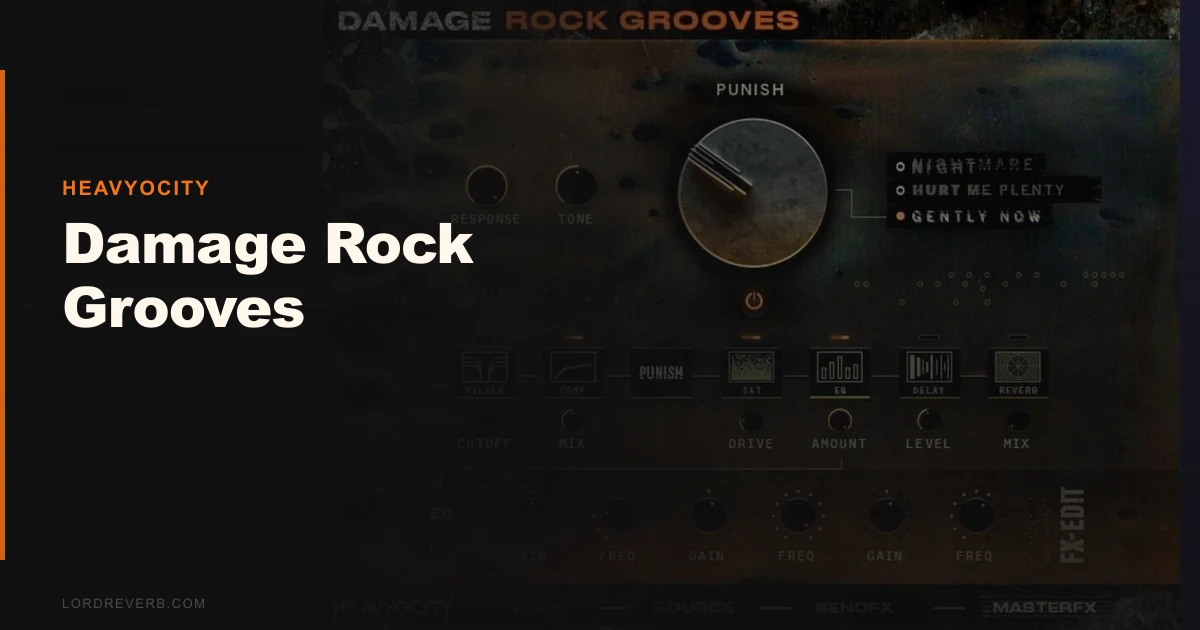
We were 20 minutes into a trailer cue, a mid-tempo riff over a temp-track drum loop that sounded like it was recorded in a gym, when we dropped Damage Rock Grooves into the session. We grabbed a Heavy Groove at 130 BPM, pushed the Punish Knob to “Hurt Me Plenty,” and the whole track snapped into focus. That’s the pitch for Damage Rock Grooves: it’s a drum loop library built to make heavy guitar music sound like money, fast.
This is Heavyocity’s follow-up to their Damage drum instrument. Where Damage gave you one-shot hits and rhythmic beds, Rock Grooves gives you full loops with breakout stems. It’s built for rock, metal, and trailer production specifically. If you’re producing indie pop or jazz, stop reading now.
First Impressions: It Looks Like Heavyocity, It Sounds Like Heavyocity
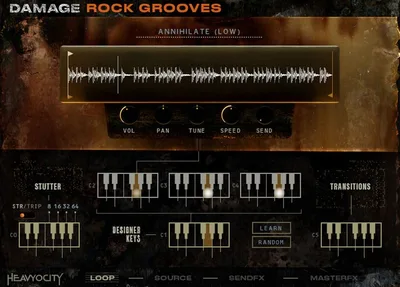
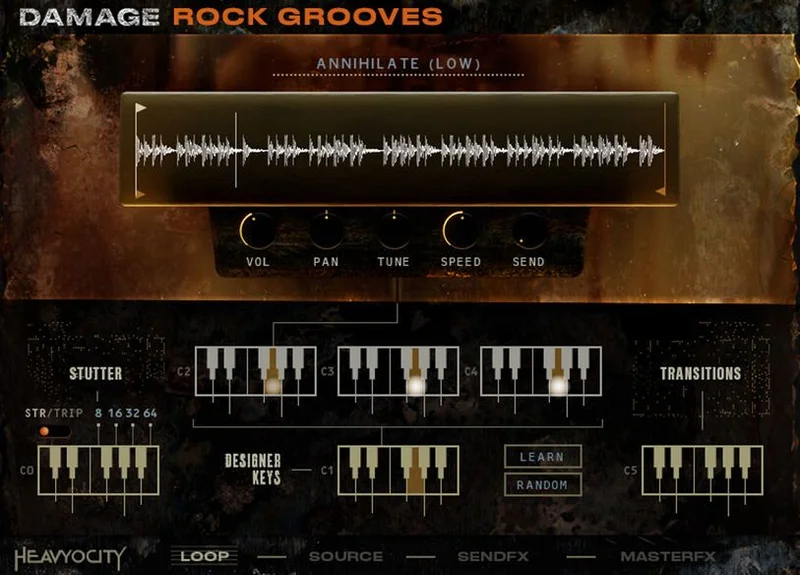
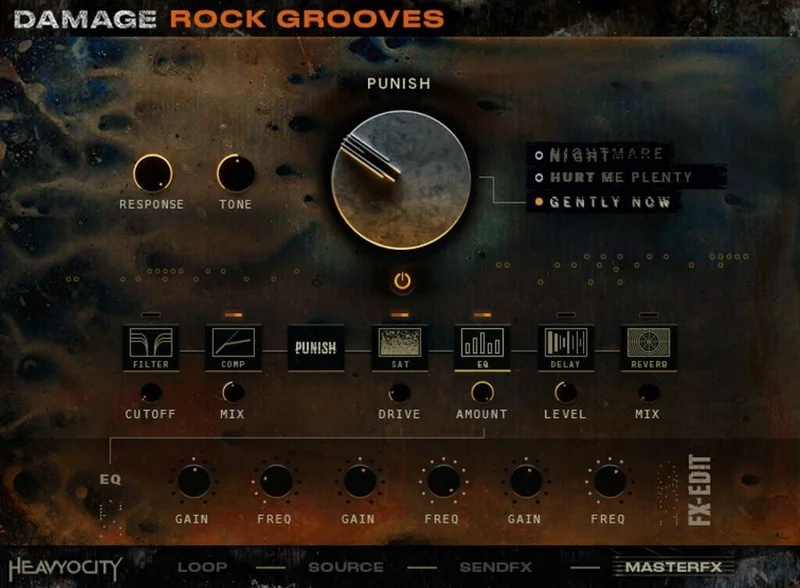
Loading the library into Kontakt 6 Player takes a few minutes depending on your drive speed. The interface is clean and dark. Very Heavyocity. You get a browser on the left, a waveform display in the centre, and the Punish Knob front and centre.
The 43 presets load fast. Twenty-seven are curated groove presets, and 16 are built specifically to lock in with Damage Guitars. We loved how quickly a usable sound arrived. We did not love how quickly we hit the ceiling of customisation. More on that later.
The loop quality is immediately obvious. These were recorded well.
Getting It Into a Real Workflow
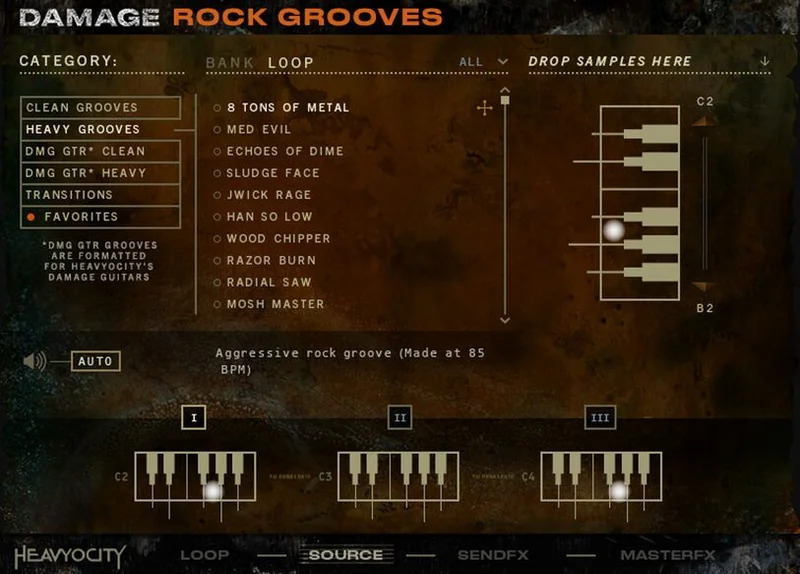
The workflow is browser-forward. You filter by tempo, then by category: Clean Grooves, Heavy Grooves, or Damage Guitar Grooves. Over 910 loops in v2, broken into 228 full loops, each with Low, Mid, and High stems. That stem architecture is genuinely clever.
Here’s how we used it on a track. We pulled the full loop onto one Kontakt instance for the main groove. Then we loaded the High stem separately to layer the cymbal texture under a programmed MIDI hat pattern. The result sounded like a real drummer and a programmed kit playing together. Satisfying.
The friction point: tempo matching is manual. Damage Rock Grooves doesn’t stretch or flex to your DAW tempo. You find a loop that’s close to your BPM and either warp it in your DAW or write around it. That’s annoying when you’re at 118 BPM and every loop you want sits at 110 or 125.
The Punish Knob has three modes: Gently Now, Hurt Me Plenty, and Nightmare. Each mode applies a different processing chain to the signal. We ran a clean groove through Nightmare at full tilt. The kick got tighter and more aggressive. The snare cracked harder. The room got smaller. It’s not subtle, and it’s not meant to be.
What It's Genuinely Good At
The stem system is the headline feature. Every full loop ships with a Low stem (kick and bass frequencies), a Mid stem (snare body, toms), and a High stem (hats, cymbals, snare crack). You can blend these independently in your DAW or Kontakt. That means you can take a Heavy Groove and gut the low end, then replace it with the Low stem from a different groove entirely.
We matched a kick from one groove to the cymbal pattern of another. It worked in under four minutes. No sample editor, no transient shaping, no detective work.
The Damage Guitars integration is the other strong suit. If you’re running Damage Guitars in the same session, the 16 dedicated presets are tuned to complement its frequency profile. The low end doesn’t fight. The transients don’t stack in the same window. Someone at Heavyocity actually thought about that, and it shows.
For trailer music, the Heavy Groove category is nearly a complete toolkit. Aggressive, wide, punchy (by which we mean: the transient attack reads at roughly 5-10ms with hard limiting on the bus, not soft saturation).
The Rough Edges
Two drum kits. That’s it. Clean and heavy. No per-drum control. No mic bleed adjustment. No room/close mix slider. You get the Punish Knob and the stem faders. That’s your signal chain.
Compare that to programming your own kit in a dedicated drum plugin where you control every mic and every drum head tuning. Damage Rock Grooves doesn’t compete on that axis. It’s not trying to.
But we wish Heavyocity had added at least one more kit character. Something with more room, more vintage, more air. The clean kit is clean but it’s also a bit sterile. The heavy kit is brilliant but it’s one flavour.
The tempo-matching issue we mentioned is a real workflow killer for some sessions. If you write to grid and your song is at a locked BPM that the library doesn
‘t hit, you’re warping audio. That’s not the end of the world, but it’s friction.
Who This Is Really For
✅ Buy if you produce heavy rock or metal and want radio-ready drum loops you didn’t have to record yourself.
✅ Buy if you’re already running Damage Guitars and want a drum library that was literally designed around it.
✅ Buy if you work in trailer music and need aggressive percussion beds that sit under guitar without fighting for space.
❌ Skip if you need granular drum customisation, per-mic control, or tunable kit pieces.
❌ Skip if your sessions run at tempo-locked BPMs that don’t land near common rock tempos (90-140 BPM range).
❌ Skip if you’re outside rock, metal, and trailer music. These loops don’t stretch to other genres without serious processing.
Score Breakdown
| Category | Score | Notes |
|---|---|---|
| Sound Quality | 4.5/5 | Recorded with genuine weight; the heavy kit hits like it should |
| Value for Money | 4.0/5 | Paying full price for 910+ loops with stems is fair; v1 at $29 is a steal if you don't need v2 features |
| Ease of Use | 3.5/5 | Browser workflow is quick; tempo matching is manual and annoying |
| Features | 3.0/5 | Stem system and Punish Knob are clever; two fixed kits with no per-drum control hold it back |
| CPU Efficiency | 4.0/5 | Runs light in Kontakt Player; multiple stem instances add up but stay manageable |
| Overall | 4.1/5 | Best drum loop library in its lane, but that lane is narrow |
Alternatives to Consider
If you need more per-drum control, GetGood Drums offers Kontakt-based kits with individual mic channels and kit piece mixing. It’s more complex to set up but you own every detail of the sound.
Splice drum loops give you access to a wider genre spread and individual one-shots, but the subscription model adds up. And the rock content on Splice isn’t recorded to the same standard as what’s here. We’d point you toward our Kontakt instrument round-up if you want a broader comparison.
For the trailer music market, Gravity by Heavyocity itself sits a rung above in terms of orchestral percussion integration. But if guitars are in your session, Gravity won’t carry the rock weight that Damage Rock Grooves delivers. They’re not really competing, they’re stacking.
Damage Rock Grooves 2 costs $49 and it does exactly one thing exceptionally well: it makes heavy guitar music sound like it has a real drummer behind it, immediately, without a recording session or a drum programmer. The stem architecture is underrated and the Damage Guitars pairing is genuinely useful.
The producer it’s wrong for is the one who wants to build a kit from scratch or work outside rock and metal. For everyone else in that genre space, this is the drum loop library we’d actually buy ourselves.
Frequently Asked Questions
Do I need the full version of Kontakt to run Damage Rock Grooves?
No. Damage Rock Grooves runs in the free Kontakt 6 Player. You don't need a full Kontakt licence. You will need a Native Instruments account to activate it through Native Access.
What's the difference between Damage Rock Grooves v1 and v2?
Version 1 contains over 750 production-ready loops. Version 2 expands that to over 910 loops, with 228 full loops each carrying Low, Mid, and High stems. V2 also includes the redesigned Punish Knob with its three processing flavours. V1 is available at $29 and v2 sits at a higher price.
How does the stem system actually work in practice?
Each full loop ships as a complete mix plus three breakout layers: Low (kick and sub-heavy content), Mid (snare body and toms), and High (cymbals and snare crack). You load each stem as a separate Kontakt instance and route them to individual DAW channels. That lets you mix stems from different grooves together or process each layer independently.
Does Damage Rock Grooves work for genres outside rock and metal?
Not really. The kit sounds, the tuning, and the loop feel are built for heavy music. You can process the stems aggressively to shift the character, but there are far better options if your genre is EDM, hip-hop, or pop. We'd only recommend it for rock, metal, and trailer production.