
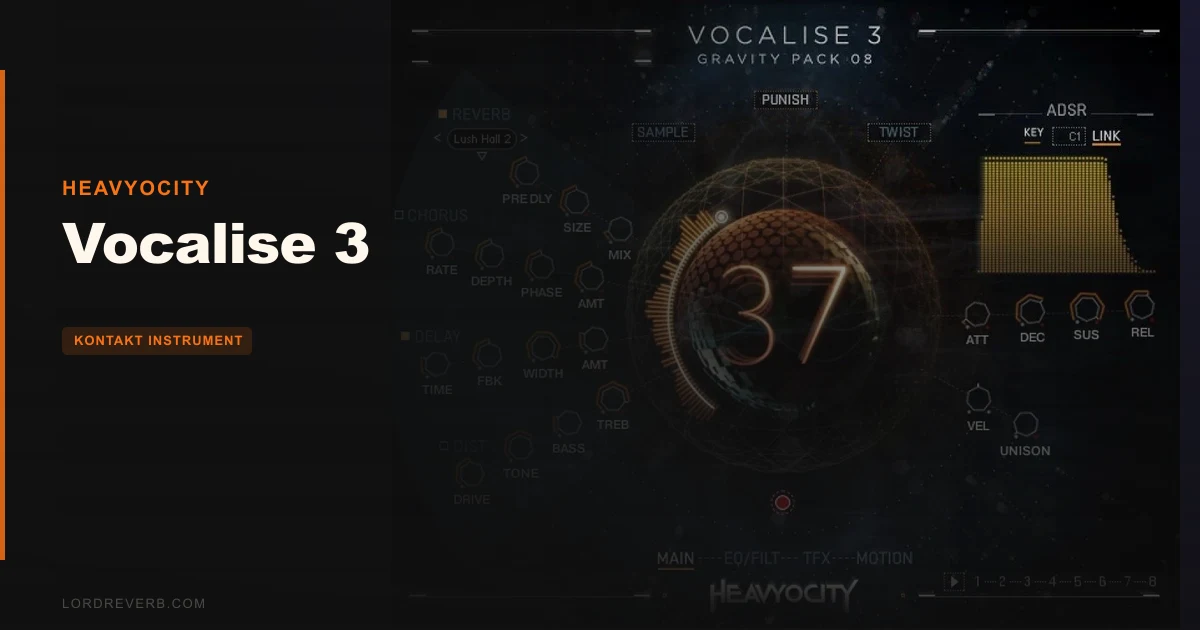
Vocalise 3 by Heavyocity is one of the strongest Kontakt vocal texture libraries on the market right now, and at $119 it's justifiable, but only if you know exactly what it is and what it will never be.
We loaded it up mid-session on a sync cue. Sparse string bed, no clear direction yet, brief running at 88 BPM. We hit one of the tempo-synced melodic phrase presets in D minor and the whole track locked into a gravitational pull we didn't plan for. The phrase breathed with the tempo. The vowels smeared across the bar line in a way that felt composed, not sampled.
That feeling lasted about 40 minutes. Then we tried to use it on a pop vocal track as a doubling layer. That's where it stopped cooperating, and that's the conversation most reviews skip entirely.
This review is for film composers, sync library writers, ambient producers, and electronic artists who need dense, processable vocal clouds behind their arrangements. If you're building tracks around a lead vocal, close this tab.
What Vocalise 3 Actually Is (and the One Thing It's Not)
Vocalise 3 is a Kontakt instrument, not a vocal processor. It ships with 7GB of uncompressed vocal content (4.71GB compressed), comprising 2,033 sound sources spread across melodic phrases, syllabic pedals, tempo-synced intervals, vowels, scapes, and drones.
The headline numbers: 384 tempo-synced melodic phrases in four keys with major and minor modes, 576 tempo-synced intervals across 24 mapped presets, and 36 tempo-synced multi-sampled syllabic pedals. It also carries 16 dynamic vowels and 184 vocal scapes and drones.
What it's not: a lead vocal library. None of the 190 NKIs are built for clear, intelligible lyrical content sitting at the front of a mix. The source material was recorded and processed for texture, movement, and emotional weight in the background or mid-ground of a cue. If you want Adele in Kontakt, this isn't it. If you want the choir from the Dune score to haunt your mix at -18dB, you're exactly in the right place.
It also doesn't let you import your own vocals. You're working with Heavyocity's material. That's a hard constraint worth knowing before you spend $119.
Living With It
Setup involves the Heavyocity Product Portal, Native Access registration, and pointing Kontakt at the library. Three separate pieces of software touching your system before you hear a note. It's annoying. Not a dealbreaker, but compared to a simple drag-and-drop install, it feels like a lot of ceremony.
Once you're in, the UI splits cleanly into the main instrument page and the Motion page. The Motion engine is where Vocalise 3 earns its keep. It gives you programmable patterns for volume, pitch, and pan, separately or in combination, producing rhythmic movement that doesn't require MIDI programming. We set a 16-step volume pattern against a held vowel chord and got a stuttering, gated texture that sat perfectly behind a 130 BPM techno kick. That's not an obvious use case for a "cinematic vocal library," but the engine doesn't care what genre you're in.
The Trigger FX system is clever. Assignable to MIDI keys below the playable range, they fire real-time processing snapshots: filtering sweeps, pitch drops, rhythmic gates. We mapped one to a pad on our controller and hit it at the 32nd bar of a cue. The whole texture convulsed and came back clean. That kind of live control is satisfying in a way that preset browsing never is.
The 300+ Motion Presets (saved as NKAs) are a solid starting point. We'd say roughly 60 of them are genuinely usable immediately. The rest are either too extreme or too similar to justify the count, which is a mild frustration with the library's marketing more than its content.
CPU load sits at medium with one NKI open on an Apple M2. Load four heavily modulated instances simultaneously and you'll feel it. Not unmanageable, but bounce or freeze before you add your sixth instrument track.
The Trade-Offs Worth Talking About
The phrase content is the strongest argument for buying Vocalise 3. Tempo-synced phrases in four keys across major and minor modes mean you can drop them into almost any project without manual pitch correction. That's a real time-saver. The trade-off is that "almost any key" still means four specific keys. If your cue is sitting in B major, you're pitching up from A or down from C, and you'll hear it on the longer phrase tails if you push too far.
The Motion engine genuinely differentiates this library. Two producers can load the exact same NKI and produce entirely unrecognisable results by the time the Motion page has done its work. That replayability is underrated when you're building a sync catalogue and need source material that doesn't sound immediately recognisable.
The limitation that stings: the Kontakt requirement. You need full Kontakt 6.7.1 or above to run this. Kontakt Player, the free version, doesn't cut it here. If you bought into the Kontakt Player ecosystem expecting this to work, you will need to budget for the full Kontakt licence on top of the cost of Vocalise 3.
The historic low price has dropped on sale. At that price, this is a no-hesitation purchase. At $119 full price, it's still worth it for film and sync producers, but worth waiting for a promotion if your budget is tight.
Against the Field
The most direct competition comes from three places.
Spitfire LABS (Soft Piano and Voices): Free. Sounds gorgeous. But it has almost no modulation capability by comparison. Vocalise 3 wins the moment you need anything beyond a held chord.
EastWest Hollywood Choirs: Better for intelligible, clearly sung choral parts. More realistic voice leading. But it costs significantly more and its real-time performance tools are less immediate than Vocalise 3's Trigger FX system. If you need the choir heard and understood, EastWest wins. If you need texture and atmosphere at a lower price point with more modulation depth, Vocalise 3 wins.
Output Exhale: The closest stylistic competitor. Also built for processed, atmospheric vocals. Exhale has a slightly more electronic character and is more at home in hip-hop and trap production. Vocalise 3 sits more naturally in cinematic and ambient work. We'd own both if forced to choose, but if you pick only one, your genre decides it.
See how Vocalise 3 compares to other Heavyocity instruments in our Heavyocity Keys & Synth Bundle review.
The Real Verdict
Vocalise 3 is brilliant at one specific thing: creating dense, tempo-locked, processable vocal atmospheres for film, sync, and electronic production. It's not trying to replace a session singer, and it doesn't pretend to.
At $119 we'd buy it. On sale, it is one of the best-value Kontakt libraries we have used. The Motion engine alone justifies the price for anyone doing atmospheric work regularly.
Skip it if you need full Kontakt and don't own it yet, if you're building vocal-forward pop tracks, or if you wish you could feed your own recordings into the engine. It can't do that. For everyone else: this is a library we'd genuinely load on almost every cinematic session.
Score Breakdown
| Category | Score | Notes |
|---|---|---|
| Sound Quality | 4.5/5 | Phrase recordings are clean, phase-coherent, and hold up to significant processing without artifacts |
| Value for Money | 4.0/5 | Strong at $119; the Kontakt requirement adds real cost for players who don't already own it |
| Ease of Use | 3.5/5 | UI is logical but the three-step install process (Portal, Native Access, Kontakt) adds friction |
| Features | 4.5/5 | 2,033 sources, Motion engine, Trigger FX, and 300+ NKAs cover serious ground |
| CPU Efficiency | 3.5/5 | Medium load solo; stacks up quickly with multiple instances open and motion running |
| Overall | 4.2/5 | One of the most capable atmospheric vocal Kontakt libraries at this price point |
Alternatives to Consider
Output Exhale is the closest rival for electronic-leaning producers. It carries a stronger hip-hop and trap identity, with a more aggressive default processing character. If your work skews darker and more beat-driven, Exhale deserves a serious look before you commit to Vocalise 3.
EastWest Hollywood Choirs is the right choice if you need intelligible, clearly pitched choral performances rather than atmospheric textures. It's a higher investment, but the vocal realism at the front of a mix is in a different category. Check our Kontakt instrument reviews roundup for a broader comparison.
Spitfire LABS Voices is free and worth having in your signal chain regardless. It won't replace what Vocalise 3 does with its Motion engine, but for simple textural pads behind a cue, it covers the basics at zero cost. If you're exploring Kontakt instruments more broadly, our Palm Mute Piano review is worth reading for another angle on creative Kontakt design.
If you're already in the Heavyocity ecosystem and want to understand how Vocalise 3 stacks against their keyboard-focused content, our Heavyocity Keys & Synth Bundle review covers that ground directly.
At $119, Vocalise 3 is a focused, well-built library that does one thing at a very high level. The day it hits a sale price, it becomes a near-mandatory purchase for any producer who touches cinematic, ambient, or atmospheric work. If that's your world, don't wait for the next version.
Frequently Asked Questions
Does Vocalise 3 work with the free Kontakt Player?
No. Vocalise 3 requires the full version of Kontakt 6.7.1 or above. The free Kontakt Player will open the instrument but lock it to a 15-minute demo mode. If you don't already own full Kontakt, factor that additional cost into your buying decision.
Can I import my own vocal recordings into Vocalise 3?
No. Vocalise 3 doesn't support custom sample import. You're working entirely with Heavyocity's 7GB of recorded and processed source material. If custom vocal manipulation is your priority, look at tools like Output Portal or granular instruments with import functionality instead.
Is Vocalise 3 useful for genres outside film scoring?
Yes, more than its marketing suggests. The Motion engine's step-sequenced volume, pitch, and pan patterns make it a legitimate tool for electronic, ambient, and even tech-house producers. We've used tempo-synced syllabic pedals effectively on tracks running at 128 BPM. The cinematic positioning is accurate but doesn't tell the whole story.
What's the difference between Vocalise 3 and its predecessors?
Vocalise 3 adds expanded syllables, new emotive textures, the updated Motion page, and Trigger FX compared to Vocalise and Vocalise 2. The core library identity stays the same: atmospheric, processable vocal content for background and mid-ground use. If you own an earlier version, the upgrade value depends on how heavily you use the Motion engine and live performance features.