
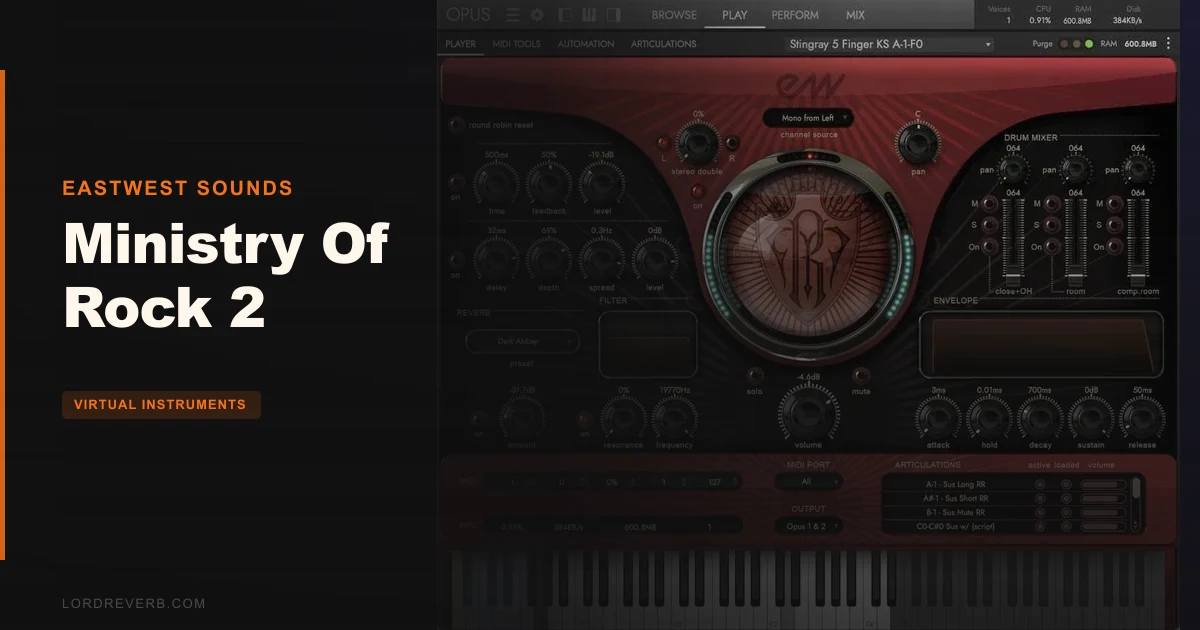
Ministry of Rock 2 is the most complete all-in-one rock virtual instrument EastWest has ever shipped, and it beats Addictive Drums 2 on guitar and bass coverage while matching it on drums, but it's not a clean win. This is a review for producers deciding between a purpose-built drum plugin with add-ons versus one library that covers the whole signal chain. We've tested both paths. Here's where MOR 2 lands.
The library runs on EastWest's Opus engine and has an MSRP that drops noticeably during regular sales. At the sale price, it's genuinely hard to argue against it, if rock, hard rock, or cinematic action cues are your output.
This is for film composers, rock producers, and trailer music writers. Not for jazz. Not for pop. Not for anything requiring subtle.
How It Compares Out of the Box
The obvious fight is Ministry of Rock 2 vs. Addictive Drums 2 plus an amp sim plus a bass library. AD2 wins on drum programming speed. Its MIDI groove browser and visual kit editor are faster to dial in. MOR 2 answers that with scope: the 57GB collection covers drums, a full guitar roster recorded through six amp brands, and a 5-string Musicman Stingray bass with 7,000 samples and true legato.
Superior Drummer 3 is the other comparison you'll see. SD3 destroys MOR 2 on drum customisation, it's not close. But SD3 doesn't touch a guitar. For the price of SD3 alone, you're getting MOR 2's entire band.
First impression on install: it's a lot. The Opus browser is clean, but 57GB of content means you need to know what you're looking for. Give it a day before judging the organisation.
Performance Deep Dive
The drums were recorded in EastWest Studio 1 on three large rock kits from DW, Gretsch, and Ludwig, plus 6 additional snares, using vintage and modern gear from Neve, Neumann, Telefunken, AKG, Manley, Fairchild, Royer, Chandler, and Meitner. That’s not a budget session.
We loaded the DW kit and pushed a 130bpm rock groove through it at high velocity. The kick sits around 60–80Hz with a natural attack peak near 4kHz. There's no weird resonance buildup in the 200–300Hz mud zone that plagues cheaper libraries. The snare cracks at around 200ms of natural ambience without washing the hat.
Repetition samples were recorded for everything, plus extreme dynamics and three mic positions for drums, close, room, or close plus compressed room. We ran the close mic and compressed room blend at about 70/30. The result sits in a dense mix without fighting the guitars for space.
The guitars were recorded on Fender Jaguar, Fender Telecaster Thinline, Carvin 7 String, Baritone, Gibson Les Paul, and Schecter 7 String through Fender, Divided By Thirteen, Marshall, Mesa Boogie, Bogner, and Vox amps. Articulations include round robin, hammer-on and pull-off legato, sliding legato, and dozens of other techniques. Dual channel recordings let you pick a real amp sound or send the direct signal to your own plugins.
We ran the direct signal through Neural DSP Nolly. The tracking was clean and the dry signal had no phase weirdness. Gain staging into the plugin at -18dBFS gave us plenty of headroom. Convincing. Annoying that the amp-mic'd versions aren't always labelled clearly enough to skip auditioning five patches to find the right character.
The bass section includes all remastered content from Hardcore Bass and Hardcore Bass XP, plus the new 5-string Musicman Stingray. Fender, Hofner, Gibson, Silvertone, Rickenbacker, Musicman, and Lakland basses were recorded through large bass rigs.
The Stingray's true legato is satisfying. We played a descending run crossing from G-string to D-string at 110bpm. The slides landed without glitching, and the note-to-note handoff didn't trigger a retrigger artifact. That's a problem we've hit in cheaper bass libraries constantly.
Where It Wins
The LIVE drum technology is the headline feature that actually delivers. The 57GB collection features LIVE technology that enables multi-sampled drums to sound like a live performance. What that means in practice: the round-robin and velocity layering work together so repeated 16th-note hat patterns don't sound like a metronome. The slight timing and tonal variation between hits adds up to something that feels human.
We've hit libraries where 64th note hat rolls go completely robotic after bar two. MOR 2 holds it together for eight bars before we started consciously listening for the pattern. That's a win.
The guitar and bass breadth at this price is hard to beat. Buying a dedicated guitar library, a dedicated bass library, and a drum library separately will cost you two to four times what MOR 2 costs on sale. The sessions used real top-tier players including Shane Gibson (KoRn), Greg Suran (Goo Goo Dolls, Avril Lavigne), and Tal Bergman (Billy Idol, Rod Stewart). That session credibility shows in the feel of the performances.
For film scoring virtual instruments and media music, MOR 2's range across heaviness, from clean Telecaster jangle to Schecter 7-string chug, covers more of a cue brief than almost any single competitor.
Where the Competition Wins
Superior Drummer 3 beats MOR 2's drum section on every technical axis. More microphone positions, deeper MIDI grooves library, better room blending, and more articulations. If drums are your primary output and you're only tracking rock, SD3 is worth the higher cost.
Addictive Drums 2's workflow speed is frustrating to concede, but we have to. Its drag-and-drop MIDI, visual kit editing, and fast preset browsing are faster day-to-day than hunting through Opus for the right patch. Time is money in a session.
The keyswitch mapping in MOR 2 is inconsistent. Guitar keyswitches in one patch don't match the same positions in another. That's not a dealbreaker, but it slows down rock virtual instrument workflows until you've memorised each patch's layout. Frustrating.
CPU load is real. On a 2020 MacBook Pro with an M1 chip via Rosetta 2, loading two guitar patches and the DW kit pushed our DAW buffer from 256 to 512 samples before we stopped getting crackle. On a spec'd studio machine it's fine. On a laptop at 2.7GHz with 8GB RAM, the stated minimum, expect to freeze tracks early.
Who Should Buy Which
- ✅ Buy MOR 2 if you produce rock, hard rock, or cinematic action cues ITB and need a complete band in one library at a reasonable price.
- ✅ Buy MOR 2 if you're a film composer who needs credible guitar and bass articulations without hiring session players on every cue.
- ✅ Buy MOR 2 if you already own Superior Drummer 3 and want guitars and bass that match its session quality without building a separate rig.
- ❌ Skip MOR 2 if drums are your only need. Superior Drummer 3 or Addictive Drums 2 will serve you better and cost less per feature.
- ❌ Skip MOR 2 if you're on a laptop at minimum spec. 57GB and the Opus engine will punish a CPU-limited machine in a real session.
- ❌ Skip MOR 2 if you need jazz, fusion, or any dynamic range below "rock club at soundcheck." It's not built for that.
Score Breakdown
| Category | Score | Notes |
|---|---|---|
| Sound Quality | 4.5/5 | Real session players, world-class studio, convincing LIVE drum technology |
| Value for Money | 4.5/5 | At $69 on sale, drums plus guitar plus bass in one library is hard to beat. |
| Ease of Use | 3.0/5 | Opus browser is manageable but keyswitch inconsistency across patches slows workflow |
| Features | 4.0/5 | 57GB, 60,000+ samples, true legato bass, dual-channel guitar, scope is impressive |
| CPU Efficiency | 3.0/5 | Heavy on resources; requires a fast SSD and a capable multi-core CPU to run comfortably |
| Overall | 4.0/5 | A brilliant content library let down by workflow friction and hardware demands |
Alternatives to Consider
Superior Drummer 3 (Toontrack), The best drum plugins for rock conversation starts here. Better drum customisation and mic blending than MOR 2, but no guitar or bass. If you're a dedicated drum programmer first, this is the right call.
Addictive Drums 2 (XLN Audio), Faster workflow, lighter CPU, strong rock kits. You'll need separate guitar and bass solutions, which adds cost. Check our Addictive Drums 2 review for the full breakdown.
Session Guitarist: Electric Sunburst (Native Instruments), If guitars are your main gap and you're happy with your current drum solution, this is a more focused and frankly easier guitar library to work with. It won't give you the 7-string Schecter or the bass section, but the chord strumming engine is more intuitive day-to-day. See our best guitar virtual instruments roundup for the comparison.
At $69 on sale, Ministry of Rock 2 is the most cost-efficient complete rock band you can load into a DAW. If your machine can handle it. That's the honest caveat: the library earns its price, but it'll expose every weakness in an underpowered setup. Don't buy it on a three-year-old laptop running at minimum spec unless you love the freeze-tracks workflow. For a well-spec'd studio machine, this is our pick for rock and cinematic ITB production, not because it's perfect, but because nothing else at this price covers the whole signal chain this well.
Frequently Asked Questions
Does Ministry of Rock 2 work without the EastWest Opus engine?
No. Ministry of Rock 2 runs exclusively through EastWest's Opus engine, which is required for playback and is available as a free download from EastWest. Opus handles activation, library management, and plugin hosting across VST2, VST3, AU, and AAX formats. It's not compatible with Kontakt or any other third-party sampler.
Is Ministry of Rock 2 the same as the original Ministry of Rock?
No. MOR 2 is not a replacement, it's an expansion in scope. The library nearly triples the original's size to 57GB and adds new content at both ends of the heaviness spectrum. Most importantly, it introduced the LIVE drum technology and an all-new 5-string Musicman Stingray bass with 7,000 samples that the original never had.
Can I use Ministry of Rock 2 guitars with my own amp sims?
Yes. Dual channel recordings let you pick a real amp sound or use the direct signal with popular plugins. That means you can route the dry direct signal into Neural DSP, Amp Room, or any amp sim in your signal chain. The direct signal is clean and phase-coherent. Just watch your gain staging going in.
Does EastWest ComposerCloud include Ministry of Rock 2?
Yes. Ministry of Rock 2 is part of EastWest's ComposerCloud subscription, which gives you access to the full EastWest library for a monthly fee. If you produce across multiple genres and want access to orchestral, cinematic, and rock libraries simultaneously, ComposerCloud is worth pricing against an outright purchase. Check EastWest's site for current subscription pricing.